
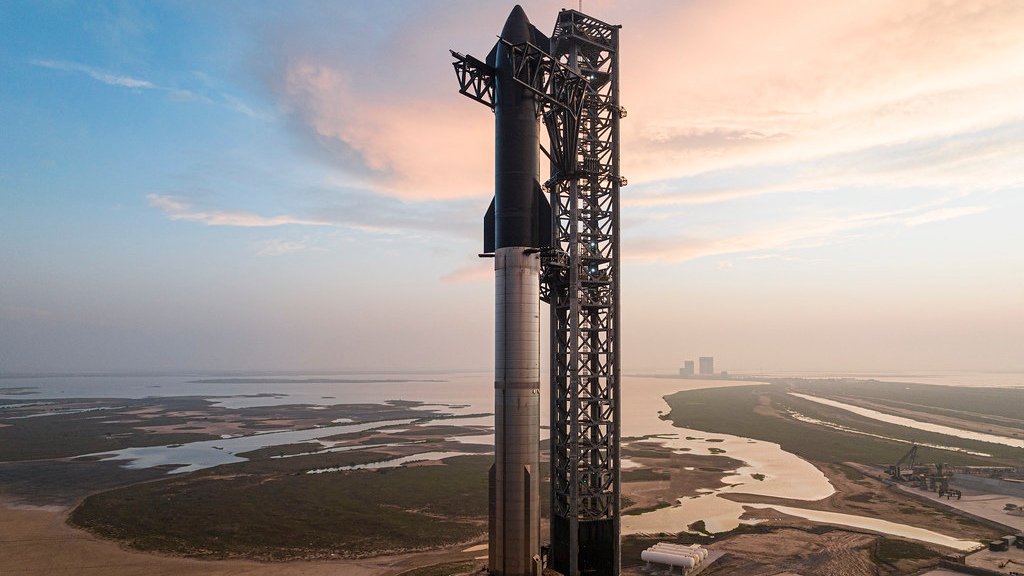
The Real Reason SpaceX Is Building The Starship: For more than a decade, the public story surrounding SpaceX Starship has been closely associated with one enormous ambition: sending humans to Mars. Elon Musk has repeatedly described Starship as the vehicle capable of transporting people and equipment to the Red Planet and eventually supporting a permanent human presence there.
But the material behind SpaceX’s Starship strategy points toward a more immediate purpose. While Mars colonization remains a long-term objective, Starship’s near-term role is centered on something much closer to Earth: industrializing Low Earth Orbit (LEO) and supporting the industrial development of the Moon.
Why Low Earth Orbit Has Become So Important
For decades, the most commercially valuable part of space was considered to be Geostationary Earth Orbit (GEO). At approximately 35,786 kilometers above Earth, GEO allows satellites to remain positioned over roughly the same region of the planet.
This made GEO particularly useful for traditional satellite television, radio and communications. A single satellite could cover an enormous geographic area.
However, modern space infrastructure has created a different demand.
From GEO to LEO
Low Earth Orbit, generally around 500 kilometers above Earth, offers advantages that are increasingly important for modern communications and observation. Satellites operating much closer to Earth can provide lower latency and higher-resolution imaging.
The challenge is that individual LEO satellites move rapidly relative to the Earth’s surface. A single satellite therefore cannot provide continuous coverage over one location.
The solution is the mega-constellation.
Thousands of satellites can operate together as a network, creating continuous connectivity and persistent coverage. This is the basic infrastructure model behind Starlink.
Starship Is About More Than Launching Rockets
SpaceX’s Falcon 9 fundamentally changed the economics of orbital launch through partial reusability. But simply launching payloads for customers is only one part of the larger space economy.
When SpaceX launches another company’s satellite, it receives a launch payment. Once that satellite is in orbit, however, the launch itself does not necessarily create an ongoing consumer relationship.
Starlink presents a different model.
From Launch Provider to Space Infrastructure
By deploying its own satellites, SpaceX can use rockets as part of a larger infrastructure strategy. Starlink turns orbital deployment into the foundation for a recurring communications service.
The source material describes SpaceX as having deployed more than 11,000 Starlink satellites, illustrating the scale of the constellation strategy.
This changes the strategic importance of Starship.
Instead of being simply another rocket, Starship can function as a large-scale transportation system for orbital infrastructure.
Starship Could Become the Railroad of Space
One of the most interesting ideas in the source material is the comparison between Starship and the transcontinental railroads of the 19th century.
Railroads did not simply transport passengers. They created infrastructure that connected industries, settlements and markets.
A similar concept could emerge in space.
Moving Massive Payloads Into Orbit
The proposed Starship architecture is intended to move significantly larger quantities of hardware into orbit than conventional launch systems.
The source material outlines ambitious targets involving high-frequency launches, increased payload capacity and the deployment of large numbers of Starlink satellites. It also identifies potential future payloads such as orbital AI data-center hardware.
If those capabilities are achieved, the economics of building infrastructure in orbit could change substantially.
Instead of treating every satellite or orbital facility as an isolated project, Starship could provide the transportation backbone for an expanding space industrial ecosystem.
The Strategic Importance of LEO
The competition in Low Earth Orbit is not limited to SpaceX.
Other major satellite initiatives include Amazon’s Project Kuiper, Chinese mega-constellation programs such as Guowang and Qianfan, and defense-oriented systems.
Starlink and Starshield
The source material also highlights Starshield, which applies the broader LEO constellation concept to military and national-security applications.
Such systems can support areas including secure communications, reconnaissance and domain awareness.
This gives orbital infrastructure an importance beyond commercial internet.
As more communications, observation and computing capabilities move into space, the ability to launch, replace and expand orbital infrastructure becomes increasingly important.
That is where Starship’s enormous payload capacity could become strategically significant.
The Moon Is the Second Major Piece
The source material identifies another major objective for Starship: the industrialization of the Moon.
Mars may be the most famous destination associated with Starship, but lunar infrastructure offers a much closer operational step toward a broader space economy.
Why the Lunar South Pole Matters
The Lunar South Pole is particularly important because of two valuable resources.
The first is the presence of high-elevation regions that can receive sunlight for extended periods, sometimes described as Peaks of Eternal Light.
The second is the existence of permanently shadowed regions, where water ice may be preserved.
Water is especially important because it could support life-support systems and potentially be processed into hydrogen and oxygen propellant.
The source material describes the usable area around these resources as limited, creating competition over strategically valuable lunar locations.
Why Starship’s Heavy-Lift Capability Matters on the Moon
Building a permanent lunar presence would require much more than sending astronauts.
Future lunar infrastructure could require habitats, power systems, scientific equipment, mining machinery and other industrial hardware.
Transporting this equipment requires a launch system capable of carrying extremely large payloads.
This is where Starship’s proposed heavy-lift architecture becomes important. Instead of sending small amounts of equipment through many separate launches, a high-capacity vehicle could transport substantially larger quantities of infrastructure.
That makes Starship potentially useful as a lunar logistics vehicle, not simply a Mars spacecraft.
Mars May Be the Destination, But It Is Not the First Step
The most important distinction is that Mars remains part of the long-term vision, but the path toward Mars can involve several intermediate stages.
The source material describes an evolution from an earlier vision of direct Earth-to-Mars transportation toward an architecture based on Earth-orbit industrialization, lunar infrastructure and eventually deep-space transportation.
Building the Infrastructure First
A civilization attempting large-scale deep-space exploration would need infrastructure capable of supporting those missions.
That could include:
- Large orbital transportation systems
- LEO satellite networks
- Orbital manufacturing and computing
- Lunar bases
- Propellant production
- Deep-space staging infrastructure
The Moon could eventually serve as another operational hub because its lower gravity could make launching material into space easier than launching from Earth.
In this model, LEO and lunar orbit become staging points for increasingly ambitious missions.
The Bigger Picture: Starship as an Industrial Vehicle
The central idea behind the source material is that Starship should not be viewed solely as a Mars rocket.
Its broader purpose is described as an industrial freight and transportation system for space.
That distinction matters.
A vehicle designed primarily to carry astronauts to Mars would have a relatively narrow mission profile. A reusable heavy-lift system capable of repeatedly moving enormous payloads could support many different industries simultaneously.
The Real Reason SpaceX Is Building Starship
The deeper strategy described in the source is therefore about space infrastructure.
Starship could provide the transportation capacity needed to expand Low Earth Orbit, deploy massive satellite networks, deliver hardware for orbital computing and support the development of lunar infrastructure.
Mars remains the ultimate long-term destination in the vision, but the industrial foundation may have to be built much closer to Earth first.
The source ultimately characterizes Starship as an industrial freight vehicle designed to build and expand space infrastructure.
If successful, the significance of Starship would extend beyond a single destination. Its importance would come from making the movement of enormous quantities of hardware into space more routine.
That could transform LEO from a satellite environment into an industrial ecosystem, while the Moon could become another logistical and resource hub.
In that sense, the real story behind Starship is not simply about getting to Mars.
It is about building the transportation infrastructure that could make a much larger space economy possible.
FAQs
1. What is the main purpose of SpaceX Starship?
The source presents Starship as more than a Mars spacecraft. Its near-term purpose is to support the industrialization of Low Earth Orbit (LEO) and the development of lunar infrastructure, while Mars remains a long-term objective.
2. Is Starship being built only to colonize Mars?
No. Mars colonization is part of SpaceX’s long-term vision, but the source describes Starship’s immediate role as supporting orbital infrastructure, satellite deployment, and lunar development.
3. Why is Low Earth Orbit important?
Low Earth Orbit (LEO) offers lower communication latency and better opportunities for high-resolution observation compared with much higher orbits such as GEO. Modern mega-constellations require large numbers of satellites operating in LEO.
4. What is the difference between GEO and LEO?
Geostationary Earth Orbit (GEO) is approximately 35,786 kilometers above Earth, while Low Earth Orbit is generally hundreds of kilometers above the surface. GEO provides broad coverage from a single satellite, whereas LEO requires many satellites to maintain continuous coverage.
5. How does Starlink relate to Starship?
Starlink represents SpaceX’s large-scale satellite network, while Starship could provide the transportation capacity needed to deploy additional satellites and other orbital infrastructure at much larger scale.
6. Why does SpaceX need a larger rocket than Falcon 9?
The source describes Starship as a heavy-lift transportation system capable of moving substantially larger payloads into orbit. This capacity could support mega-constellations, orbital infrastructure and lunar development.
7. Is Starship intended to carry Starlink satellites?
Yes. The source specifically identifies the deployment of large numbers of additional Starlink satellites as one potential use for Starship.
8. Could Starship be used for orbital data centers?
The source identifies orbital AI data-center hardware as a potential future payload for Starship, reflecting the broader idea of moving computing infrastructure into space.
9. What is Starshield?
Starshield is described in the source as a defense-oriented application of LEO mega-constellation technology, supporting capabilities such as secure communications, reconnaissance and domain awareness.
10. Why is the Moon important to the Starship program?
The source identifies the Moon as a major operational target because lunar infrastructure could provide a stepping stone toward broader deep-space activity.
11. Why is the Lunar South Pole significant?
The Lunar South Pole contains areas that may receive extended sunlight as well as permanently shadowed regions containing water ice. These resources could be important for future lunar infrastructure.
12. How could lunar water ice be useful?
Water ice could potentially support life-support systems and, after processing, provide hydrogen and oxygen that could be used as rocket propellant.
13. Could Starship help build a lunar base?
The source suggests that Starship’s heavy-lift capability could be useful for transporting large quantities of habitats, power systems, mining equipment and other infrastructure to the Moon.
14. What does Starship have to do with the future of space infrastructure?
The source presents Starship as an industrial freight vehicle capable of transporting the large quantities of hardware required to expand orbital and lunar infrastructure.
15. What is the real reason SpaceX is building Starship?
According to the source’s central argument, Starship is being developed not simply as a Mars transportation vehicle, but as a large-scale system for industrializing Earth orbit, supporting lunar development and eventually enabling deeper-space transportation.
Read More:
1 thought on “The Real Reason SpaceX Is Building The Starship”