
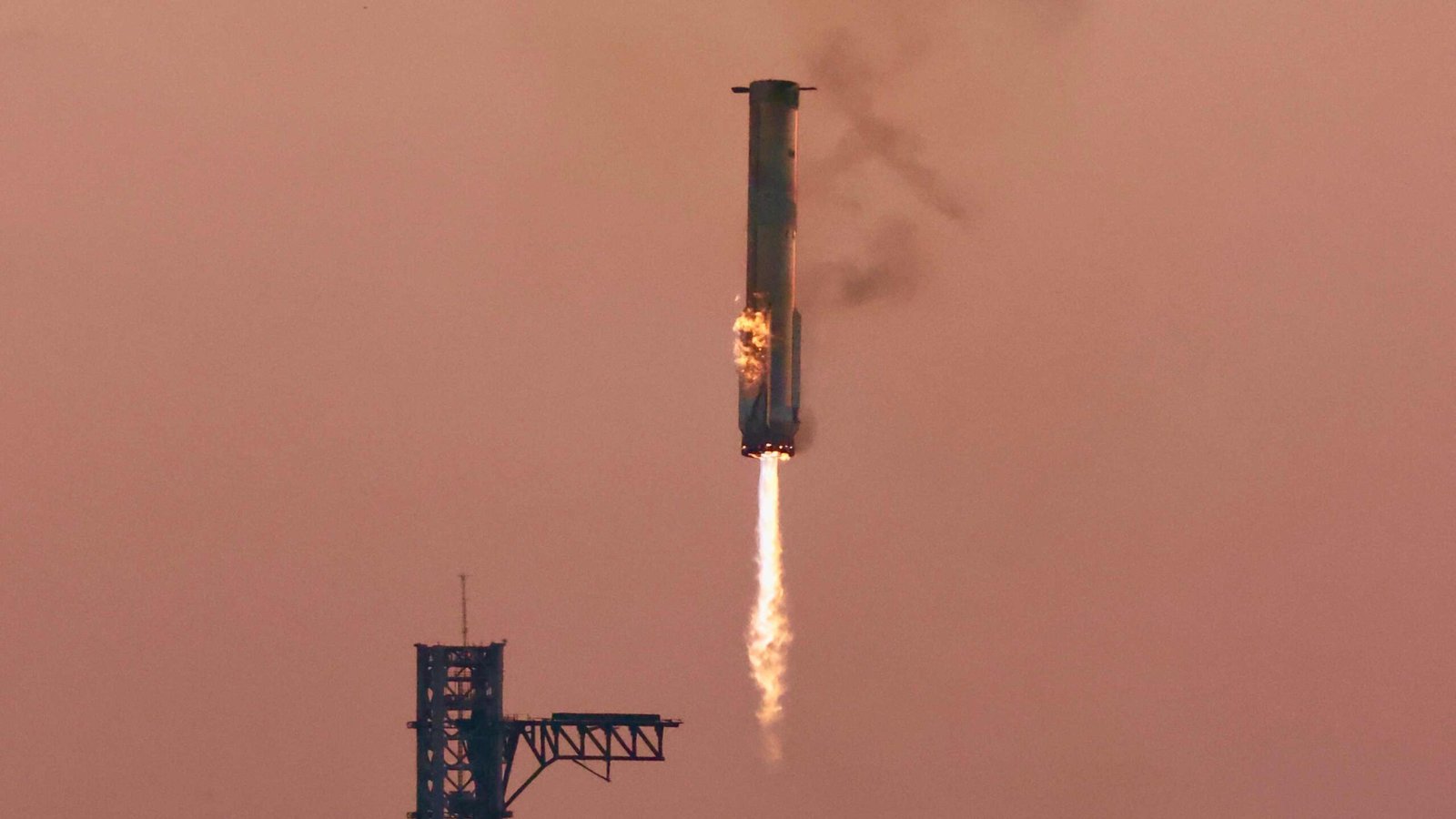
Elon Musk announces Starship Fight 15 Giant Leaps after new S41 Landing Footage Explained: The space exploration industry is entering an exciting new era as SpaceX pushes toward full rocket reusability, Rocket Lab prioritizes structural safety for its Neutron rocket, and NASA continues unlocking the mysteries of the early solar system. Among these developments, SpaceX Starship Flight 15 stands out because of its ambitious recovery objectives and the engineering lessons gained from previous test flights.
Following the impressive landing footage from Starship Flight 14, Elon Musk and the SpaceX team are working toward a major milestone: recovering both the Super Heavy booster and the Starship upper stage. Meanwhile, Rocket Lab is addressing a carbon-composite manufacturing issue before Neutron’s first launch, and NASA’s OSIRIS-REx mission has delivered valuable asteroid samples for scientific research.
Together, these developments demonstrate how reusable rockets, advanced manufacturing, and planetary science are shaping the future of space exploration.
SpaceX Starship Flight 15: A Giant Leap Toward Full Reusability
SpaceX’s Starship Flight 15 represents another important step toward making fully reusable orbital transportation a practical reality. Designed to carry people, cargo, and potentially future missions to the Moon and Mars, Starship is central to Elon Musk’s long-term space exploration ambitions.
Previous test flights have provided valuable data about engine performance, atmospheric reentry, thermal protection, and controlled landings. Flight 14 delivered particularly useful onboard footage showing the Super Heavy booster transitioning from a supersonic descent into its landing burn.
The footage highlighted the progress made in controlling the massive booster during its return. Although the vehicle ultimately ended its flight in the ocean, the test demonstrated important improvements in guidance, stability, and landing procedures.
The Ambitious Double-Catch Objective
One of the most ambitious goals associated with Starship Flight 15 is the potential recovery of both rocket stages using the mechanical arms of SpaceX’s launch tower, commonly known as the chopsticks.
The Super Heavy booster is designed to return to the launch site, where the tower’s mechanical arms can capture it after a controlled descent. The Starship upper stage must independently navigate atmospheric reentry, manage intense heating, and return with sufficient precision for a potential tower catch.
If both recoveries are achieved during the same mission, SpaceX would demonstrate a major advancement in fully reusable orbital launch systems.
This capability could reduce hardware replacement costs, shorten turnaround times, and make frequent launches more practical. However, the exact recovery configuration and outcome depend on flight readiness, safety conditions, and official mission plans.
Why Rocket Reusability Matters
Traditional orbital rockets often discard major components after launch. Manufacturing replacements for these components requires time, materials, specialized equipment, and significant financial investment.
SpaceX’s reusable approach aims to change this model by recovering and refurbishing expensive rocket hardware.
The potential advantages include:
- Lower launch costs: Reusing major components could reduce the cost of delivering payloads to orbit.
- Faster turnaround: Recovered vehicles could return to service after inspection and refurbishment.
- Higher launch frequency: Reusability could support more frequent satellite deployments and exploration missions.
- Deep-space opportunities: Lower transportation costs could help support future lunar and Mars missions.
SpaceX has also discussed ambitious future launch-cadence targets. Achieving weekly launches, followed by multiple launches per week, would require reliable recovery operations, rapid refurbishment, and substantial ground infrastructure.
The Engineering Challenges Behind a Double Catch
Recovering both stages introduces complicated coordination requirements. After catching the Super Heavy booster, ground teams must secure the vehicle, conduct safety checks, and prepare the launch infrastructure for subsequent operations.
Meanwhile, the Starship upper stage must complete its own flight profile and return safely.
Engineers must account for wind conditions, vehicle telemetry, structural loads, landing accuracy, and tower safety. Extending the orbital phase could provide additional time for ground operations, but orbital duration is constrained by propellant reserves, thermal conditions, and mission requirements.
Additional launch and recovery infrastructure could eventually reduce dependence on a single tower. However, any specific plan involving other Starbase facilities or Florida launch infrastructure must be confirmed through official announcements.
Safety remains essential. If conditions are unsuitable for a tower catch, a controlled water landing may be preferable to risking the vehicle or ground equipment.
Rocket Lab Neutron Rocket: Why Safety Comes Before Speed
While SpaceX pursues ambitious recovery operations, Rocket Lab’s Neutron rocket highlights another essential aspect of aerospace engineering: the importance of identifying manufacturing defects before flight.
Neutron is a medium-lift launch vehicle designed to expand Rocket Lab’s capabilities beyond its smaller Electron rocket. Its development is intended to support larger payloads, commercial satellite constellations, and other demanding space missions.
However, the rocket’s first flight has faced delays following the discovery of a manufacturing issue involving a carbon-composite propellant tank component.
Understanding the Carbon-Composite Defect
During quality inspections, engineers identified microscopic voids in the composite material of a forward dome. This structural component helps seal the propellant tanks and must withstand demanding mechanical and operational conditions.
Carbon-composite structures are valuable in aerospace applications because they can provide high strength while keeping vehicle mass relatively low. Nevertheless, manufacturing inconsistencies can compromise structural performance.
Small internal voids do not automatically mean a component will fail. Their significance depends on their size, distribution, location, and the loads the component must withstand.
Rocket Lab’s decision to address the issue before launch reflects the importance of maintaining reliable structural margins.
Neutron’s Path Toward Its First Flight
The company plans to manufacture a replacement component, inspect it thoroughly, and conduct the necessary integration and structural testing before proceeding toward launch.
Although delays can affect development schedules and commercial plans, correcting defects on the ground is generally preferable to discovering them during flight.
Neutron also represents an important strategic step for Rocket Lab. A successful medium-lift vehicle could allow the company to compete for larger satellite deployment contracts and expand its role in the commercial launch market.
The development process demonstrates that manufacturing quality, testing, and engineering discipline are just as important as ambitious launch schedules.
NASA OSIRIS-REx: Unlocking the Secrets of Asteroid Bennu
Beyond rocket development, NASA’s OSIRIS-REx mission has made significant contributions to planetary science by bringing material from the near-Earth asteroid Bennu back to Earth.
The spacecraft launched in 2016, reached Bennu in 2018, and collected a sample in October 2020. Its return capsule landed in Utah in September 2023, delivering material preserved for detailed laboratory analysis.
NASA’s mission team recovered approximately 121.6 grams of asteroid material, exceeding the original collection requirement.
What Bennu’s Samples Reveal
Bennu preserves material dating back approximately 4.5 billion years, offering scientists an opportunity to investigate conditions that existed during the formation of the solar system.
Analysis has revealed evidence of water-altered minerals and carbon-rich compounds, providing important clues about the chemistry of ancient asteroids.
These findings help researchers investigate how water and organic building blocks may have been transported to early Earth. However, the presence of organic compounds does not itself demonstrate that life existed on Bennu.
The samples also help scientists understand how asteroids formed, evolved, and interacted with other bodies throughout solar system history.
Overcoming a Difficult Sample Collection
The sample collection operation presented a significant engineering challenge when Bennu’s loose surface material filled the spacecraft’s sampling mechanism and prevented the collection head from closing as intended.
Engineers responded by securing the sample container and preparing it for the journey home.
The successful return demonstrated the importance of careful planning, real-time problem-solving, and reliable spacecraft systems in deep-space missions.
OSIRIS-APEX: The Mission Continues
Although the original OSIRIS-REx sample-return mission concluded after delivering its cargo, the spacecraft itself continued operating.
Renamed OSIRIS-APEX, the probe is traveling toward asteroid Apophis, which it is scheduled to encounter in 2029.
The extended mission will study Apophis following its close approach to Earth and investigate how the asteroid’s surface responds to the effects of Earth’s gravitational interaction.
This work could improve scientific understanding of asteroid structure and contribute to future planetary-defense research.
How These Three Space Developments Shape the Future
SpaceX, Rocket Lab, and NASA have different objectives, but their work illustrates three complementary priorities in modern aerospace engineering.
SpaceX is pursuing reusable launch technology, with the goal of reducing costs and increasing launch frequency. Rocket Lab is demonstrating why structural reliability and quality control must remain central to rocket development. NASA is expanding scientific knowledge through sample-return missions and continued asteroid exploration.
These efforts also highlight the importance of iterative testing. Rocket developers learn from each test, manufacturing teams correct flaws before launch, and planetary scientists use returned samples to investigate questions that spacecraft instruments alone cannot fully answer.
As commercial launch capabilities improve and scientific missions become more sophisticated, these developments could support more ambitious satellite networks, lunar exploration, deep-space research, and future planetary-defense initiatives.
Conclusion
The latest developments surrounding SpaceX Starship Flight 15, Rocket Lab’s Neutron rocket, and NASA’s OSIRIS-REx mission demonstrate how quickly aerospace technology is evolving.
Starship’s potential double-catch recovery represents an ambitious objective for reusable orbital transportation. Neutron’s manufacturing challenges emphasize that structural integrity must take priority over schedule pressure. Meanwhile, Bennu’s returned samples are helping scientists understand the ancient materials that contributed to the formation of our solar system.
Although each program faces different technical challenges, all three share a common principle: the future of space exploration depends on engineering innovation, rigorous testing, and learning from every mission.
FAQs
1. What is SpaceX Starship Flight 15?
Starship Flight 15 is a planned test flight in SpaceX’s Starship development program. It aims to build on lessons from previous flights and advance the vehicle’s performance, recovery systems, and reusability.
2. What is the main goal of Starship Flight 15?
One major objective associated with Flight 15 is attempting to recover both the Super Heavy booster and Starship upper stage using the launch tower’s mechanical arms. The exact recovery plan depends on official mission confirmation and flight conditions.
3. What are the Starship chopsticks?
The Starship chopsticks are the mechanical arms attached to SpaceX’s launch tower. They are designed to catch and support returning rocket stages, helping SpaceX recover hardware for inspection and potential reuse.
4. Why is catching both Starship stages important?
Recovering both stages could demonstrate a major step toward full rocket reusability. It could reduce hardware replacement costs, shorten refurbishment timelines, and support more frequent launches.
5. What did Starship Flight 14’s S41 landing footage reveal?
The reported S41 landing footage showed the Super Heavy booster transitioning from a supersonic descent into its controlled landing burn. It provided useful information about booster guidance, stability, and thermal protection performance before the vehicle’s ocean termination.
6. How could Starship reusability reduce launch costs?
Reusability allows expensive rocket components to be recovered, inspected, refurbished, and potentially flown again. This approach could reduce manufacturing waste and lower the cost of launching satellites, cargo, and future crewed missions.
7. Will SpaceX launch Starship every week in 2027?
SpaceX has discussed ambitious goals for increasing Starship launch frequency, potentially reaching weekly launches and eventually multiple launches per week. These are development targets, not guaranteed schedules, and depend on vehicle reliability, regulatory approvals, and infrastructure readiness.
8. What safety challenges could affect a Starship double catch?
Important challenges include wind conditions, landing accuracy, vehicle telemetry, structural loads, and launch tower safety. If conditions are unsuitable, SpaceX may choose a controlled water landing instead of risking a tower recovery.
9. What is Rocket Lab’s Neutron rocket?
Neutron is Rocket Lab’s medium-lift launch vehicle designed to carry larger payloads than its Electron rocket. It is intended to support commercial satellite deployments, constellation missions, and other demanding space transportation requirements.
10. Why was Rocket Lab’s Neutron rocket delayed?
The reported delay followed the discovery of microscopic voids in a carbon-composite forward dome during manufacturing inspections. Rocket Lab is addressing the issue to ensure the component meets its structural integrity and safety requirements before flight.
11. What are carbon-composite voids in a rocket component?
Carbon-composite voids are small internal gaps or imperfections within a composite material. Depending on their size, location, and distribution, they can affect structural strength and performance under pressure or other demanding loads.
12. When is Rocket Lab Neutron expected to launch?
The supplied report places Neutron’s first flight in 2027, following the manufacturing issue. The schedule depends on replacement component production, inspections, integration, and successful structural testing.
13. What was NASA’s OSIRIS-REx mission?
OSIRIS-REx was NASA’s asteroid sample-return mission designed to study Bennu and bring material from its surface back to Earth. The samples provide scientists with valuable evidence about the early solar system.
14. How much asteroid material did OSIRIS-REx return to Earth?
OSIRIS-REx returned approximately 121.6 grams of material from asteroid Bennu, exceeding its original collection requirement. Scientists are analyzing the samples to investigate the asteroid’s composition and ancient history.
15. What did NASA discover from the Bennu asteroid samples?
Analysis has revealed water-altered minerals and carbon-rich compounds. These findings help researchers understand the chemical ingredients present in the early solar system and investigate how asteroids may have delivered water and organic materials to early Earth.
16. What is OSIRIS-APEX, and what will it study?
OSIRIS-APEX is the extended mission of the original OSIRIS-REx spacecraft. It is traveling to asteroid Apophis for a planned encounter in 2029, when it will study the asteroid’s properties and investigate how its surface responds to gravitational interactions during its close approach to Earth.
Read More:
- Elon Musk just confirmed the Tesla and SpaceX merger step everyone was waiting for
- SpaceX showcases exactly how it plans to catch Starship next month
- SpaceX stock gets a slew of price target boosts after bullish earnings call
- SpaceX confirms Starship 15 launch window with massive ambitions
- Tesla reports Q3 Earnings today: here’s what to expect