
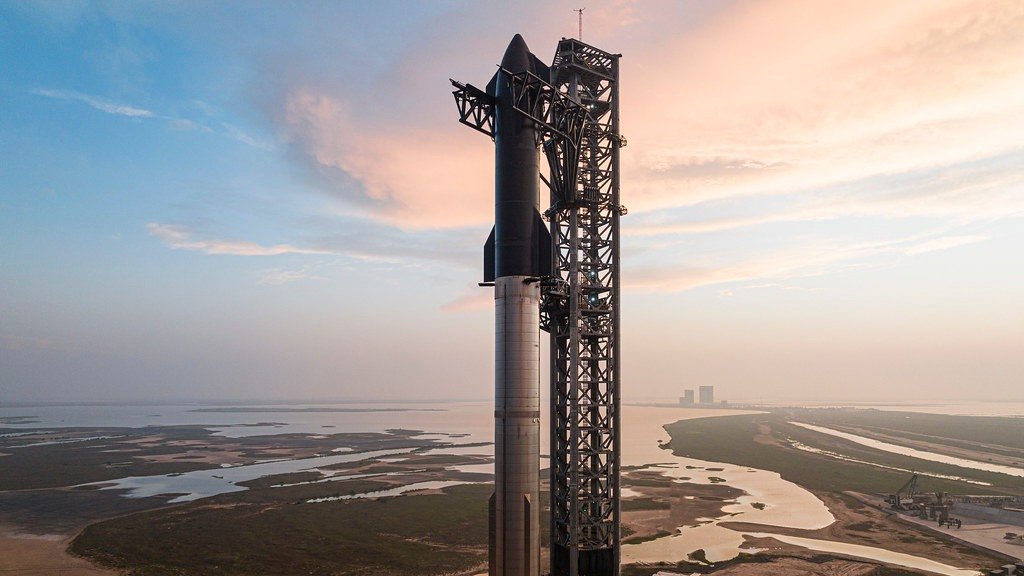
SpaceX’s Secret Solution to Catch Both Stages with A Single Tower is Incredible: The future of space exploration and reusable rocket technology is approaching an extraordinary milestone. SpaceX is working toward an ambitious goal that could completely transform how rockets are launched, recovered, and reused. While the company has already demonstrated the ability to catch its massive Super Heavy booster using the mechanical arms of its Mechazilla launch tower, the next major challenge is even more impressive: catching both the Super Heavy booster and the Starship upper stage using a single launch tower during the same mission.
This revolutionary recovery concept could eliminate the need for separate recovery infrastructure and significantly reduce the time required to prepare rockets for subsequent launches.
But how can SpaceX accomplish two complicated recovery operations with only one tower? The proposed solution involves extending Starship’s orbital mission to approximately 24 hours, giving ground teams enough time to recover the booster, clear the launch area, and prepare the tower for the returning spacecraft.
1. The Challenge of Catching Both Starship Stages
SpaceX’s Starship transportation system consists of two enormous components: the Super Heavy first-stage booster and the Starship upper stage. Both vehicles are designed with reusability in mind, making their recovery essential to the company’s long-term ambitions.
The Super Heavy booster returns to the launch site shortly after liftoff. Using precisely controlled maneuvers, it positions itself near the launch tower, where Mechazilla’s mechanical arms catch the descending rocket.
However, recovering the booster is only the beginning of the challenge.
After the booster has been caught, engineers must complete several important ground operations before the tower can safely receive another vehicle.
Booster Stabilization and Securing
Immediately after the catch, the booster must be mechanically secured to prevent unwanted movement. Engineers also need to manage residual gases, inspect critical connections, and ensure that the vehicle is stable.
Transfer to a Ground Stand
Once secured, the enormous booster must be removed from the catching area and transferred to an appropriate ground stand. This operation requires carefully coordinated mechanical systems and ground personnel.
Mechazilla Tower Inspection
The launch tower must undergo detailed inspections following the recovery. Engineers examine hydraulic systems, mechanical pivot points, structural connections, sensors, and other critical components.
These procedures cannot simply be rushed. A mechanical problem during the next catch could result in serious damage to the vehicle and launch infrastructure.
Therefore, SpaceX needs a solution that provides sufficient time between the booster recovery and Starship’s return.
2. The Incredible 24-Hour Orbital Mission Solution
One potential solution is to extend Starship’s orbital mission to approximately 24 hours.
Earlier Starship orbital flight profiles were considerably shorter, with missions involving approximately six orbits over nine to ten hours. Extending the mission to a full day would allow the spacecraft to complete approximately 16 Earth orbits, depending on its actual orbital trajectory.
This additional time could completely change the recovery sequence.
Instead of immediately returning to Earth after the booster lands, Starship would remain in orbit while ground crews complete the necessary recovery operations.
The concept provides three major advantages.
More Time for Booster Recovery
Ground teams would have additional hours to stabilize the Super Heavy booster, disconnect necessary interfaces, and move the vehicle away from the tower.
Complete Tower Diagnostics
Technicians could inspect Mechazilla’s mechanical arms, hydraulic actuators, sensors, and control systems without being forced to rush through safety procedures.
A Larger Operational Safety Buffer
Unexpected delays are common in complex aerospace operations. A 24-hour orbital window would provide flexibility if booster clearance or tower inspections take longer than anticipated.
Ultimately, the additional orbital time could make a single-tower dual-stage recovery strategy operationally possible.
3. Engineering Challenges of Keeping Starship in Orbit for 24 Hours
Although extending the mission sounds relatively simple, maintaining a massive spacecraft in orbit for an entire day presents several significant engineering challenges.
SpaceX must ensure that Starship’s propulsion, electrical, thermal, and navigation systems remain operational throughout the extended mission.
Cryogenic Propellant Management
Starship uses extremely cold liquid methane and liquid oxygen as rocket propellants. Maintaining these fluids at the correct temperatures for 24 hours is a major challenge.
Heat from the surrounding environment can gradually warm the propellants, increasing pressure and potentially causing boil-off.
SpaceX must rely on advanced insulation, thermal management systems, and cryogenic technologies to maintain suitable propellant conditions.
Reliable propellant storage is especially important because the spacecraft must retain sufficient fuel for its eventual de-orbit maneuver and landing sequence.
Upgraded V3 Electrical Architecture
A longer mission also places additional demands on Starship’s electrical infrastructure.
Avionics, batteries, power distribution systems, and integrated inverters must operate reliably throughout the entire orbital period.
The spacecraft needs redundant electrical systems capable of maintaining critical functions even if individual components experience faults.
Attitude and Thermal Control
Starship must maintain an appropriate orientation while traveling around Earth.
Its thermal control systems must protect sensitive equipment from dramatic temperature variations as the spacecraft moves between sunlight and Earth’s shadow.
The reaction control system plays an important role in maintaining the spacecraft’s orientation and controlling its movement.
Reliable Raptor Engine Restart
One of the most important requirements is ensuring that the Raptor engines can reliably restart after remaining dormant in space for an extended period.
The engines must be ready to perform the de-orbit and landing-related maneuvers when required.
Achieving reliable engine restarts after 24 hours would represent another important milestone for Starship’s long-duration orbital capabilities.
Autonomous Navigation and Starlink Connectivity
Starship must continuously monitor its position, velocity, and orbital trajectory.
Advanced onboard flight software will be essential for handling navigation requirements and unexpected situations.
Communication systems, including Starlink-based infrastructure where applicable, can support data transmission and mission monitoring throughout the flight.
4. Starship’s Hypersonic Return and Mechazilla Catch
After completing its extended orbital mission, Starship must execute one of the most challenging stages of the entire flight: returning from orbital velocity and landing near the launch tower.
Unlike Super Heavy, which performs a relatively short suborbital flight, Starship reaches orbital speeds of approximately 27,000 km/h.
Returning safely from this velocity requires sophisticated aerodynamic control, thermal protection, and propulsion systems.
The landing sequence involves several important stages.
The Belly-Flop Maneuver
During atmospheric descent, Starship uses its forward and aft aerodynamic flaps to control its orientation.
The spacecraft adopts a horizontal belly-flop position, increasing atmospheric drag and helping reduce its velocity.
The Flip and Landing Burn
As Starship approaches the landing zone, it performs a carefully controlled rotation to transition from its horizontal descent orientation into a vertical position.
Its Raptor engines then ignite to control the final descent and landing.
The Mechazilla Chopstick Catch
The final objective is to position Starship precisely between the mechanical arms of the launch tower.
The spacecraft must approach with carefully controlled speed, alignment, and lateral movement.
The tower’s mechanical arms then engage the designated structural load points to support the vehicle.
Successfully completing this maneuver after a full-day orbital mission would demonstrate an extraordinary level of reusable spacecraft engineering.
5. FAA Approval and the Future of Starship Missions
Technical achievements alone are not enough to make dual-stage recovery possible. SpaceX must also satisfy important regulatory and safety requirements.
The Federal Aviation Administration (FAA) evaluates commercial launch and reentry operations to ensure that they meet applicable public safety standards.
An extended orbital mission could introduce additional trajectory considerations, particularly when the spacecraft returns over coastal regions, populated areas, or busy shipping routes.
SpaceX must demonstrate that its flight profile includes appropriate risk assessments, emergency procedures, and contingency plans.
Regulatory approval will therefore remain an important part of the development process.
6. Why Dual-Stage Recovery Could Change Space Exploration
Successfully catching both Starship stages with a single tower could represent a major advancement in reusable launch technology.
Today, recovering and refurbishing rockets can require considerable time, specialized equipment, and expensive infrastructure.
A more efficient recovery system could help SpaceX move toward its long-term goal of making Starship rapidly reusable.
The potential benefits extend far beyond launching satellites.
Orbital Refueling
Reliable long-duration propellant storage and spacecraft operations are important technologies for future orbital refueling missions.
NASA’s Lunar Exploration Plans
Starship is being developed as a major component of NASA’s Artemis lunar exploration architecture. Improved reusability could support future lunar transportation operations.
Future Mars Missions
Ultimately, SpaceX wants to develop a transportation system capable of carrying people and cargo to Mars.
Long-duration spacecraft operations, reliable propulsion, thermal management, and rapid vehicle turnaround are all essential capabilities for achieving that ambition.
Conclusion
SpaceX’s ambition to catch both the Super Heavy booster and Starship upper stage using a single launch tower represents one of the most exciting challenges in modern aerospace engineering.
The proposed 24-hour orbital mission strategy offers an interesting solution to the timing problem. By keeping Starship in orbit while ground teams recover the booster and inspect the Mechazilla tower, SpaceX could create the operational window needed for a second catch.
However, achieving this objective will require major advances in cryogenic propellant management, electrical reliability, thermal control, autonomous navigation, and precision landing technology.
If successfully demonstrated, this approach could bring SpaceX closer to a future where entire orbital launch systems are recovered and reused with unprecedented efficiency.
The ultimate goal is simple but revolutionary: launch, catch, refuel, and fly again.
FAQs
1. What is SpaceX trying to achieve with its dual-stage recovery system?
SpaceX aims to catch both the Super Heavy booster and Starship upper stage using the same Mechazilla launch tower during a single mission. This could significantly improve rocket reusability and reduce recovery infrastructure requirements.
2. What is Mechazilla?
Mechazilla is SpaceX’s giant launch tower equipped with mechanical arms, commonly called chopsticks. These arms are designed to catch returning Super Heavy boosters and potentially Starship spacecraft.
3. Why does SpaceX want to catch both Starship stages?
Catching both stages could eliminate the need for separate landing and recovery infrastructure. It could also reduce refurbishment time, operational costs, and launch complexity.
4. How can SpaceX catch two rocket stages using one tower?
The proposed strategy involves extending Starship’s orbital mission to approximately 24 hours. This gives ground crews sufficient time to recover the Super Heavy booster, clear the catching area, and inspect the tower before Starship returns.
5. Why is a 24-hour orbital mission important for Starship?
A 24-hour mission creates a larger recovery window between the booster landing and Starship’s atmospheric return. This additional time allows engineers to complete essential ground operations safely.
6. How many orbits can Starship complete in 24 hours?
Starship could complete approximately 16 Earth orbits during a 24-hour mission, depending on its orbital trajectory and flight profile.
7. What happens after SpaceX catches the Super Heavy booster?
After the catch, ground teams must stabilize the booster, manage residual gases, disconnect necessary interfaces, transfer the vehicle to a ground stand, and inspect the launch tower.
8. What are the biggest challenges of keeping Starship in orbit for 24 hours?
The major challenges include cryogenic propellant management, electrical system reliability, thermal control, attitude stabilization, Raptor engine restarts, and autonomous navigation.
9. How does SpaceX prevent liquid methane and oxygen from warming in orbit?
SpaceX must use advanced insulation and thermal management technologies to limit heat transfer and maintain suitable propellant temperatures. Long-duration cryogenic storage remains an important engineering challenge.
10. Why are Raptor engine restarts important for a 24-hour mission?
Raptor engines must remain reliable after an extended period in space. They need to restart when required to perform critical de-orbit and landing-related maneuvers.
11. How fast does Starship travel during orbital flight?
Starship travels at approximately 27,000 km/h when operating in low Earth orbit. Returning safely from this speed requires advanced thermal protection and precise flight control.
12. What is the belly-flop maneuver in Starship’s landing sequence?
The belly-flop maneuver involves positioning Starship horizontally during atmospheric descent. Its aerodynamic flaps help control the spacecraft and generate drag to reduce its speed.
13. How does the Mechazilla chopstick catch work?
Mechazilla uses two large mechanical arms to capture a returning vehicle at designated structural load points. The vehicle must approach the tower with precise positioning and controlled movement.
14. Does the FAA need to approve Starship’s extended orbital mission?
Yes. SpaceX must obtain the necessary regulatory authorization for its launch and reentry operations. The FAA evaluates flight safety, trajectory risks, and potential hazards to the public.
15. How could dual-stage recovery benefit future Mars missions?
Dual-stage recovery could improve vehicle reusability, reduce operational costs, and support faster launch turnaround. These capabilities are important for developing a sustainable transportation system for future Mars missions.
16. Will SpaceX’s single-tower dual-stage recovery make Starship fully reusable?
It could become an important step toward full and rapid reusability. However, SpaceX must also demonstrate reliable recovery, inspection, maintenance, refueling, and repeated launches of both Starship stages.
Read More:
- Elon Musk’s Grok Bot is picking up the phone now, and the first calls are wild
- SpaceX moves to challenge AT&T, Verizon with Qualcomm-powered 5G
- Elon Musk hilariously comments on Midterm election results
- Tesla registrations in Germany nearly quadruple in October
- Musk’s Tesla and SpaceX decline after Democratic Midterm sweep