
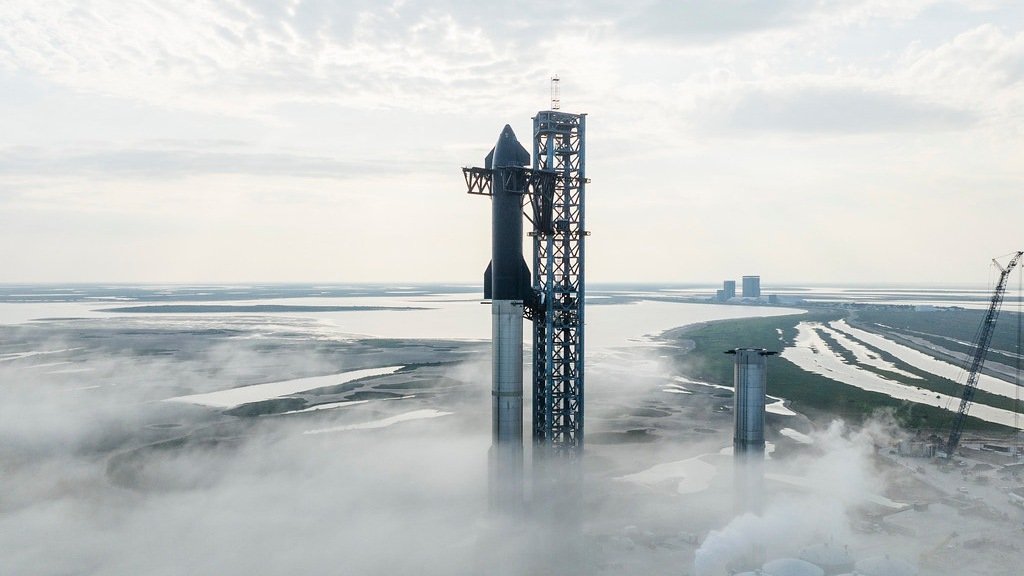
Something WEIRD Is Happening With SpaceX Starship HLS: The future of America’s return to the Moon is becoming increasingly complicated as NASA’s Artemis program moves closer to its next major milestones. At the center of this ambitious lunar exploration effort is SpaceX Starship Human Landing System (HLS), a massive spacecraft designed to transport astronauts from lunar orbit to the Moon’s surface and support a new era of human space exploration.
Although SpaceX continues to affirm its commitment to NASA’s original 2021 Human Landing System contract, questions surrounding development schedules, technical challenges, and shifting industry priorities are attracting attention across the aerospace sector. Meanwhile, NASA is expanding its mission architecture, alternative contractors are gaining importance, and international competition is adding pressure to America’s lunar ambitions.
Something unusual is happening with the Starship HLS roadmap: the project is advancing through an increasingly complex series of requirements while the overall schedule remains a major subject of debate.
NASA’s Artemis Acceleration Conference Reveals Important Updates
NASA’s recent Artemis Acceleration Conference provided valuable insight into the development milestones that SpaceX and other industry partners must complete before astronauts can return to the lunar surface.
The updated roadmaps highlight the enormous amount of testing, hardware development, and operational preparation required to make the next generation of lunar missions possible.
Artemis 3 Milestones Focus on Critical Testing
The Artemis 3 mission includes several important technical objectives involving spacecraft integration, communications, and launch system preparation.
Key development activities include:
- Docking Integration: Demonstrating reliable connections between spacecraft and supporting mission systems.
- Communications Testing: Verifying communication capabilities required for lunar operations.
- Booster and Ship Testing: Conducting major testing activities scheduled for Q2.
- Hardware Transportation: Moving important hardware to Cape Canaveral during Q3.
- Cabin 1 Prototype: Showcasing a full-scale cabin interior prototype designed to demonstrate the future astronaut environment.
These milestones are essential because sending astronauts to the Moon requires much more than successfully launching a rocket. Every component must operate reliably under demanding conditions.
Artemis 4 Introduces a Much Larger Development Roadmap
The Artemis 4 development program represents an even more extensive series of technical objectives, with milestones extending throughout 2027 and early 2028.
Some of the most important requirements include completing and testing Cabin 1, demonstrating advanced landing legs, and developing the airlock systems needed for astronaut movement.
NASA’s roadmap also includes several major uncrewed mission demonstrations.
These include an uncrewed tanker demonstration, an uncrewed lander flight, and an uncrewed landing mission targeted for early 2028 within the supplied development timeline.
Another critical objective involves deploying an orbital propellant depot and demonstrating large-scale fuel transfer operations in low-Earth orbit.
This infrastructure is particularly important because Starship HLS is designed around orbital refueling rather than carrying all the propellant required for a lunar journey during its initial launch.
Starship HLS Faces a Major Orbital Refueling Challenge
One of the biggest technical challenges facing SpaceX Starship HLS is orbital refueling.
Unlike traditional lunar spacecraft, Starship requires a substantial amount of propellant to travel between Earth orbit and the Moon. Launching with enough fuel for the entire journey would create major limitations.
Instead, SpaceX plans to use multiple tanker launches to transfer propellant into an orbital depot before the lunar mission proceeds.
Why Orbital Refueling Is So Difficult
The concept sounds straightforward, but executing it reliably is an enormous engineering challenge.
SpaceX must demonstrate that multiple tanker spacecraft can launch, reach the correct orbit, rendezvous, and transfer cryogenic propellants safely.
Cryogenic propellants must remain at extremely low temperatures. Managing evaporation, fluid movement, pressure, and transfer operations in microgravity introduces additional technical complexity.
The company must also establish a reliable launch cadence capable of supporting the number of tanker missions required.
Without successful orbital propellant aggregation, Starship HLS cannot complete its intended deep-space lunar transportation mission.
Reusability and System Reliability Remain Essential
Orbital refueling is not the only challenge.
SpaceX must also demonstrate reliable booster recovery, spacecraft reusability, and increasingly frequent Starship flights.
The company’s long-term strategy depends on transforming experimental flight operations into a repeatable transportation system.
This requires consistent performance across launch vehicles, ground infrastructure, spacecraft systems, and recovery operations.
A single successful demonstration cannot establish the reliability needed for routine lunar transportation.
SpaceX’s Expanding Projects Raise Resource Allocation Questions
Another interesting development involves the growing number of projects competing for engineering attention and infrastructure.
SpaceX is simultaneously expanding its launch operations, Starship development, and global communication business through Starlink. The broader technology ecosystem associated with Elon Musk also includes artificial intelligence and orbital computing ambitions.
Multiple Mega-Projects Create Engineering Complexity
SpaceX is developing infrastructure across multiple locations, including Florida and Louisiana, while continuing to expand its Starship operations.
These activities require significant investment, specialized engineering teams, manufacturing capabilities, and testing resources.
Critics question whether managing so many ambitious projects simultaneously could stretch available engineering resources.
However, expanding infrastructure does not automatically mean that Starship HLS is receiving fewer resources. SpaceX’s broader operations may also provide manufacturing experience, launch capabilities, and technological improvements that support its lunar program.
The important question is whether the company can maintain the required development pace across all these activities.
Blue Origin Is Becoming an Important Alternative
The competitive environment surrounding NASA’s lunar exploration strategy has changed considerably since the original HLS contract was awarded in 2021.
At that time, SpaceX held the central position in NASA’s initial crewed lunar landing architecture.
Today, NASA is pursuing a more diversified approach involving multiple commercial providers.
NASA’s Multi-Contractor Strategy
NASA has incorporated alternative commercial providers, including Blue Origin, into its broader lunar exploration plans.
This approach gives NASA additional options for future missions and reduces dependence on a single company’s development schedule.
Blue Origin is developing its own lunar lander technologies while investing heavily in the New Glenn rocket.
The company’s expanding capabilities could become increasingly important as NASA evaluates future lunar transportation requirements.
China’s Lunar Ambitions Add International Pressure
International competition is another major factor influencing the Artemis schedule.
China has outlined ambitions for a crewed lunar landing by 2030, creating additional urgency around America’s plans to establish a sustainable human presence on the Moon.
For NASA, maintaining progress is not simply about completing an individual mission. It is also about developing the infrastructure, partnerships, and transportation systems necessary for long-term lunar exploration.
NASA and SpaceX Have Entered a New Relationship
The relationship between NASA and SpaceX has changed dramatically since the company’s founding in 2002.
During its early years, SpaceX depended heavily on government contracts and NASA support to establish itself as a serious aerospace competitor.
Today, the situation is very different.
SpaceX Has Become a Major Part of America’s Space Infrastructure
SpaceX now plays an important role in American space transportation through its Falcon 9 rockets, Dragon spacecraft, and Starship development program.
Its frequent launch operations have transformed the commercial launch industry.
NASA also depends on commercial transportation capabilities to support cargo missions, astronaut transportation, and other important space operations.
This creates a more interconnected relationship in which both organizations benefit from continued cooperation.
The Transition Toward Starship Could Change Launch Operations
SpaceX’s long-term strategy emphasizes transitioning toward a fully reusable Starship architecture.
However, existing systems such as Falcon 9 and Dragon continue to support important government and commercial missions.
Launch infrastructure at Kennedy Space Center, including Launch Complex 39A, will remain an important consideration as Starship operations expand.
Managing the transition without disrupting existing launch commitments will require careful coordination.
Elon Musk’s Mars Vision Adds Another Layer of Complexity
Another factor influencing discussions about Starship HLS is Elon Musk’s long-term ambition to make humanity a multiplanetary species.
Although the Moon is an important destination for NASA’s Artemis program, Musk has repeatedly emphasized Mars as a central objective for SpaceX.
Starship is being developed as a transportation system capable of supporting missions beyond Earth orbit.
Its potential applications include lunar exploration, Mars transportation, satellite deployment, and other large-scale space infrastructure projects.
Is the Moon a Stepping Stone Toward Mars?
From SpaceX’s broader perspective, lunar development can help demonstrate technologies needed for more ambitious interplanetary missions.
These include reusable spacecraft, orbital refueling, advanced life-support systems, and large-scale manufacturing.
However, NASA’s immediate priority is returning astronauts to the lunar surface and building a sustainable exploration architecture.
Balancing these different objectives is an important part of the relationship between NASA’s mission requirements and SpaceX’s long-term development strategy.
What Happens Next for SpaceX Starship HLS?
The coming years will be critical for determining whether Starship HLS can meet the technical and operational requirements of NASA’s Artemis program.
Several milestones will deserve close attention:
- Orbital Refueling Demonstrations: Successful cryogenic propellant transfers will be essential for future lunar missions.
- Uncrewed Starship HLS Testing: SpaceX must demonstrate the lander’s ability to complete critical mission operations.
- Landing System Development: Advanced landing legs, airlocks, and astronaut cabin systems must become operational.
- Booster and Ship Reusability: Reliable recovery and rapid turnaround will support a sustainable launch architecture.
- NASA Mission Integration: SpaceX must coordinate its development activities with NASA’s evolving Artemis requirements.
These milestones will provide a clearer picture of the project’s actual progress than ambitious announcements or projected completion dates alone.
Final Thoughts: The Future of Starship HLS Remains Uncertain
The growing complexity surrounding SpaceX Starship HLS reflects the enormous difficulty of returning humans to the Moon using a next-generation reusable transportation system.
NASA’s updated Artemis roadmaps, orbital refueling requirements, expanding commercial competition, and SpaceX’s broader development priorities all contribute to the uncertainty surrounding the program.
However, these challenges do not necessarily indicate that the project is failing or that SpaceX is abandoning its lunar responsibilities.
Instead, they demonstrate how many interconnected technologies must work together before Starship can become a reliable lunar transportation system.
Ultimately, the most important question is not whether SpaceX can build the world’s largest rocket. It is whether the company can successfully transform Starship into a dependable, reusable, orbital-refueling-based lunar lander that meets NASA’s demanding safety and mission requirements.
The answer will shape the future of the Artemis program, America’s lunar ambitions, and potentially humanity’s journey toward Mars.
FAQs
1. What is SpaceX Starship HLS?
SpaceX Starship HLS (Human Landing System) is a lunar lander developed by SpaceX for NASA’s Artemis program. It is designed to transport astronauts from lunar orbit to the Moon’s surface and support future human exploration missions.
2. Why is Something WEIRD happening with SpaceX Starship HLS?
The unusual situation surrounding Starship HLS involves evolving development schedules, complex technical requirements, orbital refueling challenges, and increasing competition from alternative lunar lander providers.
3. What is NASA’s Artemis program?
NASA’s Artemis program is an initiative designed to return astronauts to the Moon, establish sustainable lunar exploration capabilities, and develop technologies that could eventually support human missions to Mars.
4. What are the major Artemis 3 milestones for SpaceX?
The major Artemis 3 milestones include docking integration, communications testing, booster and spacecraft testing, hardware transportation to Cape Canaveral, and development of the full-scale Cabin 1 interior prototype.
5. What is planned for Artemis 4 development?
The Artemis 4 development roadmap includes cabin testing, advanced landing legs, airlock demonstrations, uncrewed tanker operations, uncrewed lander flights, and orbital propellant depot development.
6. Why does SpaceX Starship HLS need orbital refueling?
Orbital refueling allows Starship to receive additional propellant from tanker spacecraft in Earth orbit. This capability is essential because the lunar lander requires substantial fuel to complete its journey from Earth orbit to the Moon and back.
7. How does orbital refueling work for Starship?
SpaceX plans to launch multiple Starship tanker vehicles that transport cryogenic propellant into orbit. The fuel is transferred to an orbital depot or another Starship, allowing the lunar spacecraft to obtain the propellant needed for its mission.
8. What is the biggest technical challenge facing Starship HLS?
One of the biggest challenges is demonstrating reliable cryogenic orbital propellant transfer. SpaceX must also prove spacecraft reusability, booster recovery, high-frequency launches, and dependable lunar landing operations.
9. Is SpaceX facing competition in NASA’s lunar lander program?
Yes. Blue Origin is developing alternative lunar landing capabilities for NASA. The agency’s multi-contractor strategy provides additional options and reduces dependence on a single commercial provider.
10. How could Blue Origin affect SpaceX Starship HLS?
Blue Origin’s lunar lander development introduces additional competition in NASA’s lunar exploration architecture. Its New Glenn rocket and lunar transportation technologies could provide alternative capabilities for future Artemis missions.
11. Why is China creating pressure for NASA’s Artemis program?
China’s goal of achieving a crewed lunar landing by 2030 has increased international competition. This makes mission scheduling, technological development, and America’s long-term lunar exploration strategy increasingly important.
12. Is SpaceX focusing on Starship HLS or Mars missions?
SpaceX is pursuing multiple objectives, including Starship HLS development and Mars exploration. Elon Musk views Starship as a transportation system that could eventually support lunar missions, interplanetary travel, and human settlement beyond Earth.
13. How has NASA’s relationship with SpaceX changed?
NASA initially helped SpaceX establish itself through government contracts and technical partnerships. Today, SpaceX is a major commercial space transportation provider, supporting astronaut missions, cargo transportation, satellite launches, and future lunar exploration.
14. Will SpaceX replace Falcon 9 and Dragon with Starship?
SpaceX’s long-term vision involves transitioning toward a fully reusable Starship architecture. However, Falcon 9 and Dragon continue to support existing commercial and government missions while Starship development progresses.
15. What important Starship HLS milestones should investors and space enthusiasts watch?
Important milestones include successful orbital refueling, uncrewed lunar landing demonstrations, booster recovery, spacecraft reusability, landing leg development, airlock testing, and NASA mission integration.
16. Can SpaceX Starship HLS successfully support NASA’s future Moon missions?
Starship HLS has the potential to become an important part of NASA’s lunar exploration strategy. However, its success depends on proving orbital refueling, reliable spacecraft operations, safe astronaut transportation, and successful lunar landing capabilities.
Read More: