
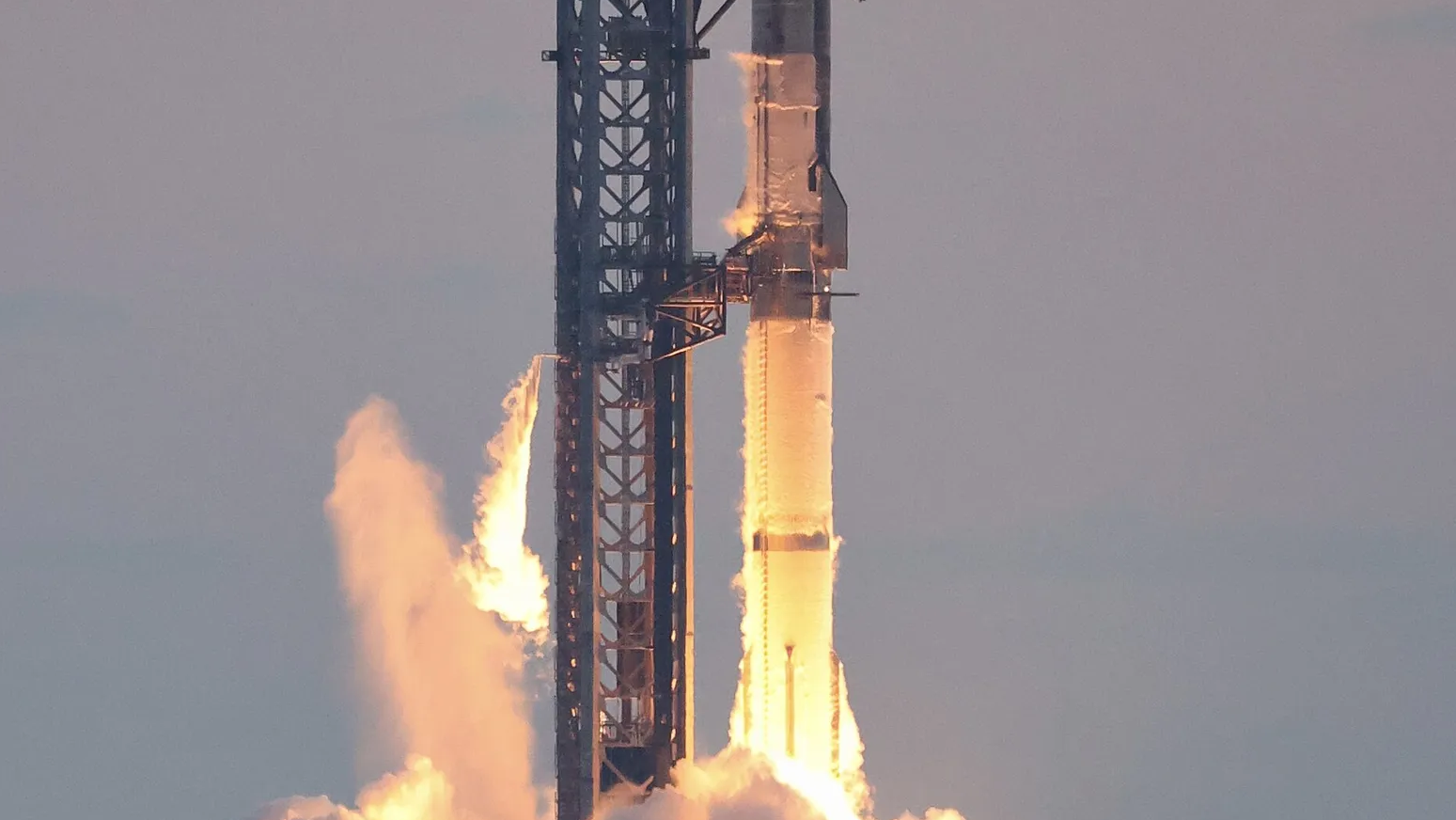
SpaceX just Reveals Starship Flight 15 Timeline to Make History: SpaceX is preparing for one of the most ambitious milestones in the history of aerospace engineering as it advances toward Starship Flight 15. This mission could represent a major turning point in the development of fully reusable rockets, with the company aiming to recover both the Super Heavy booster and the Starship upper stage directly at the launch tower.
After years of engineering improvements, flight testing, atmospheric re-entry experiments, and orbital milestones throughout 2026, SpaceX is working toward a breakthrough that could fundamentally change how rockets are launched and reused. The ambitious Flight 15 mission is designed around an approximately 22-hour mission profile, combining an extended orbital journey, satellite deployment, multiple return checkpoints, and two challenging tower recovery attempts.
If successful, this mission could demonstrate an entirely new approach to commercial space transportation, reducing refurbishment requirements and making frequent launches more economically practical.
SpaceX Starship Flight 15: A Historic Double Tower Catch Attempt
The biggest objective of Flight 15 is to demonstrate the recovery of both rocket stages at the launch site during a single mission.
Traditionally, rockets have relied on ocean landings, expendable hardware, or separate recovery systems. SpaceX is pursuing a different strategy by developing a system in which enormous rocket stages can return to the launch facility and be caught by mechanical arms attached to the launch tower.
The Super Heavy booster will attempt the first recovery, followed much later by the Starship upper stage.
This approach could provide several important advantages:
- Faster rocket turnaround times.
- Reduced transportation and recovery costs.
- Less dependence on offshore recovery operations.
- Simplified post-flight inspections and refurbishment.
- Increased launch frequency.
- Improved long-term commercial spaceflight economics.
However, successfully catching two enormous rocket stages during one mission introduces significant engineering challenges. Both vehicles must execute precise flight maneuvers while meeting demanding structural, aerodynamic, and propulsion requirements.
1. Pre-Launch Countdown and Propellant Loading Timeline
Before Starship leaves the launch pad, SpaceX must complete an extremely coordinated countdown sequence. Both stages require thousands of tons of cryogenic propellants, including liquid oxygen and liquid methane.
T-50 Minutes: Final Engineering Readiness
Approximately 50 minutes before liftoff, the flight director polls the engineering teams to confirm that the launch system, rocket hardware, ground infrastructure, and mission operations are ready.
This checkpoint is essential because any unexpected technical issue could delay the countdown.
T-35 Minutes: Cryogenic Propellant Loading Begins
At approximately T-35 minutes and 33 seconds, propellant loading begins.
The booster receives liquid oxygen followed by liquid methane. The Starship upper stage undergoes a similar fueling sequence shortly afterward.
Managing cryogenic propellants requires extremely precise temperature and pressure control because these liquids must remain at very low temperatures.
T-21 Minutes: Raptor Engine Chilldown
At approximately T-21 minutes and 40 seconds, the Raptor engine chilldown sequence begins.
This process prepares the engine components for the extreme temperatures associated with cryogenic propellants and rocket ignition.
Final Countdown and Liftoff
Booster propellant loading concludes around T-2 minutes and 50 seconds, followed by the upper stage at approximately T-2 minutes and 10 seconds.
The target liftoff time in the supplied mission timeline is 4:45 PM Central.
As all 33 Raptor engines ignite, the launch pad’s water deluge system releases enormous quantities of water to help manage acoustic energy and extreme heat.
2. Starship Ascent and Super Heavy Booster Recovery
Once Starship clears the launch tower, the mission enters one of its most demanding phases.
Max Q: Testing Rocket Structural Strength
At approximately T+58 seconds, Starship reaches Max Q, the point of maximum aerodynamic pressure during ascent.
This moment places enormous stress on the vehicle’s structure. The rocket must maintain stability while traveling at tremendous speed through Earth’s atmosphere.
MECO and Hot-Staging Separation
Around T+2 minutes and 19 seconds, the Super Heavy booster reaches Main Engine Cutoff (MECO).
Approximately two seconds later, hot-staging separation takes place. The upper stage ignites its engines while separating from the booster, continuing its journey toward orbit.
Super Heavy Boost-Back Burn
At approximately T+2 minutes and 26 seconds, the Super Heavy booster begins its boost-back maneuver.
The B22 booster is expected to use 13 Raptor engines, consisting of 10 middle-ring engines and three central engines, to reverse its horizontal velocity and return toward Starbase.
This maneuver is essential for guiding the booster back to the launch facility.
First Booster Catch Attempt at Pad 2
Around T+6 minutes and 10 seconds, the booster begins its landing burn.
Flight 15 introduces two important hardware milestones:
- The first booster catch attempt at Pad 2.
- The first tower recovery attempt involving a V3 Super Heavy booster, featuring integrated catching points on its grid fins.
The launch tower’s mechanical arms, commonly called chopsticks, must precisely position themselves to catch the returning booster.
If successful, the booster will be secured and transferred to the orbital launch mount for inspection.
3. The 22-Hour Orbital Mission and Satellite Deployment
While the Super Heavy booster returns to Earth, Starship continues its journey into orbit.
This extended mission is particularly important because SpaceX wants to demonstrate that the upper stage can operate reliably for an extended period before attempting its return.
Starship Engine Cutoff and Orbital Insertion
At approximately T+8 minutes and 9 seconds, Starship reaches Starship Engine Cutoff (SECO), marking the end of its powered ascent.
Around T+26 minutes and 10 seconds, a roughly 20-second orbital insertion burn is scheduled to establish a stable orbital trajectory.
Reaching orbit is an important milestone, but maintaining vehicle health throughout an extended mission is equally critical.
Deployment of 26 Satellites
Between approximately T+35 minutes and T+1 hour and 17 minutes, Starship is scheduled to deploy 26 satellites.
The deployment sequence is expected to last more than 40 minutes, with approximately one satellite released every 90 to 120 seconds.
This operation will help demonstrate Starship’s potential as a high-capacity satellite deployment platform.
In the future, such capabilities could support large satellite constellations, commercial communications networks, and other orbital infrastructure.
Three Critical Orbital Return Checkpoints
SpaceX has included three return-check windows to evaluate vehicle conditions and prepare for the eventual atmospheric re-entry.
| Checkpoint | Mission Timeline |
|---|---|
| Early Hawaii Return Check | T+1 Hour, 27 Minutes |
| Mid Chile Return Check | T+7 Hours, 15 Minutes |
| Final Hawaii Return Check | T+20 Hours, 42 Minutes |
These checkpoints are particularly important because Starship is expected to complete approximately 14 orbital revolutions during the extended mission.
They provide opportunities to assess vehicle performance, trajectory conditions, and readiness for the return journey.
4. Atmospheric Re-Entry: Starship Faces Its Biggest Test
After spending nearly a full day in space, Starship enters the final and potentially most challenging stage of Flight 15.
Returning from orbit requires the spacecraft to withstand extreme temperatures, aerodynamic forces, and rapidly changing atmospheric conditions.
De-Orbit Burn
At approximately T+21 hours and 36 minutes, Starship performs its scheduled de-orbit burn.
This short engine maneuver adjusts the spacecraft’s trajectory to guide it toward the planned atmospheric entry corridor.
Accurate positioning is essential because even relatively small trajectory differences can affect the vehicle’s landing conditions.
Heat Shield and Hypersonic Re-Entry
During atmospheric re-entry, Starship encounters intense thermal energy as it decelerates from orbital velocity.
Its heat shield must protect the vehicle’s structure from extreme temperatures while aerodynamic forces help slow the spacecraft.
This phase will provide important information about the durability of Starship’s thermal protection system and its ability to support repeated orbital flights.
5. The Final Starship Tower Catch: SpaceX’s Ultimate Challenge
The final objective is the most extraordinary part of the mission: catching the Starship upper stage directly at the launch tower.
According to the supplied timeline, the landing burn begins around T+22 hours and 32 minutes.
Three sea-level Raptor engines are expected to ignite to slow the descending spacecraft.
The Signature Flip Maneuver
As Starship approaches the landing area, it performs its signature flip maneuver, transitioning from horizontal flight into a vertical landing position.
This maneuver requires precise coordination between the spacecraft’s flight-control software, propulsion system, and aerodynamic control surfaces.
The engine sequence then steps down from three engines to two and finally one as Starship approaches the tower.
Can the Chopsticks Catch Starship?
The final catch requires exceptional accuracy.
The returning spacecraft must align itself with the tower’s mechanical arms while maintaining the correct speed, orientation, and position.
A successful upper-stage catch would represent a historic achievement in reusable rocket engineering.
It would demonstrate that SpaceX can potentially recover both major stages at the launch site during one mission.
6. Why Starship Flight 15 Could Change the Future of Spaceflight
The importance of Flight 15 extends far beyond a successful launch or landing.
SpaceX’s long-term vision involves building a fully reusable transportation system capable of supporting frequent commercial launches, large satellite deployments, lunar missions, and eventually human exploration of Mars.
Recovering both stages could help reduce the cost and complexity of future missions.
It could also establish a foundation for faster launch operations, where rockets return to the same infrastructure, undergo inspections, receive necessary maintenance, and prepare for another flight.
However, achieving this vision requires consistent performance across multiple missions. A successful double catch would be a major milestone, but operational reliability, refurbishment requirements, safety, and launch cadence would still need to be demonstrated.
Conclusion: Starship Flight 15 Could Become a Defining SpaceX Milestone
SpaceX Starship Flight 15 represents an ambitious attempt to push reusable rocket technology into an entirely new phase.
From the coordinated cryogenic fueling sequence and 33-engine liftoff to the Super Heavy booster recovery, 26-satellite deployment, 22-hour orbital journey, and final Starship tower catch, every stage of the mission presents a major engineering challenge.
The ultimate objective is clear: recover both rocket stages at the launch site and move closer to a fully reusable space transportation system.
If the mission achieves its double tower catch objective, it could become one of the most significant milestones in modern aerospace engineering.
The biggest question remains: Can SpaceX successfully catch both Super Heavy and Starship during the same mission? Flight 15 aims to put that extraordinary vision to the test.
FAQs
1. What is SpaceX Starship Flight 15?
Starship Flight 15 is an ambitious SpaceX test mission designed to demonstrate advanced rocket reusability, extended orbital operations, satellite deployment, and the recovery of both the Super Heavy booster and Starship upper stage at the launch tower.
2. What is the main objective of Starship Flight 15?
The primary objective is to achieve a double tower catch, recovering both rocket stages at the launch site during a single mission. This could represent a major breakthrough in fully reusable rocket technology.
3. How long will the Starship Flight 15 mission last?
According to the supplied mission timeline, Flight 15 is planned to last approximately 22 hours, including orbital operations, satellite deployment, return checkpoints, atmospheric re-entry, and the final landing attempt.
4. How many Raptor engines will power Starship Flight 15?
The Super Heavy booster is equipped with 33 Raptor engines for liftoff. The Starship upper stage uses its own Raptor propulsion system to continue toward orbit and perform subsequent flight maneuvers.
5. What time is Starship Flight 15 scheduled to launch?
The supplied timeline identifies a target liftoff time of 4:45 PM Central. Actual launch timing may change depending on weather conditions, technical readiness, and regulatory approvals.
6. What is the Max Q phase during Starship Flight 15?
Max Q is the point during ascent when the rocket experiences maximum aerodynamic pressure. In the supplied timeline, it occurs approximately 58 seconds after liftoff and represents an important structural and aerodynamic test.
7. What is hot-staging separation in Starship Flight 15?
Hot-staging is a separation technique in which the Starship upper stage ignites its engines shortly before separating from the Super Heavy booster. This allows the spacecraft to continue accelerating toward orbit.
8. What is special about the Super Heavy booster recovery in Flight 15?
Flight 15 is expected to introduce the first booster catch attempt at Pad 2 and the first tower recovery attempt involving a V3 Super Heavy booster with integrated catching points on its grid fins.
9. How many satellites will Starship Flight 15 deploy?
Starship Flight 15 is scheduled to deploy 26 satellites during its orbital mission. The deployment sequence is expected to take more than 40 minutes, with satellites released approximately every 90 to 120 seconds.
10. What are the three orbital return checkpoints in Flight 15?
The three scheduled return checkpoints are the Early Hawaii Return Check at T+1 hour, 27 minutes, the Mid Chile Return Check at T+7 hours, 15 minutes, and the Final Hawaii Return Check at T+20 hours, 42 minutes.
11. How many times will Starship orbit Earth during Flight 15?
According to the supplied mission plan, Starship is expected to complete approximately 14 orbital revolutions during its extended 22-hour mission.
12. What happens during Starship’s de-orbit burn?
The de-orbit burn is a short engine maneuver scheduled around T+21 hours and 36 minutes. It adjusts Starship’s trajectory to guide the spacecraft toward its planned atmospheric re-entry corridor.
13. How will Starship survive atmospheric re-entry?
Starship relies on its advanced thermal protection system and heat shield to withstand extreme temperatures during hypersonic atmospheric re-entry. The system is designed to protect the vehicle while aerodynamic forces slow it down.
14. What is the Starship flip maneuver during landing?
The flip maneuver is a critical landing procedure in which Starship transitions from horizontal flight into a vertical position. Its Raptor engines then slow the spacecraft for a controlled landing or tower catch attempt.
15. Why is catching Starship with tower chopsticks so important?
The tower’s mechanical catching arms, known as chopsticks, are designed to capture returning rocket stages without requiring traditional landing legs. Successful recovery could reduce refurbishment complexity, transportation requirements, and turnaround times.
16. Why could Starship Flight 15 change the future of space exploration?
A successful double tower catch could demonstrate a major step toward fully reusable rockets. This technology could eventually support more affordable satellite launches, commercial space transportation, NASA lunar missions, and SpaceX’s long-term ambition of sending humans to Mars.
Read More:
- Tesla SILVER Cybercab REVEALED! Elon Drops HUGE Battery Update
- Tesla Robotaxi enters its newest city, reaching San Antonio
- Tesla exec hints at a wild fix for Robotaxi’s biggest weather problem
- Tesla slims Cybertruck offerings to only its most expensive trim
- SpaceX just officially revealed Starship Flight 15 Launch This Week!
2 thoughts on “SpaceX just Reveals Starship Flight 15 Timeline to Make History! Can They Make It Succeed?”