
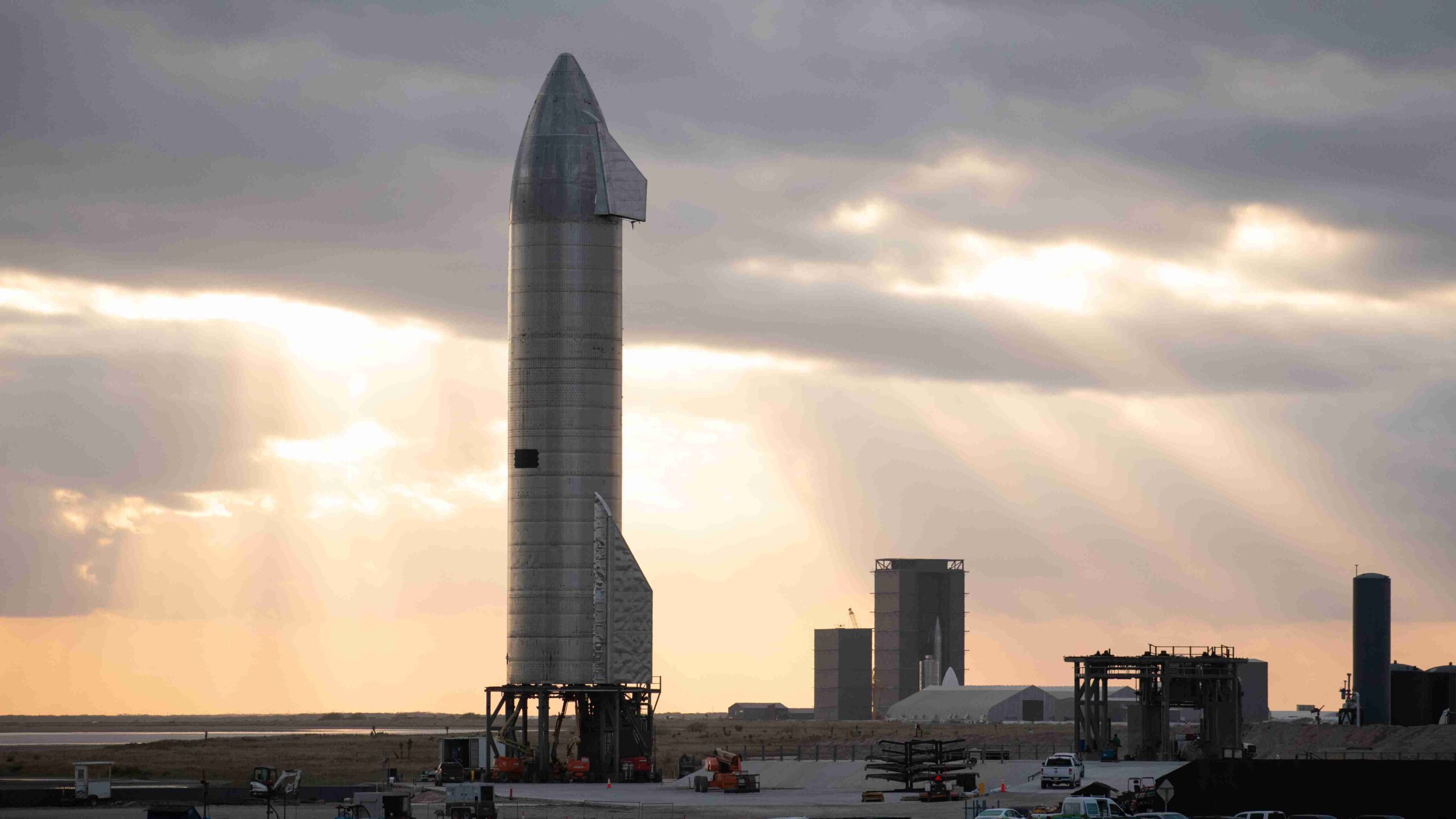
SpaceX Found Something Weird in Starship Booster’s 33-Engine Static Fire test…No Launch in May: The journey to Mars has never been simple, and for SpaceX, it’s proving to be anything but predictable. While the company continues to push the boundaries of space exploration with its Starship program, recent developments suggest that progress is not as smooth as it may appear from the outside. Beneath the awe-inspiring visuals of roaring engines and fiery test launches lies a complex web of engineering challenges, unexpected anomalies, and meticulous problem-solving.
Recent updates from Starbase in South Texas reveal that SpaceX has encountered unusual sensor readings during one of its most critical tests—the 33-engine static fire test. This discovery has raised serious questions about the readiness of Starship’s next flight and whether a May launch is still feasible.
In this in-depth blog, we’ll break down what really happened during the test, why it matters, and what it means for the future of SpaceX’s ambitious plans.
The Illusion of Perfection: What the 33-Engine Test Really Showed
A Spectacle That Hid a Complicated Truth
At first glance, the full-engine static fire test looked like a complete success. Massive plumes of flame, thunderous vibrations, and synchronized ignition of all 33 Raptor engines painted a picture of near perfection. For many observers, it seemed like SpaceX was ready to take the next giant leap.
However, the reality behind the scenes was far more nuanced.
An internal video released by SpaceX revealed that what appeared flawless externally was actually a tense and uncertain moment for engineers. The test was not a clean success—it was a controlled event filled with unexpected challenges.
The Manifold Mystery: What Went Wrong?
Early Shutdown Raises Concerns
One of the most critical issues during the test was an early shutdown triggered just seconds after ignition. At approximately T+1.88 seconds, the system detected a pressure drop in one of the ramp manifolds, leading to an automatic abort.
This wasn’t just a minor glitch—it was a significant anomaly that demanded immediate attention.
Why This Matters
The manifold system plays a crucial role in managing fuel and pressure across the engines. A drop in pressure could indicate:
- Sensor malfunction
- Structural stress
- Flow inconsistencies
- Potential engine instability
Even if the issue turns out to be sensor-related, the implications are serious. In a system as complex as Starship, distinguishing between a false alarm and a real failure is critical.
Simulation vs Reality: The Limits of Engineering Models
Why Testing Can’t Replicate Everything
SpaceX engineers have long acknowledged a key challenge in aerospace development: simulations can only go so far.
While individual systems can be tested in isolation, nothing truly replicates the extreme environment created when 33 engines ignite simultaneously. The vibrations, acoustic forces, and thermal stress create a unique scenario that can only be experienced in real-world tests.
This is where unexpected behavior often emerges.
The “Theoretical Vibe” Problem
The term “theoretical vibe” refers to the complex interaction of forces during engine ignition. These forces can:
- Interfere with sensor readings
- Cause unexpected structural responses
- Trigger automated safety systems
In this case, it’s possible that the sensor readings were affected by these intense conditions rather than an actual mechanical failure.
“Only the Paranoid Survive”: SpaceX’s Engineering Philosophy
Why Caution Is a Strength, Not a Weakness
One of the defining traits of SpaceX’s approach is its commitment to extreme vigilance. Internally, the company embraces a mindset often summarized as:
“Only the paranoid survive.”
This philosophy drives engineers to treat every anomaly—no matter how small—as a potential indicator of larger issues.
Preventing Failure Before It Happens
Rather than ignoring the sensor anomaly, SpaceX chose to:
- Abort the test early
- Inspect the engines thoroughly
- Analyze every data point
This approach may slow progress in the short term, but it significantly reduces the risk of catastrophic failure during an actual launch.
The Aftermath: Engine Damage and Replacement Efforts
Only 10 Engines Salvaged
Following the test, engineers conducted a detailed inspection of the booster’s engines. The results were sobering:
- Only 10 engines were deemed reusable
- The rest required replacement or repair
This outcome highlights the harsh reality of testing cutting-edge rocket technology.
Logistical Challenges
Replacing engines is no small task. It involves:
- Transporting new engines
- Reintegrating them into the booster
- Conducting additional tests
In this case, SpaceX had to pull engines from another booster, adding complexity and time to the process.
The Raptor 3 Learning Curve
A Powerful Yet Evolving Engine
The Raptor 3 engine represents a major step forward in rocket propulsion. It is more powerful, efficient, and streamlined than its predecessors. However, it is still in the early stages of operational maturity.
Reliability Concerns
During earlier tests, a rapid shutdown command caused unexpected mechanical damage to multiple engines. This revealed a critical issue:
Protective systems themselves can introduce new risks.
Balancing safety mechanisms with mechanical resilience is one of the key challenges SpaceX must overcome.
Flight 12: A High-Stakes Mission
Why Flight 12 Is So Important
Flight 12 is not just another test—it marks the debut of the V3 architecture. This new version includes upgrades across multiple systems:
- Engines
- Heat shields
- Fuel systems
- Structural components
The goal is to validate a design that can support mass production and rapid reuse.
What’s at Stake
A successful Flight 12 would:
- Prove the viability of the V3 design
- Bring SpaceX closer to operational Starship missions
- Lay the groundwork for future milestones
A failure, on the other hand, could delay the program significantly.
The Road Ahead: Starship’s Ambitious Roadmap
Flight 13: Reaching Full Orbit
Following Flight 12, the next major milestone is achieving full orbital capability. This would mark a historic moment for the program and the aerospace industry as a whole.
Flight 14: Full Reusability
Perhaps the most ambitious goal is complete reusability. This involves:
- Catching the booster using mechanical arms
- Recovering both stages of the rocket
- Rapid turnaround for future flights
If successful, this would revolutionize space travel economics.
Why the May Launch Is Unlikely
Delays Are Inevitable
Given the issues uncovered during the static fire test, a May launch now appears unlikely. Several factors contribute to this:
- Need for engine replacements
- Additional inspections
- Potential repeat of the test
A More Realistic Timeline
Experts suggest that:
- Late May is the earliest possible window
- A summer launch is more likely
While delays can be frustrating, they are a normal part of developing advanced aerospace systems.
The Bigger Picture: Why These Delays Matter
Short-Term Setbacks, Long-Term Gains
In the grand scheme of the Starship program, a few weeks—or even months—of delay is insignificant compared to the potential rewards.
Each test, failure, and anomaly provides valuable data that improves the system.
Building a Safer Future
By addressing issues now, SpaceX is ensuring:
- Greater reliability
- Increased safety
- Higher success rates in future missions
This is especially important as the company moves toward crewed missions and lunar exploration.
Conclusion: A Necessary Step Toward the Stars
The recent findings from the 33-engine static fire test serve as a powerful reminder that progress in space exploration is rarely linear. What may look like a setback is actually a critical step forward.
SpaceX’s willingness to confront problems head-on, analyze them in detail, and adapt accordingly is what sets it apart. The discovery of “something weird” in the test is not a failure—it’s an opportunity to refine and improve.
While the delay of Flight 12 may push back timelines, it ultimately strengthens the foundation of the Starship program. And as SpaceX continues its journey toward Mars, these moments of uncertainty will play a crucial role in ensuring long-term success.
The road to the stars is filled with challenges—but with each test, SpaceX is getting closer to turning its vision into reality.
FAQs
1. What is the Starship 33-engine static fire test?
The 33-engine static fire test is a ground test where all Raptor engines on the Starship booster are ignited simultaneously to evaluate performance, stability, and system integration without liftoff.
2. Why is the 33-engine test important?
This test validates the booster’s ability to handle extreme thrust, vibration, and thermal stress, which are critical for a successful launch.
3. What went wrong during the recent test?
The test experienced an early shutdown due to a detected pressure drop in one of the ramp manifolds, triggering an automatic safety abort.
4. Was the issue caused by hardware failure or sensors?
It is still under investigation, but early signs suggest it may be related to sensor anomalies rather than a complete hardware failure.
5. What is a ramp manifold in Starship?
A ramp manifold is part of the system that regulates fuel and pressure distribution across multiple engines during ignition.
6. Why can’t SpaceX simulate these issues beforehand?
Even advanced simulations cannot fully replicate the extreme conditions created when 33 engines fire simultaneously, including complex vibrations and acoustic forces.
7. What does “Only the paranoid survive” mean at SpaceX?
It reflects SpaceX’s philosophy of treating every small issue as critical, ensuring maximum safety and reducing the risk of catastrophic failure.
8. How many engines were damaged in the test?
After inspection, only about 10 engines were salvageable, while the rest required replacement or repair.
9. What is the Raptor 3 engine?
The Raptor 3 engine is SpaceX’s latest rocket engine, designed to be more powerful, efficient, and suitable for rapid reuse.
10. Why is the Raptor 3 still facing challenges?
As a new design, it is still undergoing real-world testing, and engineers are working to improve its reliability and durability.
11. What is Flight 12 in the Starship program?
Flight 12 is the upcoming test flight that will debut the V3 architecture, featuring major upgrades across the rocket system.
12. Why is Flight 12 so critical?
It aims to prove that Starship can support mass production, reusability, and future space missions, including lunar and Mars exploration.
13. Will Starship launch in May?
A May launch now seems unlikely due to the need for engine replacements, further testing, and possible re-validation.
14. When is the next likely launch window?
The earliest possible timeline is late May, but a more realistic expectation is a summer launch.
15. How do these delays impact SpaceX’s Mars plans?
Short-term delays help improve system reliability, ensuring a safer and more successful path toward long-term goals like Mars missions and lunar exploration.
Read More:
- Tesla’s biggest rivals fights charging wait times with a modern approach
- SpaceX Board has set a Mars bonus for Elon Musk
- Tesla gives HW3 owners another massive update
- Tesla Model 2 2026 $25K, Gigacasting saves $1 5Kcar—but $10K rear repairs vs BYD risk
- 2026 3 NEW INSANE 4.0 Tesla Tech Destroys ALL EVs Industry
2 thoughts on “SpaceX Found Something Weird in Starship Booster’s 33-Engine Static Fire test…No Launch in May”