
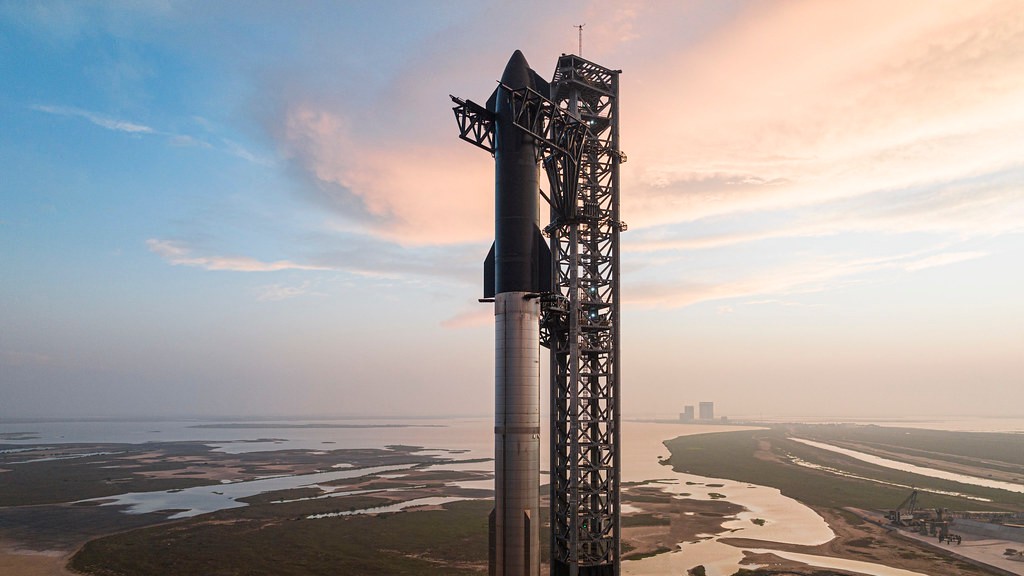
SpaceX’s Insane Plan to Make History in Starship Flight 13: SpaceX is preparing for one of its most ambitious missions yet with Starship Flight 13. This mission is far more than another routine test—it represents the next major step toward transforming Starship Version 3 (V3) into a fully operational, rapidly reusable spacecraft capable of supporting missions to Earth orbit, the Moon, and eventually Mars.
Following the lessons learned from Starship Flight 12, engineers have introduced major improvements across the vehicle, including Raptor 3 engine upgrades, a redesigned thermal protection system, new launch procedures, Starlink V3 satellite deployment, and an in-space engine relight test.
If Flight 13 succeeds, it could become one of the most important milestones in SpaceX’s journey toward building the world’s first fully reusable orbital rocket.
Why Starship Flight 13 Is So Important
Unlike previous test flights, Starship Flight 13 combines engineering validation with operational objectives. SpaceX wants to prove that Starship is ready to move beyond experimental testing and begin carrying real payloads into orbit.
The mission has four primary goals:
- Improve Raptor 3 engine reliability
- Test advanced thermal protection system (TPS) upgrades
- Deploy the first operational Starlink V3 satellites
- Successfully restart a Raptor engine in space
Achieving these objectives would bring SpaceX significantly closer to launching Starship on regular commercial and deep-space missions.
Raptor 3 Engine Upgrades After Flight 12
Stronger Super Heavy Booster Performance
During Flight 12, SpaceX encountered several propulsion issues. One engine shut down shortly after liftoff, while additional engine instability occurred during the booster’s descent.
To solve these problems, engineers have introduced several major improvements:
- Redesigned propellant plumbing
- Additional structural shielding
- Improved engine control software
- Smarter multi-engine abort logic
These upgrades are designed to help the flight computer better manage all 33 Raptor 3 engines even if one or more experience unexpected performance changes.
Upper Stage Engine Improvements
The Starship upper stage also experienced an unexpected shutdown of one of its vacuum-optimized Raptor Vacuum (RVac) engines during Flight 12.
For Flight 13, SpaceX has modified:
- Engine startup procedures
- Chilldown operations
- Engine bay hardware
These improvements aim to ensure reliable engine operation in the vacuum of space.
New Heat Shield Technology Will Face Its Biggest Test
Experimental Thermal Protection System
One of the most visible changes on Flight 13 is the appearance of white heat shield tiles mixed with the traditional black hexagonal tiles.
These experimental tiles serve two important purposes:
- Simulate the performance of missing tiles during re-entry.
- Provide bright visual reference points for high-resolution satellite cameras.
Engineers will also test:
- New tile attachment mechanisms
- Modified aft flap protection
- Updated aft skirt designs
These experiments will help SpaceX understand how Starship handles extreme heating during atmospheric re-entry.
Ultra-Fast Fuel Loading Makes Starship Even More Efficient
One of the biggest improvements in Starship V3 is its dramatically faster fueling process.
Thanks to upgraded ground systems at Starbase, SpaceX can now fully fuel the nearly 5,000-metric-ton rocket in only about 30 minutes.
Flight 13 Countdown Timeline
T-50 Minutes
Final propellant loading poll.
T-37 Minutes
Liquid Oxygen loading begins.
T-35 Minutes
Liquid Methane loading starts.
T-21 Minutes
Raptor engine chilldown begins.
T-2 Minutes
Fuel loading is completed.
T-30 Seconds
Final launch approval.
The shorter countdown reduces cryogenic boil-off, lowers operational risk, and supports SpaceX’s long-term goal of multiple launches per day.
Liftoff: More Than 9,000 Tons of Thrust
At launch, all 33 Raptor 3 engines ignite simultaneously, producing over 9,000 metric tons of thrust.
This makes Starship the most powerful rocket ever built.
Flight 13 will also use an updated launch trajectory, flying through the strait between Mexico and Cuba before continuing toward its orbital path.
Meanwhile, the upgraded water deluge system at Orbital Launch Pad 2 will protect both the launch pad and rocket by absorbing enormous acoustic and thermal energy during liftoff.
Fixing the Hot-Staging Problem
One of Flight 12’s biggest issues occurred during the hot-staging maneuver.
Tiny differences in engine startup timing caused the Super Heavy booster to rotate nearly 90 degrees off its intended path.
For Flight 13, SpaceX has introduced:
Improved Engine Startup Sequence
The revised ignition software minimizes microsecond timing differences between engines, allowing for a much smoother booster flip after stage separation.
This improvement should increase structural stability and improve recovery performance.
Super Heavy Booster Recovery Gets Major Improvements
After stage separation, the Super Heavy booster begins its return toward the Gulf of Mexico.
Flight 12 revealed another important issue—several engines failed to relight properly during the boost-back burn.
To solve this, Flight 13 includes:
- Earlier landing burn ignition
- Improved engine restart logic
- Better deceleration timing
Instead of approaching the ocean too quickly, engineers expect the booster to perform a much gentler soft splashdown, giving SpaceX valuable recovery data.
Starlink V3 Satellites Will Fly for the First Time
One of the biggest milestones for Flight 13 is its transition from a pure test mission into a partially operational flight.
Deployment of 20 Starlink V3 Satellites
For the first time, Starship will deploy 20 operational Starlink V3 satellites into low Earth orbit.
These satellites are larger, more capable, and specifically designed to take advantage of Starship’s enormous payload capacity.
Six Camera Satellites Join the Mission
The mission also carries six specialized camera satellites.
After deployment, these satellites will photograph Starship during atmospheric re-entry, providing engineers with unprecedented views of:
- Heat shield performance
- Plasma interaction
- Structural heating
- Tile behavior
The resulting data will be invaluable for future reusable Starship missions.
One of the Most Critical Tests: Raptor Engine Relight in Space
Perhaps the most important objective of Flight 13 is the in-space restart of a Raptor 3 engine.
This test is essential because future Starship missions will require engines to restart after reaching orbit.
A successful relight enables:
- Orbital maneuvering
- Satellite deployment adjustments
- Controlled deorbit burns
- Lunar landing missions
- Mars missions
This milestone was skipped during Flight 12, making it one of the highest-priority objectives for Flight 13.
Re-Entry Will Push Starship to Its Limits
Following orbital operations, Starship will begin its descent over the Indian Ocean.
As it re-enters Earth’s atmosphere, temperatures will soar as plasma surrounds the spacecraft.
Engineers will closely monitor:
- Experimental white heat shield tiles
- New flap protection systems
- Thermal loads
- Structural stress
The six deployed camera satellites will capture detailed imagery throughout re-entry, providing insights never before available.
Final Landing Flip Demonstrates Future Catch Capability
One of Starship’s most dramatic moments is its famous belly-flop maneuver.
As the spacecraft slows, three sea-level Raptor engines ignite and rotate the vehicle from a horizontal position back to vertical.
Flight 13 may also include experimental engine throttling, allowing engineers to study how Starship behaves if one engine loses thrust during landing.
These tests are critical for future Mechazilla tower catches, where Starship will eventually be captured directly by giant robotic arms instead of landing in the ocean.
Final Thoughts
Starship Flight 13 represents one of the most significant missions in SpaceX history. Every phase of the mission—from launch and hot staging to satellite deployment, engine relight, atmospheric re-entry, and landing—has been carefully designed to validate technologies required for full reusability.
If successful, Flight 13 will demonstrate major improvements in Raptor 3 engine reliability, heat shield durability, rapid launch operations, and orbital capabilities while marking the first operational deployment of Starlink V3 satellites.
More importantly, it will move SpaceX one giant step closer to its ultimate vision: building a fully reusable transportation system capable of carrying humans and cargo to the Moon, Mars, and beyond. The success of Flight 13 could mark the beginning of a new era in space exploration.
FAQs
1. What is Starship Flight 13?
Starship Flight 13 is SpaceX’s next major test mission for the Starship Version 3 (V3) rocket. It aims to validate upgraded engines, improved heat shield technology, satellite deployment, and an in-space engine relight.
2. Why is Starship Flight 13 important?
Flight 13 is considered a crucial milestone because it could move Starship from an experimental test vehicle to a fully operational and rapidly reusable launch system capable of supporting future Moon and Mars missions.
3. What improvements were made after Starship Flight 12?
SpaceX upgraded the Raptor 3 engines, improved engine control software, redesigned propellant systems, enhanced the thermal protection system (TPS), and adjusted landing and hot-staging procedures based on lessons learned from Flight 12.
4. What are the primary objectives of Starship Flight 13?
The mission aims to improve engine reliability, test new heat shield designs, deploy operational Starlink V3 satellites, perform an in-space Raptor engine relight, and collect valuable re-entry data.
5. How many Raptor engines power Starship Flight 13?
The Super Heavy booster uses 33 Raptor 3 engines, while the Starship upper stage is powered by six Raptor engines, including both sea-level and vacuum-optimized variants.
6. What are the new white heat shield tiles on Starship?
The white thermal protection tiles are experimental components designed to simulate missing tiles during re-entry and serve as high-visibility targets for satellites capturing detailed images of the spacecraft.
7. What is the purpose of deploying Starlink V3 satellites?
Flight 13 will deploy 20 operational Starlink V3 satellites to demonstrate Starship’s ability to carry and release real commercial payloads into low Earth orbit.
8. Why is the in-space Raptor engine relight so important?
Successfully restarting a Raptor engine in orbit is essential for future missions involving orbital maneuvering, satellite deployment, controlled deorbit burns, lunar missions, and eventual journeys to Mars.
9. How fast can SpaceX fuel Starship Flight 13?
Thanks to upgraded ground systems at Starbase, SpaceX expects to complete propellant loading for the massive Starship rocket in approximately 30 minutes, significantly reducing launch preparation time.
10. What is hot staging in Starship?
Hot staging is a separation technique where the Starship upper stage ignites its engines while still attached to the Super Heavy booster, allowing for a more efficient transition between stages.
11. Where will Starship Flight 13 land?
The Super Heavy booster is expected to perform a controlled splashdown in the Gulf of Mexico, while the Starship upper stage will target a splashdown in the Indian Ocean near Western Australia after completing its mission.
12. What is the PEZ payload dispenser?
The PEZ dispenser is Starship’s internal payload deployment mechanism that sequentially releases satellites into orbit, similar to how a PEZ candy dispenser ejects candies.
13. How many satellites will Starship Flight 13 carry?
The mission is expected to carry 20 operational Starlink V3 satellites along with 6 specialized camera satellites that will photograph Starship during atmospheric re-entry.
14. How powerful is Starship during liftoff?
At launch, the 33 Raptor 3 engines generate more than 9,000 metric tons of thrust, making Starship the most powerful rocket ever built.
15. What data will SpaceX collect during Flight 13?
SpaceX will gather information on engine performance, heat shield durability, aerodynamic behavior, satellite deployment, engine relight capability, re-entry temperatures, and landing performance.
16. What happens if Starship Flight 13 is successful?
A successful Flight 13 would validate several critical technologies needed for a fully reusable launch system and move SpaceX closer to routine commercial launches, lunar missions under NASA’s Artemis program, and future human missions to Mars.
Read More:
- SpaceX unveils Starlink next-gen V5 kit: here’s what’s new
- Tesla responds to strange Supercharging pricing error with classy move
- Lucid CEO dispels any rumors of bankruptcy: ‘So far from the facts’
- Elon Musk’s Texas ranch to showcase the lifelong work that changed the world
- Tesla AI5 Optimus Chip Finally Enters Production
2 thoughts on “SpaceX’s Insane Plan to Make History in Starship Flight 13! Here’s Launch Timeline”