


SpaceX’s Starship program has captivated space enthusiasts and industry watchers around the world. The excitement surrounding Starship is not just about reaching orbit or landing on the Moon and Mars — it’s about revolutionizing how humanity accesses space.
One of the most anticipated milestones is the ability to catch the Starship spacecraft upon its return to Earth using giant mechanical arms, enabling rapid reuse. This ambitious feat would transform spaceflight economics and frequency.
Recently, Elon Musk dropped some significant updates that have altered expectations about when the first Starship catch attempt will take place. In this post, we’ll dive into the details of Musk’s latest comments, explore the technical and operational challenges SpaceX faces, and discuss why this milestone is crucial for the future of space exploration.
What Is Starship Catching and Why Does It Matter?
Before diving into the news, let’s clarify what “catching Starship” means and why it matters so much.
What Is Starship Catching?
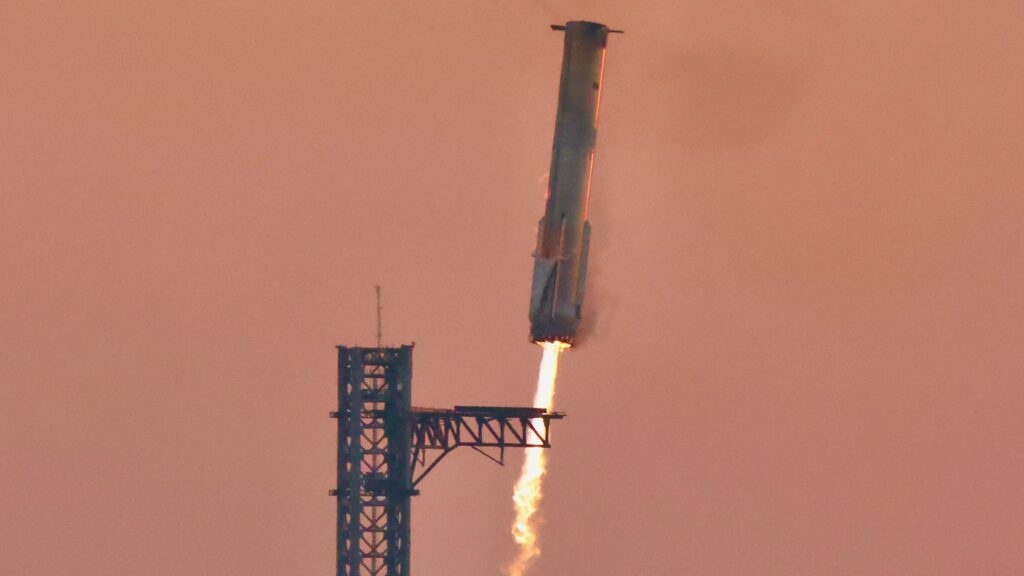
The term “catching” refers to SpaceX’s innovative plan to use large, mechanical arms (colloquially called “chopsticks”) attached to launch towers to grab the Starship spacecraft mid-air as it descends back to Earth. Instead of landing in the ocean and requiring expensive refurbishment, the spacecraft could be caught directly on the tower, inspected, refueled, and launched again with minimal downtime.
This technique is revolutionary because it would enable full rapid reusability, drastically lowering costs and turnaround times compared to traditional rocket systems.
Why Is Catching Starship Important?
- Cost Reduction: Eliminates costly ocean recovery and refurbishment
- Increased Launch Cadence: Faster turnaround allows more frequent missions
- Foundation for Future Missions: Essential for orbital refueling, Moon landings, and Mars colonization
- Industry Leadership: Sets SpaceX apart in a competitive space launch market
The ability to catch Starship is a cornerstone of Elon Musk’s vision to make humanity a multiplanetary species, starting with the Moon and Mars.
Elon Musk’s Recent Comments: A Shift in Timeline
Initial Optimism for 2025
Until recently, Musk and SpaceX insiders projected that the first Starship catch attempt could happen in 2025, potentially even earlier in the year. After several successful test flights, optimism was high that SpaceX would pull off this historic maneuver soon.
- In mid-2025, Musk suggested the catch could occur before the end of the year
- The company maintained cautious optimism post-Flight 9 discussions
New Interview Signals Delay
However, in a recent interview with Tesla Owners Silicon Valley, Musk sounded less certain:
- Instead of a firm commitment, he said “maybe this year” — implying it’s possible but not guaranteed
- More confidently, he identified the first half of 2026 as the most likely timeframe for the first catch attempt
This more hesitant tone indicates SpaceX faces unexpected technical or operational challenges delaying the catch.
Why Is the Starship Catch Delay Happening?
Flight Performance and Technical Challenges
SpaceX’s Starship program is extraordinarily complex, and recent flights have revealed ongoing challenges.
- Flights 7, 8, and 9 showed difficulties with engine reliability, heat shield integrity, and payload deployment
- Flight 10 is planned to perform an ocean landing, intentionally avoiding a catch attempt to minimize risk
- The Super Heavy booster will also not be caught on Flight 10 as critical goals from Flight 9 remain incomplete
Implications for Flight 11 and Beyond
Flight 11 is the earliest plausible opportunity for a catch attempt because:
- Its hardware is the final Version 2 Starship, designed for higher risk operations
- However, Flight 11’s success depends entirely on Flight 10’s outcome
If Flight 10 fails, the catch attempt will likely move to Flight 12, which is expected to debut Starship Version 3 (V3).
Why Not Attempt Catch on Flight 12 (V3)?
SpaceX is unlikely to combine the risks of a new vehicle design (V3) with the complexity of a catch maneuver:
- A failure on V3’s maiden flight could undermine confidence
- V3’s debut alone is a critical milestone needing focus without added risk
Technical Complexities Behind Catching Starship
Catching Starship is far more complex than catching the booster stage. Here are some key challenges:
1. Orbital Re-Entry and Heat Shield
- Starship completes a full orbit, exposing it to intense temperature swings and vacuum pressure
- It relies on a heat shield made of over 18,000 tiles to protect against plasma and aerodynamic forces during re-entry
- The heat shield system has yet to meet SpaceX’s durability standards, with past flights exposing weaknesses
- Musk has cited the heat shield as one of Starship’s two biggest ongoing challenges
2. Engine Reliability
- The Raptor engines power Starship through launch, orbital maneuvers, and landing burns
- Engine failures have caused mission cut-short across multiple flights in 2025
- For a successful catch, engines must perform flawlessly in a demanding sequence of ignition, burns, and restarts
3. Precise Timing and Maneuvering
- The catch requires perfect synchronization between the descending Starship and the mechanical arms on the tower
- Even minor errors could damage the ship, the tower, or other infrastructure
4. Ground Infrastructure Readiness
- The chopsticks system at Launch Pad 1 is designed primarily for catching the booster
- Pad 2 is under construction and will host a specialized system to catch both the ship and booster
- Construction at Pad 2 is ongoing, but no official testing has begun — stable operation likely won’t start until late 2025 at the earliest
Flight 10: The Crucial Next Step
Flight 10 is shaping up to be a critical milestone in SpaceX’s Starship development.
Key Objectives for Flight 10
- Booster 16 will attempt a more aggressive landing profile, including a higher angle of attack and two-engine landing
- Ship 37 must successfully deploy payload, manage complex engine reignition sequences, and survive atmospheric re-entry
- SpaceX plans heat shield experiments, including testing new tile materials and removing some shield sections to improve design
- Flight 10 will end with a controlled ocean landing, setting the stage for future catch attempts
Why Flight 10 Matters
- Flight 10 will test the resilience and reliability of hardware and software systems under demanding conditions
- Success will build confidence to attempt the first Starship catch on Flight 11 or later
- Failure will push catch attempts further into 2026, delaying key milestones
The Broader Impact of Catching Starship
Enabling Orbital Refueling
One of the most significant uses of Starship catching is enabling the orbital refueling infrastructure.
- SpaceX plans to build a fleet of Starship “tankers” to refuel ships in orbit, allowing much larger payloads to deep space
- Early mastery of catch techniques will help perfect refueling operations by ensuring ships can land safely and quickly after missions
Moon and Mars Missions
- SpaceX is targeting uncrewed lunar landings and Mars missions starting in late 2026
- These missions require precise landings, quick turnaround, and robust operational reliability
- Mastering the catch will increase mission success rates and reduce costs for interplanetary travel
Achieving Full Reusability
- Full reusability is key to lowering space access costs and enabling frequent launches
- It supports SpaceX’s vision of building sustainable bases on the Moon and Mars
- Rockets that can be rapidly reused will make colonization and space industry economically viable
Competitive Landscape and Industry Implications
While Starship aims for full reusability, most current rockets are only partially reusable or expendable.
Current Competitors
- NASA’s Space Launch System (SLS) and ULA’s Vulcan remain largely expendable
- Blue Origin’s New Glenn, Rocket Lab’s Neutron, and Stoke Space’s Nova aim for partial reusability but still lag behind Starship’s ambitious scope
Why Full Reusability Matters
- It gives SpaceX a significant competitive advantage in launch costs and cadence
- Others are trying to catch up, but SpaceX’s early breakthroughs and operational experience could keep it in the lead
- The global space industry is evolving rapidly, and leadership depends on innovation like Starship catching
Looking Ahead: What to Expect Next
- SpaceX aims to launch Flight 10 by late August 2025, with ongoing tests to ensure reliability
- If Flight 10 succeeds, Flight 11 could attempt the first catch, likely in Fall 2025
- If delays continue, the first catch attempt will slip into early 2026, possibly on the second V3 mission
- Elon Musk’s recent comments reflect a realistic assessment of these risks and challenges
Final Thoughts: The Future of Spaceflight Is Close
Elon Musk’s revelation about the revised timeline for Starship catching is a reminder that space exploration is incredibly difficult but worth every challenge. While the milestone may not be reached this year, the groundwork being laid with Flight 10 and subsequent missions is crucial.
The ability to catch Starship will revolutionize rocket reusability, reduce launch costs, and open the door to sustainable lunar bases and Mars colonization. It’s a pivotal piece in SpaceX’s grand vision of making life multiplanetary.
Will SpaceX succeed in catching Starship soon? The world waits with bated breath as this engineering marvel approaches reality.
Stay Updated on SpaceX’s Journey
If you’re passionate about space exploration and want the latest insights on SpaceX and Starship:
- Follow our blog for in-depth updates
- Subscribe to newsletters and video channels covering space news
- Engage with space communities and share your excitement
The next frontier awaits, and with SpaceX pushing boundaries, the future looks brighter than ever.
FAQs
1. What does “catching Starship” mean?
Catching Starship refers to SpaceX’s plan to use mechanical arms on a launch tower to grab the Starship spacecraft mid-air during its descent, enabling rapid reuse without ocean landings.
2. Why is catching Starship so important for SpaceX?
It drastically reduces refurbishment costs and turnaround times, enabling faster, cheaper launches and supporting ambitious missions to the Moon and Mars.
3. When did Elon Musk say the first Starship catch attempt would happen?
Initially, Musk hoped for a catch attempt in 2025, but recent comments suggest it may slip to the first half of 2026.
4. What caused the delay in Starship catching attempts?
Challenges with recent flights, technical issues like engine reliability and heat shield durability, and the need for fully operational ground infrastructure have contributed to delays.
5. Which SpaceX flight is expected to first attempt catching Starship?
Flight 11 is the earliest likely candidate for the first catch attempt, depending on the success of Flight 10.
6. Why won’t SpaceX try catching Starship on Flight 10?
Flight 10 aims for a safer ocean landing to minimize risk and complete critical test objectives before attempting a catch.
7. What is the difference between Starship Version 2 and Version 3?
Version 3 is a newer design expected to improve reliability and operational capability. Flight 12 is slated to debut V3.
8. Why is Starship catching harder than catching the booster?
Starship endures full orbital re-entry with extreme heat and pressure changes, making heat shield durability and precise timing more challenging.
9. What role does the heat shield play in Starship catching?
The heat shield protects Starship from intense heat during re-entry. It must be highly durable for safe catches and quick turnarounds.
10. How critical are the Raptor engines to the catch process?
The Raptor engines must perform flawlessly during launch, orbital maneuvers, and landing burns to enable a successful catch.
11. What is the current status of the catch infrastructure?
Mechanical arms (“chopsticks”) at Pad 1 are mostly for booster catching; a new specialized system at Pad 2 is under construction but not yet operational.
12. How will Starship catching affect SpaceX’s lunar and Mars missions?
Catching will enable rapid reuse and orbital refueling, both essential for sustaining human missions to the Moon and Mars.
13. What are some of the risks involved in attempting to catch Starship?
Risks include engine failures, heat shield damage, precise synchronization errors, and infrastructure malfunctions.
14. How does catching Starship compare with competitors’ rockets?
Starship aims for full rapid reusability, unlike most competitors that only partially reuse rocket components or use expendable rockets.
15. What is the significance of Flight 10 for the Starship program?
Flight 10 will test critical systems under demanding conditions, laying the groundwork for future catch attempts.
16. Will Starship catch attempts speed up SpaceX’s launch cadence?
Yes, successful catching will enable faster turnaround times and more frequent launches.
17. What happens if Flight 10 fails?
A failure in Flight 10 could delay the first catch attempt to Flight 12 or later, pushing timelines further into 2026.
18. Why does SpaceX need two launch towers for catching both stages?
Catching both the booster and Starship requires separate, specialized systems to handle their different sizes and descent profiles.
19. How can fans stay updated on Starship catching milestones?
Follow official SpaceX announcements, subscribe to space news channels, and engage with communities tracking Starship development.
Read More:
- Tesla is making preparations to bring FSD to Japan and Thailand
- A Tesla Model Y L Robotaxi is a legitimate $47k Waymo killer
- More Tesla Cybercab equipment are arriving in Giga Texas
- Tesla Model Y Performance zips around Nurburgring with new features
- Tesla Model Y L addresses one huge complaint from many owners