


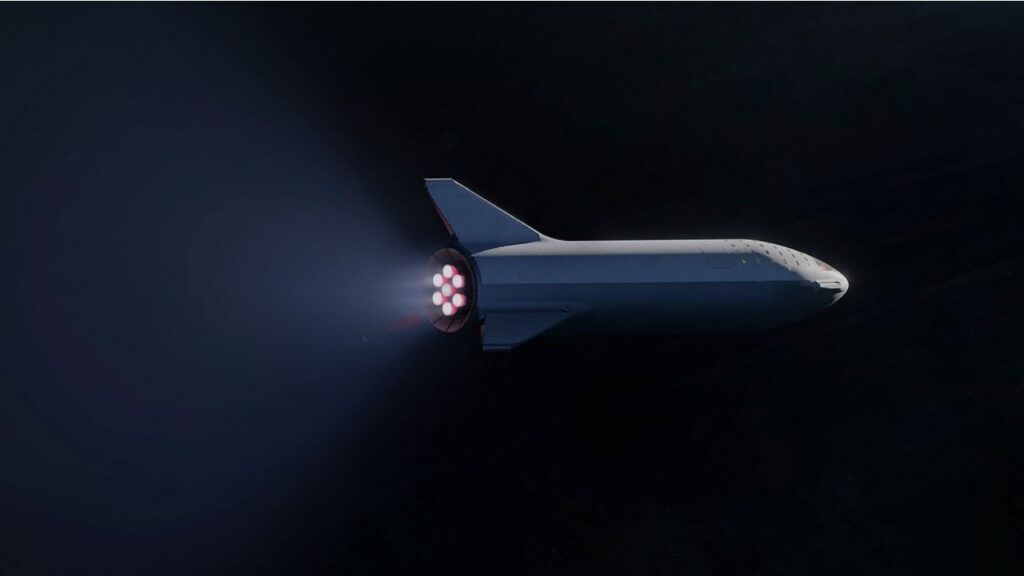
What are the real limits of SpaceX’s Starship? It’s a question that sparks debate every time this colossal spacecraft is mentioned. Designed by SpaceX to be fully reusable and capable of carrying massive payloads into orbit, Starship isn’t just another rocket—it’s a revolutionary vehicle that could define the future of humanity in space.
Recently, a team of world-class scientists shed new light on just how far Starship’s capabilities may extend. This analysis has led to a growing consensus: Starship is not just game-changing—it may be mission-critical for the future of deep space exploration.
The Scientific Backing: Why Starship Is More Than Hype
In a recent discussion featured on Fermat’s Library and amplified on social media platform X (formerly Twitter), three leading astrophysicists—Martin Elvis (Harvard-Smithsonian Center for Astrophysics), Charles Lawrence (NASA JPL), and Sara Seager (MIT)—revealed a compelling vision for Starship’s future.
Their paper makes one bold claim:
“Starship could accelerate astrophysics by decades.”
Even Elon Musk responded to this with a simple but powerful word: “Absolutely.”
This isn’t just about ambition—it’s grounded in what the scientific community urgently needs to avoid a potential crisis in space science.
The Looming Crisis in Astrophysics
Flagship Observatories Are Aging Fast
Today’s most powerful observatories—Hubble and Chandra—have provided decades of insights but are reaching the end of their life spans:
- Hubble, launched in 1990, is expected to end operations by the early 2030s.
- Chandra, launched in 1999, faces similar obsolescence and is often at risk during budget cuts.
Meanwhile, James Webb Space Telescope (JWST), launched in 2021, is groundbreaking—but it doesn’t cover all observation wavelengths.
The Observational Gap
Between 2030 and 2040, experts warn of a data gap, when old observatories shut down and next-gen telescopes—like LUVOIR, Origins, and Lynx—remain grounded.
Why? Budget constraints and logistical barriers.
NASA’s astrophysics budget has already been slashed by nearly two-thirds, dropping from $1.5 billion to just $500 million.
This is where Starship’s revolutionary design could become a saving grace.
Why Starship Is the Key to the Future
Unmatched Payload Capacity
Starship is built to carry over 100 metric tons to low Earth orbit (LEO). This far exceeds:
- Delta IV
- Atlas V
- Ariane 5
- Falcon 9
- NASA’s own Space Launch System (SLS) Block 1B
The Starship V3 variant is even more ambitious, projected to carry:
- 200+ metric tons to LEO
- 21 tons to Geostationary Transfer Orbit
- 18 tons to Sun-Earth L2 (a prime telescope location)
With in-orbit refueling, Starship could deliver 100+ tons of observatory equipment to the Moon, Mars, or deep space destinations.
Drastically Lower Launch Costs
One of Starship’s biggest innovations is cost-efficiency:
- Constructed from stainless steel
- Powered by methane and liquid oxygen
- Designed for full reusability
This brings the projected cost per launch down to just $2 million, compared to $150M–$500M for current rockets.
Such affordability could finally make it possible to launch massive telescopes even on limited budgets.
Starship’s Design Advantages for Science Missions
Massive Internal Volume
Starship offers an internal volume of 1,000 cubic meters in its early iterations—far larger than any existing rocket.
Future versions may offer up to 2,000 cubic meters, making it possible to:
- Launch entire telescopes fully assembled
- Avoid costly folding mechanisms
- Reduce the risk of in-orbit assembly failure
This simplifies engineering and allows for the use of less expensive materials like glass mirrors instead of beryllium.
Faster, Simpler Mission Deployment
- Higher launch frequency means observatories don’t have to wait years for a launch window.
- Simplified logistics mean lower risk and shorter development timelines.
- NASA and private companies gain schedule flexibility, speeding up mission timelines across the board.
Designing Around Starship—A New Standard
The paper’s authors urge NASA, academia, and aerospace companies to stop treating Starship as just another launcher and instead treat it as a platform.
Key recommendations include:
- Designing observatories to fit Starship’s dimensions
- Planning for in-orbit servicing, integration, and potential retrieval
- Embracing Starship-centric strategies to avoid a scientific “lost decade” in the 2030s
If these steps aren’t taken, there’s a real risk that other nations may leapfrog the U.S. in space science.
The Road Ahead – What SpaceX Still Needs to Accomplish
Technical Milestones
While Starship made progress with flights 7 and 8 in early 2025, they didn’t fully meet all mission benchmarks. Upcoming missions—flight 9 and beyond—are critical.
These need to:
- Prove successful orbit-to-landing sequences
- Validate thermal protection systems
- Demonstrate payload deployment accuracy
Infrastructure Development
SpaceX is rapidly upgrading its launch infrastructure:
- Starbase in Texas now features an improved orbital launch mount and flame trench.
- More launchpads and drone ships will be needed to handle high-frequency launches.
A new Star Factory in Boca Chica will significantly scale production with vertically integrated systems. However, expansion to Florida launch facilities is essential for redundancy and collaboration with NASA.
Orbital Refueling: The Final Frontier
A game-changing feature under development is in-orbit refueling, which will be essential for:
- Moon missions under NASA’s Artemis program
- Mars-bound crewed missions
- Delivering payloads far into the solar system
SpaceX aims to test this capability by 2026, opening the door to true interplanetary travel.
Artemis 3 and Beyond: The Real Tests Begin
The first major scientific milestone for Starship is Artemis 3, scheduled for 2027:
- Will use Starship as NASA’s Human Landing System (HLS)
- A successful moon landing would prove Starship’s reliability and reset global expectations
Next in line: Mars missions, both robotic and human. These will:
- Lay groundwork for multiplanetary life
- Provide critical data for deep space missions
- Cement SpaceX’s role in interplanetary science and exploration
Starship’s Utility Beyond Science
Military and Government Applications
Starship could become a strategic asset due to:
- Rapid deployment
- Gigantic cargo bay
- Low cost-per-launch
This makes it useful for defense logistics, earth observation, and even disaster response systems.
Commercial and International Opportunities
As Starship proves itself, we may see:
- International science payloads
- Commercial deep space missions
- Global partnerships for infrastructure and technology sharing
The Verdict—Starship Is More Than a Rocket
Starship represents the infrastructure humanity needs to truly scale into the solar system. Its unique blend of:
- Massive capacity
- Low cost
- Frequent launches
- High reliability
…makes it unlike anything before it.
Whether you’re passionate about space science, excited about Mars colonization, or simply curious about our future, one thing is clear:
Starship isn’t optional. It’s essential.
Final Thoughts
If SpaceX meets its goals, Starship will redefine space exploration, research, and even planetary defense.
But the timeline is tight. The next two years will be pivotal in proving Starship’s flight readiness, refueling capability, and launch cadence.
FAQs
1. What is SpaceX’s Starship and why is it significant?
Starship is SpaceX’s fully reusable, next-generation spacecraft designed to carry humans and cargo into space. Its large payload capacity, low cost, and reusability make it a potential game-changer for space exploration and astrophysics research.
2. How much payload can Starship carry into space?
Starship can carry over 100 metric tons to low Earth orbit (LEO). Future versions, like Starship V3, are projected to carry up to 200 metric tons—the most of any spacecraft ever built.
3. How does Starship compare to NASA’s SLS or Falcon 9?
Starship surpasses both NASA’s Space Launch System (SLS) and SpaceX’s Falcon 9 in terms of payload capacity, cost efficiency, and reusability. It’s designed to launch more frequently and more affordably, making it ideal for both science and commercial missions.
4. What role could Starship play in astrophysics?
Starship can launch next-generation space observatories like LUVOIR, Lynx, and Origins earlier and at lower costs. It may help prevent a scientific data gap as aging telescopes like Hubble and Chandra go offline.
5. Why is Starship important for the future of space telescopes?
Its huge internal volume and high payload capacity allow space telescopes to launch fully assembled, eliminating the need for complex folding systems or in-orbit construction, reducing both risk and cost.
6. How much does a Starship launch cost?
Estimates suggest that Starship launches could cost as little as $2 million per flight, thanks to its reusability and use of low-cost materials and fuel. This is significantly cheaper than traditional rockets, which can cost hundreds of millions per launch.
7. When will Starship be used for NASA missions?
Starship is scheduled to be used in NASA’s Artemis 3 mission in 2027 as the Human Landing System (HLS) to return astronauts to the Moon. Future missions could include Mars exploration and deep-space science missions.
8. What is orbital refueling and why does it matter?
Orbital refueling is the process of transferring fuel in space between spacecraft, allowing Starship to travel farther—to the Moon, Mars, or beyond. SpaceX aims to begin testing this by 2026.
9. Can Starship be used for non-scientific missions?
Yes. In addition to science, Starship has potential applications in military logistics, commercial satellite deployment, space tourism, and even emergency global transport systems.
10. What infrastructure does SpaceX need to support Starship?
SpaceX is building out infrastructure including launchpads, drone ships, refueling depots, and a Star Factory in Texas to mass-produce Starships. Expansion to Florida and global facilities is also underway.
11. What is the observational gap scientists are worried about?
Between 2030 and 2040, aging space telescopes may retire before their replacements are ready. Without new launches, there could be a decade-long gap in space-based scientific data—a problem Starship could help prevent.
12. What do scientists say about Starship’s future role?
Experts from Harvard, NASA, and MIT believe Starship could accelerate astrophysics by decades. They recommend that future observatories be designed around Starship’s capabilities to maximize scientific returns.
Read More:
- Disaster! China’s desperate attempt to COPY the Inside Starship…Musk laugh
- United Airlines debuts Starlink Wi-Fi on Detroit flight
- Tesla posts FSD demonstrations in Australia and France
- Tesla welcomes Chipotle President Jack Hartung to its Board of Directors
- Tesla Giga Berlin seems to be using FSD Unsupervised to move Model Y units