


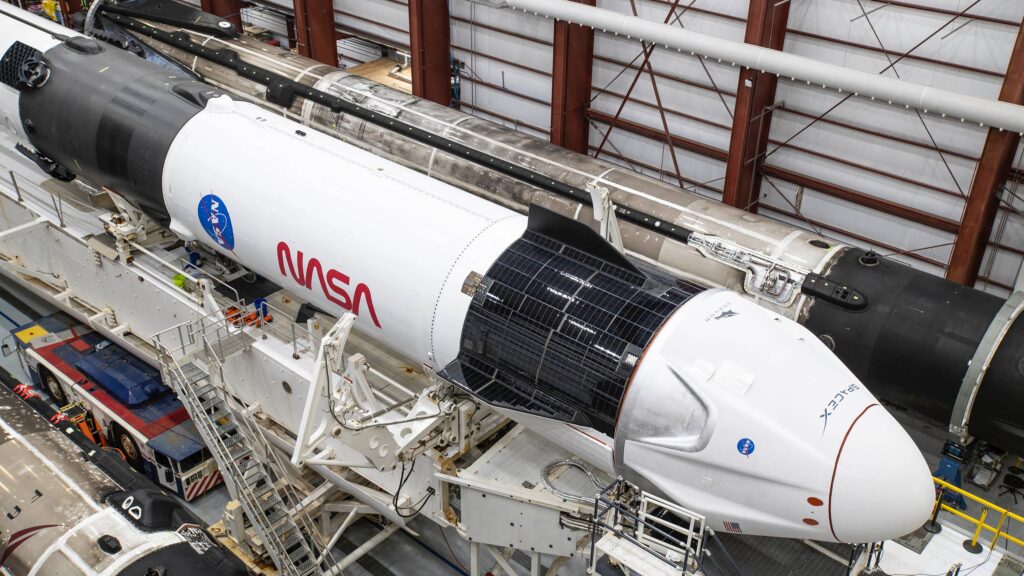
The space race is heating up again, and recent setbacks with SpaceX’s Starship version two have sparked serious doubts among experts about the United States’ ability to meet NASA’s Artemis 3 Human Landing System (HLS) deadline.
As China advances quietly but steadily with its lunar program, the pressure is mounting on NASA and its private partners. In a stunning development, a bold new plan has emerged: Elon Musk’s Superheavy booster might launch Blue Origin’s Blue Moon lander for a critical NASA mission. This unexpected collaboration could be one of the most audacious moves in aerospace history. But how realistic is this plan? Let’s dive deep.
The Artemis 3 Deadline: Can SpaceX Deliver?
Explosions and Failures Shake Confidence
After a series of explosions involving Starship version two, industry insiders are beginning to doubt whether SpaceX can meet the crucial Artemis 3 HLS deadline to land humans on the Moon by 2027—or even by 2030. The challenges are mounting, and each failed test flight chips away at confidence.
- SpaceX has now faced nine failed test flights related to the Starship upper stage.
- The failures primarily stem from problems with the orbital Starship vehicle, including re-entry issues and payload deployment malfunctions.
- The recent issue with Ship 36 added to the tally, making it a total of ten test flights with significant issues.
- Repairs at the Starbase facility in Boca Chica, Texas add 1 to 2 months of downtime before another test can even happen.
Critical Challenges Still Ahead
Even if Starship manages to reach orbit successfully, the spacecraft still needs to:
- Transfer hundreds of tons of cryogenic propellant between vehicles in orbit.
- Store cryogenic fuel for up to 100 days without boil-off.
- Land safely on the rugged lunar surface without tipping over or sustaining damage.
All these technical hurdles mean the Artemis HLS program faces inevitable delays, putting the U.S. at risk of losing the race back to the Moon.
China’s Steady Moon Ambitions
While the U.S. struggles, China’s National Space Administration (CNSA) has been making impressive, quiet progress:
- The Chang’e lunar program has completed several robotic missions.
- The Manga Crater spacecraft completed an uncrewed test flight in 2020.
- A full-scale prototype of the Lunar lander “Lua” is currently undergoing thermal and vacuum testing.
- The Long March 10 rocket, designed to support lunar missions, shows strong potential.
- CNSA aims to land two astronauts on the Moon before 2030, likely targeting 2029.
While this timeline is technically two years behind Artemis 3’s planned landing, NASA’s delays mean China could very well arrive first.
A Bold New Plan: Combining Forces to Beat China
The Proposal for Collaboration
In response to these setbacks, an editorial by American Space proposes a daring new strategy: instead of fierce competition, companies like SpaceX, Blue Origin, and United Launch Alliance (ULA) should join forces to leverage their unique strengths and get astronauts back to the Moon—more than 50 years after Apollo 17.
What Each Company Brings to the Table
SpaceX’s Superheavy Booster
- Has already demonstrated impressive launch and recovery capabilities.
- Successfully landed and was caught by Mechazilla (the launch tower’s mechanical arms) three times.
- Will soon be upgraded to a Block 3 variant featuring up to 33 Raptor 3 engines delivering around 9,240 tons of thrust.
- Capable of launching 180 to 200 tons to low Earth orbit (LEO) with full reusability, or up to 200 tons expendable.
Blue Origin’s Blue Moon Lander
- Has developed the Blue Moon Mark 1 lunar lander, expected to be ready for a moon landing as early as August or September 2025.
- The lander relies heavily on orbital refueling using hydrogen and oxygen propellants delivered by multiple tankers.
- Uses a reusable cis-lunar transport vehicle to transfer fuel to lunar orbit.
- Has a BE-7 engine with a solid specific impulse (ISP) of 453 seconds, offering efficient lunar descent and ascent.
United Launch Alliance (ULA)
- Provides the highly efficient Centaur 5 upper stage, known for its exceptional fuel efficiency.
- Though Centaur 5 uses most of its fuel just to reach orbit when launched on a Vulcan rocket, in this proposed plan, it would serve as the Earth Departure Stage (EDS).
- This means it would push the lunar lander directly toward the Moon, greatly enhancing mission efficiency.
How the Proposed Mission Architecture Could Work
Step 1: Launching the Stack
- As the Artemis 3 launch window approaches, a Superheavy Block 3 booster would launch a stack into low Earth orbit.
- The stack consists of a fully fueled Centaur 5 upper stage (acting as the Earth Departure Stage) and the Blue Moon Mark 2 lander mounted on top.
- This replaces the traditional Starship upper stage with Centaur 5, supported by Blue Moon for lunar landing.
Step 2: Blue Moon’s Lunar Journey
- To make this possible, Blue Origin would reduce about 3 tons of dry mass from the Blue Moon lander.
- This slimming down allows the Centaur 5 to push the lander directly to the Moon without requiring orbital refueling.
- Once arriving in a near-rectilinear halo orbit (NRHO), Blue Moon would prepare for descent.
Step 3: Artemis 3 Crew Launch
- The Artemis 3 astronauts would launch aboard Orion, carried by the Space Launch System (SLS) rocket.
- Orion would dock directly with Blue Moon in lunar orbit, bypassing the Gateway Space Station, which was reportedly dropped from the program due to budget cuts.
- Blue Moon then lands two astronauts on the lunar surface to complete their mission objectives.
Step 4: Return Trip
- After completing their lunar mission, the astronauts return to Orion aboard Blue Moon.
- Orion carries them safely back to Earth.
The Technical Feasibility of the Plan
Payload Capacity and Launch Requirements
- Superheavy, in an expendable configuration, can launch up to 200 tons.
- The combined fully fueled stack (Centaur 5 + Blue Moon) weighs just over 107 tons, well within Superheavy’s maximum capacity.
- This means even a reusable Superheavy booster could manage the mission, dramatically reducing costs.
Centaur 5’s Efficiency
- Powered by four RL10 engines (a design that dates back over 50 years but still highly efficient).
- Has a specific impulse of around 460 seconds, excellent for deep space maneuvers.
- Dry mass of 5.5 tons carrying about 54 tons of propellant.
- Capable of performing the Trans-Lunar Injection (TLI) burn requiring about 3,200 m/s delta-V.
Blue Moon Mass Constraints
- To work within this architecture, Blue Moon’s dry mass must not exceed 12,500 kg.
- Since most of its weight is propellant, slimming the dry mass is critical.
- The BE-7 engine’s ISP of 453 seconds supports the lander’s mission profile for landing, surface operations, and ascent back to NRHO.
Modifications Needed for Superheavy
- Superheavy’s hot staging ring, currently optimized for Starship, would need redesigning to fit the Centaur 5’s tail.
- This modular ring must detach cleanly around 80 km altitude during stage separation.
- SpaceX is already developing a Block 3 variant of Superheavy with three grid fins instead of four, reducing weight while maintaining control.
Current Issues with Starship’s Upper Stage
The existing Starship upper stage suffers from excessive weight due to:
- Stainless steel heat shield tiles.
- Systems needed for full reusability.
- This weight reduces its overall performance, forcing SpaceX to cut propulsion system parts, which may contribute to leaks, fires, and engine failures.
The Importance of the Tanker Version and Refueling
- SpaceX is focusing heavily on orbital refueling technology with the Starship tanker variant.
- Elon Musk confirmed an orbital refueling demonstration could happen as soon as next year.
- This refueling capability is mission-critical not only for lunar landings but also for Mars exploration.
- However, for the proposed Superheavy-Centaur-Blue Moon mission, the goal is to avoid complex orbital refueling to reduce risk.
What This Means for NASA and the U.S. Space Race
- SpaceX has received at least $2.6 billion from NASA for HLS contracts.
- Despite setbacks, SpaceX remains committed to delivering on lunar landing obligations.
- NASA still controls key mission elements like the SLS rocket and Orion spacecraft.
- The U.S. has a 5-year head start over China in lunar mission development.
- But time is running out: estimates suggest China could attempt its lunar landing within four years.
Why Collaboration Could Be the Key to Winning
- Combining Superheavy’s raw launch power, Blue Moon’s landing capabilities, and ULA’s efficient upper stage could speed up lunar return.
- This plan could succeed without the need for a brand-new NASA program or Apollo-level spending.
- Political will and rapid decision-making are required to move forward.
- Working together as a nation and with private companies will be essential to secure the U.S.’s future in space.
Conclusion: The Race to the Moon Is on
With the US facing growing challenges in SpaceX’s Starship development and China’s steady lunar progress, the stakes are high. The proposed Superheavy + Centaur 5 + Blue Moon collaborative mission architecture offers a promising path to meeting the Artemis 3 deadline and returning humans to the Moon before 2029.
It’s a bold, innovative, and ambitious plan—one that could reshape the future of space exploration and ensure America’s leadership among the stars.
FAQs
1. What caused doubts about SpaceX meeting the Artemis 3 lunar landing deadline?
SpaceX has faced multiple Starship test flight failures, delays in repairs, and technical challenges with orbital refueling and safe lunar landings, raising concerns about meeting the 2027 Artemis 3 deadline.
2. How is China progressing in the lunar race compared to the US?
China’s space agency, CNSA, has successfully tested lunar spacecraft and landers, with plans to land astronauts on the Moon by 2029, potentially beating the US despite a later timeline.
3. What is the new collaboration plan involving SpaceX, Blue Origin, and ULA?
The plan proposes combining SpaceX’s Superheavy booster, Blue Origin’s Blue Moon lunar lander, and ULA’s Centaur 5 upper stage to create a unified mission architecture capable of landing astronauts on the Moon efficiently.
4. What role does SpaceX’s Superheavy booster play in the new plan?
Superheavy provides the raw launch power, capable of delivering up to 200 tons to low Earth orbit, making it suitable for launching the combined Centaur 5 and Blue Moon lander stack.
5. Why is Blue Origin’s Blue Moon lander important in this mission?
Blue Moon is a sophisticated lunar lander designed to carry astronauts to the Moon’s surface, and the new plan involves slimming its mass to allow direct lunar transfer without complex orbital refueling.
6. How does ULA’s Centaur 5 upper stage contribute to the mission?
Centaur 5 would act as the Earth Departure Stage, performing the critical Trans-Lunar Injection burn to send Blue Moon from low Earth orbit to the Moon efficiently.
7. What technical challenges does this collaboration face?
Key challenges include redesigning the Superheavy staging ring for Centaur 5, reducing Blue Moon’s dry mass, and ensuring safe docking and lunar landing operations within mission constraints.
8. Can the Superheavy booster be reused for this mission?
Yes, although using an expendable Superheavy is possible, a reusable Block 3 Superheavy with modifications could launch the mission, greatly reducing costs.
9. Why is orbital refueling such a critical issue?
Orbital refueling is technically complex but necessary for some lunar missions; the new plan aims to avoid this by slimming down the lander and leveraging the Centaur 5 stage’s efficiency.
10. How does this plan affect NASA’s Artemis program timeline?
If successful, the collaboration could allow NASA to land astronauts on the Moon before 2029 without requiring a completely new program, potentially maintaining US leadership in the space race.
11. What advantages does NASA still have over China?
NASA benefits from a 5-year head start, the powerful Space Launch System (SLS), the Orion crew capsule, and private sector partnerships, despite current challenges.
12. What is the significance of the Gateway Space Station in this mission?
Recent budget updates suggest the Gateway Station may be dropped from Artemis 3, simplifying the mission by having Orion dock directly with the lunar lander in orbit.
Read More:
- Tesla investors will be shocked by Jim Cramer’s latest assessment
- Tesla China registrations hit 20.7k in final week of June, highest in Q2
- Tesla sees explosive sales growth in UK, Spain, and Netherlands in June
- Elon Musk hints at when Tesla could reduce Safety Monitors from Robotaxi
- Tesla launches ultra-fast V4 Superchargers in China for the first time