


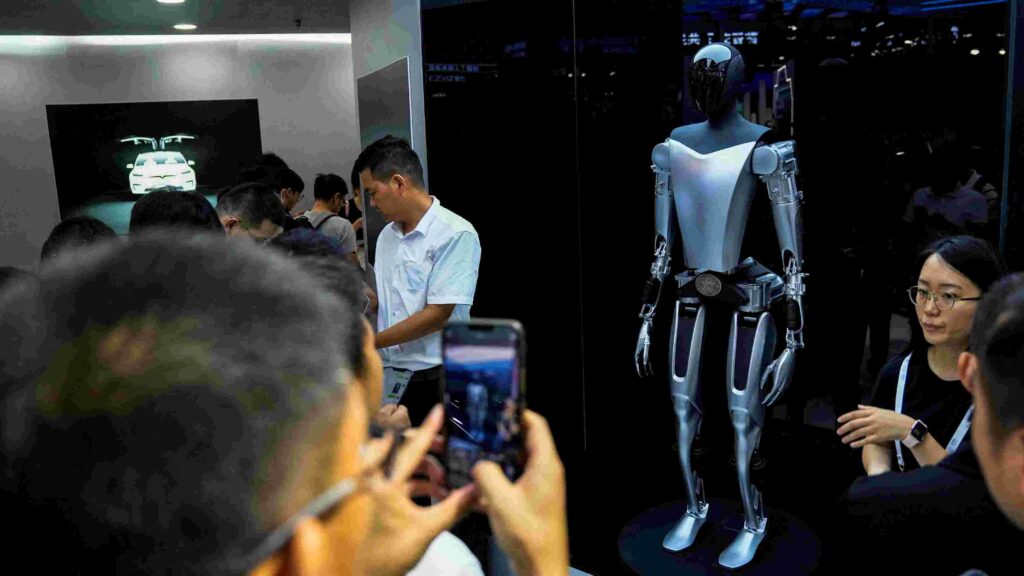
The race toward humanoid robotics is no longer science fiction. With the development of Tesla Bot Optimus, Elon Musk is attempting to transform artificial intelligence and robotics into the most valuable product Tesla has ever created.
According to Musk, Tesla could eventually manufacture each Optimus robot for around $10,000, while selling it for approximately $50,000 in the early stages. If achieved, this would represent one of the largest gross margins in modern hardware history.
But how realistic is this claim? And can Optimus truly become a household robot that changes the global economy?
Let’s break it down.
Tesla Optimus: From Factory Floor to Global Digital Workforce
Unlike traditional industrial robots bolted to factory floors, Optimus is designed to move like a human, think using AI, and operate in real-world environments.

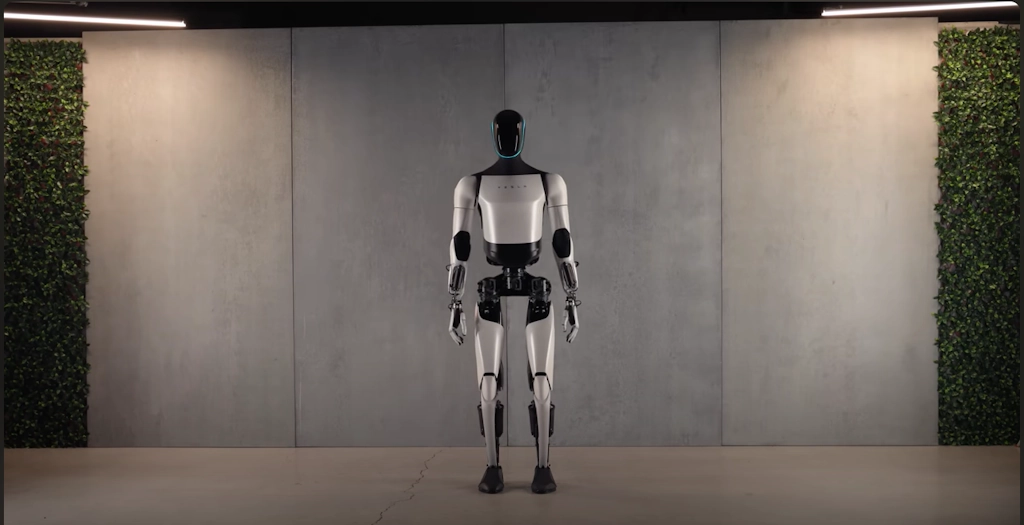
Most factory robots today are fixed machines built for repetitive, controlled tasks. Optimus is different.
It is powered by the same artificial intelligence architecture Tesla uses for Full Self-Driving (FSD). That means Tesla is effectively reusing its EV AI platform to create what could become a 24/7 digital labor force.
This is a massive shift in robotics.
Instead of programming every movement manually, Optimus learns from:
- Real-world video data
- Neural networks trained on Tesla vehicle fleets
- End-to-end AI systems
The result? A humanoid robot that can potentially:
- Work in factories
- Assist in warehouses
- Perform household chores
- Care for children and the elderly
And eventually… perhaps even work in space.
The $10,000 Manufacturing Target: Vision or Reality?
Early prototypes of Optimus — including Generation 2 and 2.5 — were far from cheap.
Analysts estimated material costs between:
- $46,000
- Up to $60,000 per robot
Why so expensive?
Because humanoid robots require:
- High-precision actuators
- Harmonic reducers
- Advanced servo motors
- Highly dexterous robotic hands
These components are extremely costly today.
Reaching a $10,000 production cost is not just about mass production. It requires:
- Custom component redesign
- New manufacturing processes
- Supply chain optimization
- Massive economies of scale
Musk has admitted that this goal will be extremely difficult — but not impossible.
Tesla has a history of driving down costs in batteries, motors, and vehicle manufacturing. The company believes it can do the same with robotics.
China’s Role in Lowering Optimus Costs
To achieve aggressive cost reductions, Tesla has relied heavily on Chinese suppliers.
Reports suggest that 50–70% of Optimus core components — including actuators and motors — are sourced from China.
Some key partners include:
- Zhejiang Sanhua Intelligent Controls
- Ningbo Tuopu Group
Chinese components can be 30–50% cheaper than comparable Western alternatives due to:
- Large-scale manufacturing
- Government subsidies
- Deep robotics expertise
- Mature supply ecosystems
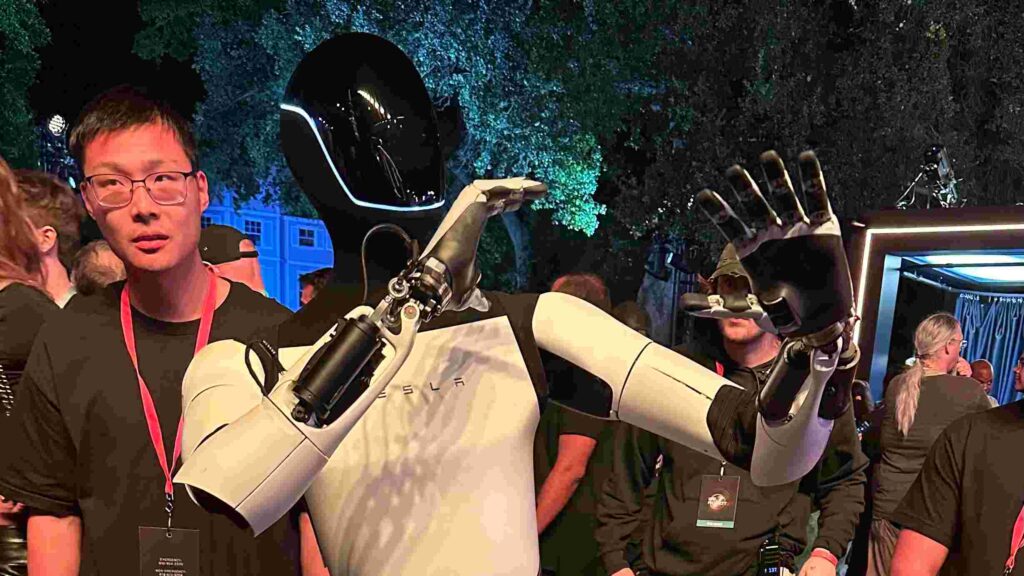
This strategy mirrors how companies like Apple Inc. leverage Chinese partners to manufacture products like the iPhone at scale.
⚠️ The Risk Factor
However, this dependency creates vulnerabilities:
- Trade disputes
- Export restrictions
- Geopolitical tensions
- Supply chain disruptions
If Chinese components were removed from the supply chain, production costs could potentially rise to over $130,000 per robot — making the $20,000 long-term pricing target nearly impossible.
Tesla plans to gradually localize supply chains, but this transition could take years.
Production Shift: From Cars to Robots
Tesla is launching Optimus production at its Fremont factory in California.
This represents a major strategic pivot.
Musk has indicated plans to reduce or halt production of the Model S and Model X at Fremont to make room for Optimus Gen 3 manufacturing.
Fremont is Tesla’s highest output plant in North America and offers:
- Existing infrastructure
- Skilled manufacturing workforce
- Proximity to Silicon Valley talent
Eventually, large-scale production may expand to Giga Texas, where Tesla aims to reach 1 million robots per year.
Interestingly, this pivot is not expected to cause mass layoffs. Instead, Musk suggests it could create new roles in:
- Robot supervision
- Fleet management
- AI operations
Why $50,000 Is Still a Bargain
The initial selling price for Optimus Gen 3 is expected to be around $50,000 or more.
While that sounds expensive, consider this:
The average selling price of humanoid robots today often exceeds $100,000.
If Optimus can:
- Work 24 hours a day
- Replace repetitive factory labor
- Reduce injury risks
- Deliver consistent productivity
Then the return on investment could justify the price.
For industrial customers, the math becomes compelling.
A robot that operates 24/7 without breaks, insurance, or fatigue could pay for itself within a few years.
Public Launch Timeline: Why the Delay Until 2027?
Although Optimus Gen 3 is set for limited production, wide public release likely won’t happen until late 2027.
According to Elon Musk’s remarks at the World Economic Forum, humanoid robots require a much higher safety threshold than cars.
Cars operate under human supervision.
Optimus operates around humans autonomously.
Throughout 2026, Tesla plans to deploy Optimus exclusively in its own factories to:
- Collect real-world data
- Improve movement reliability
- Refine environmental awareness
- Enhance decision-making
Nearly every core system in Gen 3 — including actuators, hands, and AI5 hardware — is brand new.
Historically, products with this many new components ramp slowly.
Safety and reliability must come first.

Can Optimus Really Help at Home?
Musk frequently discusses Optimus as more than just a factory robot.
He envisions it helping with:
- Elder care
- Child supervision
- Pet monitoring
- Household chores
Elder Care Potential
Global populations are aging rapidly.
Families face rising healthcare costs and limited availability of caregivers.
Optimus could potentially:
- Assist with mobility
- Detect falls
- Remind patients to take medication
- Provide companionship
Loneliness among seniors is a growing crisis. A robot assistant that offers interaction and monitoring could be transformative.
Child & Pet Safety
Optimus is not meant to replace parents.
Instead, it could:
- Supervise children while adults are busy
- Monitor for safety risks
- Feed and walk pets
- Alert owners of emergencies
However, Musk has stressed that home robots must include hardware-level safety constraints that prevent AI override of human authority.
Trust will be everything.
Optimus in Space: Moon Before Mars
In a surprising shift, Elon Musk has stated that his priority has moved from Mars to the Moon.
Optimus Gen 3 could potentially be launched aboard spacecraft developed by SpaceX.
This echoes Tesla’s 2018 publicity moment when a Roadster was sent into space on a Falcon Heavy rocket.
Why send a humanoid robot to the Moon?
Because building a self-sustaining lunar base is far more achievable in the near term than colonizing Mars.
Optimus could:
- Collect planetary data
- Build infrastructure
- Analyze minerals
- Scout for subsurface water ice
- Operate in extreme temperatures
Unlike traditional rovers like NASA’s Perseverance, which move slowly and rely on specific terrain constraints, Optimus can:
- Walk at over 3 mph
- Use bipedal motion
- Manipulate tools
- Adapt using neural networks
Its 22 degrees of freedom in each hand allow for complex manipulation.
Its AI system processes camera input directly into action — ideal for unpredictable environments where pre-programming every scenario is impossible.
The Battery Problem on the Moon
One major challenge remains: power.
On Earth, Optimus can recharge.
On the Moon?
There are no charging stations.
Potential solutions could include:
- Solar charging arrays
- Swappable battery modules
- Nuclear-based compact energy systems
- Wireless power transmission
If Tesla solves the energy problem, Optimus could become the first scalable humanoid robotic explorer.
AI Risks and Musk’s Warning
Despite pushing AI aggressively, Elon Musk remains one of its most vocal critics.
He has repeatedly warned that AI development must be handled with extreme caution.
He often references the dangers of runaway AI systems — even joking about not wanting to wake up in a scenario resembling a film like The Terminator.
This dual stance — builder and critic — defines Musk’s approach:
- Accelerate innovation
- But maintain strict safeguards
Will Optimus Really “Sell Like Hotcakes”?
At $50,000, Optimus could generate enormous profit margins if production costs truly fall to $10,000.
If Tesla reaches:
- 1 million units per year
- $40,000 gross margin per unit
That equals $40 billion in annual gross profit from robots alone.
And if the price drops to $20,000 with even lower manufacturing costs at scale?
Optimus could become:
- Tesla’s most important product
- A global labor disruptor
- A new economic category
The market is watching every move Tesla makes.
Final Thoughts: A Hopeful Future or Over-Optimism?
Elon Musk has a history of ambitious timelines — and missing some of them.
Skepticism is healthy.
But it’s also true that Tesla has repeatedly achieved what many considered impossible.
Optimus represents more than a robot.
It represents:
- A new labor model
- A new manufacturing challenge
- A new AI frontier
- A potential humanitarian tool
Whether it becomes a $50,000 luxury industrial machine or a $20,000 household assistant for millions remains to be seen.
But one thing is certain:
If Tesla successfully manufactures Optimus at scale for $10,000 per unit, it could fundamentally reshape the global economy — on Earth and perhaps even beyond it.
And if Musk’s optimistic vision holds true, the age of humanoid robots working alongside humans may arrive much sooner than we think.
FAQs
1. What is Tesla Bot Optimus?
Tesla Bot Optimus is a humanoid robot developed by Tesla, Inc. under the leadership of Elon Musk. It is designed to perform real-world tasks in factories, warehouses, homes, and potentially even in space.
2. How much will Optimus cost?
The initial selling price of Optimus Gen 3 is expected to be around $50,000, with a long-term target price between $20,000 and $30,000 once mass production reaches scale.
3. How much does it cost Tesla to manufacture Optimus?
Elon Musk has suggested that Tesla aims to reduce production costs to approximately $10,000 per robot. However, early prototypes reportedly cost between $46,000 and $60,000 due to expensive components.
4. Why is Tesla confident it can lower the cost to $10,000?
Tesla plans to leverage:
- Mass production at scale
- Vertical integration
- AI hardware optimization
- Lower-cost component sourcing
The company has previously reduced costs dramatically in electric vehicles and battery production.
5. Where will Optimus be manufactured?
Initial production is launching at Tesla’s Fremont factory, with large-scale expansion expected at Giga Texas in Austin.
6. When will Optimus be available to the public?
Limited production is expected in 2026 for internal factory use. A broader public release may not happen until late 2027, pending safety and reliability validation.
7. What makes Optimus different from other humanoid robots?
Unlike most humanoid robots priced above $100,000, Optimus:
- Uses Tesla’s Full Self-Driving AI platform
- Is designed for mass production
- Aims for dramatically lower pricing
- Learns through neural networks rather than rigid programming
8. What tasks can Optimus perform?
Optimus is designed to:
- Handle repetitive factory work
- Move materials in warehouses
- Perform household chores
- Assist elderly individuals
- Monitor children and pets
Future versions may handle far more complex tasks.
9. Can Optimus really help with elder care?
According to Elon Musk, Optimus could:
- Assist with mobility
- Detect falls
- Provide medication reminders
- Offer companionship
This could address growing global challenges related to aging populations.
10. Is Optimus safe to use around humans?
Tesla emphasizes hardware-level safety mechanisms to prevent AI override of human control. Extensive factory testing is planned before public release to ensure reliability.
11. Why is Tesla using Chinese suppliers?
Many components, including actuators and motors, are sourced from China because they are significantly cheaper and benefit from mature manufacturing ecosystems.
Key suppliers reportedly include:
- Zhejiang Sanhua Intelligent Controls
- Ningbo Tuopu Group
12. Does relying on China create risks?
Yes. Trade disputes, export controls, or geopolitical tensions could disrupt supply chains and increase production costs significantly.
13. How does Optimus learn tasks?
Optimus uses Tesla’s AI system, similar to what powers its autonomous driving technology. Neural networks process visual data from cameras and convert it directly into actions using end-to-end learning.
14. Could Optimus work on the Moon or Mars?
Elon Musk has suggested that Optimus could eventually operate in space, potentially launched via SpaceX missions. Its humanoid form allows it to use tools and infrastructure designed for humans.
15. How would Optimus be powered in space?
Possible solutions include:
- Solar charging systems
- Swappable battery packs
- Nuclear-based compact energy sources
Energy management remains one of the biggest technical challenges for space deployment.
16. Will Optimus replace human workers?
Optimus is primarily intended for repetitive, dangerous, or physically demanding tasks. Tesla argues that it could increase overall productivity and create new types of jobs related to robot supervision and management.
17. Could Optimus become Tesla’s most important product?
Elon Musk has repeatedly stated that humanoid robots could eventually surpass Tesla’s electric vehicles in importance and revenue. If Tesla achieves production of 1 million robots per year, Optimus could become the company’s largest profit driver.
Read More:
- SpaceX Drops Bombshell Upgrade on Starship Flight 12 Stunned Everyone!
- Tesla seeks approval to test FSD Supervised in new Swedish city
- SpaceX targets 150Mbps per user for upgraded Starlink Direct-to-Cell
- Tesla Cybertruck Dual Motor AWD estimated delivery slips to early fall 2026
- Tesla Model S and X customization options begin to thin as their closure nears
- Tesla set to activate long-awaited Cybertruck feature