


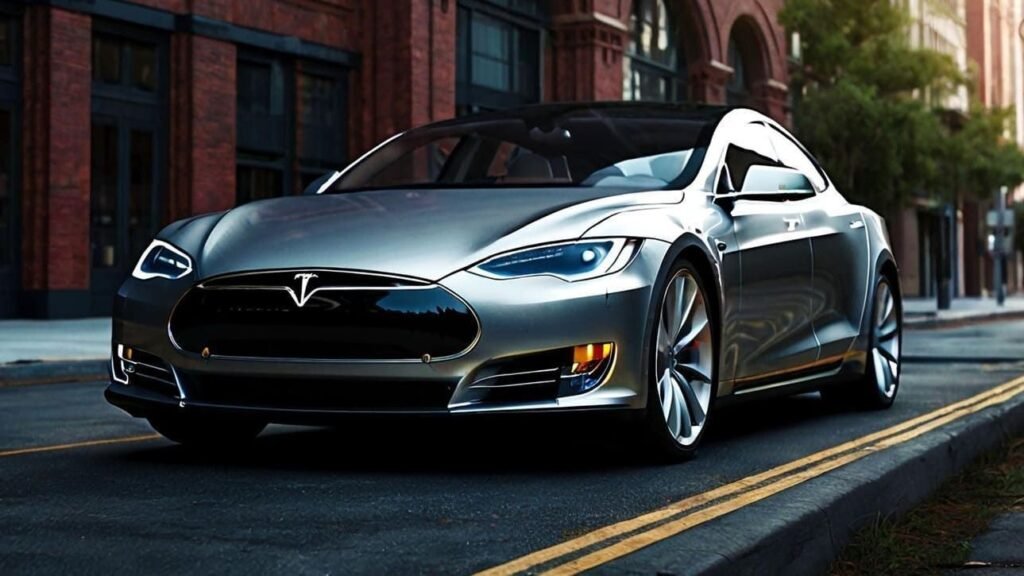
The year 2026 represents a turning point for Tesla. Once the undisputed leader of the global electric vehicle (EV) revolution, the company now finds itself navigating unfamiliar territory. Sales are softening, stock performance has dipped by around 20%, and global competition—especially from Chinese automakers—is stronger than ever.
At the center of Tesla’s comeback strategy is the highly anticipated Model 2, a compact electric SUV targeted at an aggressive $25,000 price point. This vehicle isn’t just another addition to Tesla’s lineup—it’s a bold attempt to redefine how cars are manufactured, priced, and sold at scale.
But beneath the excitement lies a controversial engineering decision that could significantly impact consumers. While Tesla’s innovative Gigacasting technology promises billions in savings, it also introduces a potential downside: repair costs that could skyrocket after even minor accidents.
The Strategic Importance of the Tesla Model 2
Why Tesla Needs the Model 2
Tesla’s pivot toward the Model 2 reflects a shift in market demand. For years, the company focused on premium EVs and futuristic projects like robotaxis. However, the global EV market has matured, and affordability is now the primary driver of adoption.
The Model 2 is designed to meet this demand by offering:
- A compact SUV form factor
- A length of approximately 4.28 meters
- Urban-friendly maneuverability
- A significantly lower price than the Model 3 and Model Y
This is not simply a cheaper version of an existing model. Instead, Tesla has built the Model 2 from the ground up, optimizing every component for cost efficiency and mass production.
Competing in a New EV Landscape
Tesla is no longer competing in a vacuum. Automakers from China, including BYD, Xiaomi, and XPeng, are producing high-quality EVs at competitive prices. These companies benefit from strong supply chains and lower production costs, forcing Tesla to innovate aggressively to stay relevant.
Gigacasting: Tesla’s Revolutionary Manufacturing Approach
What is Gigacasting?
At the heart of the Model 2 lies Gigacasting, a manufacturing technique that replaces dozens of individual components with a single cast piece of aluminum.
Traditionally, car manufacturing involves assembling:
- 70–100 individual metal parts
- Extensive welding and fastening
- Time-consuming assembly processes
With Gigacasting, Tesla simplifies this dramatically:
- A single large casting replaces multiple parts
- Production time is reduced from hours to minutes
- Labor and material costs drop significantly
Manufacturing Efficiency Breakdown
| Metric | Traditional Manufacturing | Tesla Gigacasting |
|---|---|---|
| Number of Parts | 70–100 components | 1 solid structure |
| Assembly Process | Complex welding & riveting | Single mold casting |
| Cost Savings | Standard | ~$1,500 per vehicle |
The $3 Billion Advantage
While saving $1,500 per vehicle may seem modest, the scale changes everything. Tesla aims to produce 2 million Model 2 units annually, which translates into:
- $3 billion in yearly savings
- Improved profit margins
- The ability to offer a $25,000 EV profitably
This is a game-changing advantage in a market where price competitiveness is critical.
The Engineering Trade-Off: Integration vs Repairability
Understanding the “Crash Can”
In traditional vehicles, the crash can acts as a mechanical fuse. It absorbs energy during low-speed impacts (typically under 25 km/h) and protects the vehicle’s main structure.
Key characteristics of conventional crash cans:
- Bolted onto the frame
- Easily replaceable
- Repair costs typically under $1,000
Tesla’s Radical Design Choice
In the Model 2, Tesla integrates the crash can directly into the Gigacast structure. This means:
- The crash can is not removable
- It becomes part of the vehicle’s main frame
Why This Matters
This design leads to a critical issue:
- Minor collisions can transfer energy across the entire structure
- Damage is no longer isolated to a small, replaceable part
Real-World Impact
In practical terms:
- A small rear-end bump that costs $800 to fix on a traditional car
- Could cost $10,000 or more on a Gigacast Tesla
This is the core dilemma: Tesla saves money in manufacturing, but consumers may pay the price later in repairs.
The Hidden Costs: Insurance and Ownership
Insurance Premium Increases
Insurance companies are already reacting to Gigacasting data from existing Tesla models. Early projections suggest:
- Annual premiums could rise by $400–$600
- Higher repair costs increase insurer risk
Five-Year Ownership Impact
Over a typical ownership period:
- Additional insurance costs: $2,000–$3,000
- In high-risk regions: up to $5,000
This effectively raises the real cost of ownership by as much as 20%.
Resale Value Concerns
Another hidden consequence is depreciation:
- Buyers in the used car market may avoid vehicles with high repair risks
- Gigacast vehicles could lose value faster than competitors
The Chinese Counter-Strategy: A Smarter Balance?
Modular Design Philosophy
Chinese automakers are taking a different approach. Instead of fully integrating large structural components, they are:
- Using partial casting
- Keeping impact zones modular and replaceable
This hybrid strategy offers:
- Lower repair costs
- Easier maintenance
- Better long-term ownership value
Supply Chain Advantages
Chinese EV manufacturers also benefit from:
- Strong control over lithium-ion battery supply chains
- Lower production costs in electronics
- Government support and infrastructure
These advantages reduce the need for extreme manufacturing shortcuts like full Gigacasting integration.
Global Competition Dynamics
Tesla still maintains an advantage in markets like the United States due to tariffs and brand loyalty. However, in regions such as:
Consumers are becoming more cost-conscious and are evaluating:
- Total Cost of Ownership (TCO)
- Repair costs
- Insurance premiums
In these markets, Tesla’s strategy faces stronger resistance.
Is the $25,000 Price Tag Misleading?
Breaking Down the True Cost
At first glance, the Model 2 appears to be a breakthrough:
- Affordable entry price
- Advanced technology
- Tesla brand appeal
However, when factoring in hidden costs:
- Higher insurance premiums
- Expensive repairs
- Faster depreciation
The total cost could rise significantly beyond the initial sticker price.
A Risk-Reward Equation
Buyers will need to weigh:
Pros:
- Lower upfront cost
- Cutting-edge manufacturing
- Tesla ecosystem and software
Cons:
- Potentially massive repair bills
- Higher insurance costs
- Uncertain resale value
The Bigger Picture: Innovation vs Practicality
Tesla’s approach highlights a broader industry debate:
- Should automakers prioritize manufacturing efficiency?
- Or focus on long-term ownership affordability?
Gigacasting is undeniably a technological breakthrough. It simplifies production, reduces costs, and enables mass-market EV adoption. However, it also shifts some of the financial burden from the manufacturer to the consumer.
Conclusion: Will the Tesla Model 2 Succeed?
The Tesla Model 2 is one of the most important vehicles in the company’s history. It represents a bold attempt to democratize electric mobility while maintaining profitability.
From an engineering standpoint, it is a masterpiece. From a consumer perspective, it introduces new uncertainties.
Ultimately, the success of the Model 2 will depend on a simple question:
Is a $25,000 price tag enough to justify the risk of a $10,000 repair bill?
If consumers embrace the trade-off, Tesla could reclaim its dominance in the EV market. If not, competitors with more balanced designs may gain the upper hand.
As 2026 unfolds, the Model 2 will serve as a real-world test of whether radical innovation can align with everyday practicality—or whether the future of EVs lies somewhere in between.
FAQs
1. What is the Tesla Model 2?
The Tesla Model 2 is an upcoming compact electric SUV expected to launch in 2026 with a starting price of around $25,000, making it Tesla’s most affordable EV.
2. Why is the Model 2 so important for Tesla?
The Model 2 is crucial because it targets the mass market, helping Tesla compete with affordable EVs from companies like BYD and XPeng.
3. What is Gigacasting in Tesla vehicles?
Gigacasting is a manufacturing process where Tesla uses large casting machines to create major parts of the car as a single aluminum piece, reducing complexity and cost.
4. How much money does Gigacasting save Tesla?
Tesla saves about $1,500 per vehicle, which could translate to nearly $3 billion annually if production reaches 2 million units per year.
5. Why is Gigacasting controversial?
While it reduces manufacturing costs, it also makes repairs more expensive, especially after minor accidents, because large sections are integrated rather than replaceable.
6. What is a crash can in a car?
A crash can is a safety component designed to absorb impact during low-speed collisions, protecting the main structure of the vehicle.
7. How is Tesla’s crash can different in the Model 2?
In the Model 2, the crash can is integrated into the main structure, meaning it cannot be easily replaced like in traditional vehicles.
8. Why can repairs be so expensive in Gigacast vehicles?
Because damage can spread across the entire cast structure, even a small dent may require replacing or repairing a large section, costing up to $10,000 or more.
9. How will insurance costs be affected?
Insurance premiums for Gigacast Teslas could increase by $400–$600 per year due to higher repair risks.
10. What is the total cost impact over time?
Over five years, owners may pay an extra $2,000–$5,000 in insurance and related costs, increasing the total cost of ownership.
11. Will the Model 2 have lower resale value?
Possibly yes. Concerns about high repair costs may lead to faster depreciation in the used car market.
12. How are Chinese automakers approaching this differently?
Companies like BYD and XPeng use a hybrid design, combining casting with modular components to keep repairs cheaper and easier.
13. Is the $25,000 price tag misleading?
It can be, because hidden costs like insurance and repairs may significantly increase the real ownership cost.
14. What are the main advantages of the Tesla Model 2?
Key benefits include affordability, advanced technology, efficient manufacturing, and access to Tesla’s software ecosystem.
15. Should you buy the Tesla Model 2?
It depends on your priorities. If you value a low upfront cost and cutting-edge tech, it’s appealing—but if you’re concerned about long-term repair and insurance costs, you may want to compare alternatives.
Read More:
- 2026 3 NEW INSANE 4.0 Tesla Tech Destroys ALL EVs Industry
- Tesla begins probing owners on FSD’s navigation errors with small but mighty change
- Tesla Model Y L gets biggest hint yet that it’s coming to the U.S.
- Tesla wins big as NHTSA drops three-year, 120k unit probe against Model Y
- Starship Flight 12 Launch DELAYED Cause of Major PROBLEM…What Exactly Went Wrong?