


SpaceX is that much closer to launching their next-gen Starship after completing today’s full duration static fire out of Starbase, Texas. This marks a direct signal that Flight 12, the maiden voyage of Starship V3, is imminent. SpaceX confirmed the test on X, posting that the full duration firing was completed ahead of the vehicle’s next flight test.
The road to today started on March 16, when Booster 19 completed a shorter 10-engine static fire, also at the newly constructed Pad 2. That test ended early due to a ground systems issue but confirmed all installed Raptor 3 engines started cleanly. Booster 19 returned to the Mega Bay, received its remaining 23 engines for a full complement of 33, and rolled back out this week for the complete test campaign. Musk confirmed earlier this month that Flight 12 is now 4 to 6 weeks away.
Countdown: America is going back to the Moon and SpaceX holds the key to what comes after
The numbers behind the world’s most powerful rocket are genuinely hard to put in context. Each Raptor 3 engine produces roughly 280 tons of thrust, and with all 33 firing simultaneously from the super heavy booster, this generates approximately 9,240 tons of combined thrust, more than any rocket in history. For context, that’s enough thrust to lift the entire Empire State Building, and then some. V3 stands 408 feet tall and can carry over 100 tons to low Earth orbit in a fully reusable configuration. The V2 generation topped out at around 35 tons.
Historically, a successful full-duration static fire is the last major ground milestone before launch. SpaceX has followed this pattern with every Starship iteration since the program began in 2023. Musk has been direct about the ambition behind all of it. “I am highly confident that the V3 design will achieve full reusability,” he wrote on X earlier this year. Full reusability of both stages is the foundation of SpaceX’s plan to make regular flights to the Moon and Mars economically viable. Today’s test brings that goal one significant step closer.
Starship V3 delivers on two most critical promises of full reusability and in-orbit refueling. The reusability case is straightforward, and one we have seen with Falcon 9 wherein the rocket can fly again within a day rather than building a new one for every mission. It’s the only economic model that makes frequent lunar cargo runs viable. The in-orbit refueling piece is less obvious but equally essential. To reach the Moon with enough payload, Starship requires roughly ten dedicated tanker flights to fuel up a propellant depot in low Earth orbit before it can even begin its journey to the lunar surface. That capability has never been demonstrated at scale, and Flight 12 is the first step toward proving it works. As Teslarati reported, NASA’s Artemis II crew completed a historic lunar flyby earlier this month, the first humans to travel beyond low Earth orbit since 1972, but getting astronauts to actually land and eventually supply a permanent Moon base requires a cargo pipeline that only a fully reusable, refuelable Starship V3 can deliver at the volume and cost NASA’s plans demand.
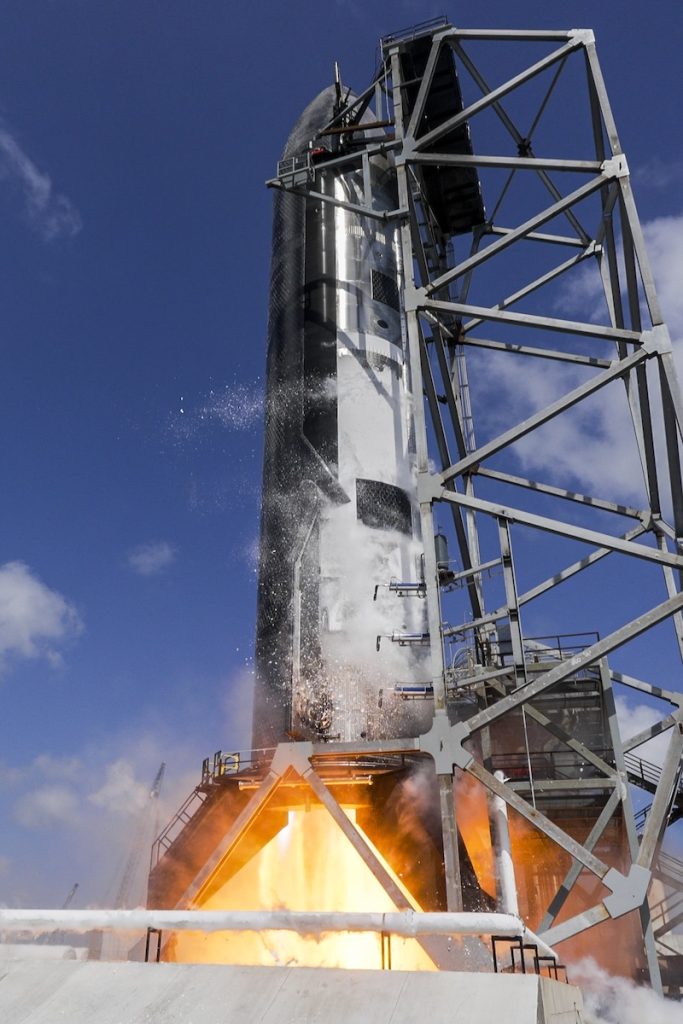
SpaceX Starship full duration static fire on April 14, 2026 from Starbase, Texas (Credit: SpaceX)
The post The Starship V3 static fire everyone was waiting for just happened appeared first on TESLARATI.