

The global space industry is entering one of its most competitive and transformative eras yet. For more than a decade, SpaceX’s Falcon 9 has dominated the orbital launch market, setting new standards for reusability, reliability, and cost efficiency. Blue Origin’s New Glenn has been waiting in the wings, promising heavy-lift capability and competition at scale.
But now, a new contender is rapidly approaching—and it may be closer than many realize. Rocket Lab’s Neutron rocket, often nicknamed the “Hungry Hippo,” represents a bold and unconventional attempt to reshape the medium-lift launch market. Cheaper, more efficient for certain missions, and radically different in design, Neutron could fundamentally alter how satellite launches are planned and priced.
So what exactly is Neutron? When will it fly? How does it compare to Falcon 9? And why, despite all this innovation, does SpaceX still sit in a league of its own? Let’s break it all down.
What Is Neutron? Rocket Lab’s Big Leap Forward
From Electron to Neutron: Scaling Up for a New Space Era
Rocket Lab is no stranger to success. Since its debut in 2017, the Electron rocket has become one of the most reliable small-lift launch vehicles in the world. With more than 70 successful launches, Electron carved out a dominant position in the small satellite market, offering customers dedicated launches, high reliability, and rapid launch cadence.
However, the space industry has evolved rapidly.
Modern satellite constellations—whether for Earth observation, communications, or defense—are larger, heavier, and more complex than the small CubeSats Electron was designed to carry. Launching these payloads efficiently requires medium-lift rockets capable of delivering large batches of satellites into orbit.
Recognizing this shift, Rocket Lab officially announced Neutron in March 2021.
Neutron Rocket Specifications and Capabilities
A Medium-Lift Rocket Built for Constellations
Neutron is a partially reusable medium-lift launch vehicle designed to deliver up to 13,000–15,000 kg to low Earth orbit (LEO). Its mission is clear:
Serve large satellite constellations with faster turnaround times and better mission “right-sizing.”
Key highlights include:
- Payload to LEO: ~13–15 metric tons
- Height: ~43.5 meters
- Engines: 9 × Archimedes (methalox)
- Reusability: First stage + integrated fairing
- Target launch price: ~$55 million per launch
Neutron isn’t trying to be the biggest or most powerful rocket. Instead, it’s designed to be efficient, reusable, and perfectly sized for customers who don’t need Falcon 9’s full lifting power.
The Hungry Hippo Design: Why Neutron Looks So Different
A Fixed Fairing That Changes Everything
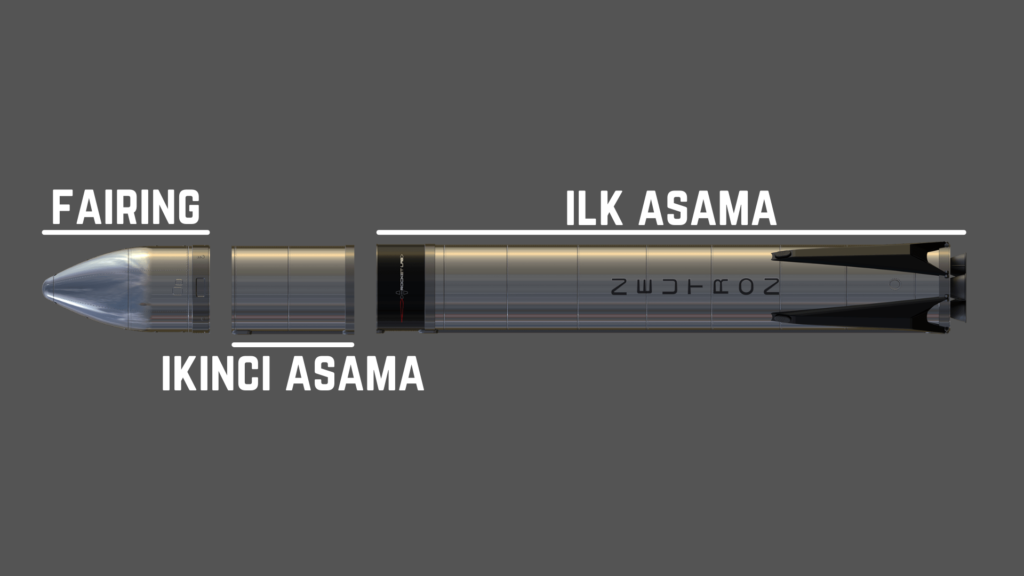
One of Neutron’s most revolutionary features is its fixed, reusable fairing, nicknamed the “Hungry Hippo.”
Unlike Falcon 9, where the payload fairing separates a few minutes after liftoff and must be recovered from the ocean, Neutron’s fairing:
- Never separates from the booster
- Opens in space like a hippo’s mouth
- Deploys the payload
- Closes again
- Returns to Earth attached to the first stage
This design offers major advantages:
- No separate fairing recovery ships
- Immediate fairing reuse
- Faster turnaround between flights
- Lower operational complexity
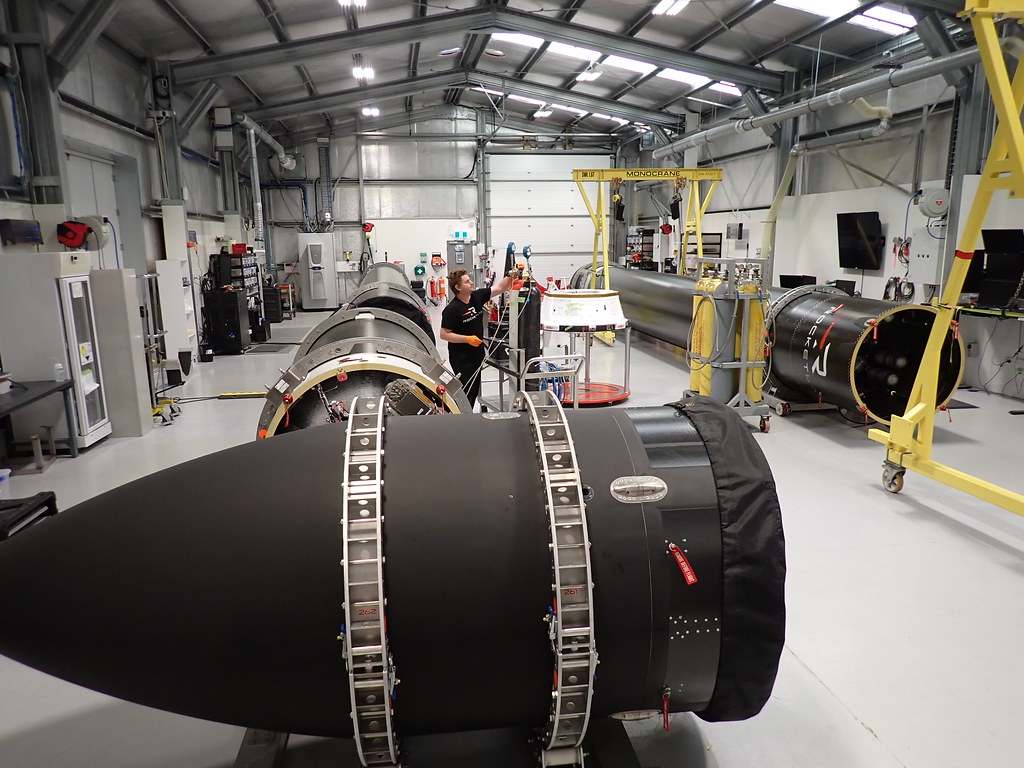
Rocket Lab recently completed qualification testing showing that the fairing can open and close in just 1.5 seconds under flight conditions, far faster than traditional separation and recovery processes.
Neutron Testing Updates and First Launch Timeline
How Close Is Neutron to Its First Flight?
Rocket Lab has been making steady, tangible progress toward Neutron’s debut.
Recent milestones include:
- Completion of fairing qualification and acceptance testing
- Successful 275,000-pound load tests simulating max-Q conditions
- 125% mechanical load testing on aft control surfaces
- Shipment of Neutron hardware to Launch Complex 3 (LC-3) at Wallops Island, Virginia
- Installation of the second-stage static fire test stand
The next critical milestone is the static fire test of Neutron’s second stage, powered by a single Archimedes engine.
Expected First Launch Date
- Optimistic scenario: Q1 2026
- More realistic window: Mid-2026
Given Rocket Lab’s disciplined testing approach and Electron’s strong heritage, many analysts expect Neutron’s debut to proceed smoothly.
The Archimedes Engine: Rocket Lab’s Methane Powerhouse
Why Methalox Matters
Neutron is powered by Archimedes engines, which burn liquid methane and liquid oxygen (methalox) using a staged combustion cycle—the same advanced approach used by SpaceX’s Raptor engines.
This gives Archimedes several advantages:
- Higher specific impulse
- Cleaner combustion
- Better reusability
- Reduced engine wear
Archimedes Performance Numbers
- Sea-level thrust: ~730 kN (164,000 lbf)
- Vacuum thrust: ~890 kN (200,000 lbf)
- Sea-level ISP: ~329 seconds
- Vacuum ISP: ~367 seconds
These are very strong numbers for a modern medium-lift engine.
Neutron vs Falcon 9: Engine and Performance Comparison
Archimedes vs Merlin 1D
Falcon 9 is powered by nine Merlin 1D engines, which use a gas-generator cycle and RP-1 kerosene fuel.
Merlin 1D performance:
- Sea-level thrust: ~845 kN (190,000 lbf)
- Vacuum thrust: ~981 kN (220,500 lbf)
- Sea-level ISP: ~282 seconds
- Vacuum ISP: ~348 seconds
While Archimedes outperforms Merlin in efficiency (ISP), Merlin 1D still wins in:
- Raw thrust per engine
- Throttle range (40–100%)
- Proven reliability across hundreds of flights
Total Booster Power
- Falcon 9 total thrust: ~7,670 kN
- Neutron total thrust: Significantly lower
This difference reflects vehicle size:
- Falcon 9 height: ~70 meters
- Neutron height: ~43.5 meters
Falcon 9 simply needs more power to lift a taller, heavier rocket with a larger payload.
Payload Capacity: Falcon 9 Still Leads
In pure lift capability:
- Falcon 9: ~22.8 metric tons to LEO
- Neutron: ~13–15 metric tons to LEO
There’s no question—Falcon 9 wins on raw performance.
But payload capacity isn’t the only metric that matters.
Launch Costs: Where Neutron Becomes Competitive
Price Per Launch vs Price Per Kilogram
Rocket Lab is targeting a $55 million launch price for Neutron.
That works out to roughly:
- ~$4,230 per kg for a 13-ton payload
Falcon 9 typically costs around $67 million per launch, translating to:
- ~$2,600–$2,940 per kg at full capacity
So no, Neutron does not beat Falcon 9 on cost per kilogram.
Why Neutron Still Makes Sense
Many customers don’t need Falcon 9’s full payload capacity.
For them:
- Paying for unused mass margin is inefficient
- Dedicated Neutron launches offer better mission optimisation
- Faster turnaround and simplified reuse reduce scheduling friction
In this niche, Neutron becomes extremely attractive.
Reusability Showdown: Falcon 9 vs Hungry Hippo
Both rockets are partially reusable and land on drone ships.
Falcon 9 Reuse System
- Fairings separate and splash down
- Specialized ships recover them
- Booster lands separately
- Highly proven and reliable
Neutron’s Advantage
- Fairing never separates
- No ocean recovery for fairings
- Single integrated system
- Potentially faster and cheaper reuse
Falcon 9’s system works exceptionally well—but Neutron’s design is cleaner and more streamlined.
Why Falcon 9 Is Still in a League of Its Own
Despite Neutron’s innovation, Falcon 9 dominates for one simple reason: versatility.
Falcon 9 has:
- Launched hundreds of satellites
- Flown crew missions to the ISS
- Supported cargo resupply
- Logged over 588 successful launches
- Achieved human-rating certification
Neutron’s fixed fairing design limits it almost exclusively to satellite launches. Human spaceflight, space station modules, and large spacecraft are simply not in its future—at least for now.
Rocket Lab vs SpaceX: Rivalry or Reality?
Industry Tensions and Public Comments
The relationship between Rocket Lab and SpaceX has had its moments:
- 2020: Elon Musk publicly supported Rocket Lab after an Electron failure
- 2023: Peter Beck criticized Falcon 9 rideshares as creating an “accidental monopoly”
- 2025: Beck subtly contrasted Neutron’s cautious approach with Starship’s explosive test program
These comments reignited debates about competition—but the reality is clear.
Competitive Reality
If SpaceX vs Blue Origin is a 10/10 rivalry, then:
Rocket Lab vs SpaceX is closer to a 3/10.
Neutron doesn’t threaten Falcon 9’s core dominance—but it does carve out an important niche.
Fail Fast vs Fly When Ready: Two Philosophies
SpaceX embraces rapid iteration:
- Fly early
- Accept failures
- Learn from real-world data
Rocket Lab follows a more conservative, traditional approach:
- Extensive ground testing
- Fewer risks on first flight
- Higher confidence at debut
Neither philosophy is inherently better—they simply optimize for different goals.
Final Verdict: Why Neutron Still Matters
Neutron will not dethrone Falcon 9.
It will not replace SpaceX as the industry leader.
But it doesn’t need to.
Neutron represents:
- A smarter medium-lift option
- Better mission right-sizing
- Faster reuse potential
- Increased competition in launch pricing
And that alone is enough to change the space race forever.
FAQs
1. What is Rocket Lab’s Neutron rocket?
Neutron is a partially reusable medium-lift launch vehicle developed by Rocket Lab to deploy large satellite constellations and heavier payloads into low Earth orbit (LEO). It is designed to compete with rockets like SpaceX’s Falcon 9 and Blue Origin’s New Glenn in specific mission categories.
2. Why is Neutron called the “Hungry Hippo”?
Neutron earns the nickname “Hungry Hippo” because of its unique payload fairing design, which opens in space like a hippo opening its mouth to release satellites and then closes again before returning to Earth.
3. How much payload can Neutron carry to orbit?
Neutron can deliver approximately 13,000 to 15,000 kilograms to low Earth orbit, making it ideal for medium-sized satellite constellations and dedicated commercial launches.
4. When is Neutron expected to launch for the first time?
Rocket Lab is targeting early to mid-2026 for Neutron’s first orbital flight, depending on the outcome of ongoing engine and stage testing.
5. How much will a Neutron launch cost?
Rocket Lab is targeting a launch price of around $55 million per mission, which is lower than Falcon 9 for customers who don’t need maximum lift capacity.
6. Is Neutron cheaper than SpaceX’s Falcon 9?
Neutron is cheaper per launch, but not cheaper per kilogram. Falcon 9 carries more payload, which lowers its cost per kg. Neutron is more cost-effective for right-sized missions.
7. What makes Neutron’s fairing different from Falcon 9’s?
Neutron’s fairing is permanently attached to the booster and reused on every flight, while Falcon 9 jettisons its fairing and recovers it separately from the ocean.
8. Is Neutron a fully reusable rocket?
No. Neutron is partially reusable, with the first stage and fairing designed for reuse. This is similar to Falcon 9’s reusability approach.
9. What engines power the Neutron rocket?
Neutron uses nine Archimedes engines, which burn liquid methane and liquid oxygen (methalox) and operate on a staged combustion cycle.
10. How does Archimedes compare to SpaceX’s Merlin engine?
Archimedes offers higher efficiency (specific impulse) due to its methane fuel, while Merlin 1D provides higher thrust per engine and has a much longer, proven flight history.
11. Can Neutron launch astronauts or crewed missions?
No. Due to its fixed fairing design, Neutron is optimized for satellite launches only and is not expected to support human spaceflight missions.
12. Where will Neutron launch from?
Neutron will launch from Launch Complex 3 (LC-3) at Wallops Island, Virginia, a new facility built specifically for this rocket.
13. Will Neutron compete directly with Falcon 9?
Neutron will compete with Falcon 9 in certain mission segments, especially dedicated satellite launches, but it does not threaten Falcon 9’s dominance in heavy, crewed, or multi-role missions.
14. Why is Neutron important for the space industry?
Neutron increases competition, flexibility, and pricing options, helping satellite operators avoid paying for unused payload capacity on larger rockets.
15. Could Neutron change the future of satellite launches?
Yes. By combining innovative design, faster reuse, and right-sized performance, Neutron has the potential to reshape how medium-lift satellite missions are planned and launched. 🚀
Read More:
- Tesla supplements Holiday Update by sneaking in new Full Self-Driving version
- Tesla hints at Starlink integration with recent patent
- IT HAPPENED! 2026 Tesla Pi Pad: FINALLY Available Now for Just $119
- NVIDIA Is Finished – Elon Musk’s First Tesla GPU Chip is Finally Here
- SpaceX Breaks Record with Starship B19 Stacking Completed in Weeks! How is this possible so fast?
2 thoughts on “What Rocket Lab Just Did to Catch up with SpaceX Just Changed Space Race Forever”