
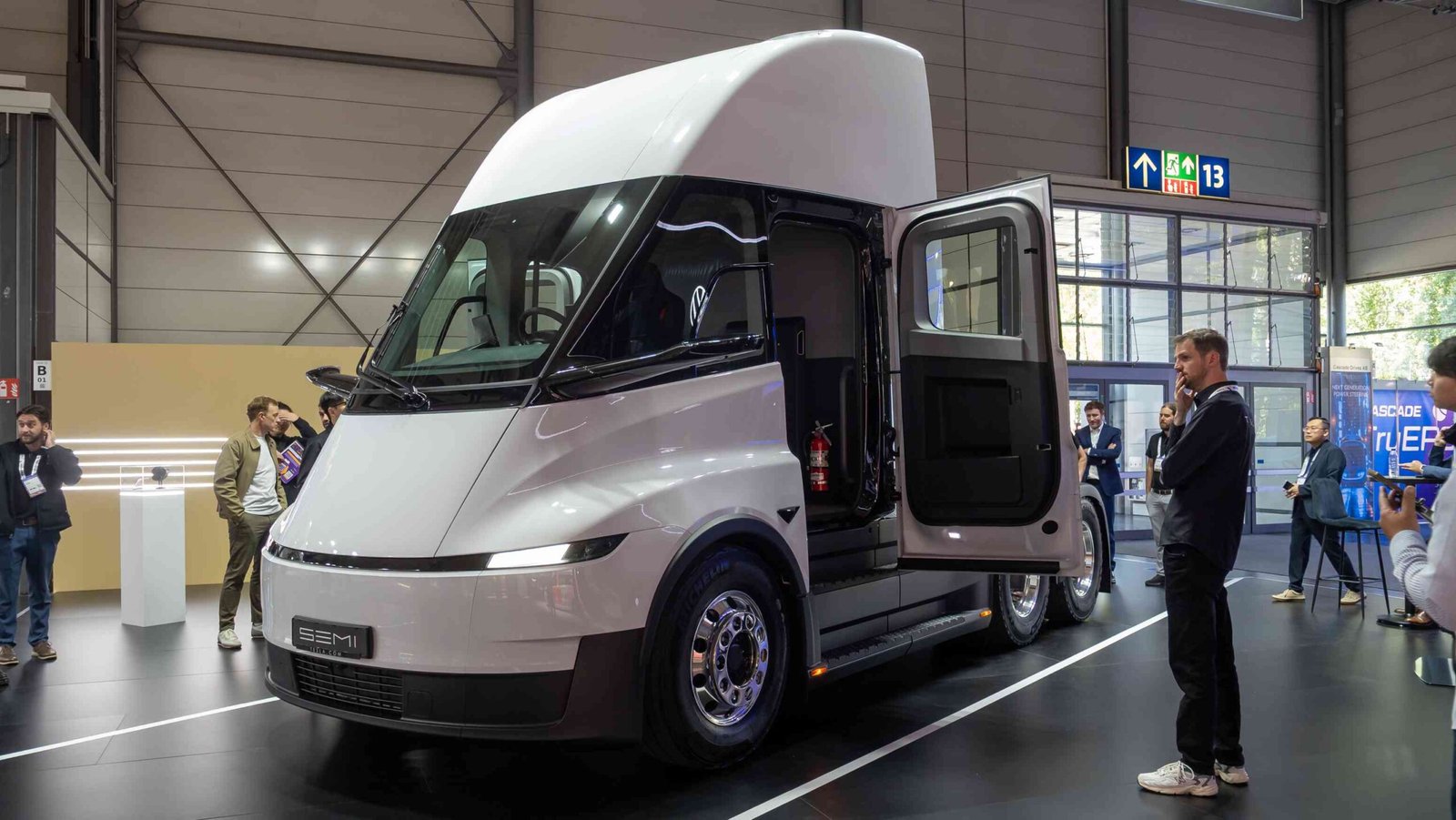
NEW Tesla Semi Amazing Ramping & HUGE Upgrade Inside: The Tesla Semi is moving toward a potentially historic transformation in the commercial trucking industry. While traditional automakers continue to focus on diesel-powered freight vehicles and consumer electric cars, Tesla is working to reshape heavy-duty transportation through advanced battery technology, automated manufacturing, and lower operating costs.
First unveiled alongside the Tesla Roadster in 2017, the Tesla Semi faced years of development challenges and production delays. However, progress in manufacturing, engineering improvements, and growing interest from commercial fleets have renewed attention on Tesla’s electric truck program.
The biggest question is no longer simply whether an electric semi-truck can work. It is whether Tesla can manufacture these vehicles at scale while delivering the reliability, payload capacity, and cost savings that transportation companies demand.
Tesla Semi Factory Ramping Up Production in Nevada
One of the most important developments surrounding the Tesla Semi is the expansion of its dedicated manufacturing operations in Nevada. Large-scale production is essential if Tesla wants to compete directly with established Class 8 truck manufacturers.
Tesla’s purpose-built facility is described as covering approximately 1.8 million square feet, with a long-term production target of 50,000 trucks annually. Achieving that level would represent a major increase over the limited production and early fleet deployments associated with the program.
Automated Manufacturing and Flexible Production
Tesla’s manufacturing strategy emphasizes automation, simplified assembly, and vertical integration. Rather than relying entirely on outside suppliers, the company aims to bring important manufacturing processes closer together.
These processes include:
- Battery pack integration to simplify vehicle assembly.
- Drive axle production to improve component coordination.
- Steel stamping for major structural components.
- Cooling system assembly to support the electric powertrain.
- Flexible production lines designed to accommodate different Semi configurations.
A unified production system could help Tesla respond to changing customer demand while reducing manufacturing complexity.
Tesla is also reportedly exploring powder coating as an alternative to conventional automotive paint processes. This approach can provide durable surface protection and corrosion resistance, although its actual production benefits depend on the final manufacturing process.
If these improvements deliver their intended results, the Nevada facility could become a critical foundation for Tesla’s commercial trucking ambitions.
Huge Tesla Semi Engineering Upgrades
Scaling production requires more than building a larger factory. Tesla must also ensure that its electric truck delivers consistent performance under demanding real-world conditions.
The latest engineering direction focuses on battery technology, vehicle weight, motor durability, and aerodynamic efficiency.
Tesla 4680 Battery Cells
Tesla’s proprietary 4680 battery cells are an important part of its broader battery development strategy. The larger cylindrical cells are designed to support manufacturing efficiency and potentially reduce battery-system costs.
Integrating battery production and vehicle assembly within a coordinated supply chain could reduce transportation requirements, shorten component lead times, and improve production planning.
However, the exact battery-cell configuration used in every production Tesla Semi should be confirmed through official specifications. The potential benefits of 4680 technology do not automatically establish that every Semi has transitioned to these cells.
Lighter Chassis for Better Payload Capacity
In commercial trucking, vehicle weight directly affects freight economics. A lighter tractor can potentially carry more cargo within applicable gross vehicle weight limits.
The supplied development estimates suggest that newer Tesla Semi configurations could weigh approximately 1,000 pounds less than earlier iterations. If achieved in production, this reduction could improve payload flexibility and operating efficiency.
For logistics companies transporting goods across long distances, even modest weight reductions can become valuable when multiplied across thousands of annual trips.
Redesigned Electric Motors
The Tesla Semi uses a powerful electric drivetrain designed for heavy loads, highway speeds, and demanding gradients. The supplied specifications describe a three-motor system delivering more than 1,000 horsepower, although exact production specifications should be verified against Tesla’s official documentation.
Potential improvements include more durable rotor construction, simplified component manufacturing, and the use of shared motor technologies.
These changes could help Tesla lower manufacturing costs while improving durability under continuous commercial use.
Aerodynamic improvements are equally important. Reducing air resistance can decrease energy consumption, particularly at highway speeds, where aerodynamic drag represents a significant portion of a truck’s energy demand.
Tesla Semi vs. Diesel Trucks: The Cost Advantage
The most important factor for commercial fleet operators is Total Cost of Ownership (TCO). A truck’s purchase price matters, but fuel, maintenance, downtime, and resale value determine its long-term financial performance.
Electric trucks generally cost more upfront than comparable diesel models, but lower energy costs can help offset the difference.
Electricity vs. Diesel Fuel Costs
Consider an illustrative comparison based on the figures supplied:
- Tesla Semi energy consumption: Approximately 1.7 kWh per mile.
- Electricity price: $0.14 per kWh.
- Diesel truck fuel economy: Approximately 8 miles per gallon.
- Annual distance: 100,000 miles.
At these assumptions, the Tesla Semi would consume approximately 170,000 kWh annually, costing around $23,800 before charging losses, demand charges, and other infrastructure expenses.
A diesel truck traveling the same distance at 8 miles per gallon would consume approximately 12,500 gallons of diesel. At $8.36 per gallon, that would cost about $104,500 annually.
This illustrative comparison suggests a potential annual energy-cost difference of approximately $80,700 per truck.
Actual savings will vary considerably depending on electricity prices, diesel prices, charging efficiency, routes, payloads, and operating conditions. The calculation also excludes charging infrastructure investments.
Five-Year Savings for Large Fleets
For companies operating dozens or hundreds of trucks, potential savings can become substantial.
A fleet of 100 electric trucks could achieve significant reductions in energy spending if the vehicles consistently deliver lower operating costs than their diesel counterparts.
However, fleet managers must also consider the purchase-price premium, depot charging equipment, electrical upgrades, maintenance arrangements, vehicle availability, and financing expenses.
The real financial advantage comes from lower total operating costs, not simply from comparing electricity prices with diesel prices.
Megawatt Charging Could Transform Electric Trucking
Charging time is one of the biggest challenges facing heavy-duty electric transportation. Long-distance freight operators cannot afford unnecessary delays while their vehicles recharge.
Tesla has developed a high-power charging strategy for the Semi, with megawatt-level charging intended to replenish substantial battery capacity during scheduled stops.
The supplied estimates suggest charging power could reach approximately 1.2 megawatts under suitable conditions. Actual charging performance depends on battery temperature, state of charge, charger capabilities, and the vehicle’s charging curve.
Charging During Driver Rest Breaks
High-power charging could allow drivers to replenish a meaningful portion of their battery range during planned breaks.
This approach may help integrate electric trucks into existing logistics schedules without requiring every charging stop to become an extended interruption.
Tesla’s longer-term charging ambitions also depend on building reliable infrastructure along major freight corridors. Commercial depots need sufficient electrical capacity, dependable charging equipment, and careful coordination of vehicle schedules.
Tesla Semi Orders and European Expansion
Commercial interest from logistics companies is an important indicator of the electric truck market’s potential. Fleet operators are evaluating electric vehicles for predictable routes, regional distribution, and operations where charging can be planned around existing schedules.
The supplied material identifies companies and procurement initiatives associated with potential Tesla Semi demand, including Einride, Wabi EV, Lincoln Transportation Services, and Zetscale Alliance.
However, the stated order quantities and supplier arrangements should be independently verified. A pre-order, procurement framework, pilot program, and confirmed delivered order are not the same thing.
PepsiCo, DHL, US Foods, and ABF Freight have also been identified as testing or evaluation partners in the supplied information. Their experiences could help demonstrate how electric heavy-duty trucks perform under real operating conditions.
European Tesla Semi Market
Europe presents another potential opportunity for Tesla’s electric truck program. Freight operators across the region face pressure to reduce emissions while maintaining reliable transportation services.
The supplied plans describe a European-focused configuration targeting approximately 550 kilometers of range, with charging capability and vehicle specifications adapted to regional requirements.
Trials reportedly targeted for 2027 would be an important step toward understanding how the Semi performs under European road regulations, charging standards, and logistics conditions. These plans should be treated as targets until confirmed by official announcements.
Can the Tesla Semi Disrupt the Trucking Industry?
The Tesla Semi combines several potentially powerful advantages: electric propulsion, software integration, high-power charging, and a manufacturing strategy focused on large-scale production.
Its success, however, will depend on execution. Tesla must demonstrate reliable vehicle availability, competitive payload capacity, durable battery performance, dependable charging infrastructure, and attractive lifecycle economics.
The proposed annual production target of 50,000 trucks would be ambitious, making manufacturing efficiency and supply-chain stability especially important.
Traditional truck manufacturers are also developing electric and other lower-emission commercial vehicles, meaning Tesla will face competition on price, service networks, vehicle performance, and customer support.
Final Verdict
The NEW Tesla Semi represents an ambitious attempt to transform heavy-duty freight transportation. Its potential upgrades in battery technology, manufacturing automation, motor design, and charging infrastructure could make electric trucking more practical for a wider range of commercial operators.
The greatest opportunity lies in combining dependable performance with lower operating costs. If Tesla can scale production, maintain vehicle quality, and establish a reliable charging network, the Semi could become an increasingly important option for freight fleets.
For now, the most important milestones to watch are verified production volumes, confirmed customer deliveries, real-world energy consumption, payload performance, and independently measured total cost of ownership.
The future of electric trucking will be determined not by ambitious promises alone, but by reliable trucks, proven savings, and the ability to deliver them at scale.
FAQs
1. What is the Tesla Semi?
The Tesla Semi is an all-electric Class 8 heavy-duty truck designed to transport freight over short and long distances. It aims to reduce fuel costs, emissions, and maintenance requirements compared with traditional diesel-powered trucks.
2. When was the Tesla Semi first unveiled?
Tesla first unveiled the Tesla Semi in November 2017, alongside the next-generation Tesla Roadster. The truck subsequently underwent years of development and testing before initial customer deliveries began in 2022.
3. What is the Tesla Semi’s targeted annual production capacity?
The supplied information describes a long-term production target of 50,000 trucks per year at Tesla’s dedicated Nevada manufacturing facility. This is a target rather than confirmation of current annual production.
4. Where is the Tesla Semi manufactured?
Tesla is developing dedicated manufacturing operations for the Semi in Nevada, USA. The facility is intended to support higher production volumes and streamline the manufacturing process.
5. What are the major Tesla Semi upgrades?
The potential upgrades discussed include battery technology improvements, a lighter chassis, redesigned electric motors, enhanced aerodynamics, and more efficient manufacturing processes. Exact specifications depend on the production configuration.
6. Does the Tesla Semi use 4680 battery cells?
Tesla manufactures proprietary 4680 battery cells as part of its broader battery strategy. However, the exact battery-cell configuration used in each Tesla Semi version should be verified through official specifications.
7. How powerful is the Tesla Semi?
The supplied information describes a three-motor electric powertrain producing more than 1,000 horsepower. Buyers should consult Tesla’s official specifications for confirmed power and performance figures for the relevant model.
8. How much weight could the upgraded Tesla Semi save?
The supplied estimates suggest that newer configurations could be approximately 1,000 pounds lighter than earlier iterations. If confirmed in production, this reduction could improve payload flexibility and freight efficiency.
9. How much energy does the Tesla Semi consume per mile?
The illustrative figures in the supplied material estimate consumption at approximately 1.7 kWh per mile. Actual energy consumption depends on payload, speed, terrain, weather, temperature, and driving conditions.
10. Is the Tesla Semi cheaper to operate than a diesel truck?
The Tesla Semi could offer lower operating costs because electricity can be cheaper than diesel fuel per mile, and electric powertrains generally require less routine maintenance. Actual savings depend on local energy prices, charging costs, vehicle utilization, and maintenance expenses.
11. How much money can a Tesla Semi save annually?
Potential savings vary by route and operating conditions. Under the illustrative assumptions in this article, annual energy costs could be approximately $80,700 lower per truck than diesel costs. This estimate is not a guaranteed saving and excludes charging infrastructure and other expenses.
12. What is Tesla’s Megawatt Charging system?
Tesla’s Megawatt Charging approach is designed to provide high-power charging for heavy-duty electric trucks. The supplied estimates mention charging power of up to approximately 1.2 MW under suitable conditions, although actual charging rates depend on the vehicle and charging infrastructure.
13. Which companies have tested or shown interest in the Tesla Semi?
The supplied information identifies companies including PepsiCo, DHL, US Foods, and ABF Freight as testing or evaluation partners. Specific orders and procurement arrangements involving other companies should be verified independently.
14. Is Tesla planning to introduce the Semi in Europe?
The supplied material describes plans for European customer trials targeted for 2027, potentially involving a configuration with approximately 550 kilometers of range. The final specifications, launch timing, and market availability depend on official announcements and regulatory requirements.
15. Can the Tesla Semi replace diesel trucks in the future?
The Tesla Semi could replace diesel trucks on suitable routes if it delivers competitive operating costs, sufficient range, dependable charging, and reliable performance. However, widespread adoption will depend on production capacity, charging infrastructure, payload requirements, purchase prices, and the needs of individual freight operators.
Read More:
- Elon Musk just confirmed the Tesla and SpaceX merger step everyone was waiting for
- SpaceX showcases exactly how it plans to catch Starship next month
- SpaceX stock gets a slew of price target boosts after bullish earnings call
- SpaceX confirms Starship 15 launch window with massive ambitions
- Tesla reports Q3 Earnings today: here’s what to expect