
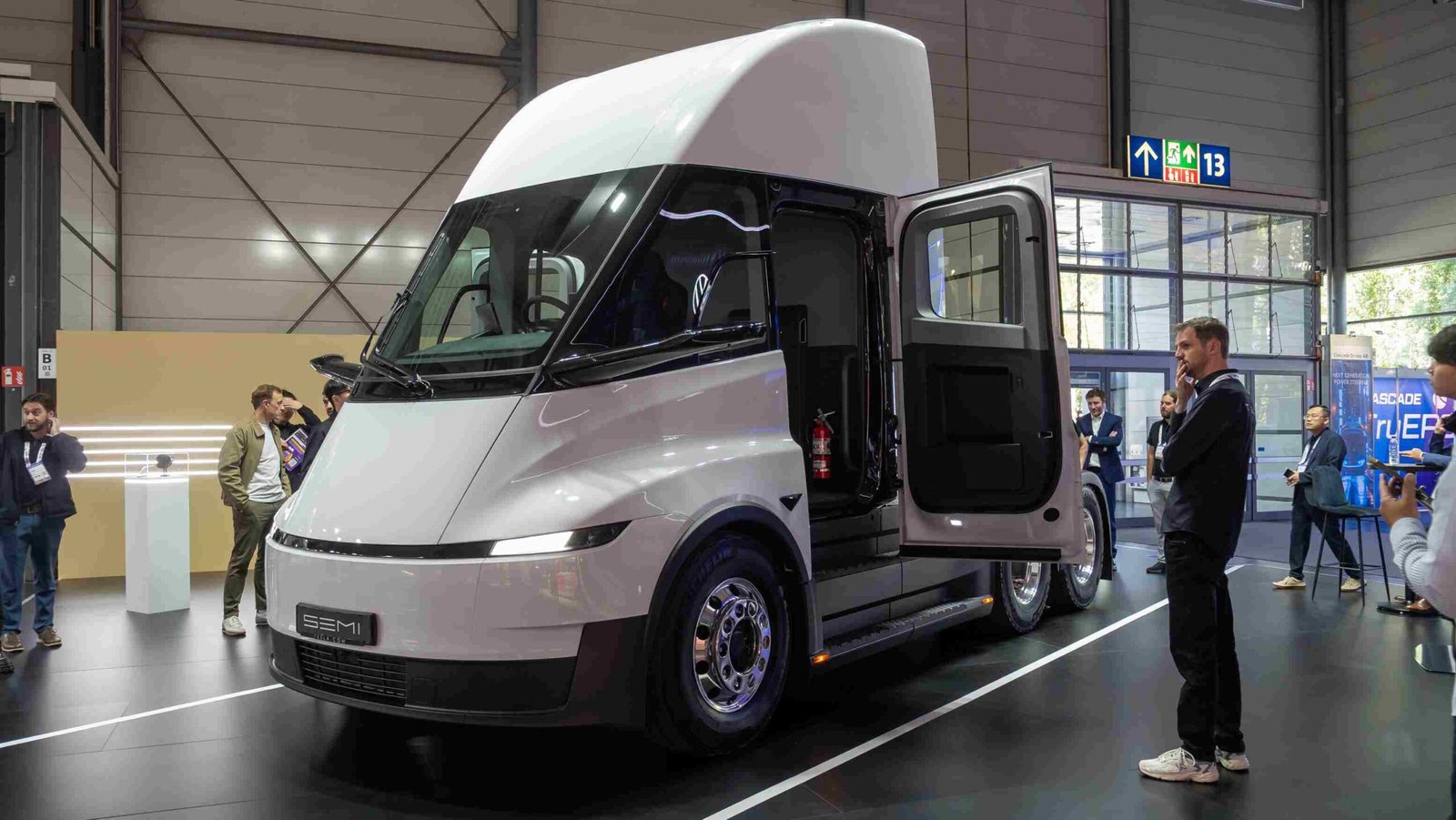
Elon Musk Reveals Tesla Semi’s 2.0 RADICAL Design Changes: The future of heavy-duty transportation is evolving rapidly, and Tesla is preparing to make another significant impact on the commercial trucking industry. The company’s recently unveiled updated Tesla Semi at Connect Trucks 2026 in Deauville, France, has attracted considerable attention from the transportation and logistics sectors.
Featuring major design improvements, advanced safety technologies, impressive performance specifications, and a powerful charging strategy, the electric truck demonstrates Tesla’s ambitions to transform long-distance freight transportation.
The updated Tesla Semi 2.0 represents more than an exterior refresh. Its engineering changes focus on driver safety, operational efficiency, European regulatory requirements, and lower fleet operating costs. With a projected operating range of up to 550 kilometers, a powerful tri-motor drivetrain, and megawatt-level charging capabilities, Tesla is positioning its electric Class 8 truck as an alternative to traditional diesel-powered vehicles.
Let’s explore the most important design changes, performance upgrades, charging developments, and commercial opportunities surrounding the updated Tesla Semi.
Tesla Semi 2.0 Introduces Major Exterior and Safety Improvements
Tesla has retained the Semi’s recognizable aerodynamic design while introducing several important hardware modifications. These changes are intended to improve visibility, reduce aerodynamic resistance, and make the truck more practical for commercial operations.
1. Digital Camera-Mirror System
One of the most noticeable updates is the introduction of a digital camera-mirror system.
Traditional large side mirrors have been replaced with aerodynamic exterior camera assemblies. These cameras transmit high-definition video feeds to two displays inside the cabin, allowing drivers to monitor surrounding traffic without relying entirely on conventional mirrors.
This technology offers several potential advantages:
- Reduced aerodynamic drag: Smaller camera housings create less air resistance than traditional mirrors.
- Improved visibility: Digital displays can provide clearer views of surrounding vehicles.
- Better maneuverability: Drivers can monitor blind spots during lane changes and difficult turns.
- Enhanced efficiency: Reduced aerodynamic resistance can contribute to improved energy consumption.
For a 16-meter tractor-trailer combination, visibility is particularly important when navigating crowded highways, distribution centers, and urban intersections.
2. Ten-Camera 360-Degree Visibility System
The updated Tesla Semi also features 10 strategically positioned cameras around the vehicle.
This surround-camera arrangement provides drivers with a comprehensive view of the truck’s surroundings. It is especially useful when reversing, entering loading docks, navigating narrow streets, and maneuvering through busy logistics facilities.
The system could also support Tesla’s broader driver-assistance technology by providing additional visual information about nearby vehicles, pedestrians, and obstacles.
3. Revised European Lighting Configuration
Tesla has also modified the front lighting arrangement to accommodate regional vehicle requirements.
Earlier American prototypes featured a continuous horizontal light bar across the front. The updated European presentation instead showcases separate headlight elements and revised upper lighting structures.
These adjustments demonstrate how Tesla is adapting its commercial electric truck for international markets rather than simply transferring its American design to Europe.
4. Emergency Escape Ladder for Driver Safety
Another important addition is an emergency escape ladder inside the cabin.
In severe rollover accidents, conventional doors can become blocked or difficult to open. An additional escape route could provide drivers with another way to leave the vehicle during emergencies.
This improvement highlights the importance of practical safety engineering in heavy-duty electric trucks.
Tesla Semi 2.0 Performance Specifications and Powertrain
Beyond its exterior changes, the updated Tesla Semi features specifications designed for demanding commercial transportation operations.
Its combination of long-distance range, high power output, and electric auxiliary systems is intended to support heavy freight transportation.
550 km Driving Range Under Heavy Loads
According to the presented specifications, the updated Tesla Semi offers an operating range of up to 550 kilometers (342 miles).
Importantly, this figure is associated with a 40-metric-ton Gross Combination Weight (GCW) configuration.
Heavy-duty electric trucks must maintain sufficient range while transporting substantial cargo. Therefore, performance under loaded operating conditions is particularly important when evaluating their commercial usefulness.
A range of 550 kilometers could make the Semi suitable for regional freight routes, distribution networks, and selected long-distance transportation operations.
Approximately 1.0 kWh Per Kilometer Energy Consumption
Energy efficiency is another major selling point.
The updated truck is reported to consume approximately 1.0 kWh per kilometer, equivalent to around 1.6 kWh per mile.
This figure provides fleet operators with a useful starting point for estimating electricity expenses.
Based on electricity prices of approximately $0.15 to $0.30 per kilometer of operating energy cost, operators can evaluate the potential savings compared with diesel transportation. Actual costs will depend on electricity tariffs, charging efficiency, route conditions, and operating schedules.
Tri-Motor Powertrain Produces Approximately 1,073 Horsepower
Tesla’s updated Semi uses a tri-motor rear-axle powertrain producing approximately 800 kW, equivalent to around 1,073 horsepower.
Electric motors deliver torque almost instantly, helping heavy trucks accelerate smoothly even when carrying substantial cargo.
The drivetrain is designed to maintain highway performance and handle demanding gradients without the traditional gear-shifting requirements of diesel powertrains.
For commercial transportation companies, consistent performance under heavy loads is essential for maintaining predictable delivery schedules.
25 kW Electric Power Take-Off System
Another important feature is the 25 kW electric Power Take-Off (ePTO) system.
This technology allows the truck to provide electrical power to auxiliary equipment without requiring a separate diesel-powered generator.
It could be particularly useful for temperature-sensitive transportation involving:
- Refrigerated food deliveries.
- Pharmaceutical shipments.
- Temperature-controlled logistics.
- Specialized commercial equipment.
By eliminating the need for separate diesel refrigeration engines in compatible applications, the electric system could reduce fuel consumption, maintenance requirements, and local emissions.
Tesla’s 1.2 MW Megacharger Could Transform Electric Trucking
Charging infrastructure remains one of the biggest challenges facing long-distance electric transportation.
Even an efficient electric truck requires a reliable network of charging stations to operate commercially. Tesla is addressing this challenge through a combination of high-power highway charging and lower-power depot charging.
1.2 MW Megacharger Supports Rapid Charging
The updated Tesla Semi’s charging strategy includes a powerful 1.2 MW Megacharger system.
With a maximum power output of approximately 1,200 kW, this infrastructure is designed specifically for heavy-duty electric vehicles.
Key reported capabilities include:
- Maximum charging power: Up to 1,200 kW.
- Charging target: Approximately 60% battery state of charge in 30 minutes.
- Primary application: Long-distance freight transportation.
- Operational advantage: Charging during scheduled driver rest periods.
The ability to replenish a substantial portion of the battery during mandatory rest breaks could help reduce downtime for commercial trucking companies.
Tesla’s infrastructure roadmap also targets more than 100 Megacharger stations across 22 major freight corridors by 2027.
If implemented successfully, this network could improve the practicality of electric freight transportation across important commercial routes.
125 kW Depot Charging for Overnight Operations
Alongside high-power highway charging, Tesla is planning a depot-based charging strategy using approximately 125 kW charging solutions.
These chargers are intended for overnight charging at logistics hubs and distribution facilities.
Instead of relying entirely on expensive high-power highway infrastructure, fleet operators could recharge vehicles while trucks are parked outside normal operating hours.
This creates a two-part charging ecosystem:
- Depot Charging: Recharges trucks overnight at commercial facilities.
- Megacharger Network: Provides rapid energy replenishment during long-distance routes.
Combining these approaches could help logistics companies manage electricity expenses, charging schedules, and fleet availability more efficiently.
Tesla Targets European Commercial Trucking Market
Tesla’s appearance at Connect Trucks 2026 in Deauville, France, represents an important step in its European commercial vehicle strategy.
The presentation, led by Tesla Business Development Manager Jean-William Dubal, focused on engaging logistics companies and potential commercial customers.
Rather than targeting ordinary vehicle consumers, Tesla is concentrating on businesses operating large transportation fleets.
Potential European customers and logistics partners mentioned in the presentation include:
- Leroy Merlin
- Danone
- Transalliance
These companies operate in industries where transportation efficiency, delivery reliability, and operating costs are important business considerations.
Tesla’s objective is to demonstrate that electric trucks can compete with diesel vehicles through lower maintenance requirements, improved energy efficiency, and reduced fuel expenses.
Customer Trials Planned for 2027
According to the presented roadmap, customer operational trials are scheduled throughout the first half of 2027, with mass deliveries targeted shortly afterward.
These trials will be important for evaluating the Semi under real commercial conditions.
Fleet operators will need to examine several factors, including:
- Actual driving range with different cargo weights.
- Charging availability along freight routes.
- Battery performance in different weather conditions.
- Maintenance and repair expenses.
- Driver comfort and vehicle reliability.
- Total Cost of Ownership compared with diesel trucks.
Real-world operational data will ultimately determine how attractive the updated Tesla Semi becomes for European logistics companies.
How Tesla Semi 2.0 Could Challenge Traditional Diesel Trucks
The commercial trucking industry is highly competitive, and purchasing decisions are generally based on long-term operating expenses rather than vehicle specifications alone.
Tesla’s Total Cost of Ownership (TCO) strategy focuses on reducing the expenses associated with electricity, maintenance, and conventional mechanical components.
Electric drivetrains have fewer moving parts than traditional combustion engines and do not require conventional engine oil changes or exhaust after-treatment systems.
However, battery replacement costs, electricity prices, charging infrastructure investments, insurance, and vehicle purchase prices must also be considered.
For companies operating hundreds or thousands of trucks, even relatively small savings per kilometer can become significant over time.
If Tesla can demonstrate reliable performance and competitive operating costs, the Semi could become an important option for commercial fleet electrification.
Conclusion: Tesla Semi 2.0 Signals a New Era for Electric Freight Transportation
The updated Tesla Semi 2.0 combines aerodynamic improvements, advanced camera technology, emergency safety features, a powerful tri-motor drivetrain, and a developing megawatt charging ecosystem.
Its reported 550 km operating range, approximately 1,073 horsepower, and 1.2 MW Megacharger capability highlight Tesla’s ambition to make heavy-duty electric transportation more practical.
The company’s growing focus on European logistics partnerships also suggests that commercial fleet adoption will be central to its expansion strategy.
However, the real test will come from customer trials, charging network deployment, manufacturing capacity, and long-term operating costs.
If Tesla successfully delivers on these objectives, the Semi could help accelerate the transition from diesel-powered freight transportation toward a more efficient electric trucking industry.
FAQs
1. What is the Tesla Semi 2.0?
The Tesla Semi 2.0 is an updated version of Tesla’s all-electric Class 8 commercial truck. It features advanced camera systems, improved safety equipment, a powerful tri-motor drivetrain, and megawatt charging technology designed to improve heavy-duty transportation.
2. What are the major design changes in the updated Tesla Semi?
The major Tesla Semi 2.0 design changes include digital camera mirrors, a 10-camera 360-degree visibility system, revised European lighting configurations, and an emergency escape ladder inside the cabin.
3. What is the driving range of the Tesla Semi 2.0?
The updated Tesla Semi offers a reported driving range of up to 550 kilometers (342 miles) under a 40-metric-ton Gross Combination Weight (GCW) configuration.
4. How much horsepower does the updated Tesla Semi produce?
The Tesla Semi features a tri-motor rear-axle powertrain producing approximately 800 kW, equivalent to around 1,073 horsepower.
5. What is the energy consumption of Tesla Semi 2.0?
The updated Tesla Semi is reported to consume approximately 1.0 kWh per kilometer, or around 1.6 kWh per mile. This efficiency can help commercial fleet operators estimate their electricity expenses.
6. What is the Tesla Semi Megacharger charging capacity?
Tesla’s Megacharger system is designed to deliver up to 1.2 MW (1,200 kW) of charging power, allowing heavy-duty electric trucks to recharge significantly faster than with conventional charging equipment.
7. How long does it take to charge the Tesla Semi 2.0?
The reported charging target is approximately 60% battery capacity in 30 minutes using the 1.2 MW Megacharger system. Actual charging times may vary depending on battery conditions and charging infrastructure.
8. How many Megacharger stations does Tesla plan to build by 2027?
Tesla’s infrastructure roadmap targets more than 100 Megacharger stations across 22 major freight corridors by 2027 to support long-distance electric trucking operations.
9. What is the purpose of the Tesla Semi’s 360-degree camera system?
The 360-degree camera system uses 10 strategically positioned cameras to provide drivers with better visibility around the truck. It helps during reversing, lane changes, tight turns, and maneuvering through crowded distribution centers.
10. Why did Tesla replace traditional side mirrors with digital cameras?
Tesla introduced digital camera mirrors to improve visibility and reduce aerodynamic drag. The cameras transmit high-definition video feeds to interior displays, helping drivers monitor surrounding traffic and blind spots.
11. What is the Tesla Semi’s 25 kW ePTO system?
The 25 kW Electric Power Take-Off (ePTO) system supplies electricity to auxiliary equipment, including compatible refrigeration systems. It can eliminate the need for separate diesel-powered generators in certain temperature-controlled transportation applications.
12. What is the purpose of the emergency escape ladder in Tesla Semi 2.0?
The emergency escape ladder provides drivers with an additional exit route during serious accidents, particularly rollover incidents where conventional cabin doors may become blocked or difficult to open.
13. When will Tesla Semi 2.0 begin European customer trials?
According to the presented roadmap, Tesla plans customer operational trials during the first half of 2027, followed by targeted mass deliveries shortly afterward.
14. Which European companies could become potential Tesla Semi customers?
Potential European commercial customers and logistics partners mentioned include Leroy Merlin, Danone, and Transalliance. Tesla is focusing on businesses that could benefit from electric freight transportation and lower operating expenses.
15. Can Tesla Semi 2.0 replace traditional diesel trucks?
The Tesla Semi 2.0 could become an alternative to diesel trucks by offering lower energy costs, reduced maintenance requirements, zero tailpipe emissions, and rapid charging. However, widespread adoption will depend on real-world driving range, vehicle pricing, charging infrastructure, reliability, and total cost of ownership.
Read More:
- Ferrari Luce sold out for 2027 after design controversy
- Tesla opens new “Cybaer” Engineering Center in Berlin
- Tesla Giga Texas reportedly moves to 24/7 production
- EVgo taps Tesla Superchargers for mass charging expansion
- SpaceX’s Secret Solution to Catch Both Stages with A Single Tower is Incredible
1 thought on “Elon Musk Reveals Tesla Semi’s 2.0 RADICAL Design Changes”