
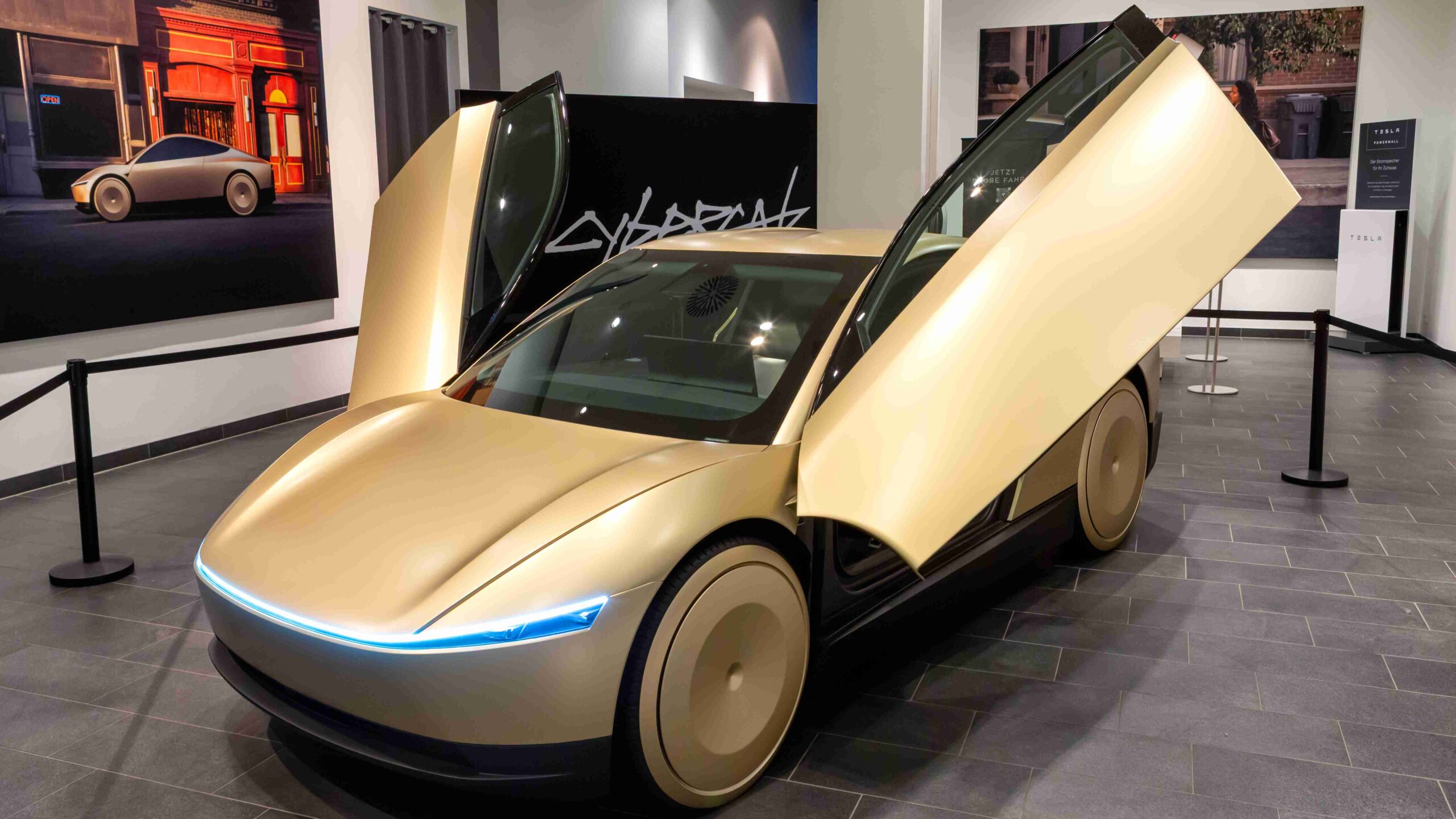
The global automotive industry is undergoing a profound transformation, and at the center of this shift stands Tesla with a bold and unconventional roadmap. No longer confined to being just an electric vehicle manufacturer, Tesla is rapidly evolving into a dominant force in artificial intelligence, robotics, and autonomous mobility. As of 2026, the company’s latest developments—from the Cybercab robotaxi to next-generation AI chips—signal a future where human-driven cars may soon become obsolete.
In this in-depth, SEO-friendly blog post, we explore Tesla’s ambitious strategy, focusing on the Cybercab revolution, the groundbreaking “unboxed” manufacturing system, cutting-edge AI hardware, and the unexpected challenges facing the Cybertruck.
The Rise of the Cybercab: Tesla’s Autonomous Vision Comes Alive
Tesla’s Cybercab represents a paradigm shift in transportation. Unlike traditional vehicles, this two-seater is designed from the ground up for full autonomy, with no reliance on human drivers.
Scaling Production at Giga Texas
The Cybercab has transitioned from concept to reality, with production accelerating at Tesla’s Gigafactory Texas. Reports indicate that over 60 Cybercab units have already been spotted on-site, contributing to a growing robotaxi fleet exceeding 500 vehicles, including modified test cars.
This growth aligns with Tesla’s well-known “S-curve” production model, where initial progress is slow but eventually leads to exponential scaling. As manufacturing processes improve and supply chains stabilize, production is expected to surge dramatically.
Regulatory Challenges and Transitional Designs
Interestingly, not all Cybercabs are fully autonomous—yet. Some prototypes still include steering wheels and pedals. These are temporary adaptations designed to meet regulatory requirements in regions where safety drivers are mandatory during testing.
However, a major milestone has been reached: several Cybercabs have been seen without any manual controls. This marks Tesla’s transition toward a truly driverless future, signaling growing confidence in its autonomous technology.
Cybercab Specifications and Efficiency
The Cybercab is engineered for affordability, efficiency, and high utilization:
- Target Price: Around $30,000, with potential to drop to $25,000
- Battery Capacity: 35 kWh (Tesla’s smallest pack yet)
- Range: Approximately 200 miles
- Efficiency: 5.5 miles per kWh
- Charging: Wireless inductive charging with over 90% efficiency
This combination makes the Cybercab ideal for continuous operation in a robotaxi network, minimizing downtime and operational costs.
The “Unboxed” Manufacturing Process: Reinventing Car Production
One of Tesla’s most revolutionary innovations is its “unboxed” manufacturing system, which completely reimagines how vehicles are built.
Breaking Away from Traditional Assembly Lines
Traditional car manufacturing involves a linear process where a vehicle moves through hundreds of sequential steps. Tesla’s unboxed method eliminates this inefficiency by building multiple sections simultaneously.
The Cybercab is constructed using modular components:
- Front section
- Rear section
- Structural battery pack
- Left and right side panels
These modules are assembled in parallel and later combined with precision, drastically reducing production time.
Efficiency Gains and Cost Reduction
The benefits of this system are significant:
- 40% reduction in factory footprint
- 30% reduction in labor costs
- Faster production cycles
Because the vehicle is assembled in separate modules, it doesn’t even touch the ground until it is fully complete. This streamlined approach enhances both speed and quality.
Eliminating the Paint Shop
One of the most expensive parts of traditional car manufacturing is the paint shop. Tesla has eliminated it entirely.
Instead, Cybercab panels are made from polyurethane materials with embedded color, removing the need for painting. These panels are joined using advanced welding techniques, resulting in:
- Lower production costs
- Reduced environmental impact
- Elimination of paint defects
This innovation alone could redefine industry standards.
AI5 Chip: Powering the Future of Autonomy
Tesla’s advancements are not limited to hardware design—they extend deep into artificial intelligence.
AI5 Performance Breakthrough
The newly developed AI5 chip delivers five times the compute power of previous systems. Designed for edge computing, it allows vehicles to process complex data in real time without relying on cloud connectivity.
This is crucial for autonomous driving, where split-second decisions can mean the difference between safety and failure.
Prioritizing Robotics Over Vehicles
Surprisingly, Tesla plans to deploy AI5 first in robotics rather than cars. The chip will power:
- Humanoid robots capable of complex tasks
- Advanced AI training systems
This indicates a strategic shift toward broader AI applications beyond transportation.
Future Roadmap: AI6 and Beyond
Tesla is accelerating its innovation cycle, targeting new chip generations every 9 months:
- AI6: Expected to double performance again
- AI6.5: Even more advanced with cutting-edge manufacturing
- Memory upgrades: Faster and more efficient data processing
These advancements will further strengthen Tesla’s leadership in AI-driven technologies.
Cybertruck Challenges: A Reality Check
While Tesla’s future looks promising, not all projects are thriving.
Slower-than-Expected Demand
The Cybertruck, once hyped as a revolutionary pickup, is facing market challenges. Initial expectations of massive demand have not fully materialized.
Internal Purchases Boost Numbers
A notable portion of Cybertruck sales has come from within Tesla’s own ecosystem. Companies associated with Elon Musk have purchased significant numbers of units, helping sustain production levels.
Market Limitations
The electric pickup market faces several obstacles:
- High prices
- Range concerns
- Limited mainstream appeal
Additionally, the Cybertruck’s unconventional design makes it a niche product, appealing to a specific audience rather than the mass market.
Tesla’s Strategic Shift: From Cars to Autonomous Services
Tesla’s long-term vision goes beyond selling vehicles—it aims to dominate autonomous mobility services.
The Robotaxi Business Model
Traditional cars sit idle most of the time. Tesla’s robotaxi model changes this by keeping vehicles active for up to 70% of the day.
This leads to:
- Higher revenue per vehicle
- Lower ownership costs
- Greater efficiency
A New Revenue Paradigm
Instead of one-time car sales, Tesla could generate continuous income through ride services, subscriptions, and AI-driven mobility solutions.
This shift positions Tesla as a technology and service company, rather than just an automaker.
What the Next 12–18 Months Will Decide
The coming year will be critical for Tesla’s transformation.
Key Milestones to Watch
- Expansion of Cybercab production
- Deployment of fully autonomous robotaxis
- Integration of AI5 hardware
- Market response to new pricing strategies
Potential Industry Impact
If successful, Tesla could:
- Accelerate the decline of traditional car ownership
- Redefine urban transportation
- Lead the global AI revolution
Conclusion: The Road to an Autonomous Future
Tesla stands at a pivotal moment in its journey. While challenges remain—particularly with the Cybertruck—the company’s focus on autonomy, AI, and innovative manufacturing places it in a unique position.
The Cybercab is more than just a vehicle; it represents a new era of mobility where efficiency, automation, and intelligence converge. Combined with breakthroughs in AI hardware and production methods, Tesla is laying the foundation for a future where transportation is safer, cheaper, and fully autonomous.
The question is no longer if this transformation will happen—but how quickly it will reshape the world.
FAQs
1. What is the Tesla Cybercab robotaxi?
The Tesla Cybercab is a fully autonomous two-seater vehicle designed specifically for robotaxi services, eliminating the need for a human driver.
2. When will the Cybercab be available to the public?
The Cybercab is currently in production scaling phase (2026), with wider deployment expected over the next 12–18 months depending on regulatory approvals.
3. What is the expected price of the Cybercab?
Tesla aims to price the Cybercab at around $30,000, with future reductions potentially bringing it closer to $25,000.
4. What is the driving range of the Cybercab?
The Cybercab is expected to offer an estimated 200-mile range on a single charge.
5. Does the Cybercab have a steering wheel?
Production versions of the Cybercab are designed to have no steering wheel or pedals, making them fully driverless vehicles.
6. How does the Cybercab charge?
The Cybercab supports wireless inductive charging, allowing it to recharge without plugging in, which is ideal for robotaxi fleets.
7. What is Tesla’s “unboxed” manufacturing process?
The unboxed process is a new manufacturing method where vehicle parts are built in parallel modules and assembled at the end, improving efficiency and reducing costs.
8. Why did Tesla remove the paint shop?
Tesla eliminated the paint shop to reduce costs, energy consumption, and environmental impact by using color-infused materials instead of traditional paint.
9. What is the Tesla AI5 chip?
The AI5 chip is Tesla’s next-generation AI processor, offering five times more computing power than previous versions for real-time autonomous driving.
10. Will AI5 be available in Tesla cars soon?
AI5 is expected to arrive in consumer vehicles around 2027, after initial deployment in robotics and AI systems.
11. What is the difference between AI5 and AI6?
AI6 is expected to deliver double the performance of AI5 and include more advanced memory and processing capabilities.
12. Why is the Cybertruck facing challenges?
The Cybertruck faces issues such as high pricing, limited demand, and its unconventional design, which appeals to a niche market.
13. What is Tesla’s robotaxi business model?
Tesla’s robotaxi model focuses on vehicles operating most of the day, generating continuous revenue instead of remaining idle.
14. How will robotaxis change transportation?
Robotaxis can reduce transportation costs, improve efficiency, and potentially eliminate the need for car ownership.
15. Is Tesla becoming an AI company?
Yes, Tesla is evolving into an AI and robotics company, focusing on autonomous systems, humanoid robots, and advanced computing technologies.
Read More:
- Ford CEO Farley says Tesla is not who to look at for EV expertise
- ARK’s SpaceX IPO Guide makes a compelling case on why $1.75T may not be the ceiling
- Tesla is building private Superchargers just for Robotaxi
- Tesla bolsters App with new safety, insurance, and storage features
- How much of SpaceX will Elon Musk own after IPO will surprise you
1 thought on “Tesla Cybercab Robotaxi Amazing New Update 2026”