
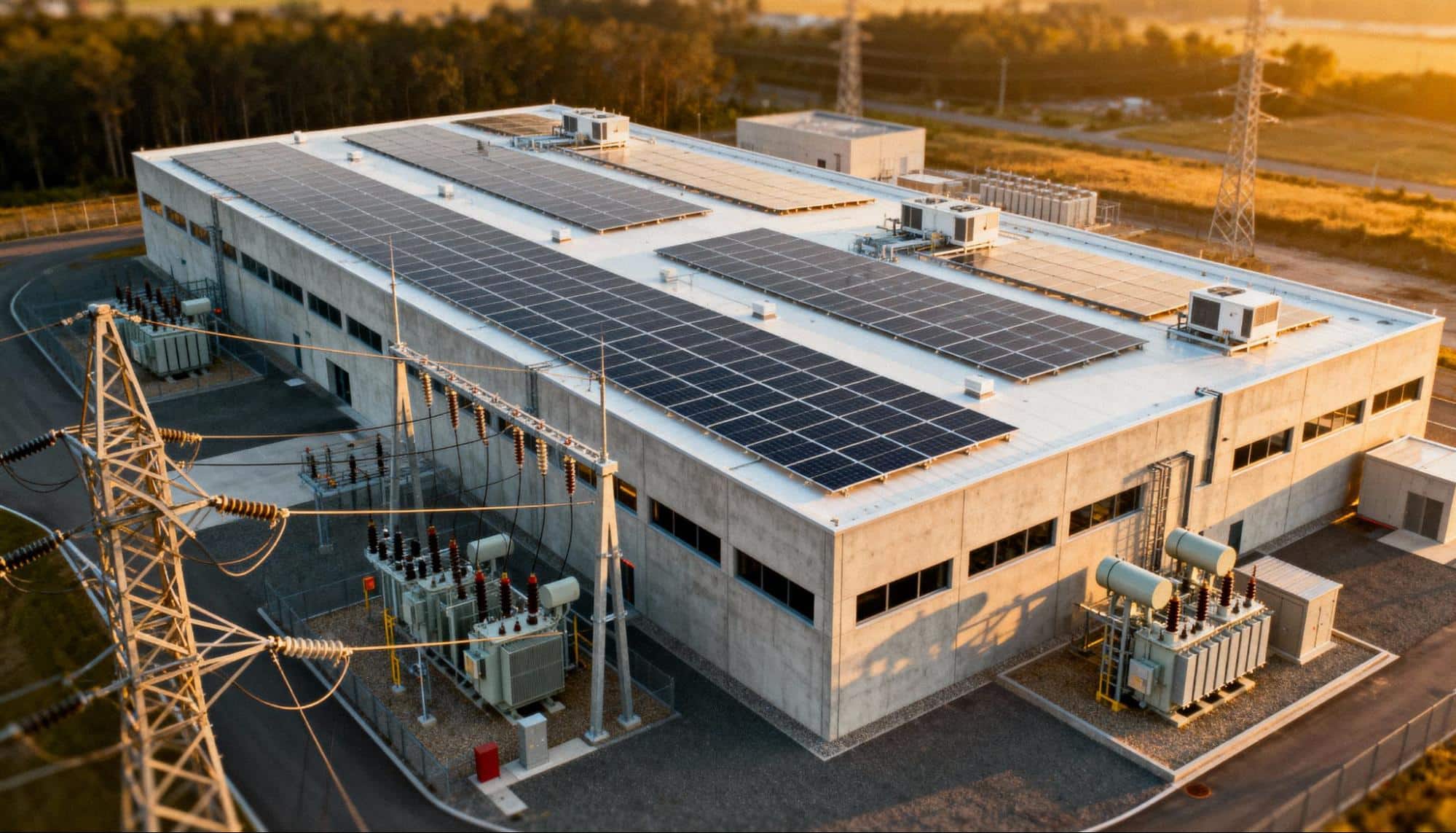
Elon Musk Just Revealed The World’s First 100GW Solar Factory: The global technology and energy sectors are entering a transformative era, and Tesla is once again positioning itself at the center of the disruption. While most headlines continue to focus on autonomous driving, artificial intelligence, and the futuristic Optimus humanoid robot, a far larger industrial revolution is quietly taking shape in Texas.
Approximately 35 miles outside Houston, Tesla is building what could become the largest solar manufacturing complex in human history. With an astonishing planned annual production capacity of 100 gigawatts (GW), this mega-project has the potential to reshape the global energy economy forever.
At the same time, Tesla is making dramatic internal shifts. The company has officially retired the legendary Model S and Model X production lines at its Fremont factory, redirecting those resources toward large-scale robotics manufacturing.
This move signals something much bigger than a simple business expansion. Tesla is evolving from an electric vehicle company into a fully integrated energy, AI, and robotics powerhouse.
Tesla’s 100GW Solar Factory Could Change the Global Energy Industry
Tesla’s upcoming Texas solar megafactory is not just another manufacturing facility. It represents one of the most ambitious industrial projects ever attempted in renewable energy.
The company is targeting a staggering 100GW annual solar production capacity, a number so massive that many analysts initially considered it unrealistic.
To understand the scale:
- The entire United States installed approximately 32GW of solar energy in 2023
- Tesla’s single factory aims to produce more than three times that amount every year
- Current U.S. solar leader First Solar projects around 17.7GW capacity by 2027
- Tesla’s target is nearly six times larger
This is not incremental growth. It is a complete redefinition of industrial-scale renewable energy manufacturing.
Why Tesla’s Solar Business Was Once Considered a Failure
For years, Tesla’s solar division struggled to gain momentum.
After Tesla acquired SolarCity in 2016 for approximately $2.6 billion, many investors expected a rooftop solar revolution. Instead, the business underperformed.
The Buffalo, New York solar factory—built with roughly $1 billion in subsidies—failed to become the manufacturing powerhouse Tesla originally promised. Eventually, portions of the facility were repurposed for:
- Supercharger hardware production
- Autopilot computing systems
- Data processing infrastructure
Critics labeled Tesla’s solar ambitions a distraction.
But behind the scenes, Tesla was learning valuable lessons about:
- Manufacturing efficiency
- Supply chain management
- Vertical integration
- Automation scaling
Those lessons are now being applied on a dramatically larger scale in Texas.
The TSP 420 Solar Panel: Tesla’s New Foundation
Tesla’s industrial pivot accelerated between late 2025 and early 2026 with the quiet rollout of a new commercial solar panel known as the TSP 420.
This product became the technological foundation for Tesla’s larger solar strategy.
Shortly afterward, Elon Musk announced plans for a fully domestic, vertically integrated solar manufacturing pipeline capable of producing 100GW annually.
Unlike traditional solar manufacturing systems that rely on fragmented overseas supply chains, Tesla wants complete control of production from start to finish.
Tesla’s Vertical Integration Strategy Explained
One of the biggest reasons Tesla continues disrupting industries is its obsession with vertical integration.
Most solar manufacturers depend on multiple suppliers spread across Asia for:
- Silicon ingots
- Wafers
- Photovoltaic cells
- Module assembly
This fragmented process creates:
- Higher logistics costs
- Supply chain bottlenecks
- Production delays
- Increased dependency on foreign manufacturing
Tesla’s Texas solar facility aims to eliminate these inefficiencies entirely.
The Brookshire complex will reportedly handle:
Continuous Silicon Ingot Pulling
Tesla plans to produce raw silicon ingots internally, reducing dependency on external suppliers.
High-Precision Wafer Cutting
The company will cut wafers directly on-site using advanced automation systems.
Photovoltaic Cell Production
Chemical deposition and curing processes will also occur inside the same facility.
Final Solar Panel Assembly
Finished solar modules will be assembled and packaged under one roof.
This creates a closed-loop manufacturing ecosystem designed for maximum efficiency and scalability.
Why Tesla Chose Texas Instead of California
Tesla’s location choice is highly strategic.
Brookshire, Texas offers several major advantages:
Access to Houston’s Deep-Water Port
One of the most important reasons is logistics.
The Houston port provides direct access for importing:
- Heavy industrial machinery
- Robotic manufacturing systems
- Gigantic automation equipment
- Specialized cleanroom infrastructure
This dramatically simplifies factory construction and expansion.
Lower Energy Costs
Texas offers lower industrial energy costs than California, an important factor for energy-intensive manufacturing.
Business-Friendly Regulations
Texas provides a faster permitting environment and fewer regulatory hurdles.
Room for Massive Expansion
Tesla has already secured over 1.65 million square feet of industrial space with options for substantial future expansion.
Tesla Is Spending Billions on the Solar Megafactory
The scale of investment behind this project is enormous.
Current estimates suggest:
- Around $2.9 billion for manufacturing equipment alone
- More than $4 billion total upfront investment
- Additional spending on cleanrooms and localized power systems
Unlike previous subsidy-driven projects, Tesla is reportedly funding much of this expansion using corporate capital.
That indicates significant confidence in long-term profitability.
The Rise of Tesla’s Energy Campus Strategy
One of the most important aspects of Tesla’s Texas development is its co-located energy campus model.
Near the solar factory sits Tesla’s new Megafactory, which manufactures large-scale battery storage systems called Megapacks.
This is extremely important because renewable energy generation and battery storage are deeply connected.
Solar power alone is intermittent. Batteries stabilize the grid.
Tesla’s strategy combines:
- Solar generation
- Battery storage
- AI-based energy optimization
- Grid-scale deployment systems
By manufacturing solar panels and Megapacks side by side, Tesla can sell complete energy infrastructure packages directly to utility companies.
This bypasses third-party integration problems and creates a much more profitable ecosystem.
Why the 100GW Goal Is So Important
Many people hear “100GW” without fully understanding the significance.
A 100GW solar production capability could theoretically power:
- Millions of homes
- Massive industrial operations
- Entire regional utility grids
It would also dramatically increase domestic U.S. solar manufacturing independence.
Currently, much of the global solar industry depends heavily on overseas supply chains. Tesla’s factory could shift a major portion of production back to the United States.
If successful, Tesla may become one of the world’s dominant energy infrastructure providers.
The End of the Tesla Model S and Model X Era
While Tesla expands into energy and robotics, another historic chapter is ending.
Tesla officially retired the production lines for the Model S and Model X at its Fremont factory.
These vehicles played a monumental role in automotive history.
When the Model S launched in 2012, electric vehicles were widely considered impractical niche products.
Tesla changed that perception permanently.
How the Model S Revolutionized the Auto Industry
The Model S introduced innovations that fundamentally changed automotive engineering.
400-Mile Electric Range
Tesla became the first automaker to produce an EV capable of surpassing 400 miles of certified range.
Incredible Performance
The Model S Plaid demonstrated sub-2-second 0–60 mph acceleration, outperforming many hypercars.
Massive Central Touchscreen
Tesla’s 17-inch touchscreen transformed how drivers interacted with vehicles.
Instead of fragmented systems, Tesla treated the car like a unified computing platform.
Over-the-Air Software Updates
Perhaps Tesla’s most revolutionary feature was OTA software updates.
Tesla vehicles could improve overnight through software patches affecting:
- Suspension tuning
- Braking systems
- Battery performance
- Thermal management
- Acceleration characteristics
This forced the global automotive industry to adopt software-defined vehicle architectures.
Tesla’s Obsession With Manufacturing Efficiency
One fascinating detail from Tesla engineers reveals how aggressively the company simplifies production.
Although the 2026 Model S visually resembles the original 2012 version, the vehicles reportedly share only about 3% of their physical components.
Over 14 years, Tesla reduced component counts by over 40%.
This matters because fewer parts mean:
- Faster assembly
- Lower costs
- Higher reliability
- Reduced manufacturing complexity
Tesla’s philosophy is simple:
Eliminate every unnecessary step.
That same strategy is now being applied to:
- The Cybercab platform
- Optimus robots
- Solar manufacturing systems
- Megapack energy infrastructure
Tesla Is Turning Car Factories Into Robot Factories
The retirement of the Model S and Model X is not merely downsizing.
Tesla is reallocating that manufacturing space to the Optimus humanoid robot program.
This may ultimately become one of the company’s most important long-term businesses.
The Fremont factory space formerly dedicated to premium EV production is now being converted into a large-scale robotics manufacturing hub.
Tesla reportedly aims to eventually produce up to:
1 Million Optimus Robots Per Year
That number sounds extraordinary, but it aligns with Tesla’s historical approach to industrial scaling.
The company consistently builds infrastructure years before demand fully materializes.
Tesla’s Shift From Cars to AI Systems
Tesla’s long-term roadmap increasingly focuses on autonomous AI-driven systems rather than traditional human-operated vehicles.
Two major products define this future:
Cybercab
Tesla’s upcoming autonomous ride-hailing vehicle is optimized for:
- Low operational costs
- Fleet deployment
- Energy efficiency
- Minimal maintenance
The Cybercab reportedly consumes around 165Wh per mile, an extremely efficient figure.
Optimus Humanoid Robot
Tesla believes Optimus could eventually handle:
- Factory work
- Warehousing
- Logistics
- Domestic assistance
- Repetitive industrial tasks
If mass production succeeds, Optimus could become one of the largest robotics platforms ever created.
Tesla’s Solar Expansion Mirrors Its Battery Revolution
Tesla’s current solar strategy closely resembles its earlier battery gamble.
Back in 2014, critics argued that scaling electric vehicles was impossible because global lithium-ion battery production was far too limited.
Tesla responded by building massive Gigafactories.
That decision completely transformed the battery industry.
Today, Tesla is using the exact same strategy in solar manufacturing.
The company believes:
- Massive scale lowers costs
- Vertical integration improves efficiency
- Automation increases margins
- Industrial control creates long-term competitive advantages
In other words, Tesla is attempting to industrialize solar energy the same way it industrialized electric vehicles.
Could Tesla Dominate the Global Energy Market?
If Tesla successfully achieves its 100GW production target, the implications could be enormous.
The company could become:
- One of the largest solar manufacturers in the world
- A dominant battery storage supplier
- A leading AI-driven grid infrastructure company
- A major robotics manufacturer
Few corporations have attempted to simultaneously scale:
- Electric vehicles
- Energy generation
- Grid storage
- Artificial intelligence
- Robotics
Tesla is attempting all of them at once.
Risks and Challenges Tesla Still Faces
Despite the excitement, major obstacles remain.
Supply Chain Complexity
Building a fully integrated solar supply chain at this scale is incredibly difficult.
Manufacturing Execution Risk
Scaling advanced production systems often creates unexpected bottlenecks.
Global Competition
Chinese solar manufacturers remain highly dominant and cost-competitive.
Economic Volatility
Interest rates, commodity prices, and energy policy shifts could affect profitability.
Still, Tesla has repeatedly demonstrated an unusual willingness to invest aggressively during periods of skepticism.
Final Thoughts
Tesla’s Texas solar megafactory may ultimately become one of the most important industrial projects of the decade.
The company is no longer simply building electric cars. It is constructing a vertically integrated ecosystem spanning:
- Renewable energy
- Grid storage
- Artificial intelligence
- Autonomous transportation
- Humanoid robotics
Meanwhile, the retirement of the Model S and Model X marks the symbolic end of Tesla’s first era and the beginning of something much larger.
Whether Tesla succeeds or not, one thing is increasingly clear:
The company is attempting to reshape not just transportation, but the entire global infrastructure stack powering modern civilization.
FAQs
1. What is Tesla’s 100GW solar factory?
Tesla’s 100GW solar factory is a massive solar manufacturing complex being developed near Houston, Texas. The facility is expected to become the largest solar manufacturing plant in the world, capable of producing up to 100 gigawatts of solar panels annually.
2. Where is Tesla building the new solar megafactory?
Tesla is constructing the solar megafactory in Brookshire, Texas, approximately 35 miles outside Houston. The location offers strong logistics advantages due to its proximity to Houston’s deep-water port.
3. Why is Tesla’s 100GW target such a big deal?
The scale is unprecedented. Tesla’s proposed annual output would exceed more than three times the total U.S. solar installations recorded in 2023, making it one of the most ambitious renewable energy projects ever attempted.
4. What products will Tesla manufacture at the Texas solar factory?
The factory is expected to produce:
- Silicon ingots
- Solar wafers
- Photovoltaic cells
- Complete solar panel modules
Tesla plans to handle the entire manufacturing process under one roof.
5. What is vertical integration in Tesla’s solar strategy?
Vertical integration means Tesla controls multiple stages of production internally instead of relying on third-party suppliers. This helps reduce costs, improve efficiency, and minimize supply chain disruptions.
6. How much is Tesla investing in the solar megafactory?
Reports suggest Tesla may invest over $4 billion into the project, including manufacturing equipment, cleanroom facilities, automation systems, and infrastructure.
7. Why did Tesla choose Texas for the solar factory?
Texas offers several advantages including:
- Lower energy costs
- Faster regulatory approvals
- Large industrial space availability
- Access to Houston’s shipping port
- Business-friendly policies
8. What is the Tesla TSP 420 solar panel?
The TSP 420 is Tesla’s newly validated commercial solar panel platform that could serve as the foundation for its next-generation large-scale solar manufacturing strategy.
9. How does Tesla’s solar factory compare to other solar manufacturers?
Tesla’s planned 100GW production target far exceeds most U.S. competitors. For comparison, First Solar is projected to reach around 17.7GW capacity by 2027.
10. What is Tesla’s co-located energy campus model?
Tesla’s energy campus strategy combines:
- Solar panel manufacturing
- Battery storage production
- Energy infrastructure systems
By producing solar panels and Megapacks in the same area, Tesla can deliver integrated energy solutions more efficiently.
11. Why did Tesla discontinue the Model S and Model X production lines?
Tesla retired the legacy production lines to free up factory space for newer initiatives, especially the Optimus humanoid robot program and future AI-driven manufacturing systems.
12. What made the Tesla Model S revolutionary?
The Model S transformed the EV industry by introducing:
- Long-range electric driving
- Over-the-air software updates
- High-performance acceleration
- A software-centric vehicle architecture
It helped make electric vehicles mainstream globally.
13. What is Tesla Optimus?
Tesla Optimus is a humanoid robot designed to perform repetitive and labor-intensive tasks in factories, warehouses, and potentially homes in the future.
14. How many Optimus robots does Tesla plan to produce?
Tesla reportedly aims to scale production to as many as 1 million Optimus robots annually over the long term.
15. What is the Tesla Cybercab?
The Cybercab is Tesla’s upcoming autonomous transportation platform designed specifically for self-driving ride-hailing fleets with extremely low operating costs.
16. Could Tesla become a major energy company?
Yes. With large-scale solar manufacturing, battery storage systems, and AI-powered grid technologies, Tesla is positioning itself as a global energy infrastructure company—not just an automaker.
17. What are the biggest risks facing Tesla’s solar expansion?
Key challenges include:
- Supply chain complexity
- Manufacturing scalability
- Competition from Chinese solar firms
- Economic uncertainty
- Regulatory and energy market fluctuations
Despite these risks, Tesla continues pursuing aggressive industrial expansion strategies.
Read More:
- Elon Musk revealed SpaceX Just Turned the Starship Program Up a Notch
- Tesla Cybercab Robotaxi Tech Just Changed… INSANE!
- Tesla Cybertruck’s newest trim is nearing its first deliveries
- SpaceX Starlink gets its latest airline adoptee, grabbing three of the ‘Big Four’
- SpaceX’s Solution to Prevent Starship Booster V3 from Brutal Explosion is Actually Genius