
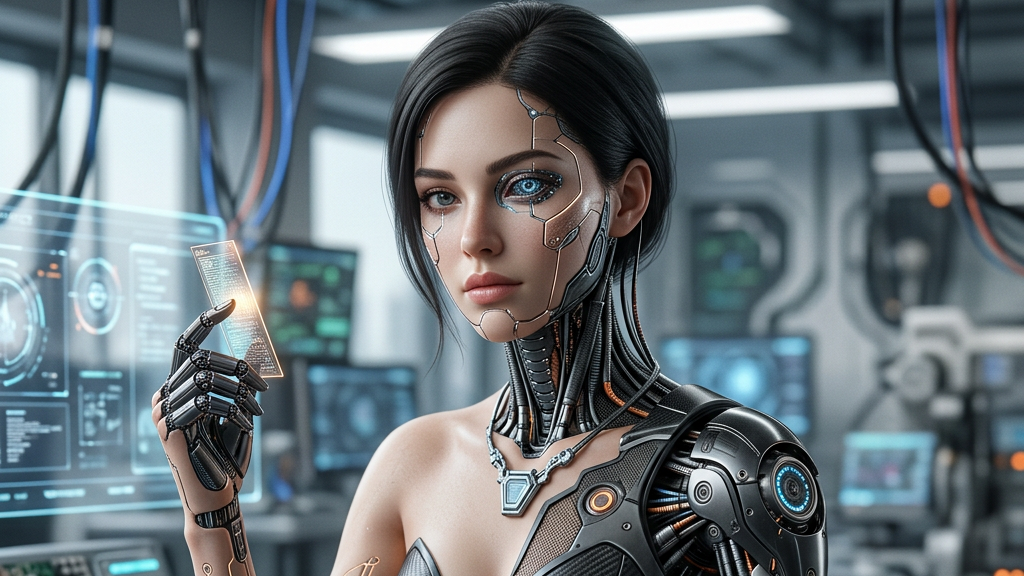
Elon Musk’s New Tesla Robot Prototype With a Female Face Shocked the Industry: The world of robotics is evolving faster than ever, and recent speculation surrounding Tesla’s next-generation humanoid robots has sparked widespread discussion across the technology industry.
While Tesla officially continues to focus on the development of the Tesla Optimus robot for industrial and logistics applications, emerging reports suggest that the company may be exploring a much more ambitious vision: highly realistic humanoid androids featuring synthetic skin, lifelike facial expressions, advanced artificial intelligence, and human-like appearances.
If these rumors prove accurate, Tesla could be preparing one of the most disruptive technological breakthroughs of the century. Such a development would represent a dramatic shift from traditional industrial robots toward intelligent humanoid companions capable of integrating seamlessly into homes, healthcare facilities, businesses, and everyday human environments.
In this article, we’ll explore the technology, potential applications, ethical concerns, market opportunities, and future implications of Tesla’s rumored human-like robot project.
The Evolution of Tesla Optimus: Beyond Industrial Robotics
Tesla’s Optimus project was originally introduced as a practical humanoid robot designed to perform repetitive, dangerous, and physically demanding tasks. The robot was envisioned as a workforce assistant capable of handling logistics, manufacturing operations, warehouse duties, and other labor-intensive activities.
However, industry analysts now believe Tesla may be considering a more advanced category of humanoid robots that look and behave remarkably like humans.
Unlike conventional robots that feature visible metal frames and mechanical joints, these next-generation androids could include:
- Synthetic skin
- Realistic facial structures
- Human-like hair
- Advanced emotional expressions
- Natural voice communication
- Artificial muscles
- Deep integration with Large Language Models (LLMs)
Such capabilities would fundamentally change how humans interact with machines.
Why Artificial Intelligence Changed Everything
For decades, robotics faced a major limitation.
Hardware engineers focused on building machines capable of movement, while software developers worked separately on artificial intelligence systems. The result was highly specialized robots that could perform specific tasks but struggled with real-world adaptability.
Modern Generative AI has dramatically changed that equation.
Today’s advanced AI systems can:
- Understand natural language
- Process visual information in real time
- Recognize objects and people
- Interpret context
- Maintain long conversations
- Learn user preferences
- Respond dynamically to changing environments
This means robots are no longer just mechanical tools. They are becoming the physical embodiment of intelligent digital assistants.
The New Robotics Formula
The future humanoid robot can be viewed as the combination of:
Advanced AI Brain + Human-Like Body = Intelligent Physical Assistant
This convergence of robotics and AI is creating opportunities that seemed impossible only a decade ago.
Building on the Tesla Optimus Foundation
One reason Tesla could potentially move quickly into realistic humanoid robotics is that much of the underlying technology already exists within the Optimus platform.
Developing a lifelike android entirely from scratch would require billions of dollars and many years of research. Instead, Tesla can leverage technologies it has already perfected.
Existing Tesla Optimus Technologies
Tesla has already invested heavily in:
Advanced Actuators
The company has developed sophisticated rotary and linear actuators that enable precise movement while maintaining significant strength.
Battery Technology
Tesla remains a global leader in battery innovation. Efficient battery systems are essential for humanoid robots expected to operate throughout an entire day.
Computer Vision Systems
Tesla’s autonomous driving technology relies on powerful computer vision algorithms trained using massive datasets.
These same technologies can help robots understand and navigate complex environments.
Balance and Locomotion
Walking on two legs remains one of robotics’ greatest engineering challenges. Tesla’s work on bipedal movement provides a significant foundation for future humanoid development.
By combining these existing technologies with realistic cosmetic enhancements, Tesla could accelerate the path toward human-like androids.
The Science Behind Lifelike Humanoid Robots
Creating a robot that looks genuinely human involves far more than attaching synthetic skin to a mechanical skeleton.
Engineers must solve numerous challenges involving:
- Material science
- Sensory feedback
- Facial movement
- Emotional expression
- Heat management
- Durability
Each component must work together seamlessly.
Electronic Skin (E-Skin): The Future of Human-Like Touch
One of the most exciting areas of robotics research is Electronic Skin, commonly known as E-Skin.
Traditional robot coverings suffer from several limitations:
- They tear easily
- They lack realistic texture
- They cannot sense pressure accurately
- They provide little environmental awareness
E-Skin aims to solve these issues.
How E-Skin Works
Electronic Skin consists of flexible synthetic materials embedded with thousands of microscopic sensors.
These sensors continuously collect data from the surrounding environment.
Pressure Detection
The robot can determine exactly how much force to apply when interacting with objects.
For example:
- Holding a fragile glass
- Picking up groceries
- Assisting elderly individuals
- Handling medical equipment
This level of sensitivity dramatically improves safety.
Temperature Awareness
Advanced E-Skin can detect:
- Human body heat
- Hot surfaces
- Environmental temperature changes
This allows the robot to protect both itself and nearby humans.
Self-Diagnostic Capabilities
Future synthetic materials may even identify small tears or structural damage automatically.
The robot could schedule maintenance before a minor issue becomes a major mechanical failure.
Artificial Facial Expressions and Micro-Actuators
Human communication relies heavily on facial expressions.
A smile, raised eyebrow, or subtle glance often conveys more information than words.
To replicate these behaviors, engineers are developing highly sophisticated networks of micro-actuators.
What Are Micro-Actuators?
Micro-actuators are tiny motors positioned beneath synthetic skin.
Thousands of these components may control:
- Eyebrows
- Eyelids
- Cheeks
- Lips
- Jaw movement
Together, they create realistic emotional expressions.
Why Facial Expressions Matter
Without emotional expression, interactions with robots can feel cold and unnatural.
Realistic expressions help create:
- Better communication
- Improved trust
- More natural conversations
- Enhanced user comfort
This technology may become one of the defining features of future humanoid robots.
The Rise of Personalized Androids
Industry observers believe Tesla could introduce extensive customization options if realistic androids become commercially available.
Just as customers customize vehicles, future robot owners may personalize their android companions.
Physical Appearance Customization
Potential options may include:
Skin Tone
Users could select various skin textures and tones.
Hair Styles
Different hairstyles and colors may be available.
Facial Features
Customers might choose unique facial structures to match personal preferences.
Height and Body Configuration
Robots could be optimized for specific environments and tasks.
Behavioral Customization Through AI
Physical appearance is only one aspect of personalization.
Future robots may also feature customized personality profiles.
Voice Customization
Owners could select:
- Voice style
- Speaking speed
- Accent preferences
- Communication tone
Behavioral Profiles
Advanced AI systems may adapt to:
- User habits
- Daily schedules
- Communication preferences
- Family dynamics
This level of personalization could significantly improve user satisfaction.
The iPhone Moment for Robotics
Technology historians often compare transformative innovations to the launch of the original iPhone.
Before smartphones became mainstream, separate devices existed for:
- Communication
- Internet access
- Media consumption
- Productivity
The iPhone unified these capabilities into a single intuitive product.
Many futurists believe realistic humanoid robots could represent a similar turning point.
Moving AI into the Physical World
Current AI assistants exist primarily behind screens.
A humanoid robot changes that dynamic entirely.
Instead of merely providing information, it can physically interact with the world.
Potential tasks include:
- Opening doors
- Carrying objects
- Organizing rooms
- Managing smart homes
- Delivering medication
- Assisting elderly family members
This transforms AI from a passive digital tool into an active physical assistant.
Ethical Challenges of Human-Like Robots
As humanoid robots become increasingly realistic, important ethical questions emerge.
The Uncanny Valley Problem
The Uncanny Valley describes the discomfort humans experience when something appears almost—but not entirely—human.
Robots that closely mimic human appearance may trigger feelings of unease if imperfections become noticeable.
Engineers must carefully balance realism and user comfort.
Emotional Attachment to AI Companions
Future androids may remember years of interactions with their owners.
They could:
- Recall conversations
- Recognize emotional patterns
- Offer personalized support
- Simulate empathy
While these features may provide significant benefits, they also raise concerns.
Potential Risks
Experts worry that some individuals may develop deep emotional attachments to machines.
Particularly vulnerable groups include:
- Children
- Elderly individuals
- Socially isolated people
This raises important questions about companionship, emotional dependency, and human relationships.
How Humanoid Robots Could Transform the Workforce
One of the most significant impacts of advanced humanoid robotics will likely be labor market disruption.
Industries Most Likely to Change
Humanoid robots could influence:
Logistics
Warehouse operations may become increasingly automated.
Hospitality
Hotels, restaurants, and customer service environments could deploy humanoid assistants.
Security
Robots may handle routine monitoring and patrol functions.
Administrative Support
Basic clerical and organizational tasks could become automated.
Healthcare
Medical support and patient monitoring may see major advancements through robotics.
The Growing Demand for Elderly Care Robots
Perhaps the strongest economic argument for advanced humanoid robotics comes from demographic trends.
Many countries are facing rapidly aging populations.
Regions Facing Demographic Challenges
These include:
As populations age, demand for healthcare and caregiving services continues to rise.
At the same time, workforce availability is declining.
How Humanoid Robots Can Help
Future androids could assist with:
- Medication management
- Mobility support
- Vital sign monitoring
- Emergency response
- Daily household tasks
This may become one of the earliest large-scale commercial applications for lifelike robotics.
Tesla Robot Pricing and Market Predictions
Like most revolutionary technologies, realistic humanoid robots will likely debut at premium prices.
Phase 1: Late 2020s
Early prototypes may enter:
- Research facilities
- Corporate testing programs
- Medical institutions
Estimated pricing could range between $50,000 and $100,000 per unit.
Phase 2: Mid-2030s
As manufacturing scales and supply chains mature:
- Production costs should decline
- Adoption rates may increase
- Consumer availability could expand
At this stage, owning a humanoid robot may become financially comparable to purchasing a family vehicle.
Will Tesla Actually Build Human-Like Androids?
At present, Tesla has not officially confirmed the development of ultra-realistic humanoid robots featuring female faces, synthetic skin, or emotional expression systems.
The company’s public focus remains centered on Tesla Optimus and industrial automation.
However, technology history repeatedly demonstrates that revolutionary products often begin as speculation long before becoming reality.
Many innovations once dismissed as science fiction eventually transformed everyday life:
- Smartphones
- Electric vehicles
- Artificial intelligence
- Autonomous driving
- Virtual assistants
Humanoid robotics may be next.
Conclusion
The possibility of Elon Musk’s new Tesla robot prototype with a female face represents far more than a cosmetic redesign of existing robotics technology. It signals a potential shift toward a future where intelligent machines become deeply integrated into human society.
By combining Tesla Optimus technology, advanced AI models, electronic skin, micro-actuator facial systems, and personalized behavioral profiles, Tesla could help usher in a new era of human-machine interaction.
While significant technical, ethical, and regulatory challenges remain, the momentum behind humanoid robotics continues to grow. Whether these rumored Tesla androids arrive in the late 2020s or later, one thing is clear: the boundary between science fiction and reality has never been thinner.
The next decade may determine whether lifelike humanoid robots become one of the most important technological breakthroughs in modern history.
FAQs
1. What is Tesla’s new robot prototype with a female face?
Tesla’s rumored new robot prototype is believed to be a highly realistic humanoid android featuring synthetic skin, lifelike facial expressions, advanced AI, and a more human-like appearance compared to the industrial-focused Tesla Optimus robot.
2. Has Tesla officially confirmed the development of a female-faced humanoid robot?
No. Tesla has not officially confirmed the existence of a female-faced humanoid robot. Current discussions are based on industry speculation, analyst reports, and rumors surrounding Tesla’s future robotics roadmap.
3. How is this robot different from Tesla Optimus?
Tesla Optimus is primarily designed for industrial and logistical tasks. The rumored humanoid android would focus on human interaction, realistic appearance, emotional expression, and domestic assistance, making it suitable for homes, healthcare, and service industries.
4. What technologies could power Tesla’s realistic humanoid robots?
Potential technologies include Large Language Models (LLMs), electronic skin (E-Skin), advanced computer vision, artificial muscles, micro-actuators for facial expressions, and Tesla’s existing battery and robotics systems.
5. What is Electronic Skin (E-Skin)?
Electronic Skin (E-Skin) is a synthetic material embedded with thousands of microscopic sensors that allow robots to detect pressure, temperature, touch, and environmental changes, helping them interact safely with humans and objects.
6. Can Tesla’s humanoid robot display emotions?
The robot would not experience real emotions but could simulate emotional responses through advanced AI and facial micro-actuators. This would allow it to display smiles, surprise, concern, and other expressions during interactions.
7. What tasks could a Tesla humanoid robot perform at home?
A future Tesla android could potentially assist with household chores, organize items, manage smart home devices, monitor health conditions, provide companionship, carry objects, and help elderly family members with daily activities.
8. Could users customize the appearance of their Tesla robot?
Industry analysts believe Tesla may offer customization options such as skin tone, hairstyle, facial features, height, voice settings, and personality profiles, similar to configuring a vehicle before purchase.
9. How would artificial intelligence improve humanoid robots?
Advanced AI would enable robots to understand conversations, recognize people, interpret visual information, remember user preferences, adapt to routines, and make intelligent decisions in real-world environments.
10. What industries could benefit from humanoid robots?
Potential industries include healthcare, hospitality, logistics, warehousing, retail, customer service, security, elderly care, and administrative support.
11. Will humanoid robots replace human jobs?
Humanoid robots may automate repetitive and physically demanding tasks, potentially transforming some job sectors. However, they are also expected to create new opportunities in robotics engineering, AI development, maintenance, and human-machine collaboration.
12. What is the Uncanny Valley effect?
The Uncanny Valley is a psychological phenomenon where a robot appears almost human but not perfectly human, causing discomfort or unease among observers due to subtle imperfections.
13. Why are aging populations driving demand for humanoid robots?
Countries with aging populations face growing healthcare and caregiving needs while experiencing workforce shortages. Humanoid robots could help provide assistance, monitoring, mobility support, and companionship for elderly individuals.
14. How much could a Tesla humanoid robot cost?
Early estimates suggest advanced humanoid robots may initially cost between $50,000 and $100,000 during the first commercial phases. Prices could decrease significantly as production scales in the 2030s.
15. When could realistic Tesla humanoid robots become available?
Analysts speculate that limited pilot programs could begin in the late 2020s, while broader consumer availability may emerge during the mid-2030s as manufacturing technology becomes more affordable.
16. Could Tesla’s humanoid robots change everyday life?
Yes. If successfully developed, realistic humanoid robots could transform daily life by acting as personal assistants, caregivers, household helpers, workplace support staff, and physical extensions of advanced artificial intelligence systems.
Read More:
- SpaceX Reveals New Starship Launch Date to Make History in ORBIT! Never Done Before
- Starship Flight 13 Testing in Line — What’s Next for SpaceX?
- Something Weird is Happening With The SpaceX IPO
- SpaceX (SPCX) IPO is live today at $135: Here’s exactly what you need to know
- New Tesla Battery Technology! Tesla Model 2: Elon Musk’s 4680 Battery EXPOSED
2 thoughts on “Elon Musk’s New Tesla Robot Prototype With a Female Face Shocked the Industry”