
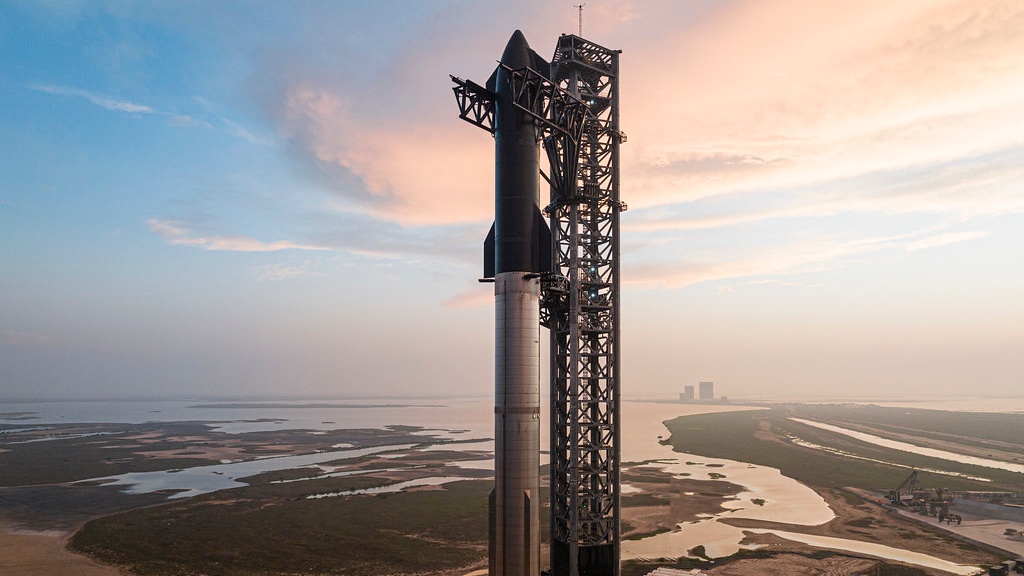
Starship Booster 20 ready to FIRE 33 Raptor in Hours…Final Preparation is Kind of Mind-Blowing: The countdown to SpaceX Starship Flight 13 has entered its most exciting stage. At the company’s Starbase facility in Boca Chica, Texas, engineers are working around the clock to prepare Booster 20 (B20) and Starship Upper Stage 40 (S40) for what could become another historic milestone in reusable rocket development.
Unlike previous launch campaigns, SpaceX is dramatically compressing weeks of testing into a continuous, high-intensity workflow, proving that the company is moving closer to its goal of rapid, airline-like space operations.
Beyond the launch itself, Starship is becoming a major player in the global space economy with new commercial contracts, lunar cargo missions, and increasing interest from military launch programs. Here’s everything happening before Flight 13.
Booster 20 Rolls to the Launch Pad
One of the biggest milestones has already taken place as Super Heavy Booster 20 successfully rolled out from the Mega Bay to Orbital Launch Pad 2.
This move officially marks the beginning of the final launch campaign. After transportation using self-propelled modular transporters, the massive booster was carefully positioned beneath the launch tower where SpaceX’s famous “chopstick” arms lifted it onto the Orbital Launch Mount (OLM).
The rollout required carefully planned road closures during the early morning hours, ensuring the enormous vehicle could safely reach the launch complex.
With Booster 20 now installed on the launch mount, the next major milestone is the highly anticipated 33-engine static fire test.
Starship Flight 13 Launch Date
Current regulatory notices now point toward July 15, 2026, as the primary launch target after earlier FAA documents suggested July 14.
The updated launch timeline includes:
Flight 13 Preparation Timeline
- July 9: Booster 20 rollout and mounting
- Next Step: Full 33-Raptor static fire
- Launch Week: Final stacking and Flight Termination System checks
- Primary Launch Target: July 15, 2026
SpaceX also prepared backup transportation windows to avoid delays caused by weather or technical issues, highlighting the company’s focus on maintaining an aggressive launch schedule.
The Massive 33-Raptor Static Fire Test
Perhaps the most exciting event before launch is the full-duration static fire, where all 33 Raptor engines ignite simultaneously while the booster remains secured to the launch pad.
Together these engines generate over 9,000 metric tons of thrust, making Super Heavy the most powerful rocket booster ever built.
Why This Test Matters
Although the spectacle of 33 engines firing together attracts worldwide attention, SpaceX engineers are focused on collecting valuable performance data.
Key Objectives Include
1. Verify Flight 12 Upgrades
Engineers want to confirm that software and hardware improvements have completely eliminated the engine shutdown issues observed during Flight 12.
2. Combustion Performance
The test pushes engines close to operational limits to study combustion stability, startup timing, fuel flow, and turbopump behavior.
3. Structural and Acoustic Testing
The enormous vibrations produced during ignition create intense acoustic forces. Engineers will verify that these vibrations do not damage electronics, plumbing, or structural components.
Successfully completing this test would represent one of the final major hurdles before launch.
Pad 2 Receives Major Infrastructure Upgrades
Preparing Starship isn’t only about the rocket itself.
SpaceX has been heavily upgrading Ground Support Equipment (GSE) at Pad 2, making operations faster, smoother, and more reliable.
New Electric Chopstick System
The launch tower’s giant mechanical arms recently completed several hours of testing after receiving important upgrades.
Instead of relying solely on hydraulic systems, SpaceX has begun replacing key components with precision electric actuators.
The benefits include:
- Less vibration
- Higher positioning accuracy
- Reduced mechanical wear
- Improved booster catching capability
- More stable vehicle lifting operations
These upgrades are expected to improve future booster recovery operations significantly.
Booster Quick Disconnect System Tested
Engineers also completed extensive testing of the Booster Quick Disconnect (BQD) system.
This critical hardware connects the booster to:
- Liquid methane
- Liquid oxygen
- Power
- Communication systems
- Pressurization lines
During testing, engineers cycled protective covers, extended and retracted umbilicals, and performed high-pressure gas purge operations to ensure there were no cryogenic leaks before launch.
Starship Upper Stage 40 Completes Static Fire
While Booster 20 dominates headlines, Starship Upper Stage 40 (S40) has quietly completed its own important testing campaign.
At the Massey’s test facility, S40 successfully performed:
Single Engine Static Fire
followed by
Full Six-Engine Static Fire
Completing both tests within roughly 10 days demonstrates SpaceX’s rapidly improving production and testing cadence.
S40 has now returned to Mega Bay 2, where engineers are carrying out inspections while integrating its payload systems before stacking atop Booster 20.
Starship’s Commercial Business Is Growing Fast
Although NASA’s Artemis program remains one of Starship’s biggest priorities, the rocket is rapidly becoming the preferred transportation system for commercial lunar missions and private space infrastructure.
Several major contracts highlight Starship’s growing importance.
iSpace Books $50 Million Starship Mission
Japanese lunar exploration company iSpace recently signed an agreement with SpaceX to purchase approximately 500 kilograms of dedicated cargo capacity aboard a future Starship mission.
The contract is reportedly valued at approximately $50 million, with launch planned no earlier than 2030.
Mission Goals
Using Starship’s enormous payload capacity, iSpace plans to transport its Mobile Cargo System (MCS) to the Moon.
The robotic platform will deploy:
- Solar power systems
- Communication equipment
- Scientific instruments
- Infrastructure for future lunar operations
Despite experiencing landing failures during previous Moon missions, iSpace continues investing in Starship because of its unmatched cargo capability.
Even Bigger Commercial Missions Ahead
Starship’s commercial pipeline extends well beyond lunar cargo.
Astrolab Lunar Rover
Astrolab plans to launch an advanced next-generation lunar rover aboard an uncrewed Starship mission.
Thanks to Starship’s enormous payload bay, the rover will be significantly larger than any previously delivered to the Moon.
Voyager Space’s Starlab
Another landmark agreement involves Voyager Space, which intends to launch its Starlab commercial space station aboard a single Starship flight expected in 2028.
Rather than assembling multiple modules in orbit through numerous launches, Starship’s massive payload fairing allows the entire station to launch in one integrated mission.
This dramatically reduces complexity, costs, and mission risk.
US Space Force Expands National Security Launch Competition
Starship’s growing influence comes as the United States Space Force reshapes its National Security Space Launch (NSSL) Phase 3 program.
Instead of relying primarily on SpaceX and United Launch Alliance, the military is encouraging additional commercial providers to strengthen industrial resilience.
Relativity Space Joins the Program
Relativity Space has entered the Lane 1 framework with its developing Terran R reusable rocket.
Although Terran R has not yet flown, it is designed to compete directly in the medium-to-heavy lift launch market.
Impulse Space Brings Space Tug Technology
Another significant addition is Impulse Space.
Rather than building launch rockets, the company develops orbital transfer vehicles, often called space tugs.
Its Helios kickstage is designed to receive satellites in low Earth orbit before transporting them into highly specialized destinations such as:
- Geostationary Orbit (GEO)
- High-energy transfer orbits
- Deep-space trajectories
This approach allows different companies to handle different parts of a mission, creating a far more flexible transportation ecosystem.
Why Flight 13 Could Be a Turning Point
Starship Flight 13 is much more than another test launch.
It represents the next step toward high-frequency reusable spaceflight, where launch vehicles, launch pads, and ground systems operate with unprecedented speed and efficiency.
The combination of:
- Booster 20’s 33-engine verification
- Upgraded launch infrastructure
- Successful S40 testing
- Growing commercial contracts
- International lunar partnerships
- Expanding military launch opportunities
shows that Starship is evolving into a complete space transportation platform, not simply an experimental rocket.
If the upcoming static fire succeeds and the July 15 launch proceeds as planned, Flight 13 could become one of the most important demonstrations of SpaceX’s long-term vision. It will showcase not only the raw power of 33 Raptor engines but also the remarkable progress toward creating a fully reusable, high-capacity, industrial-scale space transportation system capable of supporting lunar exploration, commercial space stations, national security missions, and eventually human journeys to Mars.
FAQs
1. What is Starship Flight 13?
Starship Flight 13 is the latest integrated test flight of SpaceX’s fully reusable Starship launch system, featuring Super Heavy Booster 20 and Starship Upper Stage 40.
2. When is the Starship Flight 13 launch scheduled?
The current target launch date is July 15, 2026, although SpaceX may adjust the schedule depending on weather, technical readiness, or regulatory approvals.
3. Why is Booster 20 important?
Booster 20 (B20) is the Super Heavy first-stage rocket that will power Starship off the launch pad using 33 Raptor engines, making it one of the most powerful rocket boosters ever built.
4. What is the 33-Raptor engine static fire test?
The static fire test is a pre-launch procedure where all 33 Raptor engines ignite simultaneously while the booster remains secured to the launch mount to verify engine performance and system reliability.
5. How much thrust do the 33 Raptor engines produce?
When operating together, the 33 Raptor engines generate more than 9,000 metric tons of thrust, making Super Heavy the most powerful rocket booster developed to date.
6. What upgrades were made after Starship Flight 12?
SpaceX introduced software improvements, engine reliability updates, combustion refinements, and structural enhancements to reduce engine shutdown issues and improve overall flight performance.
7. What improvements were made to Launch Pad 2?
SpaceX upgraded the launch tower with precision electric actuators, improved the Booster Quick Disconnect (BQD) system, and completed extensive testing of ground support equipment for smoother launch operations.
8. What is Starship Upper Stage 40 (S40)?
Starship Upper Stage 40 is the spacecraft that sits atop Booster 20. It has successfully completed both single-engine and six-engine static fire tests ahead of Flight 13.
9. What is the iSpace Starship contract?
Japanese company iSpace signed an estimated $50 million agreement with SpaceX to launch approximately 500 kilograms of lunar cargo aboard a future Starship mission planned for 2030 or later.
10. What is the Mobile Cargo System (MCS)?
The Mobile Cargo System (MCS) is a robotic lunar cargo platform developed by iSpace to transport equipment, deploy infrastructure, and support future Moon exploration missions.
11. How will Starship help commercial space stations?
Starship’s massive payload capacity allows companies like Voyager Space to launch an entire commercial space station, such as Starlab, in a single mission instead of multiple launches.
12. Why is the US Space Force expanding the NSSL program?
The National Security Space Launch (NSSL) Phase 3 program aims to increase competition, improve launch flexibility, and strengthen the resilience of America’s national security space capabilities.
13. What is Relativity Space’s role in the NSSL program?
Relativity Space has joined the NSSL Phase 3 Lane 1 framework with its upcoming Terran R reusable rocket, which is designed for medium-to-heavy lift missions.
14. What does Impulse Space do?
Impulse Space develops orbital transfer vehicles, or space tugs, such as the Helios kickstage, which move satellites from low Earth orbit to higher-energy or specialized orbits.
15. Why is Starship considered revolutionary?
Starship combines full reusability, enormous payload capacity, rapid launch turnaround, and low-cost transportation, making it suitable for missions to Earth orbit, the Moon, Mars, and beyond.
16. Why is Starship Flight 13 significant?
Starship Flight 13 is expected to validate major hardware upgrades, demonstrate improved launch infrastructure, and showcase SpaceX’s progress toward building a high-frequency, fully reusable space transportation system for commercial, scientific, and national security missions.
Read More:
- SpaceX Turning Starship Testing Up a Notch, Never Seen Before
- Tesla FSD is about to know your specific house and neighborhood better than any map
- Tesla battery recycling efforts increased 20 percent last year
- Radiologist who drove Tesla off cliff has attempted murder charges dismissed
- Tesla Semi’s Next Upgrade Will Change Truck Safety Forever
1 thought on “Starship Booster 20 ready to FIRE 33 Raptor in Hours…Final Preparation is Kind of Mind-Blowing”