
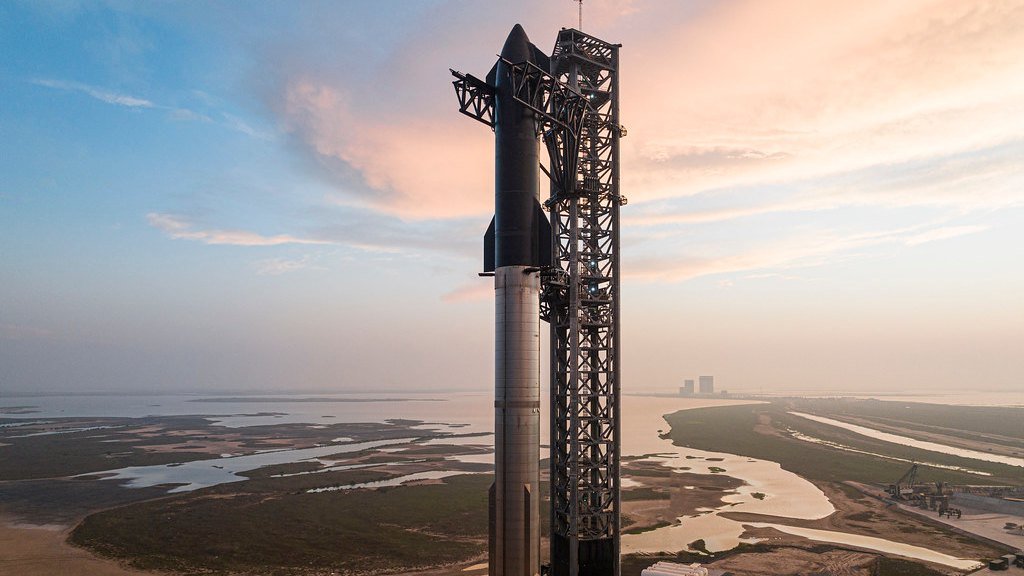
Elon Musk just Revealed Starship Flight 14 Launch Date & Goals Beyond What We Expected: The commercial space industry is entering a new era, and Starship Flight 14 could become one of the most important missions in modern aerospace history. Following the success of Starship Flight 13, Elon Musk has officially revealed SpaceX’s ambitious plans for the next launch during the company’s Q2 financial and operational update.
The upcoming mission isn’t just another test flight. It is expected to introduce the first operational orbital mission, deploy Starlink V3 satellites, and potentially attempt the first-ever catch of Starship’s upper stage using the massive Mechazilla launch tower.
At the same time, the global space industry is experiencing significant changes. European launch startup Rocket Factory Augsburg (RFA) has delayed its maiden orbital mission, while satellite communications giant EchoStar’s Hughes business has filed for Chapter 11 bankruptcy, highlighting how rapidly Low Earth Orbit (LEO) satellite networks are disrupting traditional Geostationary Orbit (GEO) systems.
Let’s take a detailed look at everything happening in the aerospace industry.
Starship Flight 14 Launch Date: When Will SpaceX Launch?
According to Elon Musk, Starship Flight 14 is currently targeting a late August launch window, provided regulatory approvals and final testing proceed as planned.
This timeline supports SpaceX President Gwynne Shotwell’s vision of achieving a monthly Starship launch cadence, something never before accomplished with a super-heavy launch vehicle.
If successful, SpaceX would establish an entirely new operational standard for reusable rockets.
Why Monthly Launches Matter
Traditional launch providers often require several months between missions.
SpaceX, however, aims to reduce turnaround time to approximately 30 days, dramatically lowering launch costs while increasing launch availability for commercial, scientific, and government missions.
This rapid cadence is one of the biggest competitive advantages SpaceX has built through continuous hardware improvements and fast manufacturing.
Starship Flight 14 Hardware Is Nearly Ready
One reason SpaceX can target another launch so quickly is that much of the hardware preparation was completed well before Flight 13.
Ship 41
The upper-stage vehicle, Ship 41, successfully completed cryogenic proof testing in June and only requires final engine installation, inspections, and static fire testing.
Booster 21
Similarly, Booster 21 completed cryogenic testing before Flight 13, allowing engineers to focus on integration and engine validation rather than structural testing.
With static fire tests expected early in the month, SpaceX remains on track for its planned launch schedule.
Starship Flight 14 Will Reach True Orbit
Unlike the previous thirteen Starship missions, which followed carefully planned suborbital trajectories, Starship Flight 14 is expected to enter a true operational orbit.
This is a major milestone.
Previous flights intentionally re-entered Earth’s atmosphere over the Indian Ocean after testing propulsion, guidance, and re-entry systems.
An orbital mission changes everything.
Once Starship successfully reaches orbit, it can begin deploying commercial payloads, perform longer-duration missions, and support future lunar and Mars operations.
Starlink V3 Satellites Will Make Their Operational Debut
Perhaps the biggest commercial objective of Starship Flight 14 is deploying the first operational Starlink Version 3 (V3) satellites.
During Flight 13, prototype V3 satellites were carried primarily for testing.
Flight 14 is expected to deploy fully operational satellites into orbit.
Why Starlink V3 Is Important
The new generation of Starlink satellites offers several significant improvements:
- Higher bandwidth capacity
- Larger satellite architecture
- Improved Direct-to-Cell capabilities
- Greater network efficiency
- More users served per satellite
Unlike the smaller Starlink V2 Mini satellites launched aboard Falcon 9, Starlink V3 has been specifically designed to utilize Starship’s enormous payload capacity.
This dramatically increases the number of satellites that can be deployed during each mission while reducing launch costs.
SpaceX Could Attempt Its Most Difficult Landing Yet
One of the most exciting announcements involves SpaceX’s plan to attempt catching the Starship upper stage using the launch tower’s mechanical arms.
This would be a historic achievement.
Why Catching Starship Is So Difficult
Recovering the upper stage is considerably harder than catching the Super Heavy booster.
The spacecraft must:
- Re-enter Earth’s atmosphere at approximately Mach 25
- Survive extreme temperatures using thousands of heat shield tiles
- Execute its famous belly-flop maneuver
- Rotate into a vertical position
- Align perfectly with the launch tower’s chopsticks
Any error during these final seconds could result in mission failure.
Successfully catching Starship would represent another massive step toward fully reusable space transportation.
Booster Catch May Be Delayed
Interestingly, Elon Musk suggested that SpaceX may not attempt to catch both the booster and upper stage during the same mission.
There are practical reasons behind this decision.
Currently, Starbase has only one operational launch tower.
Engineers would have very little time to recover the booster, reposition equipment, and prepare the tower before Starship returns from orbit.
Additionally, SpaceX continues refining Raptor engine performance based on data collected during previous missions.
Once the second launch pad becomes operational, simultaneous recoveries should become much more practical.
Rocket Factory Augsburg Faces Another Delay
While SpaceX continues accelerating development, Europe is still working toward independent launch capability.
German launch startup Rocket Factory Augsburg (RFA) recently experienced a setback during integrated testing of its RFA1 rocket at SaxaVord Spaceport in Scotland.
Engineers detected a technical anomaly during launch pad testing.
As a result, the company decided to:
- Destack the rocket
- Investigate the issue
- Delay its inaugural orbital launch
Although disappointing, such testing delays are common during the development of new launch systems.
Why Europe Needs Independent Launch Access
Europe has historically relied on launch facilities such as French Guiana for many orbital missions.
However, increasing demand for satellite launches, defense missions, and commercial space services has created strong pressure for domestic launch capability.
Companies like Rocket Factory Augsburg hope to provide:
- Lower launch costs
- Faster launch schedules
- Independent European access to orbit
- Support for commercial satellite constellations
The market opportunity remains enormous despite current delays.
EchoStar’s Hughes Bankruptcy Highlights a Major Industry Shift
Beyond rockets, the satellite communications industry is also undergoing dramatic transformation.
EchoStar’s Hughes division recently filed for Chapter 11 bankruptcy protection after facing significant financial pressure.
The company reported:
- A $1.5 billion debt maturity
- Declining subscriber numbers
- Increased competition from Low Earth Orbit satellite providers
Rather than focusing on residential internet, Hughes now plans to prioritize enterprise, aviation, government, and defense services.
LEO vs GEO: Why Starlink Is Winning
One of the biggest reasons behind Starlink’s rapid growth is latency.
Traditional Geostationary Orbit (GEO) satellites orbit approximately 36,000 kilometers above Earth.
This results in latency around 600 milliseconds.
In contrast, Low Earth Orbit (LEO) satellites operate roughly 550 kilometers above Earth, delivering latency between 20–40 milliseconds.
This provides significant advantages for:
- Online gaming
- Video conferencing
- Remote work
- Cloud computing
- Interactive applications
As Starship Flight 14 begins deploying larger numbers of Starlink V3 satellites, SpaceX is expected to widen the performance gap between LEO and GEO satellite internet services even further.
What Starship Flight 14 Means for the Future of Space Exploration
The significance of Starship Flight 14 extends far beyond a single rocket launch.
This mission could become the turning point that transforms Starship from an experimental vehicle into a fully operational launch system.
If successful, Flight 14 would:
- Demonstrate true orbital capability.
- Deploy the first operational Starlink V3 satellites.
- Attempt the first-ever upper-stage catch using Mechazilla.
- Move SpaceX closer to achieving monthly Starship launches.
- Accelerate progress toward fully reusable rockets.
- Strengthen SpaceX’s position as the world’s leading commercial launch provider.
These milestones also support NASA’s Artemis program, future lunar missions, commercial satellite deployment, and ultimately Elon Musk’s long-term vision of making humanity a multi-planetary species.
Final Thoughts
Starship Flight 14 has all the ingredients to become one of the most historic launches in SpaceX history. From achieving true orbital flight and deploying Starlink V3 satellites to attempting an unprecedented upper-stage catch, the mission showcases how quickly SpaceX is advancing reusable rocket technology.
Meanwhile, challenges faced by Rocket Factory Augsburg and the financial struggles of EchoStar’s Hughes division demonstrate how rapidly the global aerospace and satellite industries are evolving.
As SpaceX pushes toward monthly Starship launches, the company continues to reshape the future of space transportation, satellite communications, and deep-space exploration. All eyes are now on Starbase, Texas, where final testing and static fire campaigns will determine whether Starship Flight 14 launches on schedule and takes another giant leap toward the future of spaceflight.
FAQs
1. What is Starship Flight 14?
Starship Flight 14 is SpaceX’s next planned Starship mission, expected to achieve its first true orbital flight, deploy operational Starlink V3 satellites, and potentially attempt the first-ever catch of the Starship upper stage using the Mechazilla launch tower.
2. When is Starship Flight 14 expected to launch?
SpaceX is targeting a late August launch window for Starship Flight 14, subject to successful testing and regulatory approvals.
3. What are the main objectives of Starship Flight 14?
The primary goals include reaching operational orbit, deploying Starlink V3 satellites, testing full mission capabilities, and attempting to recover the Starship upper stage using the launch tower’s chopstick arms.
4. Will Starship Flight 14 carry Starlink satellites?
Yes. Starship Flight 14 is expected to deploy the first operational Starlink Version 3 (V3) satellites, marking a major milestone for SpaceX’s satellite internet network.
5. What is different about Starlink V3 satellites?
Starlink V3 satellites are larger, more powerful, and capable of delivering significantly higher bandwidth than previous Starlink V2 Mini satellites. They are also designed to support advanced services, including Direct-to-Cell connectivity.
6. Why is Starship Flight 14 important?
Starship Flight 14 could mark the transition from experimental testing to operational missions, proving Starship’s ability to launch payloads into orbit and move closer to full reusability.
7. Will SpaceX attempt to catch the Starship upper stage?
Yes. Elon Musk has indicated that SpaceX may attempt to catch the returning Starship upper stage using the Mechazilla launch tower, making it one of the mission’s most ambitious objectives.
8. Why is catching the Starship upper stage so difficult?
The spacecraft must survive atmospheric re-entry at extremely high speeds, perform a controlled belly-flop maneuver, flip vertically, and align precisely with the launch tower for a safe catch.
9. Will SpaceX recover both the booster and the upper stage during Flight 14?
SpaceX may prioritize recovering the upper stage first. Catching both stages during the same mission could be delayed until operational procedures and infrastructure are further refined.
10. What is SpaceX’s monthly launch cadence?
SpaceX aims to launch Starship approximately once every 30 days. Achieving this rapid launch cadence would set a new benchmark for reusable heavy-lift rockets.
11. What happened to Rocket Factory Augsburg (RFA)?
Rocket Factory Augsburg postponed the first launch of its RFA1 rocket after engineers discovered a technical anomaly during integrated launch pad testing at SaxaVord Spaceport in Scotland.
12. Why did EchoStar’s Hughes business file for Chapter 11 bankruptcy?
EchoStar’s Hughes division filed for Chapter 11 restructuring due to significant debt obligations, declining subscriber numbers, and increasing competition from Low Earth Orbit satellite internet providers like Starlink.
13. What is the difference between LEO and GEO satellites?
Low Earth Orbit (LEO) satellites operate much closer to Earth, providing lower latency and faster internet speeds. Geostationary Orbit (GEO) satellites orbit much farther away, resulting in higher latency and slower response times for real-time applications.
14. How does Starship Flight 14 support future space exploration?
By validating orbital operations, payload deployment, and reusable landing technologies, Starship Flight 14 helps pave the way for future lunar missions, Mars exploration, and large-scale commercial space operations.
15. Why is Starship considered the future of spaceflight?
Starship is designed to be a fully reusable, super-heavy launch system capable of carrying massive payloads at significantly lower costs. Its rapid reusability and high payload capacity have the potential to transform satellite deployment, deep-space exploration, and human space travel.
Read More:
- Elon Musk’s First Fully Autonomous Tesla CyberHouse Is Now For Sale
- SpaceX reports beat in first earnings while minimizing losses
- SpaceX and Nvidia team up on Musk’s orbital AI bet
- SpaceX shorts get warned by Musk ally, echoing Tesla’s early struggles
- SpaceX is coming for wireless giants with Starlink Mobile