
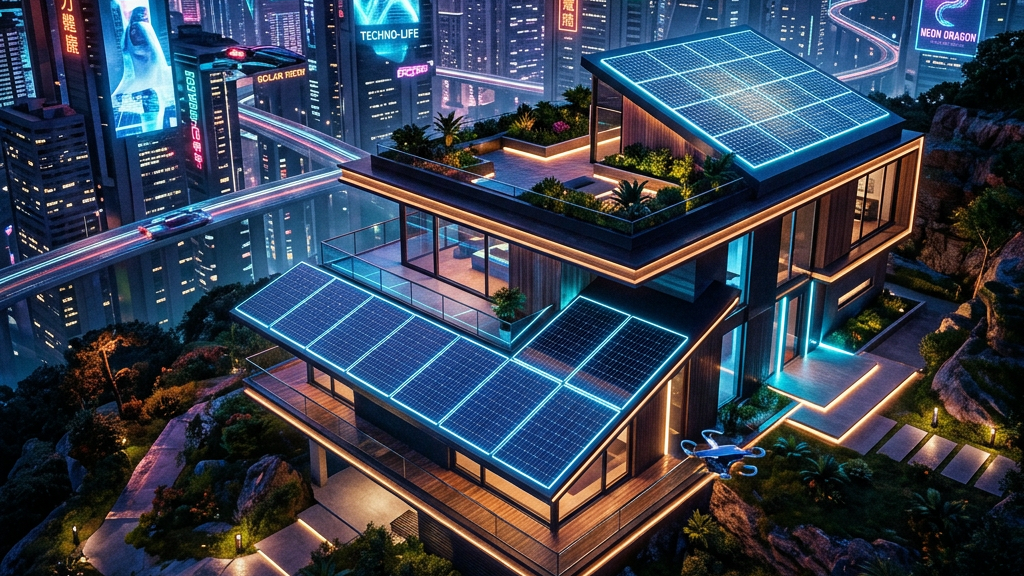
Elon Musk’s First Fully Autonomous Tesla CyberHouse Is Now For Sale: The idea of a Tesla CyberHouse has become one of the hottest discussions in the world of smart homes, renewable energy, and artificial intelligence. While social media is flooded with viral videos claiming that Elon Musk has already launched a futuristic autonomous home, the truth is much more interesting.
Tesla has not officially announced a CyberHouse product. However, the company now possesses every major technology needed to build a fully autonomous, energy-independent residential ecosystem. From Solar Roofs and Powerwall batteries to Tesla EVs, Optimus humanoid robots, AI-powered automation, and Starlink satellite internet, Tesla already has the foundation to revolutionize modern housing.
Could Tesla become the world’s next major home builder? Let’s explore the technology, architecture, pricing, and future possibilities behind the concept of the Tesla CyberHouse.
What Is the Tesla CyberHouse?
The Tesla CyberHouse is a theoretical next-generation smart home designed around Tesla’s complete ecosystem rather than traditional construction methods.
Instead of simply selling individual products like solar panels, battery storage, or electric vehicles, Tesla could combine everything into one intelligent living platform.
Imagine a home where:
- Solar energy powers your entire property.
- Powerwall batteries store electricity automatically.
- Your Tesla vehicle serves as an emergency backup battery.
- Artificial Intelligence controls lighting, heating, cooling, and security.
- An Optimus robot performs daily household chores.
- Starlink keeps the home connected even during power outages.
Rather than being just another smart house, the CyberHouse represents an entirely new way of living.
Tesla’s Shift from Cars to Complete Energy Ecosystems
Tesla originally focused on manufacturing electric vehicles, but over the past decade the company has quietly expanded into multiple industries.
Today Tesla already offers:
Solar Energy Systems
Tesla’s Solar Roof converts sunlight into clean electricity throughout the day.
Powerwall Battery Storage
The Powerwall stores excess solar energy for nighttime use or emergency backup during outages.
Electric Vehicle Integration
Future Tesla vehicles could act as massive mobile batteries using Vehicle-to-Home (V2H) technology, allowing homeowners to power their houses directly from their cars.
Artificial Intelligence
Tesla’s advanced AI software already powers Autopilot and Full Self-Driving (FSD) technology. Similar machine learning could manage an entire home’s energy usage.
Optimus Robotics
Tesla’s humanoid Optimus robot is being developed to perform repetitive physical tasks, making it a perfect companion for autonomous living.
Together, these technologies create the building blocks for a completely integrated home ecosystem.
Revolutionary Home Design Instead of Traditional Construction
Unlike conventional builders, Tesla would likely treat houses much like it designs its vehicles—with manufacturing efficiency, software integration, and continuous improvements.
Factory-Built Modular Construction
Instead of building homes brick by brick, Tesla could manufacture large modular sections inside automated factories.
These pre-built modules would arrive fully wired, insulated, and tested before being assembled on-site within days instead of months.
This approach offers several benefits:
- Faster construction
- Lower manufacturing costs
- Higher quality control
- Reduced labor requirements
Giga Casting Could Transform Housing
Tesla revolutionized automobile production through Giga Casting, replacing hundreds of individual parts with large single-piece aluminum structures.
Applying the same concept to housing could dramatically simplify construction.
Benefits may include:
- Stronger structural integrity
- Fewer assembly components
- Faster manufacturing
- Lower maintenance costs
The CyberHouse could feature minimalist geometric architecture inspired by the Cybertruck, complete with stainless steel panels, electrochromic smart glass, and hidden lighting systems.
Expandable Modular Living Spaces
Instead of forcing homeowners to buy oversized houses, Tesla could introduce a modular design.
A typical CyberHouse might begin as a compact 50–70 square meter living space.
As families grow, additional modules could simply connect to the original structure, automatically integrating electrical systems, plumbing, ventilation, and internet connectivity.
This creates a home that grows alongside its owner.
AI-Powered Autonomous Living
Perhaps the most exciting feature of the Tesla CyberHouse would be its intelligent operating system.
Automated Energy Management
Using weather forecasts, electricity prices, and household behavior, Tesla’s AI could continuously optimize energy consumption.
For example:
- On sunny days, charging is delayed until solar production peaks.
- During cloudy weather, batteries charge overnight when electricity is cheaper.
- Before heat waves, the AI cools the home early using stored energy.
- During grid failures, power instantly switches to Solar Roofs, Powerwalls, and Tesla vehicles.
Everything happens automatically without homeowner intervention.
Your Garage Becomes a Personal Power Station
The CyberHouse garage would become the center of the home’s energy network.
It could contain:
- Multiple Powerwall battery systems
- Bi-directional EV charging stations
- Solar inverters
- Smart electrical distribution panels
An idle Tesla vehicle could provide over 100 kWh of emergency electricity, keeping the home operational during extended blackouts.
Optimus Robot Takes Care of Household Chores
The future CyberHouse could be specifically designed for Tesla’s Optimus robot.
Unlike existing homes, every room would be optimized for robotic movement.
Daily tasks could include:
Cleaning
Vacuuming floors, organizing rooms, and taking out trash.
Laundry
Sorting clothes, starting washing cycles, and folding clean laundry.
Grocery Management
Accepting deliveries and storing groceries before the homeowner returns.
Kitchen Preparation
Preparing appliances, organizing ingredients, and assisting with meal preparation.
The result would be a home that actively works for its occupants.
Advanced AI Security System
Traditional security systems rely heavily on motion sensors and alarms.
Tesla’s AI could take a completely different approach.
Using computer vision technology derived from Autopilot, the home could distinguish between:
- Family members
- Delivery personnel
- Neighbors
- Suspicious intruders
Thermal sensors may even detect:
- Electrical faults
- Gas leaks
- Fire hazards
before dangerous situations develop.
This creates a far more intelligent and proactive home security system.
Off-Grid Living with Starlink
A major advantage of the CyberHouse concept is energy independence.
By combining:
- Solar Roof
- Powerwall batteries
- Rainwater harvesting
- Water filtration systems
- Starlink satellite internet
the home could continue operating even during widespread utility failures.
For remote locations, this could become one of Tesla’s most attractive selling points.
Tesla CyberHouse Price Expectations
Although Tesla has never revealed official pricing, industry analysts estimate a modular CyberHouse could cost between $100,000 and $300,000, depending on size, battery capacity, and optional features.
Considering the package could include:
- Smart home automation
- Solar power generation
- Battery storage
- Electric vehicle integration
- AI software
- Robotics
many experts believe the pricing would remain competitive with traditional residential construction.
Challenges Tesla Must Overcome
Despite its enormous potential, several obstacles remain.
Building Regulations
Construction laws vary across countries, states, and cities, making global standardization difficult.
Manufacturing Logistics
Transporting complete home modules requires a completely different infrastructure than shipping automobiles.
Development Timeline
Engineering, safety testing, certifications, and large-scale manufacturing would likely require three to five years before commercialization.
Could Tesla Really Build the Future of Housing?
Although the Tesla CyberHouse remains an unofficial concept, the technology required to build one already exists inside Tesla’s ecosystem.
By integrating Solar Roof, Powerwall, Tesla EVs, Optimus robotics, AI automation, OTA software updates, and Starlink connectivity, Tesla could transform homes into intelligent, self-improving living platforms.
Just as Tesla redefined the automobile by creating computers on wheels, it could eventually redefine residential architecture by creating homes that generate their own power, manage themselves intelligently, and continuously improve through software updates.
Whether or not the CyberHouse becomes reality, one thing is clear: the future of housing is moving toward automation, energy independence, and AI-driven living, and Tesla is one of the few companies with all the technology needed to make that vision possible.
FAQs
1. What is the Tesla CyberHouse?
The Tesla CyberHouse is a conceptual fully autonomous smart home that combines Tesla Solar Roof, Powerwall, electric vehicles, AI automation, Optimus robots, and Starlink internet into a single intelligent living ecosystem. Tesla has not officially announced this product.
2. Has Tesla officially launched the CyberHouse?
No. Tesla has not officially launched or announced a CyberHouse. The concept is based on industry analysis and Tesla’s existing technologies rather than an official product release.
3. How would the Tesla CyberHouse generate electricity?
The home would primarily generate electricity using a Tesla Solar Roof, storing excess energy in Powerwall batteries for nighttime use or emergencies.
4. Can a Tesla vehicle power the CyberHouse?
Yes. With Vehicle-to-Home (V2H) technology, compatible Tesla vehicles could act as backup batteries, supplying electricity to the home during outages or periods of high energy demand.
5. What role does Tesla Optimus play in the CyberHouse?
The Tesla Optimus humanoid robot could perform household tasks such as cleaning, laundry, accepting deliveries, organizing groceries, watering plants, and assisting with everyday chores.
6. How would AI control the Tesla CyberHouse?
An advanced AI-powered operating system could automatically manage lighting, heating, cooling, security, battery charging, and energy distribution based on weather forecasts, electricity prices, and homeowner preferences.
7. Would the Tesla CyberHouse work during power outages?
Yes. By combining Solar Roof, Powerwall batteries, and Tesla EV backup power, the CyberHouse could continue operating even when the electrical grid goes down.
8. Could the Tesla CyberHouse operate completely off-grid?
Potentially, yes. With solar power, battery storage, rainwater harvesting, advanced water filtration, and Starlink satellite internet, the home could function independently of many public utilities.
9. What is the estimated price of a Tesla CyberHouse?
Industry analysts estimate that a modular Tesla CyberHouse could cost between $100,000 and $300,000, depending on its size, battery capacity, and included technologies. Tesla has not confirmed any pricing.
10. What makes the Tesla CyberHouse different from a traditional smart home?
Unlike conventional smart homes that connect separate devices, the Tesla CyberHouse would integrate energy generation, battery storage, electric vehicles, robotics, and AI software into one seamless ecosystem.
11. Would the Tesla CyberHouse receive software updates?
If Tesla follows its current strategy, the CyberHouse could receive Over-the-Air (OTA) software updates, allowing new features, security improvements, and AI enhancements without requiring major hardware changes.
12. How would security work in the Tesla CyberHouse?
The home could use AI-powered computer vision, thermal sensors, and intelligent monitoring systems to recognize familiar visitors, detect unusual activity, and identify hazards such as gas leaks or electrical faults.
13. Could the Tesla CyberHouse be expanded in the future?
Yes. The concept includes a modular design, allowing homeowners to add extra rooms or living spaces as their family or lifestyle changes.
14. When could Tesla release the CyberHouse?
There is no official release date. If Tesla decides to enter the housing market, experts believe development, testing, certifications, and production could take several years.
15. Why is the Tesla CyberHouse attracting so much attention?
The concept combines renewable energy, artificial intelligence, robotics, and electric vehicles into a single home platform, offering a vision of energy-efficient, autonomous living that appeals to technology enthusiasts and homeowners alike.
16. Is the Tesla CyberHouse real or just a concept?
At present, the Tesla CyberHouse is a concept based on Tesla’s existing technologies and industry speculation. While many of its components already exist, Tesla has not officially confirmed plans to build or sell a CyberHouse.
Read More:
- SpaceX to report first-ever earnings today: here’s what to expect
- Tesla qualifies for awesome new first-time EV buyer incentive in California
- Tesla’s AI lead doubles down on FSD’s speed strategy, and owners are confused
- Tesla Full Self-Driving v14.3.7 early review: FSD saved me from an accident
- Tesla quietly made the Cybertruck even stronger
1 thought on “Elon Musk’s First Fully Autonomous Tesla CyberHouse Is Now For Sale”