

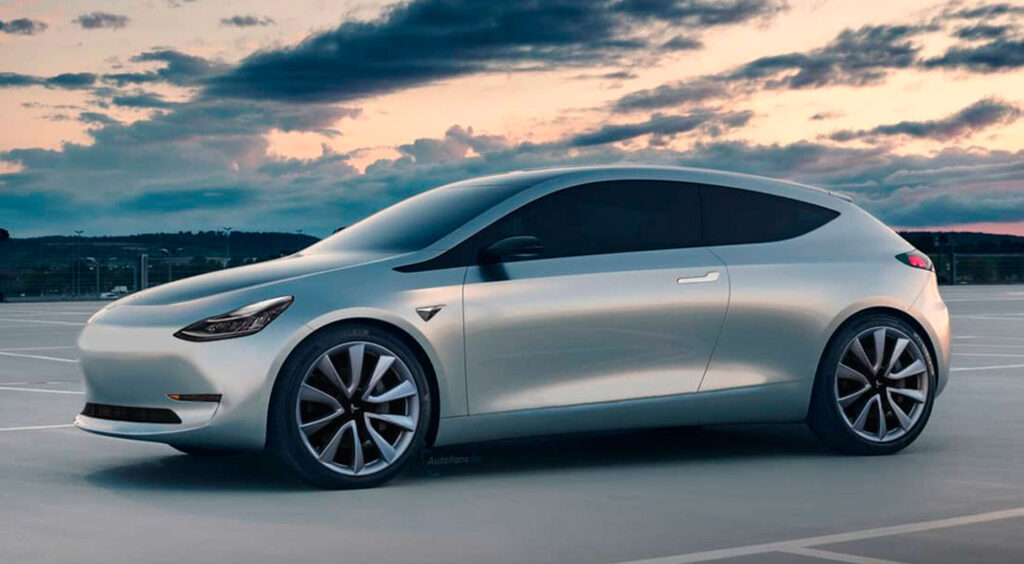
The Tesla Model 2, expected to arrive in 2026, is already one of the most anticipated vehicles in automotive history. While many consumers are excited about Tesla’s future robotaxi potential and advancements in self-driving technology, the real shockwave comes from something far more disruptive—
a Tesla priced around $10,000.
A mass-market electric car at this price level could reshape the entire global auto industry. But the biggest question is:
How can Tesla build a durable, safe, low-maintenance EV at such a low price and still make a profit?
The answer lies deep inside Tesla’s radically redesigned Model 2 production line—a system engineered from the ground up to eliminate waste, simplify manufacturing, reduce costs, and maintain unwavering quality.
In this in-depth blog post (over 2000 words), we break down the five hidden engineering and manufacturing secrets behind the Model 2’s ultra-low price—and how Tesla is reinventing car production once again.
The Hidden Engineering Behind Tesla’s Low-Cost Strategy
Before a single bolt is tightened or a robot begins welding, the Model 2 is designed in CAD using DFM (Design for Manufacturing) and DFA (Design for Assembly). These principles are crucial—and they set the stage for cost reductions long before a factory comes into play.
Industry research indicates that 70–80% of a product’s cost is locked in during the design phase, before manufacturing even starts.
This means Tesla’s engineers must consider:
- Fewer parts
- Simpler assembly
- Simplified structures
- Shared components
- Self-aligning parts
- Optimized casting
Every screw removed, every redundant bracket eliminated, and every simplified assembly operation directly reduces cost.
And Tesla has mastered this art.
1. How the Tesla Model 2 Production Line Makes It a Low-Cost Car from the Start
Radical Part Reduction: The Core of Tesla’s Cost Advantage
One of Tesla’s biggest breakthroughs was already seen on the Model Y, where the company replaced 70+ small stamped parts with two giant castings. This eliminated:
- 169 individual pieces
- 1,600 welds
- Entire sections of labor and inspection
For the Model 2, Tesla takes this even further using Gigacasting and consolidated structural designs.
Instead of dozens of brackets, supports, and small stamped panels, the car’s body is formed through:
- Single-piece castings
- Large modular assemblies
- Integrated component structures
This means:
- Less welding
- Fewer stamping operations
- Faster production
- Lower assembly labor
- Reduced defect points
- Lower long-term maintenance needs
Each simplified part is money saved—not just in manufacturing but throughout the car’s life cycle.
Standardized Fasteners and Components
Tesla aims to use 5–7 types of fasteners for the entire Model 2, instead of dozens or hundreds like traditional cars.
This reduces:
- Supply chain complexity
- Inventory space
- Purchasing costs
- Installation time
- Error risk
For owners, it also means:
- Easier repairs
- Faster service
- Lower part replacement cost
Smart Self-Aligning Parts
Parts are designed so they fit themselves into place with minimal adjustment.
A few seconds saved per part might seem small, but across:
- Hundreds of assembly steps
- Hundreds of thousands of cars per year
This translates into millions saved annually.
How much do you think Tesla saves per Model 2 just from smart design?
$500? $1,000? $2,000?
Leave your guess in the comments.
2. The Production Step That Enables True Large-Scale Manufacturing for the Model 2
Tesla’s Modular Assembly Revolution
Traditional cars are built by assembling thousands of tiny parts directly onto the main body frame. Tesla destroys this outdated method.
Instead, the Model 2 is built using modular architecture:
- Drive module (motor, inverter, gearbox)
- Battery pack module
- Interior module
- Front and rear body modules
Each module is produced on its own high-speed line and brought to final assembly 90% complete.
Faster Assembly, Fewer Errors
In modular architecture:
- Robots place modules in position
- Parts self-align
- Algorithms guide torque tools
- Connectors lock in only one direction
This significantly reduces:
- Human error
- Final assembly time
- Labor cost
- Repair and rework
Massive Economies of Scale
Tesla can use the same modules across:
- Multiple Model 2 variants
- Other small Tesla vehicles
- Future robotaxi versions
This means:
- Higher production volume
- Lower cost per part
- Shared engineering
- Fewer unique components
Tesla can even release a super-budget Model 2 variant simply by mixing:
- A smaller battery module
- A simplified interior module
- A base drive module
—All without building a new factory.
3. The Factory Method That Helps the Model 2 Avoid Wasted Time
The One-Way Flow Strategy
In older factories, parts zig-zag through warehouses and wait for forklifts, adding minutes or hours of dead time.
Tesla fixes this completely.
Model 2 parts move:
- One direction
- No detours
- No congestion
- No time-killing storage rooms
Tesla eliminates 30–40% wasted time found in inefficient factories.
Kitting: A Game-Changer for Productivity
Instead of searching through bins, workers receive pre-organized kits for each specific Model 2 configuration.
This reduces picking time by:
- 50% or more
And ensures the right parts arrive at the exact moment they’re needed.
Selective Automation (Not Blind Automation)
Tesla automates what makes sense:
Robots handle:
- Heavy lifting
- Precise torqueing
- Adhesive applications
- Welds
Humans handle:
- Delicate alignment
- Scratch-sensitive interior parts
- Complex visual adjustments
This hybrid method saves Tesla:
- Hundreds of millions in unnecessary robots
- While still cutting labor hours dramatically
4. How Tesla Ensures Quality and Minimizes Defects During Model 2 Production
Inline Quality Control—Not End-of-Line Inspection
Instead of checking everything at the end, Tesla performs micro-inspections at every step:
- Cameras inspect panel gaps
- Sensors verify bolt torque
- Electrical testers validate connections
- Fixtures check water sealing
- Real-time analytics confirm alignment
If something is wrong, the car is stopped immediately—not after it’s fully assembled.
Statistical Process Control (SPC)
Engineers track trends in:
- Torque
- Panel gap variation
- Electrical resistance
- Sensor calibration
If anything drifts toward the tolerance limit, Tesla fixes the process before bad cars pile up.
Reducing Scrap and Warranty Costs
A typical car can lose:
- 3% of cost to rework and scrap
If Tesla cuts this to 1%, that’s:
- $200 saved per Model 2
Add in lower warranty cost (another ~$100 saved), and Tesla protects both:
- Its profit margin
- The customer’s long-term experience
5. How Tesla Maximizes Factory Efficiency to Lower the Model 2’s Cost Even Further
OEE—Tesla’s Secret Factory Weapon
Overall Equipment Effectiveness (OEE) tracks:
- Uptime – Are machines running?
- Performance – Are they running at full speed?
- Quality – How many units are good on the first try?
By pushing factory uptime to 16–20 hours per day, Tesla dramatically reduces the cost per vehicle.
The Power of Higher Throughput
Consider this:
A factory producing 250,000 cars/year may add ~$2,000 of depreciation per car.
The same factory producing 700,000 cars/year?
Depreciation drops closer to $700 per car.
This massive savings goes straight into:
- Lower prices
- Higher margins
- Faster return on investment
Predictive Maintenance Keeps the Line Running
Tesla uses sensors on:
- Robots
- Conveyors
- Torque tools
- Casting machines
These sensors track:
- Heat
- Noise
- Vibration
- Cycle count
This allows maintenance to be planned—not a surprise emergency.
Less downtime = more cars = lower cost.
The Final Result: A $10,000 Tesla That Changes Everything
The 2026 Tesla Model 2 isn’t cheap because of:
- Weak materials
- Downgraded features
- Poor quality
It’s cheap because it is:
- Designed with fewer parts
- Built using giant castings
- Assembled through standard modules
- Supported by clean material flow
- Validated by constant inline quality checks
- Produced in ultra-efficient factories
Every layer of engineering and manufacturing works together to bring the price down without compromising durability or performance.
Outro – The EV That Will Redefine the Automotive Market
The Tesla Model 2 is more than just a car—
it is the result of:
- Meticulous design
- Modular engineering
- Smart material flow
- Inline quality control
- Hyper-efficient factory management
As 2026 approaches, the Model 2 is set to become the world’s first truly mass-market EV—and reshape electric mobility forever.
FAQs
1. What is the expected price of the Tesla Model 2?
The Tesla Model 2 is rumored to start around $10,000, making it one of the most affordable electric vehicles ever produced.
2. When will the Tesla Model 2 be released?
Tesla is expected to launch the Model 2 in 2026, with production beginning shortly before the official release.
3. Why is the Tesla Model 2 so cheap compared to other EVs?
Its low cost comes from Gigacasting, modular assembly, reduced part count, optimized material flow, and highly efficient factories, all of which significantly cut manufacturing costs.
4. Will the Tesla Model 2 support Full Self-Driving (FSD)?
Yes. The Model 2 is expected to be compatible with Tesla’s Full Self-Driving software, though the feature will likely be optional.
5. Is the Model 2 the same as Tesla’s robotaxi?
Not exactly. The robotaxi will be based on similar technology, but the Model 2 will be a consumer-focused version designed for private owners.
6. How many parts will the Tesla Model 2 use?
Thanks to single-piece castings and simplified design, the Model 2 will use significantly fewer parts than traditional cars, lowering cost and improving reliability.
7. What type of battery will the Tesla Model 2 use?
The Model 2 is expected to use Tesla’s next-generation battery technology, possibly including 4680 cells or a more cost-efficient lithium-iron-phosphate (LFP) pack.
8. How far will the Tesla Model 2 drive on a single charge?
While official numbers are not confirmed, estimates suggest a range of 200–250 miles, depending on battery configuration.
9. Will Tesla build new factories for the Model 2?
Not necessarily. Tesla’s modular architecture allows the Model 2 to be produced in existing factories without major new construction.
10. Will the Model 2 be safe despite its low price?
Yes. Tesla is known for high safety ratings, and the Model 2 will benefit from large cast structures and a rigid battery pack, improving crash resistance.
11. How does Tesla maintain profit margins with such a low-priced car?
Tesla maximizes margin through:
- Fewer parts
- Reduced labor
- Faster assembly
- Lower scrap and warranty costs
- High factory throughput
12. Can the Model 2 be used for ride-sharing or delivery jobs?
Absolutely. Its low price and low maintenance costs make it ideal for ride-share drivers, delivery services, and fleets.
13. Where will the Tesla Model 2 be built?
Production is expected in multiple Gigafactories, potentially including Gigafactory Texas, Mexico, and China.
14. What makes the Model 2 easier to assemble?
Tesla uses self-aligning parts, standardized fasteners, and pre-assembled modules, which drastically reduce assembly time and complexity.
15. Will there be different versions of the Model 2?
Most likely. Tesla may offer:
- A base “ultra-budget” version
- A long-range version
- A performance or dual-motor version
16. Is maintenance cheaper on the Tesla Model 2?
Yes. With fewer moving parts, fewer failure points, and simplified components, the Model 2 will likely have lower maintenance costs than gas cars.
17. Will the Tesla Model 2 qualify for EV tax incentives?
Depending on region and production location, the Model 2 may qualify for federal or state EV incentives, further lowering the final price.
Read More:
- SpaceX Revealed Raptor 3’s Insane Testing for Starship V3 Ascent Burn! Big Changes are Coming
- NVIDIA CEO Jensen Huang commends Tesla’s Elon Musk for early belief
- Tesla’s six-seat extended wheelbase Model Y L sold out for January 2026
- Tesla extends FSD Supervised ride-alongs in Europe by three months
- Tesla Semi just got a huge vote of confidence from 300-truck fleet
- Tesla CEO Elon Musk announces major update with texting and driving on FSD