
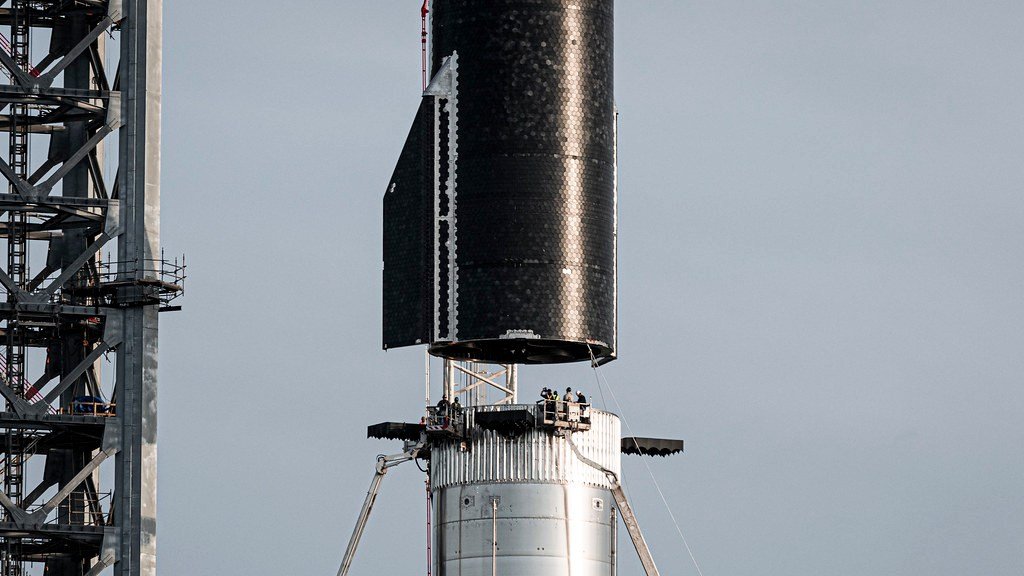
Elon Musk just Revealed S42’s Heat Shield Status after Catching Shocked the Industry: The aerospace industry has witnessed another potentially historic milestone as SpaceX Starship demonstrates just how close humanity is getting to fully reusable orbital transportation. After years of intensive engineering, experimental flights, and continuous improvements, SpaceX successfully returned its Starship upper stage, Ship 42 (S42), from space and caught it using the massive mechanical arms of the Mechazilla launch tower at Starbase.
During its remarkable mission, S42 completed approximately 14 orbits over 22 hours, deployed 26 Starlink V3 satellites, and successfully navigated atmospheric re-entry before being captured by the launch tower. This achievement represents an enormous step toward Elon Musk’s vision of making rockets reusable as routinely as commercial aircraft.
However, the successful catch was only the beginning of another important engineering challenge. SpaceX engineers needed to determine whether S42’s revolutionary heat shield, structural components, propulsion systems, and avionics had survived the extreme conditions of orbital re-entry.
Following the recovery, Elon Musk revealed encouraging initial observations about the vehicle’s condition. The results could provide valuable information about the future of Starship rapid reusability.
SpaceX Starship S42 Catch Marks a Historic Engineering Achievement
For years, SpaceX has been developing the technology required to recover both stages of its fully reusable Starship launch system. The company previously demonstrated the ability to catch a Super Heavy booster using the Mechazilla tower arms.
However, recovering an orbital-class Starship upper stage presented a much more complicated engineering challenge.
Unlike the booster, which returns relatively quickly after launch, the upper stage must survive orbital operations, extreme atmospheric heating, and a carefully controlled landing sequence.
During Flight 15, Ship 42 successfully completed these demanding objectives.
Elon Musk Inspects Starship S42 After Landing
Immediately after the tower secured S42, Elon Musk announced that the spacecraft was returning a massive amount of engineering data.
Live footage showed the vehicle safely venting its internal pressurized systems while SpaceX personnel secured the landing area and began their initial inspection.
Musk personally examined the recovered spacecraft, including observing its upper sections from a crane cabin. He was also seen sitting inside the ship’s Quick Disconnect (QD) structure while S42 remained suspended above the ground.
His initial assessment was encouraging. Musk indicated that the heat shield and Raptor engines appeared to be in surprisingly good condition.
He also suggested that the spacecraft could potentially fly again after only a few weeks of refurbishment.
Nevertheless, SpaceX still needs to complete detailed inspections before determining whether the vehicle is suitable for another flight.
Starship S42 Heat Shield Status: What Happened During Re-Entry?
The most important component of any reusable spacecraft returning from orbit is its Thermal Protection System (TPS).
Starship travels through the atmosphere at extremely high speeds, generating tremendous heat as air compresses around its exterior. Temperatures can reach thousands of degrees Fahrenheit, placing enormous demands on the spacecraft’s protective materials.
SpaceX uses thousands of hexagonal heat shield tiles designed to protect Starship’s stainless-steel structure during this process.
S42’s recovery provided an opportunity to examine how these tiles performed during an actual orbital return.
Brownish-Orange Discoloration Raises Questions
Initial photographs revealed that much of S42’s heat shield remained remarkably clean.
However, engineers and observers identified a noticeable area of brownish-orange discoloration extending from the middle section toward the left side of the spacecraft.
Closer examination also revealed localized tile damage and erosion in this region.
One possible explanation is a coolant leak during atmospheric re-entry. If coolant escapes into the extremely hot plasma surrounding the vehicle, it can change local thermal conditions and potentially accelerate oxidation or damage nearby heat shield materials.
Similar discoloration was reportedly observed near the nose section.
However, the precise cause requires confirmation through SpaceX’s engineering investigation.
Most of the Heat Shield Survived
Despite localized damage, the majority of S42’s thermal protection system appeared to remain intact.
This is particularly important because earlier developmental Starship flights experienced more extensive thermal protection challenges.
SpaceX will still need to identify compromised tiles, inspect the underlying structure, and replace damaged components before another flight.
However, the initial condition suggests that the company may not need to completely rebuild the heat shield.
For a spacecraft of Starship’s enormous size, demonstrating substantial heat shield durability represents an important step toward reusable orbital spacecraft technology.
Starship S42 Structural Integrity and GNC Performance
The heat shield was not the only system receiving attention after recovery.
SpaceX engineers also needed to evaluate the spacecraft’s structural framework, aerodynamic flaps, avionics, and guidance systems.
These components must work together perfectly during orbital operations and the demanding return to Starbase.
Leeward Side Shows Encouraging Results
The leeward side of Starship, which experiences different heating conditions from the windward surface, appeared to be in excellent condition.
Some thermal discoloration was visible around the aft flaps and surrounding structure.
However, there were no obvious signs of major structural deformation in the initial visual assessment.
Importantly, the aerodynamic flaps appeared to retain their intended geometry.
This suggests that the spacecraft’s internal structural framework successfully handled the significant aerodynamic forces experienced during atmospheric re-entry.
Guidance, Navigation, and Control Systems Worked Successfully
Another major achievement involved Starship’s Guidance, Navigation, and Control (GNC) systems.
These systems manage the spacecraft’s orientation, trajectory, navigation, and landing operations.
Previous Starship testing demonstrated how even a relatively small navigation issue could interfere with complex recovery operations.
During S42’s mission, however, the spacecraft successfully maintained stable telemetry and attitude control throughout its orbital journey.
It also completed its de-orbit maneuver and guided itself toward the Mechazilla tower without any reported major control anomalies.
This performance provides valuable evidence that Starship’s autonomous flight-control technology is progressing toward reliable orbital recovery.
Raptor Engines: How Well Did S42’s Engines Survive?
Starship’s propulsion system is another essential part of its reusability strategy.
Ship 42 carries six Raptor engines, consisting of three sea-level engines and three vacuum-optimized engines.
Following recovery, the engines showed different levels of visible discoloration.
Vacuum Raptor Engines Remain Remarkably Clean
The three vacuum Raptor engines appeared relatively clean across their exterior housings.
These engines are designed to operate efficiently in the vacuum of space and play an important role in Starship’s orbital propulsion system.
Their condition provides encouraging initial evidence about their ability to withstand demanding flight operations.
Sea-Level Engines Show Heavy Soot and Discoloration
In contrast, the three sea-level Raptor engines displayed considerably more soot and darkening.
This appearance is understandable because these engines experienced multiple demanding operating phases, including launch, orbital maneuvers where applicable, and the final landing sequence.
Most importantly, all three sea-level engines successfully reignited during the landing process.
They dynamically adjusted thrust to control the spacecraft’s descent and position it for the tower catch.
However, exterior appearance alone cannot determine whether an engine is ready for another flight.
SpaceX engineers must inspect important internal components, including:
- Ignition systems responsible for reliable engine starts.
- Fuel injectors that control propellant delivery.
- Turbopumps responsible for moving propellants at extremely high pressures.
- Internal plumbing carrying fuel and oxidizer.
- Combustion chambers exposed to extreme operating temperatures.
Non-destructive testing and targeted refurbishment will help determine whether the engines can safely return to service.
What Happens Next? Starship Flight 16 and Flight 17
Following its successful recovery, S42 is expected to undergo additional engineering inspections and refurbishment activities.
The spacecraft can be transferred to Mega Bay 2, where technicians can examine its propellant tanks, electrical wiring, fluid lines, structural connections, and flight termination systems.
Although Musk suggested that S42 could potentially fly again after a few weeks of refurbishment, that does not necessarily mean SpaceX will immediately reuse the vehicle.
The company must balance engineering priorities, hardware availability, and its upcoming launch schedule.
Meanwhile, newer hardware, including Booster 23 and Ship 43, is advancing through development and testing.
Flight 16 is another important milestone in the Starship program, while Flight 17 could eventually provide an opportunity to demonstrate additional reuse capabilities.
A recycled vehicle flight would be particularly valuable because it would help SpaceX move beyond simply recovering spacecraft toward routinely launching previously flown hardware.
Why Starship Reusability Matters for the Future of Space Exploration
The successful recovery of an orbital-class Starship could transform the economics of space transportation.
Traditional orbital rockets typically require extensive manufacturing and refurbishment between missions. SpaceX wants to replace that model with a system that can launch, return, receive routine maintenance, and fly again with significantly shorter turnaround times.
Achieving this objective could support several major industries.
1. Faster Starlink Satellite Deployment
Starship is designed to carry large payloads into orbit.
Its enormous cargo capacity could accelerate the deployment and replacement of next-generation Starlink V3 satellites, improving global internet infrastructure.
2. Orbital Data Centers and Commercial Infrastructure
Fully reusable heavy-lift transportation could make it easier to deploy large orbital structures.
Potential applications include space-based data centers, commercial space stations, scientific observatories, and other advanced infrastructure.
3. NASA Artemis Moon Missions
NASA’s Artemis program represents another major reason for developing Starship.
SpaceX’s Starship Human Landing System is intended to support astronaut transportation between lunar orbit and the Moon’s surface.
Achieving this objective requires additional milestones, including orbital propellant transfer, uncrewed lunar demonstrations, and reliable deep-space operations.
4. Future Mars Exploration
Elon Musk’s long-term vision involves using Starship to transport cargo and eventually people to Mars.
Before human missions become practical, SpaceX must demonstrate dependable launch operations, in-space refueling, atmospheric entry, and landing capabilities.
A reusable orbital Starship is an essential building block for that ambition.
Conclusion: S42 Could Change the Future of Reusable Rockets
The successful return and tower catch of Starship Ship 42 represent a significant milestone in SpaceX’s development program.
Completing approximately 14 orbits, deploying 26 Starlink V3 satellites, surviving atmospheric re-entry, and returning to Starbase demonstrate how far the Starship architecture has progressed.
More importantly, the initial inspection revealed encouraging results for its heat shield, structural framework, guidance systems, and Raptor engines.
Localized tile damage and discoloration still need investigation, and extensive internal inspections remain necessary before any potential reflight.
Nevertheless, S42 has provided SpaceX with valuable real-world engineering data.
The next major challenge is turning this successful recovery into a repeatable operational process. If SpaceX can consistently recover, inspect, refurbish, and relaunch Starship vehicles with minimal downtime, the company could fundamentally change the economics of orbital transportation.
The future of space exploration will depend not only on how powerful rockets become, but also on how frequently and affordably they can fly.
FAQs
1. What happened during SpaceX Starship Flight 15?
SpaceX Starship Flight 15 successfully demonstrated the return and recovery of an orbital-class Starship upper stage. Ship 42 completed approximately 14 orbits over 22 hours, deployed 26 Starlink V3 satellites, survived atmospheric re-entry, and was caught by the Mechazilla launch tower arms at Starbase.
2. What is Starship S42?
Ship 42 (S42) is a SpaceX Starship upper-stage vehicle that completed an orbital mission and returned to Earth. It demonstrated important capabilities involving orbital operations, satellite deployment, atmospheric re-entry, and tower-based recovery.
3. What did Elon Musk reveal about Starship S42’s heat shield?
Elon Musk indicated that the initial inspection showed the Starship’s heat shield and engines were in surprisingly good condition. Although localized damage and discoloration were visible, most of the thermal protection system appeared to have survived atmospheric re-entry successfully.
4. How many orbits did Starship S42 complete?
According to the mission details provided, Starship S42 completed approximately 14 orbits around Earth during its roughly 22-hour mission before returning for recovery at Starbase.
5. How many Starlink V3 satellites did Starship S42 deploy?
Starship S42 successfully deployed 26 Starlink V3 satellites during its orbital mission. This demonstrates Starship’s potential to support large-scale satellite deployment and next-generation space-based internet infrastructure.
6. What caused the brownish-orange discoloration on Starship S42’s heat shield?
The brownish-orange discoloration may have resulted from a localized coolant leak during atmospheric re-entry. Escaping coolant could have altered the surrounding thermal environment, contributing to oxidation and scorching of nearby heat shield tiles. The exact cause requires further engineering investigation.
7. Was Starship S42’s heat shield damaged during re-entry?
Yes, initial visual inspections revealed localized tile damage, erosion, and discoloration in certain areas. However, most of the heat shield appeared to remain intact, suggesting significant improvements in SpaceX’s thermal protection technology.
8. Can SpaceX reuse Starship S42 after its successful recovery?
Potentially, yes. Elon Musk suggested that S42 could possibly fly again after a few weeks of refurbishment. However, SpaceX must complete detailed inspections and replace damaged components before certifying the spacecraft for another mission.
9. What is the Mechazilla tower catch system?
The Mechazilla tower catch system is SpaceX’s mechanical recovery technology that uses large robotic arms, commonly called chopsticks, to catch returning rocket stages. It is designed to eliminate the need for traditional landing legs and simplify rocket recovery and reuse.
10. How many Raptor engines does Starship S42 have?
Starship S42 is equipped with six Raptor engines: three sea-level engines and three vacuum-optimized engines. The sea-level engines support atmospheric flight and landing operations, while the vacuum engines provide efficient propulsion in space.
11. Were Starship S42’s Raptor engines damaged during the mission?
Initial visual inspections showed that the three vacuum Raptor engines remained relatively clean, while the sea-level engines displayed noticeable soot and discoloration. All three sea-level engines successfully reignited during landing. Internal inspections are still necessary to determine their flight readiness.
12. What is the purpose of Starship’s Thermal Protection System (TPS)?
The Thermal Protection System (TPS) protects Starship’s stainless-steel structure from extreme temperatures during atmospheric re-entry. Its hexagonal heat shield tiles help prevent the spacecraft from overheating while returning from orbital speeds.
13. What happens to Starship S42 after its recovery?
S42 is expected to undergo detailed inspections and refurbishment, potentially at Mega Bay 2. Engineers will examine its heat shield, propellant tanks, wiring harnesses, fluid lines, structural components, engines, and other critical systems before deciding whether it can fly again.
14. How will Starship reusability benefit NASA’s Artemis program?
Starship is being developed as NASA’s Human Landing System (HLS) to transport astronauts between lunar orbit and the Moon’s surface. Successful recovery and reuse could support more frequent missions, while orbital refueling and uncrewed lunar testing remain essential development milestones.
15. How does Starship S42’s successful recovery bring SpaceX closer to Mars?
The successful recovery demonstrates progress toward a fully reusable orbital transportation system. This technology is essential for future Mars missions because SpaceX will need reliable rockets, orbital refueling, heavy cargo transportation, and reusable spacecraft to support long-term exploration and potential human settlement on Mars.
Read More:
- Elon Musk’s Tesla Semi 2.0 Massive UPDATE | Nearly 1,000 Trucks
- FAA turned down free Starlink offer before nationwide ground stop, Elon Musk says
- Your Tesla could be in the Robotaxi fleet next month, Elon Musk claims
- Tesla tuner pleading to save Cybertruck also wants to build CyberSUV
- Tesla just doubled its Miami Robotaxi geofence
2 thoughts on “Elon Musk just Revealed S42’s Heat Shield Status after Catching Shocked the Industry”