


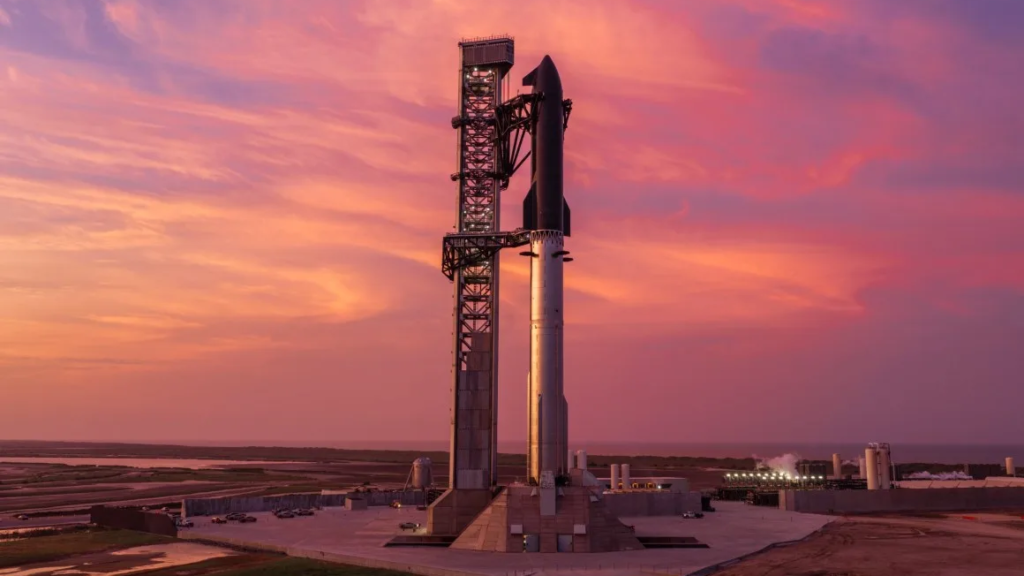
Starship Flight 14 to become the Biggest Leap ever: Unlike any others: SpaceX’s Starship program is moving into one of the most important phases in its development. Rather than following the traditional aerospace model of long development cycles and cautious testing, SpaceX has embraced a rapid “fly, test, learn, and improve” approach. Each flight provides real-world data that can be used to redesign hardware and prepare the next vehicle.
As preparations continue at Starbase in Boca Chica, Texas, Starship Flight 14 is shaping up to be far more than another experimental mission. The flight could represent a major transition from experimental testing toward an operational, orbital-class launch system.
From Experimental Flights to Starship Flight 14
The evolution of Starship has been marked by increasingly ambitious flight objectives. Early tests focused on basic flight control, atmospheric maneuvers, high-altitude operations, and landing dynamics. Later missions pushed the Super Heavy booster and Starship upper stage into increasingly demanding flight environments.
A particularly important milestone came from Flight 13 and Ship 40 (S40). The vehicle provided valuable information about how Starship’s thermal protection system performs during atmospheric re-entry.
After experiencing extreme re-entry conditions, S40 reportedly survived its ocean landing and remained afloat for an extended period. For SpaceX engineers, this created an unusual opportunity: physical post-flight hardware could be inspected rather than relying exclusively on telemetry.
The recovered vehicle offered insights into heat-shield tiles, bonding materials, seals, and the stainless-steel structure. Those observations could help engineers improve the next generation of Starship hardware.
Why Ship 40’s Data Matters
Spaceflight testing normally depends heavily on sensors and telemetry because returning an orbital spacecraft intact is exceptionally difficult. Physical hardware provides another layer of evidence.
By examining damaged, stressed, or successfully surviving components, engineers can compare real-world performance with computer simulations.
This supports SpaceX’s iterative development philosophy:
- Fly the vehicle
- Collect real-world data
- Identify weaknesses
- Redesign components
- Build the next vehicle
- Fly again
Flight 14 therefore represents the accumulation of lessons learned across numerous previous tests.
A New Recovery Strategy for Flight 14
One of the most fascinating aspects of Starship’s development is its ambitious recovery architecture. SpaceX wants to make both stages of the vehicle rapidly reusable, with the Super Heavy booster and eventually the Starship itself being recovered and flown again.
The company’s enormous launch tower, commonly associated with the Mechazilla chopstick system, is designed to capture returning vehicles.
Initially, expectations surrounding Flight 14 included the possibility of attempting an upper-stage catch. However, the recovery strategy has reportedly evolved, with additional time needed to refine the hardware and software required for such an ambitious operation.
Why Catching Starship Is So Difficult
Recovering a rocket using tower-mounted mechanical arms is dramatically different from traditional parachute or landing-leg recovery.
The system has to coordinate:
- Precise vehicle positioning
- High-speed tracking
- Hydraulic actuator movement
- Structural load management
- Guidance and control systems
- Ground-safety procedures
Attempting to recover both stages during the same mission would introduce another level of complexity.
The timing between booster recovery, upper-stage flight operations, ground equipment movements, and launch-site safety procedures must be carefully coordinated. A failure near the launch infrastructure could potentially damage equipment and delay subsequent missions.
For that reason, incremental recovery objectives can be strategically more valuable than attempting every capability simultaneously.
The Biggest Milestone: Achieving Orbital Velocity
Although the dramatic images of Starship being caught by Mechazilla may attract the most attention, the most important technical objective is arguably achieving and sustaining an orbital flight profile.
Previous integrated flight tests were designed around specific suborbital trajectories. Flight 14 represents a potential step toward a much longer and more demanding mission profile.
What Changes During an Orbital Flight?
Reaching orbit requires the spacecraft to achieve approximately 28,000 km/h of velocity, depending on the specific orbital trajectory.
That changes almost everything about the mission.
The Raptor engines must provide sustained thrust while managing propellant consumption, thermal loads, vibration, and engine performance.
The spacecraft also has to remain operational for considerably longer than during a short suborbital test.
An orbital mission can involve:
- Longer engine burns
- More demanding propellant management
- Extended time in space
- Potential payload operations
- Engine reignition testing
- Controlled de-orbit procedures
- More complex atmospheric re-entry
Successfully completing these objectives would represent a major step toward making Starship a genuine orbital transportation platform.
Major Starship Hardware Upgrades
Flight 14 is expected to incorporate improvements across multiple parts of the vehicle. These include the Raptor engines, thermal protection system, aerodynamic surfaces, structural components, and payload systems.
Raptor Engine Improvements
The Raptor engine is central to Starship’s performance. Previous tests have provided engineers with information about engine behavior during ascent, boostback, atmospheric flight, and landing.
Potential improvements include refinements to combustion stability, ignition systems, valves, fluid lines, thrust-vector control, and engine-bay protection.
Better engine reliability is essential because Starship uses a large number of engines across its two stages. A vehicle operating at this scale requires not just enormous thrust but also high system reliability.
Thermal Protection System Improvements
Atmospheric re-entry is among the toughest challenges facing Starship.
At orbital velocity, the spacecraft encounters intense aerodynamic heating. Its heat shield must protect the stainless-steel structure from extreme temperatures while also surviving vibration and mechanical stress.
Data from previous flights can help SpaceX improve:
- Heat-shield tile placement
- High-temperature seals
- Tile bonding
- Gap protection
- High-heating areas around flaps and the nose
The objective isn’t merely to make the heat shield survive one flight. SpaceX ultimately needs a system that can support rapid refurbishment and repeated missions.
Structural and Payload Improvements
Starship’s aerodynamic flaps also face tremendous forces during atmospheric flight. Reinforcing these systems and improving their thermal protection can increase reliability during future re-entry and landing operations.
The payload section is equally important. A reusable spacecraft becomes significantly more valuable when it can reliably deploy satellites and other payloads.
Future operational missions could therefore depend on repeatable payload-door mechanisms and robust zero-gravity deployment systems.
Starbase Is Becoming Part of the Rocket
Starship’s success isn’t determined by the vehicle alone. The launch site itself is effectively becoming part of the transportation system.
At Starbase, SpaceX has been developing infrastructure designed around rapid launch operations, booster recovery, vehicle servicing, and refurbishment.
Mechazilla and Ground Infrastructure
The launch tower and recovery system require extremely precise mechanical operations. Sensors, hydraulic systems, positioning equipment, and structural components must all work together.
Meanwhile, the Orbital Launch Mount has to withstand enormous acoustic, thermal, and mechanical forces generated during launch.
For Starship to eventually achieve airline-like launch frequency, SpaceX will need more than a reliable rocket. It will need fast inspections, efficient maintenance, rapid tile replacement, and streamlined ground operations.
That is why Starbase development is almost as important as Starship development itself.
What Flight 14 Could Mean for the Space Industry
A successful Starship orbital mission could have implications far beyond SpaceX.
The vehicle is designed around an enormous payload volume and a fully reusable architecture. If SpaceX succeeds in turning those concepts into reliable operations, the economics of launching large payloads could change dramatically.
Starlink and Commercial Satellites
One major application is the deployment of increasingly capable Starlink satellites.
A larger launch vehicle can transport larger satellite platforms and potentially deploy substantial quantities of spacecraft in a single mission.
Starship could also create opportunities for commercial operators requiring the deployment of large or unusually shaped spacecraft that are difficult to accommodate on conventional launch vehicles.
NASA Artemis and Lunar Missions
Starship also plays an important role in NASA’s Artemis lunar exploration architecture.
The Starship Human Landing System is designed to transport astronauts between lunar orbit and the Moon’s surface. Achieving this objective requires reliable orbital operations and eventually sophisticated in-space propellant transfer.
Consequently, improvements in Starship’s ability to reach orbit, remain operational, and perform repeated missions could become important building blocks for future lunar exploration.
Starship’s Competitive Impact
Starship’s development is also increasing competitive pressure across the launch industry.
Companies such as United Launch Alliance and Blue Origin are developing their own next-generation launch systems, while international space programs are investigating reusable launch technologies.
The central question is no longer simply whether reusable rockets are possible. The bigger question is whether reusable launch vehicles can achieve high flight frequency, reliable turnaround, and dramatically lower launch costs.
If Starship reaches that point, the competitive landscape could change significantly.
The Bigger Picture: From Rocket to Space Transportation System
The most important feature of SpaceX’s strategy may not be any individual Starship flight. It is the development philosophy behind the program.
SpaceX treats flight testing as an engineering feedback loop. Instead of attempting to perfect every component before flying, the company uses real-world missions to expose weaknesses.
Flight 14 embodies that approach.
Data from earlier vehicles can lead to new engine designs. Re-entry performance can influence heat-shield architecture. Ground operations can expose weaknesses in recovery systems. Those lessons can then be incorporated into future vehicles.
This creates a continuous cycle of testing, learning, redesigning, and flying again.
Conclusion: A Potential Turning Point for Starship
Starship Flight 14 could become one of the most consequential milestones in SpaceX’s development program. Its importance extends beyond whether the vehicle successfully completes every individual objective.
The real significance lies in the transition toward an architecture capable of orbital flight, reusable hardware, large-scale payload deployment, and eventually rapid turnaround.
If Starship can demonstrate reliable orbital operations and continue improving its recovery systems, the implications could reach commercial satellites, lunar exploration, deep-space missions, and the broader economics of access to space.
When Starship eventually launches from Starbase for Flight 14, the world will be watching more than another rocket test. It could be watching the next major step toward a reusable space transportation system—and potentially a new era in how humanity reaches orbit.
FAQs
1. What is Starship Flight 14?
Starship Flight 14 is a planned integrated flight test of SpaceX’s Starship spacecraft and Super Heavy booster. It is expected to test major vehicle upgrades, orbital-flight capabilities, and recovery technologies.
2. Why is Starship Flight 14 considered important?
Flight 14 could represent a major milestone in Starship’s development, particularly if it demonstrates a successful orbital flight profile and advances the vehicle toward operational, reusable missions.
3. What is the main goal of Starship Flight 14?
One of the most significant objectives is to demonstrate full orbital flight capability while gathering data on propulsion, thermal protection, vehicle performance, and recovery systems.
4. Will Starship Flight 14 reach orbit?
The mission is intended to advance Starship toward true orbital flight, rather than relying solely on the shorter suborbital trajectories used during earlier integrated flight tests.
5. How fast does Starship need to travel to reach orbit?
A spacecraft generally needs to reach roughly 28,000 km/h to achieve low Earth orbit, although the exact velocity depends on the mission trajectory and orbital requirements.
6. What is Mechazilla?
Mechazilla is SpaceX’s launch-tower system used for handling and recovering Starship vehicles. Its large mechanical arms, often called “chopsticks,” are designed to catch returning stages.
7. Will SpaceX catch the Starship upper stage during Flight 14?
The upper-stage catch objective may be deferred while SpaceX continues refining the necessary hardware and software. Recovery plans can change as engineers analyze data from previous missions.
8. What is the Super Heavy booster?
Super Heavy is the first stage of the Starship launch system. It provides the enormous thrust required to lift the Starship spacecraft from Earth and is designed to be fully reusable.
9. What improvements are being made to Starship’s Raptor engines?
Starship’s Raptor engines continue to receive improvements involving combustion, ignition, valves, fluid systems, thrust-vector control, and overall reliability. These upgrades are intended to improve performance during demanding flight phases.
10. How important is the Starship heat shield?
The thermal protection system (TPS) is critical because Starship must withstand extreme heating during atmospheric re-entry. Improvements to tiles, seals, bonding, and high-heating areas can help increase re-entry reliability and reusability.
11. What did Ship 40 teach SpaceX?
Ship 40 provided valuable real-world re-entry data and physical hardware for inspection. Examining its heat-shield tiles, bonding materials, and structure can help SpaceX identify weaknesses and improve future Starship vehicles.
12. Where will Starship Flight 14 launch from?
Starship missions are launched from Starbase in Boca Chica, Texas, SpaceX’s dedicated Starship development and launch complex.
13. How could Starship affect the satellite industry?
If Starship achieves reliable and frequent operations, its large payload capacity and reusable architecture could allow satellite operators to launch larger spacecraft and potentially deploy substantial satellite infrastructure more efficiently.
14. Why is Starship important for NASA’s Artemis program?
NASA has selected a Starship-derived Human Landing System (HLS) for planned lunar missions. Reliable orbital operations and technologies such as in-space propellant transfer are important parts of making lunar Starship missions possible.
15. Could Starship Flight 14 change the future of spaceflight?
Potentially, yes. A successful progression toward orbital flight, rapid reusability, and high launch cadence could significantly change the economics and accessibility of space. However, Starship still needs to demonstrate reliable, repeatable operations before its long-term impact can be fully assessed.
Read More: