
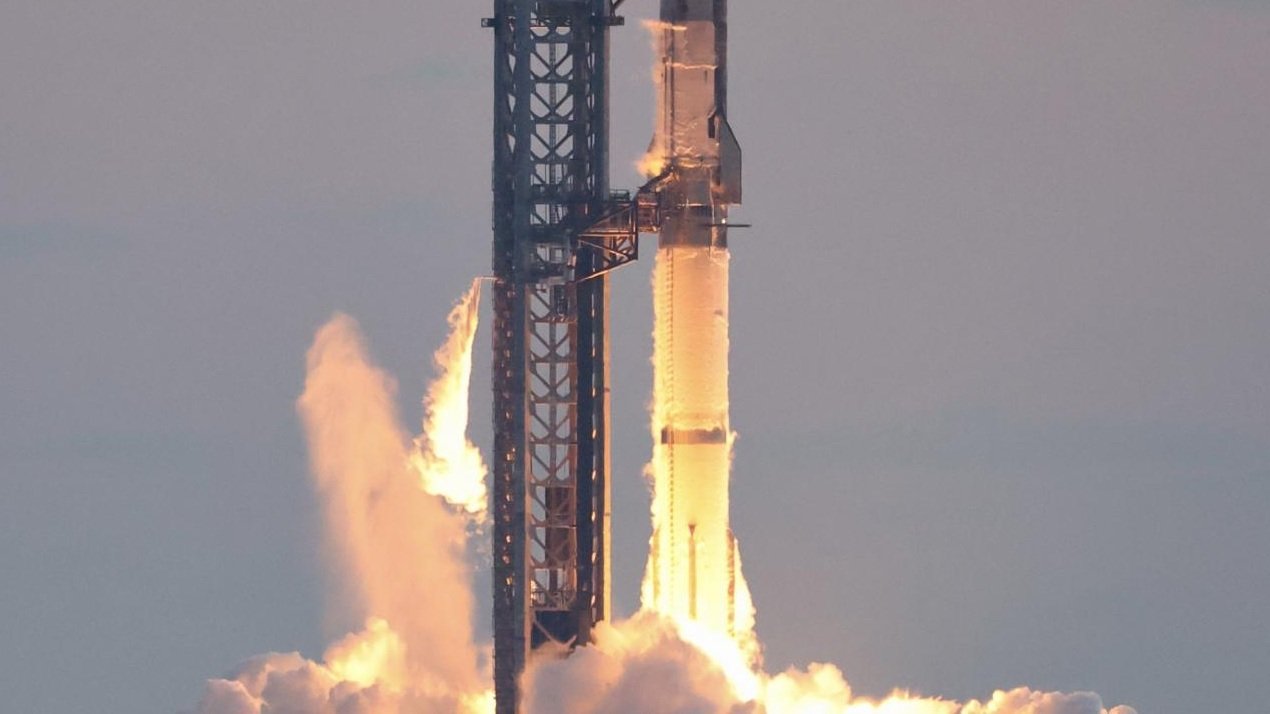
Starship Flight 15 to become the Biggest Flight Yet:: SpaceX Starship Flight 15 is shaping up to be one of the most ambitious milestones in the development of fully reusable rockets. With an ambitious recovery strategy, continued improvements to Starship hardware, and lessons learned from previous test flights, Flight 15 could represent a major step toward making orbital-class rockets reusable at an unprecedented scale.
According to the provided mission update, the targeted launch date was November 8, following Starship Flight 14. The mission’s most exciting objective is the proposed double catch, an attempt to recover both the Super Heavy booster and the Starship upper stage. If successful, this approach could transform how SpaceX operates its next-generation launch system.
However, Flight 15 is about more than a launch date. It represents a broader effort to improve rocket reliability, shorten turnaround times, and establish a foundation for future missions to Earth orbit, the Moon, and eventually Mars.
Why Starship Flight 15 Could Be the Biggest Flight Yet
A New Milestone in Rocket Reusability
Traditional orbital rockets typically discard significant portions of their hardware after launch. SpaceX is pursuing a different approach with Starship, designing a system in which both the Super Heavy booster and the Starship spacecraft can potentially return for reuse.
Previous tests demonstrated important steps toward recovering the Super Heavy booster using the launch tower’s mechanical catching arms, commonly known as the chopsticks.
Flight 15 aims to push this concept further. Instead of focusing on the booster alone, SpaceX intends to attempt the recovery of both major rocket stages during the same mission.
This proposed double-catch recovery could become a defining moment for the Starship program. Successfully recovering both stages would demonstrate progress toward a launch system designed to return, undergo inspections, and fly again.
Nevertheless, the attempt remains technically challenging, and its success is not guaranteed.
The Importance of the November 8 Launch Target
The provided update identifies November 8 as the target date for Starship Flight 15, following earlier expectations for an October launch.
The schedule adjustment reflects the time required for hardware preparation, ground testing, and engineering evaluations. Rocket development involves numerous interconnected systems, making thorough testing essential before attempting complex flight operations.
The update describes the proposed schedule as approximately a 41-day turnaround after Flight 14.
Although launch schedules can change, the planned interval illustrates SpaceX’s effort to accelerate its testing program while continuing to evaluate vehicle performance.
For Starship Flight 15, the priority is not simply reaching the launchpad quickly. It is preparing the rocket and supporting infrastructure for a mission that could introduce a more demanding recovery objective.
Starship Flight 15 Hardware and Ground Preparations
Ship 42: Preparing for Future Flight Operations
Ship 42 (S42) is one of the vehicles highlighted in the provided update.
According to the source, Ship 42 underwent cryogenic testing and simulated catch evaluations at Massey’s Test Site before returning to Mega Bay 2.
Cryogenic testing exposes a vehicle’s tanks and associated structures to extremely cold conditions, helping engineers evaluate their behavior under demanding operating conditions.
The next preparation steps described in the source include engine installation and potential static fire testing.
A static fire allows engineers to evaluate propulsion-system performance while the vehicle remains secured on the ground. These tests provide important information before a rocket is cleared for flight.
Ship 42’s progress illustrates how SpaceX uses multiple development vehicles and ground tests to refine the technologies needed for future Starship missions.
Booster 22 and Super Heavy Preparations
Booster 22 (B22) is another important part of the development activity described in the update.
The booster was reported to be inside Mega Bay 1 after completing cryogenic testing, with engine installation and preparations for static fire evaluations underway.
Super Heavy is responsible for supplying the enormous thrust required to lift Starship away from Earth. Its engines, tanks, structural systems, and flight controls must work together under extreme conditions.
For a reusable rocket, recovery adds another layer of complexity. The booster must not only perform its launch duties but also execute its return and landing sequence.
Continued ground testing helps engineers evaluate these systems before attempting increasingly ambitious recovery operations.
Ship 40 and Lessons From Previous Flights
Ship 40 (S40) also features in the development update following its recovery from the ocean after Flight 13.
The source reports that engineers returned the vehicle to Starbase for post-flight inspections, focusing on its heat shield, flaps, and propulsion systems.
These inspections are particularly important because Starship must withstand extreme heating during atmospheric reentry. Its thermal protection system and aerodynamic control surfaces are essential to its ability to return safely.
Examining recovered hardware allows engineers to compare actual flight performance with predictions and identify areas requiring improvement.
The knowledge gained from Ship 40’s inspection could contribute to the continuing development of more reliable Starship vehicles.
Understanding the Double-Catch Challenge
Catching Both the Booster and the Ship
The most significant objective associated with Starship Flight 15 is the proposed attempt to catch both stages.
During a booster catch, the Super Heavy rocket must return to the launch site and align precisely with the tower’s catching arms. The maneuver requires accurate guidance, carefully controlled engine operations, and coordination between the vehicle and ground infrastructure.
Recovering the Starship upper stage introduces a separate challenge. The spacecraft must complete its flight, manage atmospheric reentry, and approach the designated recovery area under controlled conditions.
Attempting both recoveries during one mission would require two complex operations to succeed within the same flight profile.
If successful, the demonstration would provide valuable evidence that SpaceX’s reusable launch architecture could eventually recover its major components after an orbital mission.
However, the proposed double catch should be understood as a mission objective, not a confirmed outcome.
Why Full Reusability Matters
The long-term goal of full reusability is to reduce the cost, time, and complexity associated with launching payloads into space.
If both Starship stages can be recovered, inspected, refurbished when necessary, and flown again, SpaceX could reduce the need to manufacture replacement hardware for every mission.
A reusable system could also support a higher launch cadence, provided that inspection, maintenance, refueling, and operational requirements can be managed efficiently.
These capabilities are important for ambitious future projects involving satellite deployment, lunar exploration, and Mars transportation.
Flight 14’s Engine Anomaly and the Importance of Reliability
Investigating the Engine Computer Issue
Before attempting more demanding recovery maneuvers, SpaceX must continue addressing lessons from previous missions.
The provided update states that Elon Musk identified an engine computer software issue as the preliminary explanation for an engine-out anomaly during Flight 14.
Engineers were reportedly investigating whether the problem was isolated to a particular engine computer or potentially associated with restart procedures involving the sea-level Raptor engines.
A preliminary explanation does not establish a final root cause. Additional analysis and testing are necessary to determine the precise failure mechanism and appropriate corrective actions.
Resolving such issues is critical because Starship relies on coordinated propulsion performance throughout launch, flight, and recovery.
Raptor Engines and Future Improvements
The Raptor engine is central to Starship’s performance. These engines must operate under demanding thermal, mechanical, and operational conditions.
Engine reliability becomes especially important when a mission includes complex recovery objectives. A vehicle must have sufficient control authority and dependable propulsion performance to execute its planned flight profile.
By analyzing anomalies and improving software and hardware, SpaceX can use each test flight to refine the overall system.
This iterative development approach is a major part of Starship’s long-term evolution.
What Flight 15 Could Mean for Starship’s Future
A Path Toward Faster Reuse
The proposed double catch is one part of a larger roadmap: recovering Starship vehicles, demonstrating subsequent reflights, and improving operational efficiency over time.
A successful recovery alone would not establish routine reusability. SpaceX would still need to demonstrate that recovered vehicles can be inspected, serviced, and launched again safely and reliably.
Nevertheless, each successful test could help engineers understand the requirements for operating Starship more frequently.
Preparing for Flight 16 and Florida Operations
The source identifies December 10 as the target date for Starship Flight 16, also referred to in the update as Starship Starlink 30-1.
It also notes the possibility of a launch from Kennedy Space Center’s Launch Complex 39A (LC-39A) in Florida.
If pursued, operations from Florida would represent an important expansion of Starship’s launch infrastructure. The additional preparation period would provide time for transporting hardware by barge and preparing East Coast facilities.
These plans remain subject to operational readiness and schedule changes.
Conclusion
Starship Flight 15 could become a landmark mission in SpaceX’s pursuit of fully reusable orbital-class rockets. Its proposed double-catch attempt, continued vehicle testing, and focus on propulsion reliability demonstrate the scale of the company’s ambitions.
Ship 42, Booster 22, and Ship 40 illustrate the parallel work involved in preparing hardware and learning from previous flights. Meanwhile, the investigation into Flight 14’s engine anomaly highlights why reliability must remain a priority as mission complexity increases.
If SpaceX can eventually recover both Starship stages and demonstrate rapid, reliable reflights, it could significantly change the economics of space transportation.
For now, Flight 15’s importance lies in what it aims to demonstrate: a future in which returning a massive orbital rocket to Earth is not the end of a mission, but the beginning of its next flight.
FAQs
1. What is Starship Flight 15?
Starship Flight 15 is a planned test mission in SpaceX’s Starship development program. It aims to advance rocket reusability, vehicle performance, and recovery technologies.
2. Why could Starship Flight 15 become the biggest flight yet?
Flight 15 could become a major milestone because SpaceX plans to attempt a double catch, aiming to recover both the Super Heavy booster and the Starship upper stage during the same mission.
3. What is the planned launch date for Starship Flight 15?
The provided source identifies November 8 as the target launch date. However, this is a planned date from the source, not a guarantee of launch.
4. What is the double-catch attempt?
The double-catch attempt involves using the launch tower’s mechanical catching arms to recover the Super Heavy booster while also attempting to recover the Starship upper stage.
5. How does SpaceX catch the Super Heavy booster?
SpaceX uses mechanical arms, commonly called chopsticks, attached to its launch tower to catch the returning Super Heavy booster during its landing maneuver.
6. What is Ship 42, and why is it important?
Ship 42 (S42) is a Starship development vehicle mentioned in the source. It has undergone cryogenic testing and simulated catch evaluations as part of preparations for future flight operations.
7. What is Booster 22’s role in the Starship program?
Booster 22 (B22) is a Super Heavy booster undergoing preparations that include engine installation and potential static fire testing, according to the provided update.
8. Why is SpaceX inspecting Ship 40?
SpaceX is inspecting Ship 40 (S40) after its recovery from the ocean following Flight 13. Engineers are examining its heat shield, flaps, and propulsion systems to learn from its flight experience.
9. What happened during Starship Flight 14?
The provided source describes an engine-out anomaly during Flight 14. Preliminary analysis reportedly pointed toward an issue involving an engine computer, although further investigation was needed to establish the precise cause.
10. What role do Raptor engines play in Starship Flight 15?
Raptor engines provide the propulsion required for Starship’s launch and flight operations. Their reliability is essential for vehicle performance and the successful execution of demanding recovery maneuvers.
11. Why is cryogenic testing important for Starship?
Cryogenic testing exposes vehicle tanks and structures to extremely cold conditions. It helps engineers evaluate how the hardware performs under demanding conditions before proceeding with additional testing and potential flight operations.
12. What is a static fire test?
A static fire test involves igniting a rocket’s engines while the vehicle remains secured on the ground. It allows engineers to evaluate propulsion-system performance before a flight.
13. When is Starship Flight 16 expected to launch?
The provided source lists December 10 as the target date for Flight 16, also described as Starship Starlink 30-1. The schedule could change depending on testing and operational readiness.
14. Could Starship Flight 16 launch from Kennedy Space Center in Florida?
According to the source, Flight 16 could potentially become the first Starship launch from Launch Complex 39A at Kennedy Space Center in Florida. This possibility depends on infrastructure preparation and operational readiness.
15. Why is Starship Flight 15 important for the future of space exploration?
Starship Flight 15 could advance full rocket reusability by testing the recovery of both major vehicle stages. If SpaceX eventually demonstrates reliable recovery and repeated flights, Starship could support more frequent and potentially less expensive missions to Earth orbit, the Moon, and Mars.
Read More:
- Elon Musk’s Next-Gen Battery Charging Tesla Roadster In 10 Minutes
- SpaceX’s Gwynne Shotwell just made a quiet gesture toward Tesla
- SpaceX’s biggest earnings test yet lands Tuesday, and Tesla shareholders should be watching
- Tesla CEO Elon Musk reminds everyone about Roadster’s true meaning
- Elon Musk will give ‘every kid in America’ a SpaceX share in 2027
1 thought on “Starship Flight 15 to become the Biggest Flight Yet: Unlike any others”