

Tesla Semi Shocked 15 Cents Per Mile With Real-World Test, Elon Musk “Money Machine”!: The global trucking industry may be on the verge of one of the biggest transformations in its history. For decades, diesel trucks have dominated freight transportation, moving goods across highways and supply chains worldwide. However, a new contender is challenging that long-standing dominance—the Tesla Semi.
For years, many people dismissed electric trucks as unrealistic for long-haul freight. Critics argued that they couldn’t compete with diesel trucks in terms of range, durability, and operating cost. But recent real-world data suggests something remarkable: the Tesla Semi might actually be one of the most cost-efficient trucks ever built.
In fact, according to recent pilot testing, the Tesla Semi can operate for as little as 15 cents per mile. That figure has sparked widespread discussion across the logistics industry and supports Elon Musk’s bold claim that the Tesla Semi could become a “money machine.”
Let’s take a deeper look at the real-world test results, the economic advantages, driver experience improvements, and whether the Tesla Semi could reshape the future of trucking.

The Vision Behind the Tesla Semi
When Tesla first introduced the Tesla Semi in 2017, many industry experts were skeptical. The trucking industry is notoriously conservative, and for good reason. Freight companies rely on vehicles that can operate continuously for years while carrying massive loads across long distances.
Switching from diesel engines to electric powertrains seemed risky.
Yet Tesla’s CEO, Elon Musk, repeatedly emphasized that the Tesla Semi was designed with a clear goal: dramatically lower operating costs.
According to Musk, energy efficiency is the key to transforming trucking economics. The Tesla Semi was engineered to consume far less energy per mile compared to diesel trucks, enabling fleet operators to save tens of thousands of dollars annually.
At the time, these claims sounded almost too good to be true.
But real-world testing is now beginning to prove otherwise.
Real-World Testing That Surprised the Industry
One of the most convincing demonstrations of the Tesla Semi’s efficiency came from a pilot program conducted by the logistics company Moan Transport in Texas.
Unlike laboratory tests conducted under ideal conditions, this program placed the truck into real operational environments. The Tesla Semi was used just like any other commercial freight vehicle.
It hauled real cargo, drove long routes, and operated continuously inside the company’s logistics network.
Over the course of the trial, the truck logged more than 4,700 miles.
What makes the results remarkable is that the Tesla Semi actually exceeded Tesla’s original efficiency targets.
Energy Consumption: Better Than Tesla Promised
When Tesla first announced the truck, the company estimated the Tesla Semi would consume roughly 1.7 kilowatt-hours per mile.
However, according to data released by Moan Transport, the truck achieved an average energy consumption of just 1.64 kWh per mile.
That number may sound technical, but it represents a major achievement in heavy-duty trucking efficiency.
For comparison, traditional diesel trucks rely on fuel combustion systems that lose a large amount of energy through heat and mechanical friction. Electric drivetrains, on the other hand, convert energy into motion far more efficiently.
The result is lower energy consumption and significantly reduced operating costs.

Breaking Down the 15 Cents Per Mile Cost
Now let’s look at the number that has captured the attention of the entire logistics industry: 15 cents per mile.
In Texas, the average commercial electricity rate is about 9.12 cents per kilowatt-hour.
If the Tesla Semi consumes 1.64 kWh per mile, the calculation becomes simple:
1.64 kWh × $0.0912 ≈ $0.15 per mile
That means a Tesla Semi can operate at roughly 15 cents per mile in energy cost.
At first glance, the difference might seem small. But in the trucking industry, where vehicles travel enormous distances every year, even small savings can translate into massive financial advantages.
Comparing Tesla Semi vs Diesel Trucks
To fully understand the economic impact, we need to compare the Tesla Semi with traditional diesel trucks.
A typical Class 8 diesel truck averages about 6 to 7 miles per gallon.
Let’s assume a midpoint of 6.5 miles per gallon and a diesel price of around $3.11 per gallon in the Gulf Coast region.
That results in an operating fuel cost of roughly 48 cents per mile.
Cost Comparison
| Truck Type | Energy Cost Per Mile |
|---|---|
| Tesla Semi | ~ $0.15 |
| Diesel Truck | ~ $0.48 |
This means the Tesla Semi’s energy cost is about 70% lower than a diesel truck.
That’s an enormous difference in an industry where margins are often razor thin.
How Much Money Can Trucking Companies Save?
Long-haul trucks typically travel around 100,000 miles per year.
If a diesel truck costs 48 cents per mile, the annual fuel expense is approximately:
$48,000 per year
By contrast, the Tesla Semi operating at 15 cents per mile would cost roughly:
$15,000 per year
Annual Savings Per Truck
$48,000 – $15,000 = $33,000
That means each Tesla Semi could save about $33,000 per year in fuel costs alone.
Fleet-Level Savings Become Massive
Now imagine scaling those savings across an entire fleet.
A logistics company operating 100 trucks could potentially save:
$3.3 million every year
Over a typical 10-year truck lifespan, that could translate to more than $30 million in fuel savings.
Suddenly, Elon Musk’s description of the Tesla Semi as a “money machine” begins to make a lot of sense.

Lower Maintenance Costs with Electric Drivetrains
Fuel savings are only part of the story.
Diesel trucks contain a large number of complex mechanical components, including:
- Multi-gear transmissions
- Turbochargers
- Exhaust after-treatment systems
- Fuel pumps
- Engine cooling systems
All of these components require regular maintenance and can fail over time.
Electric drivetrains are far simpler.
They contain far fewer moving parts, which means:
- Less mechanical wear
- Lower maintenance costs
- Reduced downtime
- Improved reliability
For fleet operators, reduced maintenance expenses can add thousands of dollars more in savings per truck every year.
Electricity Offers More Stable Energy Pricing
Another advantage of electric trucks is energy price stability.
Diesel prices are heavily influenced by global events such as geopolitical conflicts, oil supply disruptions, and economic volatility.
These price swings can dramatically affect logistics companies’ operating budgets.
Electricity, on the other hand, tends to be far more stable.
Many companies can even sign long-term electricity purchase agreements, allowing them to lock in predictable energy costs for years.
This makes financial planning significantly easier for large transportation companies.
A High-Tech Cabin Designed for Drivers
While efficiency is crucial, driver experience is equally important. Truck drivers often spend long hours behind the wheel, so comfort and usability matter greatly.
Tesla has introduced several improvements in the newest version of the Tesla Semi’s cabin.
One of the most noticeable upgrades is the dual 16-inch display system.
These large screens serve as the truck’s central control hub, displaying real-time information such as:
- Speed and vehicle performance
- Battery and energy consumption
- Navigation and route planning
- Safety alerts and camera feeds
The interface resembles Tesla’s passenger vehicles, turning the truck into a fully digital driving environment.
Advanced Camera System for 360° Visibility
Heavy-duty trucks are known for having dangerous blind spots.
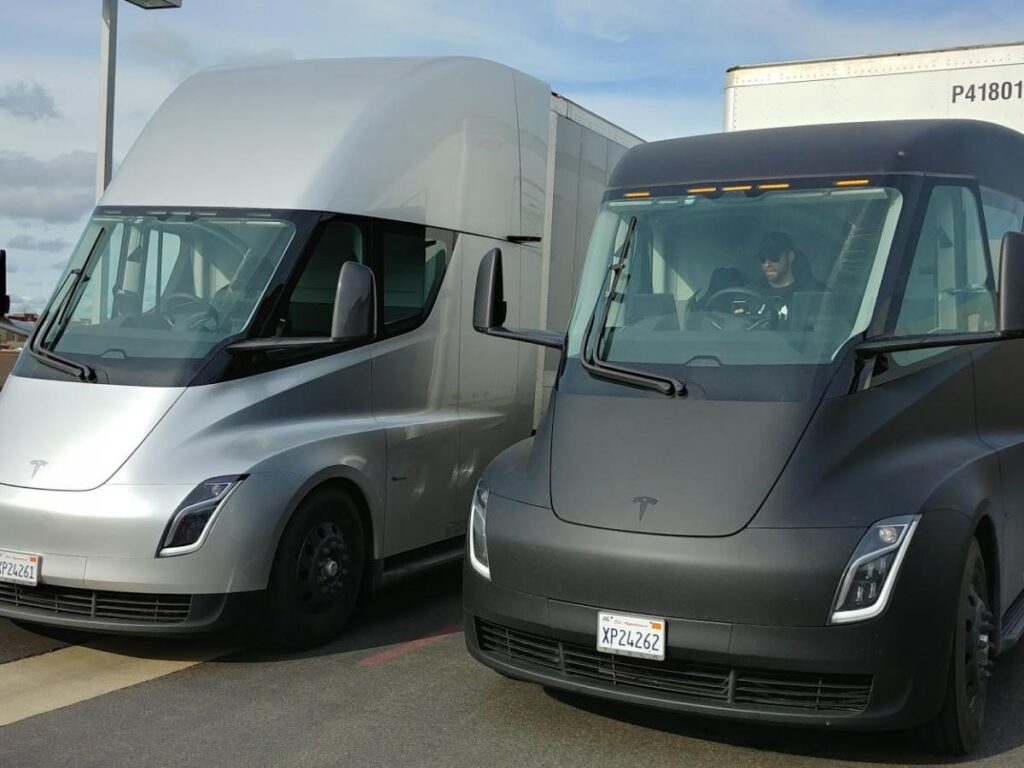
To address this issue, Tesla equipped the Semi with up to 10 cameras, creating a near 360-degree view around the vehicle.
These camera feeds are displayed on the truck’s large interior screens, allowing drivers to monitor their surroundings quickly and easily.
This system improves safety while also preparing the truck for future autonomous driving capabilities.
Driver Attention Monitoring for Safety
Tesla has also introduced a driver attention monitoring camera inside the cabin.
This system tracks the driver’s eye movement and level of focus.
If the driver appears distracted or looks away from the road for too long, the system can issue warnings.
For long-haul drivers who spend hours on highways, this technology could significantly reduce accident risks.
Small Ergonomic Improvements That Matter
Tesla didn’t just focus on high-tech upgrades.
The company also made several practical improvements that drivers appreciate during daily operations.
These include:
- Redesigned side windows for easier interaction at toll booths and loading docks
- Higher cup holder placement for better accessibility
- Expanded storage compartments for personal items and electronics
- Wireless phone charging integrated into the cabin
These details may seem minor, but they can make a big difference during long driving shifts.
Tesla Semi Production Is Finally Scaling Up
One reason the Tesla Semi hasn’t spread widely yet is production volume.
So far, fewer than 1,000 units have been produced.
However, Tesla has recently revealed its large-scale production line for the truck.
The company plans to significantly ramp up production in the near future.
If production increases successfully, the Tesla Semi could quickly become a major competitor in the freight industry.
Could the Tesla Semi Expand to Europe?
There is growing speculation that Tesla may bring the Tesla Semi to Europe.
The European truck market is massive and highly competitive. It is currently dominated by established manufacturers such as:
Many of these companies are already developing electric trucks of their own.
However, Tesla may consider manufacturing the Tesla Semi at Gigafactory Berlin-Brandenburg in Germany.
Local production would reduce shipping costs and help Tesla adapt the truck to European regulations.
Challenges Tesla Must Overcome in Europe
Despite the opportunity, entering the European truck market won’t be easy.
Several challenges remain:
Different Truck Designs
European trucks typically use cab-over designs, where the cabin sits directly above the front axle.
The Tesla Semi currently features a long-nose American design, which may require significant modifications.
Tighter Road Infrastructure
European roads are often narrower and contain many roundabouts.
Tesla may need to shorten the wheelbase of the truck to make it more maneuverable.
Sleeper Cab Requirements
European regulations often require drivers to take long rest periods.
This means Tesla might need to develop a sleeper cab version of the Semi for long-distance routes.
Charging Infrastructure
The Tesla Semi relies on Megachargers capable of over 1 megawatt of power.
Building this charging network across Europe will require major infrastructure investments.
The Future of the Tesla Semi
Despite these challenges, the Tesla Semi represents a powerful shift in trucking technology.
If the company can scale production and expand charging infrastructure, the truck could transform freight transportation by offering:
- Massive fuel savings
- Lower maintenance costs
- Improved driver safety
- Cleaner zero-emission transportation
For logistics companies under pressure to cut costs and reduce emissions, the Tesla Semi may become an increasingly attractive option.
Conclusion
The trucking industry has long relied on diesel engines, but the Tesla Semi is proving that electric trucks may finally be ready for large-scale freight operations.
With real-world testing showing operating costs as low as 15 cents per mile, the economic advantages are becoming impossible to ignore.
When combined with lower maintenance costs, advanced driver technology, and long-term energy stability, it becomes clear why Elon Musk calls the Tesla Semi a “money machine.”
If Tesla successfully ramps up production and expands globally, the Tesla Semi could become one of the most disruptive vehicles ever introduced to the logistics industry.
And if these early results are any indication, the future of trucking might just be electric.
FAQs
1. What is the Tesla Semi?
The Tesla Semi is an all-electric heavy-duty truck developed by Tesla for long-haul freight transportation. It is designed to replace traditional diesel-powered trucks with a more energy-efficient, lower-cost, and zero-emission alternative.
2. Why does Elon Musk call the Tesla Semi a “money machine”?
Elon Musk refers to the Tesla Semi as a “money machine” because of its extremely low operating costs. Real-world testing shows it can run for around 15 cents per mile, which is significantly cheaper than diesel trucks that often cost around 48 cents per mile in fuel.
3. How much does it cost to run a Tesla Semi per mile?
Based on real-world testing, the Tesla Semi costs approximately $0.15 per mile in electricity. This estimate is based on an energy consumption rate of 1.64 kWh per mile and an average electricity price of 9.12 cents per kWh.
4. How does the Tesla Semi compare to diesel trucks in fuel costs?
A typical diesel truck costs about $0.48 per mile in fuel, while the Tesla Semi costs about $0.15 per mile. This means the electric truck can reduce energy costs by nearly 70%.
5. How much money can trucking companies save with a Tesla Semi?
A long-haul truck traveling 100,000 miles per year could save around $33,000 annually by switching from diesel to the Tesla Semi. Over a 10-year lifespan, that could mean over $300,000 in savings per truck.
6. What is the energy consumption of the Tesla Semi?
Real-world testing shows the Tesla Semi consumes about 1.64 kilowatt-hours (kWh) per mile, which is slightly better than Tesla’s original target of 1.7 kWh per mile.
7. How far can the Tesla Semi travel on a single charge?
Tesla has announced two primary versions of the Semi with estimated ranges of 300 miles and 500 miles on a full charge, depending on battery configuration and load conditions.
8. Does the Tesla Semi require less maintenance than diesel trucks?
Yes. Electric trucks like the Tesla Semi have far fewer moving parts than diesel trucks. This means lower maintenance costs since there are no components such as turbochargers, complex transmissions, or exhaust systems.
9. What technology is inside the Tesla Semi cabin?
The Tesla Semi features a fully digital cockpit with dual 16-inch touchscreens, advanced navigation, energy monitoring systems, and camera feeds that provide a near 360-degree view around the truck.
10. How many cameras does the Tesla Semi have?
The truck is equipped with up to 10 cameras that help eliminate blind spots and provide enhanced visibility for the driver. These cameras also support Tesla’s advanced driver assistance systems.
11. Does the Tesla Semi support autonomous driving features?
The Tesla Semi includes hardware that supports advanced driver assistance systems and may eventually support more autonomous features in the future, although drivers are still required to remain attentive while driving.
12. How does the Tesla Semi improve driver safety?
The truck includes several safety technologies such as:
- A driver attention monitoring camera
- Multiple external cameras
- Real-time safety alerts
- Enhanced visibility systems
These features help reduce accidents and improve driver awareness.
13. How many Tesla Semi trucks have been produced so far?
Currently, production of the Tesla Semi is still ramping up, and fewer than 1,000 units have been produced so far. Tesla is working to significantly increase production in the coming years.
14. Can the Tesla Semi operate in Europe?
The Tesla Semi is currently designed primarily for North American highways, but Tesla is considering bringing the truck to Europe. However, modifications may be required to meet European regulations and infrastructure requirements.
15. What challenges does Tesla face when bringing the Semi to Europe?
Some key challenges include:
- Different truck size regulations
- Narrower roads and roundabouts
- The need for sleeper cab designs
- Building a megacharger network
Tesla may also need to redesign parts of the truck to meet European standards.
16. What is the future of the Tesla Semi?
If Tesla successfully scales production and expands charging infrastructure, the Tesla Semi could become one of the most cost-efficient and environmentally friendly trucks in the global logistics industry, potentially transforming freight transportation over the next decade.
Read More:
- Just Happened! NASA’s New Spaceplane Ready for the First Launch after Insane Runway Landing Test
- New Tesla Model 2 2026: $12,749 leak? 200-mi range + buttons return + FSD + save $22K vs Camry
- SpaceX Starship may NOT launch in Artemis 3 after NASA Redesigned Lunar Program! Why?
- What is Digital Optimus? The new Tesla and xAI project explained
- Tesla Cybercab SPOTTED Insane Specs Before BIG April Event! Elon Musk UPDATED
- Something Weird Happened with Starship Flight 12 Rocket and Pad. No Static Fire until