
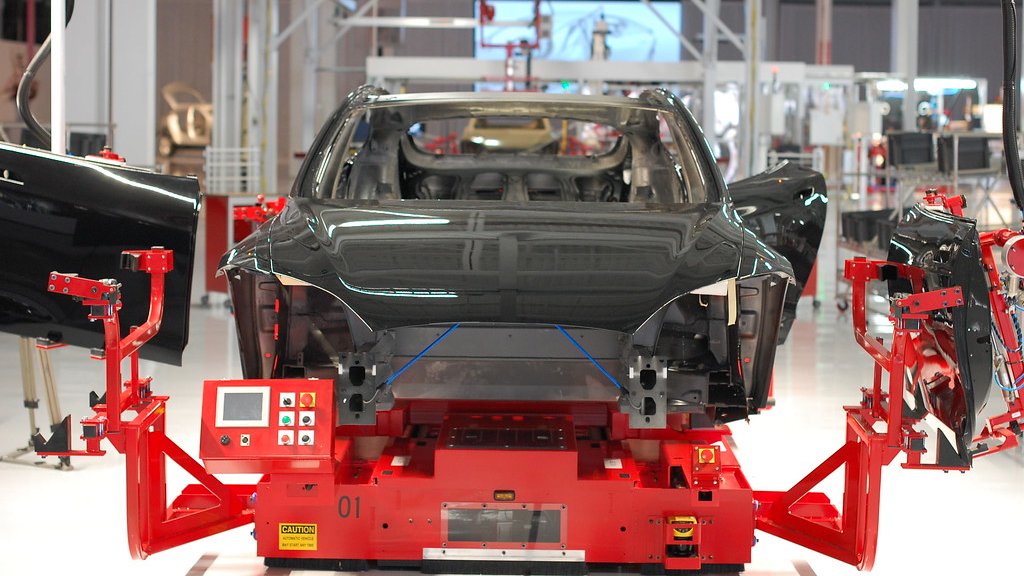
The Tesla Giga Press 4.0 is redefining the future of automotive manufacturing. As the automotive industry shifts toward faster production, stronger vehicle structures, and lower manufacturing costs, Tesla has once again positioned itself at the forefront of innovation. Equipped with an astonishing 50,000-ton clamping force, the next-generation Giga Press is capable of producing massive single-piece aluminum castings that replace dozens of traditional vehicle components.
This breakthrough is more than just a manufacturing upgrade—it represents a complete transformation in how electric vehicles are designed, built, and assembled. While the technology offers remarkable improvements in production efficiency, structural rigidity, and crash safety, it also raises important concerns regarding repairability, insurance costs, and long-term ownership.
In this article, we’ll explore how the Tesla Giga Press 4.0 works, the groundbreaking metallurgy behind it, and why this revolutionary manufacturing system is changing the global automotive industry forever.
What is Tesla Giga Press 4.0?
The Tesla Giga Press 4.0 is the latest evolution of Tesla’s giant die-casting technology. Unlike conventional automotive manufacturing, where more than 70 steel components are stamped and welded together, the Giga Press creates one large aluminum chassis section in a single casting process.
This dramatically simplifies production by reducing hundreds of manufacturing steps into one operation. The result is a lighter, stronger, and more rigid vehicle structure that improves both performance and crash protection.
One of the best examples is Tesla’s next-generation vehicle platform, where large front and rear underbody sections are manufactured as single-piece mega-castings, contributing to outstanding structural integrity.
Why Tesla Giga Press 4.0 is a Manufacturing Revolution
1. Massive 50,000-Ton Clamping Force
The most striking feature of the Tesla Giga Press 4.0 is its incredible 50,000-ton clamping force.
This enormous pressure keeps the giant steel molds perfectly sealed while approximately 100 kilograms of molten aluminum is injected into the cavity at speeds approaching 10 meters per second.
The process fills every corner of the mold within milliseconds, producing an incredibly precise structural component with minimal defects.
2. Single-Piece Mega Casting
Traditional vehicle production relies on hundreds of stamped steel parts connected through robotic welding, adhesives, and rivets.
Tesla replaces this entire assembly with a single monolithic aluminum casting.
Benefits include:
- Lower manufacturing costs
- Reduced vehicle weight
- Higher structural rigidity
- Fewer production steps
- Improved crash energy absorption
- Simplified factory operations
This represents one of the biggest manufacturing shifts since the moving assembly line transformed automobile production.
The Hidden Drawback: Repairability Challenges
Despite its remarkable engineering advantages, the Tesla Giga Press 4.0 introduces one major challenge—repairability.
Because the rear or front underbody is manufactured as one continuous aluminum structure, repairing collision damage becomes significantly more difficult.
With traditional vehicles, technicians can replace individual damaged frame sections. However, with a single-piece casting, even a relatively minor structural crack may require replacing the entire casting rather than repairing only the damaged area.
This creates a new challenge for repair shops, insurance companies, and vehicle owners.
Tesla’s Revolutionary Aluminum Alloy
One of Tesla’s greatest innovations isn’t just the machine itself—it’s the proprietary aluminum alloy developed specifically for giga-casting.
For decades, automotive manufacturers relied on the T6 heat treatment process to strengthen aluminum castings.
Unfortunately, this process often caused:
- Thermal distortion
- Dimensional warping
- Internal stress
- Production delays
- Higher manufacturing costs
Tesla solved this problem by developing a specialized aluminum-silicon alloy that naturally gains strength without requiring the traditional T6 heat treatment cycle.
Key Alloy Components
Silicon (8.5%)
The high silicon content significantly improves the flow characteristics of molten aluminum, allowing it to rapidly fill the massive mold before solidification begins.
Manganese (0.45%)
Manganese helps prevent the molten aluminum from bonding to the steel mold, improving casting quality and mold durability.
Micro-Alloying Elements
Small amounts of Vanadium, Titanium, and Zirconium create a refined grain structure that delivers excellent strength and ductility immediately after cooling.
The result is an aluminum casting with:
- Excellent yield strength
- Outstanding dimensional accuracy
- Minimal internal stress
- High structural durability
Vacuum Casting: Eliminating Air Defects
Another breakthrough inside the Tesla Giga Press 4.0 is its advanced vacuum casting system.
Before molten aluminum enters the mold, Tesla removes more than 99.9% of the air inside the die cavity.
Creating this near-vacuum environment prevents trapped gas bubbles from becoming embedded inside the aluminum.
Without these microscopic air pockets, the finished casting becomes:
- Stronger
- More durable
- Less likely to crack
- More reliable under heavy loads
Tesla also uses a highly optimized water-based lubrication system that protects the mold without contaminating the vacuum environment.
Lightning-Fast Production Cycle
Perhaps the most impressive achievement of the Tesla Giga Press 4.0 is speed.
The complete production cycle—including mold closing, vacuum creation, aluminum injection, solidification, mold opening, and robotic extraction—is completed in less than 90 seconds.
Compared to conventional manufacturing lines that require multiple stamping, welding, and assembly stages over several hours, this represents an extraordinary leap in efficiency.
Economic Advantages of Tesla Giga Press 4.0
Tesla’s manufacturing strategy delivers enormous financial benefits.
Reduced Component Count
Instead of assembling over 70 separate steel parts, Tesla creates one large structural casting.
Fewer Industrial Robots
The simplified production process eliminates approximately 600 robotic welding arms, significantly lowering equipment and maintenance costs.
Lower Production Costs
Tesla reportedly reduces chassis manufacturing expenses by approximately 40%, creating a significant competitive advantage.
Higher Factory Efficiency
With fewer production steps and shorter cycle times, Tesla can produce more vehicles using less factory space and fewer workers.
Why Competitors Are Struggling
Major automakers including Toyota, Ford, General Motors, Volvo, and BYD are investing heavily in giga-casting technology.
However, many still face significant obstacles.
Some manufacturers continue using modular casting designs rather than Tesla’s fully integrated approach.
While modular designs improve repairability, they also reduce many of the manufacturing savings achieved by Tesla.
Simply purchasing giant casting machines is not enough.
Without Tesla’s proprietary aluminum chemistry, advanced vacuum technology, and manufacturing expertise, replicating the same results remains extremely difficult.
Insurance Industry Concerns
The rise of single-piece giga-castings has created new challenges for insurers.
Because structural repairs are often impractical after significant casting damage, some accident-damaged vehicles may require complete structural replacement.
This increases repair costs and can result in more vehicles being classified as total losses following severe structural damage.
As giga-casting becomes more common, insurance companies will likely continue adapting their pricing models and repair policies.
The Future of Automotive Manufacturing
The Tesla Giga Press 4.0 is more than just a larger casting machine—it represents a completely new philosophy of vehicle production.
By combining advanced metallurgy, ultra-fast manufacturing, precision vacuum casting, and simplified assembly, Tesla is pushing automotive manufacturing toward an era defined by speed, automation, and efficiency.
Although questions surrounding repairability and long-term ownership remain, the technology has already demonstrated its ability to reduce production costs while improving structural performance.
As more automakers race to develop competing giga-casting systems, the automotive industry is entering one of its most significant periods of transformation since the birth of the assembly line.
Final Thoughts
The Tesla Giga Press 4.0 is reshaping how modern electric vehicles are built. Its 50,000-ton clamping force, innovative self-curing aluminum alloy, advanced vacuum casting technology, and ability to produce single-piece mega-castings in under 90 seconds give Tesla a substantial manufacturing advantage.
While challenges surrounding collision repair and insurance costs continue to spark debate, there’s little doubt that giga-casting is setting a new benchmark for automotive production. Whether competitors choose fully integrated castings or modular alternatives, the future of vehicle manufacturing has undeniably changed. The Tesla Giga Press 4.0 is not just another factory machine—it’s a glimpse into the next generation of automotive engineering.
FAQs
Frequently Asked Questions (FAQs)
1. What is the Tesla Giga Press 4.0?
The Tesla Giga Press 4.0 is an advanced high-pressure die-casting machine capable of producing large single-piece aluminum vehicle components using a massive 50,000-ton clamping force. It significantly reduces manufacturing complexity and production time.
2. Why is the Tesla Giga Press 4.0 important?
The Giga Press 4.0 simplifies vehicle production by replacing dozens of welded parts with a single aluminum casting. This improves manufacturing efficiency, reduces costs, and enhances structural strength.
3. How does the Tesla Giga Press 4.0 work?
The machine injects molten aluminum into a giant steel mold at extremely high speed under immense pressure. After the metal solidifies, robotic systems remove the finished structural component for vehicle assembly.
4. What are mega-castings?
Mega-castings are large, single-piece aluminum structural components that replace numerous individual parts traditionally welded together in a vehicle’s chassis.
5. What are the advantages of mega-casting?
Mega-casting offers several benefits, including:
- Lower production costs
- Reduced vehicle weight
- Improved structural rigidity
- Faster manufacturing
- Fewer production steps
- Better factory efficiency
6. Why did Tesla develop a new aluminum alloy?
Tesla created a proprietary aluminum alloy that naturally gains strength after casting, eliminating the need for traditional T6 heat treatment and reducing thermal distortion during manufacturing.
7. What is the role of silicon in Tesla’s aluminum alloy?
Silicon improves the flow of molten aluminum, allowing it to rapidly fill the complex mold before the metal begins to solidify, resulting in higher-quality castings.
8. Why does the Giga Press use a vacuum system?
The vacuum system removes nearly all air from the mold before casting. This prevents trapped gas bubbles, reduces internal defects, and produces stronger, more reliable aluminum components.
9. How fast is the Tesla Giga Press 4.0 production cycle?
The complete casting cycle—including mold closing, aluminum injection, cooling, and part removal—can be completed in under 90 seconds, making it one of the fastest automotive manufacturing processes.
10. How much does the Tesla Giga Press reduce manufacturing costs?
By replacing more than 70 individual components with a single casting and eliminating hundreds of welding operations, Tesla can reduce chassis production costs by approximately 40%.
11. Why are repairs more difficult with giga-cast vehicles?
Since the vehicle’s structural section is manufactured as one large aluminum casting, significant damage may require replacing the entire casting instead of repairing a single damaged section, increasing repair complexity and cost.
12. How does the Tesla Giga Press affect insurance costs?
Because large structural castings can be difficult or uneconomical to repair after major damage, insurance companies may face higher repair costs, which could influence insurance premiums and total-loss decisions.
13. Which automakers are developing giga-casting technology?
Several global manufacturers, including Toyota, BYD, Volvo, Ford, and General Motors, are investing in large-scale casting technologies to compete with Tesla’s manufacturing approach.
14. Is giga-casting the future of automotive manufacturing?
Many industry experts believe giga-casting will play a major role in the future of electric vehicle production because it improves efficiency, lowers manufacturing costs, and simplifies vehicle assembly.
15. What makes the Tesla Giga Press 4.0 different from previous generations?
The latest Tesla Giga Press 4.0 combines an enormous 50,000-ton clamping force, advanced vacuum-assisted casting, proprietary aluminum alloys, and ultra-fast production cycles, making it one of the most advanced automotive manufacturing systems ever developed.
Read More:
- NTSB findings on fatal Tesla crash tell a very different story
- Tesla has to fix a big problem with its old headlights, NHTSA says
- Elon Musk secretly acquires $1B energy company to power the AI future
- SpaceX’s new Gravity Space Station Rapidly Progresses toward Launch Sooner Than You Expected
- SpaceX’s Insane Plan to Make History in Starship Flight 13! Here’s Launch Timeline
1 thought on “2027 Next-Gen Giga Press 4.0: The Biggest Upgrade Yet”