
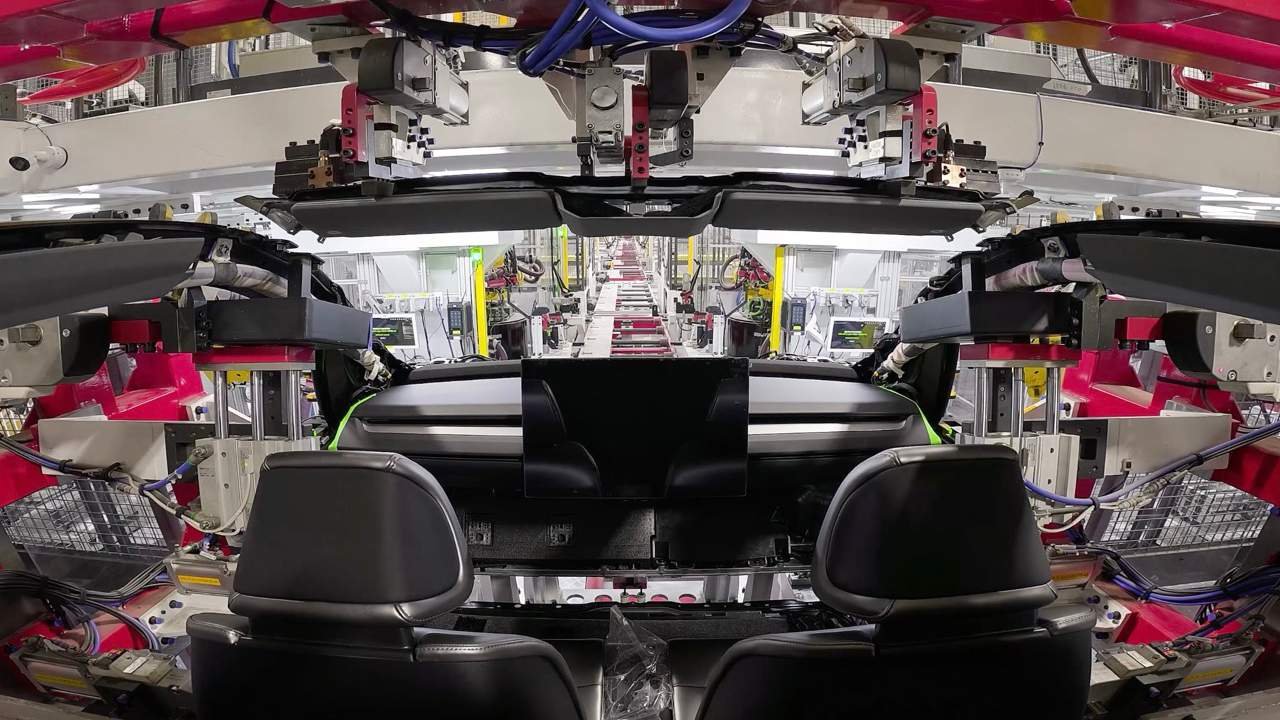
4.0 Elon Musk’s Assembly Line Destroy The Entire EV Industry: The electric vehicle (EV) industry is approaching a major manufacturing revolution, and Tesla is positioning itself at the center of this transformation. Under Elon Musk’s ambitious vision, the company is moving beyond traditional automotive production methods to create an entirely new manufacturing system capable of producing vehicles at unprecedented speeds. At Giga Texas, conventional assembly lines and outdated robotic equipment are being replaced with advanced production infrastructure designed around the revolutionary Cybercab.
Tesla’s ultimate manufacturing target is extraordinary: producing a brand-new vehicle every 10 seconds, with a long-term ambition to reduce that time to just 5 seconds. If achieved at scale, this production strategy could fundamentally change how vehicles are designed, manufactured, and delivered. More importantly, it could give Tesla a substantial competitive advantage over traditional automakers struggling with expensive factories, complicated supply chains, and labor-intensive production processes.
The Unboxed Manufacturing Revolution: Tesla’s Biggest Factory Transformation
For more than a century, automotive manufacturing has followed a relatively similar production philosophy. Vehicles move through a sequence of stamping, welding, painting, and final assembly operations. Every production station depends on the previous one, creating bottlenecks whenever a particular process slows down.
Tesla believes this traditional approach is no longer suitable for manufacturing affordable autonomous vehicles at massive scale. Its solution is the unboxed manufacturing system, an innovative production strategy that fundamentally changes how a vehicle comes together.
Parallel Module Assembly
Instead of constructing an entire vehicle around a single moving body shell, Tesla divides the Cybercab into several large modules. These include the front structure, rear structure, two side sections, roof, and structural battery pack.
Each module is manufactured independently on dedicated production lines. Robots and technicians can work on multiple sections simultaneously rather than waiting for one assembly process to finish before beginning another.
This approach improves accessibility, reduces unnecessary movement, and allows automation systems to complete complicated operations more efficiently.
Faster Final Vehicle Integration
After individual modules are completed and inspected, they converge at a central assembly station for final integration.
Tesla’s engineering estimates suggest that this manufacturing strategy could deliver significant improvements:
- 50% shorter production lines compared with conventional layouts.
- 40% less factory floor space required.
- 30% lower labor costs.
- Potentially three to four Cybercabs produced in the time required to manufacture one Model Y.
These improvements could make the Cybercab considerably cheaper and faster to manufacture, creating an important advantage as Tesla expands its autonomous transportation business.
Massive Giga Castings and Reaction Injection Molding
Another important element of Tesla’s manufacturing revolution is the simplification of vehicle structures. Traditional vehicles contain hundreds of individual metal components connected through thousands of welding operations. Tesla is replacing much of this complexity with massive single-piece aluminum castings.
50,000-Ton Giga Press Technology
The Cybercab’s front and rear structural sections utilize large aluminum castings that eliminate numerous smaller stamped components and welded joints.
Tesla has previously introduced Giga Press machines with approximately 6,200-ton and 9,000-ton clamping forces. Its next-generation manufacturing ambitions reportedly extend toward machines reaching 50,000 tons of clamping force.
The casting process requires carefully controlled temperatures and pressure. Molten aluminum is maintained between approximately 750°C and 850°C before being injected into precision-engineered molds using powerful pistons.
Freshly cast components can emerge at temperatures approaching 400°C before undergoing rapid cooling.
This process helps Tesla simplify structural manufacturing, reduce component counts, and improve production efficiency.
Eliminating the Traditional Paint Shop
Perhaps one of the most interesting Cybercab innovations is the elimination of the conventional automotive paint shop.
Tesla plans to use reaction injection molding (RIM) to manufacture polyurethane exterior body panels. Instead of applying multiple layers of paint, the desired color is integrated directly into the material during manufacturing.
This approach offers several potential advantages:
- Reduced dependence on traditional painting operations.
- Lower factory construction and equipment expenses.
- Easier replacement of damaged exterior panels.
- Less noticeable minor scratches.
- Reduced manufacturing complexity.
The supplied manufacturing estimates suggest that this strategy could save approximately 1 million labor hours during factory construction and reduce supply-chain greenhouse gas emissions by around 35%.
Removing traditional paint operations could become one of Tesla’s most important cost-saving manufacturing decisions.
Rare-Earth-Free Motors: A New Direction for Electric Powertrains
Tesla is also targeting another major EV manufacturing challenge: dependence on rare-earth materials.
Most conventional high-performance permanent-magnet electric motors rely on materials such as neodymium and dysprosium. These materials introduce supply-chain vulnerabilities and can increase manufacturing costs.
Smaller and Lighter Electric Motors
The Cybercab introduces a newly engineered rare-earth-free electric motor designed to eliminate dependence on traditional permanent magnets.
According to the supplied specifications, the new drive unit is:
- 18% smaller than previous high-performance versions.
- 25% lighter than earlier designs.
- Equipped with a simplified bar-wound stator.
- Optimized for automated, high-volume production.
Reducing motor size and weight can improve manufacturing efficiency while supporting Tesla’s broader objective of building affordable autonomous vehicles.
The simplified design is particularly important because the Cybercab production system requires components that can be manufactured quickly and consistently.
Advanced Battery Technology and the 500,000-Mile Target
Battery technology remains one of the most important factors determining the long-term economics of autonomous transportation.
Unlike privately owned vehicles, robotaxis are expected to operate for extended periods throughout the day. Consequently, battery durability, charging efficiency, and maintenance requirements become critical considerations.
Modular Battery Pack Design
The Cybercab features a modular battery pack housed inside a durable steel enclosure. This represents a different approach from Tesla’s previous battery enclosure strategies, with cost reduction and manufacturing simplicity playing important roles.
The initial configuration uses 4680 battery cells, while the modular architecture reportedly provides flexibility for future battery chemistry changes.
One potential future direction is Lithium Iron Phosphate (LFP) technology.
LFP batteries offer several advantages:
- Lower manufacturing costs.
- Improved thermal stability.
- Reduced dependence on certain expensive materials.
- Strong resistance to degradation.
- Potentially longer service lifecycles.
Although LFP batteries generally have lower energy density than some nickel-based alternatives, their durability and cost advantages make them attractive for high-utilization robotaxi fleets.
Tesla’s ambitious target is a vehicle service life of 500,000 miles (approximately 805,000 kilometers). Achieving this goal would significantly improve the economics of operating autonomous transportation networks.
Tesla Cybercab Production and Autonomous Fleet Expansion
The Cybercab manufacturing revolution is closely connected to Tesla’s broader autonomous transportation strategy.
The Giga Texas production infrastructure is designed for an annual capacity exceeding 125,000 vehicles, with a reported assembly target of approximately 10 seconds per vehicle.
Advanced Automation and Fewer Assembly Stations
Tesla’s final assembly process reportedly requires approximately 25 stations, substantially fewer than traditional Model Y production lines.
The reported automation rate reaches approximately 78%, with the body structure area achieving up to 100% automation through advanced robotic systems and autonomous mobile robots.
These technologies could allow Tesla to increase manufacturing output without proportionally increasing labor requirements.
Expansion Into New Robotaxi Markets
Tesla is also working to expand its autonomous transportation footprint beyond Austin.
The expansion strategy outlined in the supplied information includes:
- Dallas: Expanding autonomous transportation availability in Texas.
- Houston: Targeting another major metropolitan market.
- Miami: Exploring opportunities in a large urban transportation market.
The reported service schedule has expanded toward a 20-hour daily operating window, running from 6:00 AM to 2:00 AM.
Longer operating hours could increase vehicle utilization and improve the revenue potential of each robotaxi.
New Cybercab Software Features and Passenger Experience
Manufacturing efficiency is only one part of Tesla’s autonomous transportation strategy. The company must also deliver a comfortable and intuitive passenger experience.
New software features described in the supplied information include Calm Mode, which reduces screen brightness and minimizes distracting Full Self-Driving visualizations.
Additional features include:
- Rear-facing camera feeds displayed on interior screens.
- Haptic feedback through the Tesla mobile application.
- Improved accessibility features.
- Screen-reader enhancements.
- Simplified passenger interaction.
Because the Cybercab is designed without a traditional rear windshield, interior camera displays can provide passengers with additional visual information about the vehicle’s surroundings.
Safety Performance and Competition With Waymo
Tesla’s autonomous fleet expansion places it in direct competition with established robotaxi operators, particularly Waymo.
The supplied figures indicate that Tesla’s fleet recorded approximately 438,000 driverless miles during a peak testing week in Austin, without a safety monitor behind the wheel.
This represents an important operational milestone, although weekly mileage comparisons should be interpreted carefully because operating areas, service conditions, reporting periods, and fleet sizes can differ.
Waymo maintains a substantial cumulative autonomous driving mileage history nationwide dating back to 2020. However, Tesla’s manufacturing scale and integrated software ecosystem could create a different competitive advantage if its technology achieves reliable commercial deployment.
Ultimately, the robotaxi competition will depend on safety, regulatory approval, passenger trust, operating costs, and the ability to provide dependable autonomous transportation.
Conclusion: Elon Musk’s Manufacturing Vision Could Reshape the EV Industry
Tesla’s Cybercab manufacturing revolution represents a major departure from traditional automotive production. The combination of unboxed manufacturing, massive Giga Castings, reaction injection molding, rare-earth-free motors, and advanced battery technology creates a fundamentally different approach to building electric vehicles.
The ambition to manufacture one vehicle every 10 seconds, eventually targeting five seconds, demonstrates how aggressively Tesla wants to reduce production costs and increase manufacturing capacity.
With a potential retail price target below $30,000 and commercial availability targeted before the end of 2026, the Cybercab could become an important milestone in the development of autonomous transportation.
However, achieving these ambitions will depend on manufacturing execution, vehicle reliability, autonomous driving performance, and regulatory approval.
If Tesla successfully combines ultra-fast manufacturing with a commercially viable robotaxi network, its impact could extend far beyond the EV market. It could challenge the economics of traditional automotive manufacturing and transform how people think about personal transportation.
FAQs
1. What is Tesla’s new unboxed manufacturing system?
Tesla’s unboxed manufacturing system is an innovative production method that builds different vehicle sections simultaneously before combining them at a final assembly station. This approach reduces factory space, labor requirements, and production time.
2. How fast does Tesla plan to manufacture a Cybercab?
Tesla’s manufacturing target is to produce one Cybercab every 10 seconds, with a long-term ambition of reducing production time to just 5 seconds per vehicle.
3. What is the Tesla Cybercab?
The Tesla Cybercab is a fully autonomous electric vehicle designed primarily for robotaxi transportation. It features a minimalist interior, advanced autonomous driving technology, and a manufacturing system focused on reducing production costs.
4. How much factory space can Tesla’s unboxed manufacturing system save?
According to the supplied engineering estimates, Tesla’s unboxed manufacturing approach could reduce factory floor space requirements by approximately 40% compared with conventional manufacturing methods.
5. What is a 50,000-ton Giga Press?
A 50,000-ton Giga Press is an advanced industrial casting machine designed to manufacture large aluminum vehicle structures using immense clamping force. Tesla’s manufacturing ambitions include using this technology to simplify vehicle structures and reduce the number of individual components.
6. How does Tesla eliminate the traditional paint shop?
Tesla plans to use reaction injection molding (RIM) to manufacture polyurethane exterior panels with color integrated directly into the material. This reduces the need for conventional painting operations and makes damaged panels easier to replace.
7. Does the Tesla Cybercab use rare-earth-free motors?
Yes, the supplied Cybercab specifications describe a rare-earth-free electric motor that eliminates the need for materials such as neodymium and dysprosium. The motor is reportedly 18% smaller and 25% lighter than previous high-performance versions.
8. What type of battery does the Tesla Cybercab use?
The Cybercab’s initial battery configuration uses 4680 cells inside a modular steel enclosure. Its architecture is also designed to accommodate potential future transitions to Lithium Iron Phosphate (LFP) battery technology.
9. Why could LFP batteries be beneficial for Tesla robotaxis?
LFP batteries offer lower manufacturing costs, improved thermal stability, and strong resistance to degradation. These characteristics make them attractive for robotaxis that need to operate for extended periods and accumulate substantial mileage.
10. What is the targeted service life of the Tesla Cybercab?
Tesla’s ambitious target is approximately 500,000 miles (805,000 kilometers) of vehicle service life. Reaching this milestone could reduce replacement costs and improve the long-term economics of autonomous transportation.
11. How many Cybercabs can Tesla’s Giga Texas factory produce annually?
The supplied production information describes a manufacturing capacity designed to exceed 125,000 vehicles annually. This capacity is intended to support Tesla’s expanding autonomous transportation ambitions.
12. How automated is the Tesla Cybercab production line?
The Cybercab manufacturing system reportedly achieves approximately 78% automation, with the body structure area reaching up to 100% automation through advanced robotics and autonomous mobile robots.
13. Which cities is Tesla targeting for robotaxi expansion?
Beyond Austin, Tesla’s expansion strategy includes major metropolitan markets such as Dallas, Houston, and Miami. These locations could help increase the reach of its autonomous transportation network.
14. How does Tesla’s Cybercab compete with Waymo?
Tesla aims to compete with Waymo through large-scale vehicle manufacturing, autonomous driving software, and an integrated robotaxi network. Its reported 438,000 driverless miles during a peak Austin testing week highlight its operational ambitions, although direct comparisons require consistent reporting conditions.
15. What is the expected price of the Tesla Cybercab?
Tesla’s stated target in the supplied information is a price below $30,000. If achieved, this could make the Cybercab a significantly more affordable autonomous vehicle and help accelerate the adoption of robotaxi transportation.
Read More:
- Elon Musk says Tesla Cybercab future is ‘obvious to anyone with eyes and a brain’
- Tesla upfitter offers to keep Cybertruck alive
- SpaceX just cleared a key FCC hurdle in its fight with Verizon and AT&T
- Tesla overtakes Waymo in Texas as Robotaxi fleet performs shock flip
- Tesla extends Cybertruck production as Musk concedes ‘sentimentality’
2 thoughts on “4.0 Elon Musk’s Assembly Line Destroy The Entire EV Industry”