
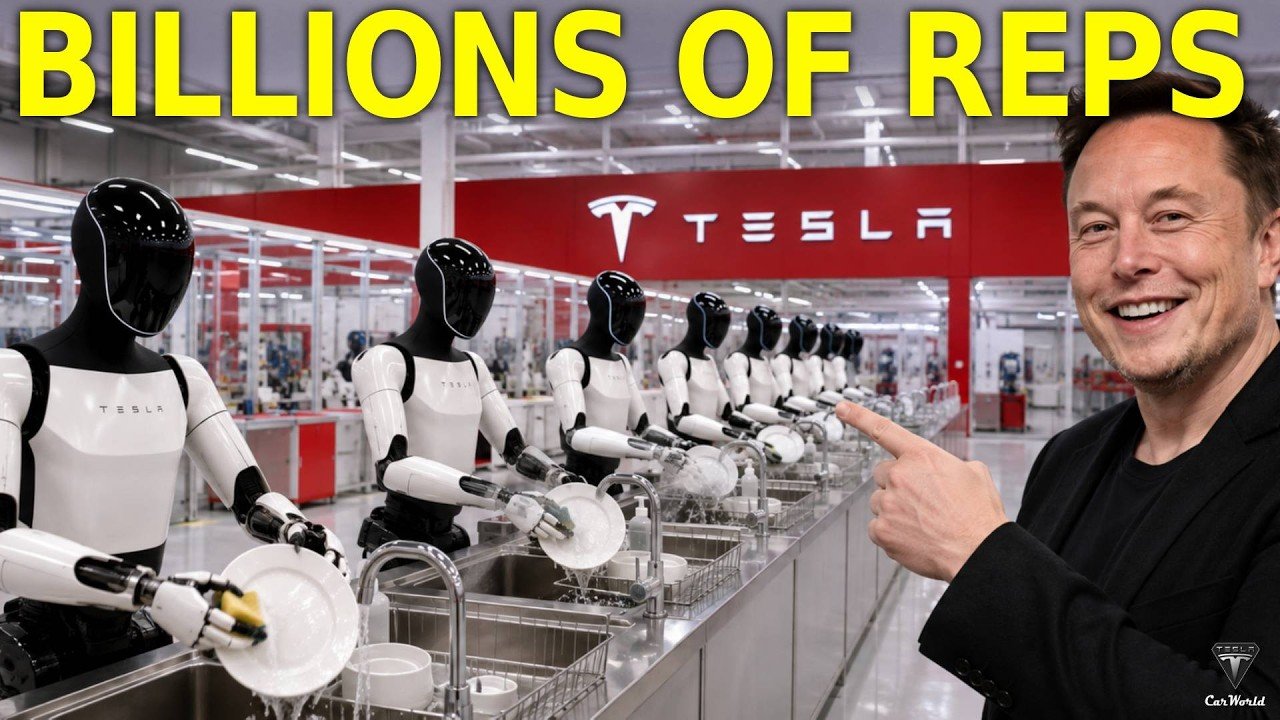
Tesla Bot Gen 3 Is FINALLY NUTTY — Can Do 5,000 Tasks: The humanoid robotics industry is entering a major new phase. What once seemed like science fiction is quickly becoming a serious engineering and manufacturing race, with companies working to create robots capable of operating in factories, warehouses, homes, and other human environments.
At the center of this transformation is Tesla Optimus, Tesla’s humanoid robot project. From early prototypes to newer generations, Tesla has increasingly focused on one critical objective: moving humanoid robots from impressive demonstrations to large-scale production and practical deployment.
The latest evolution, Optimus Gen 3, represents an important step in that journey. Instead of treating robotics as a small experimental project, Tesla is combining its experience in electric vehicles, batteries, motors, power electronics, artificial intelligence, and automated manufacturing to build a general-purpose humanoid platform.
Tesla Optimus Gen 3: From Prototype to Mass Production
The biggest story surrounding Optimus Gen 3 is not simply its appearance or mechanical improvements. It is Tesla’s ambition to manufacture humanoid robots at an unprecedented scale.
Traditional humanoid robots are difficult and expensive to build. Complex actuators, robotic hands, sensors, wiring, precision components, and software integration can make production extremely challenging. Most advanced humanoid robots have historically been produced in relatively small quantities.
Tesla wants to change that model.
Aiming for Automotive-Scale Manufacturing
Tesla’s manufacturing strategy is designed around the idea that humanoid robots can eventually be produced using techniques similar to those used for vehicles.
The company has discussed ambitious production targets involving millions of robots per year. Early manufacturing could leverage existing Tesla facilities, while future production capacity could expand significantly through Gigafactory operations.
This approach is important because the economics of robotics change dramatically when production moves from hundreds of machines to hundreds of thousands or millions.
Instead of building every robot almost like a custom machine, Tesla can standardize components, automate assembly, optimize supply chains, and reduce manufacturing costs through volume.
The Continuous Optimus Platform
Another important concept is the idea of Optimus as a continuously evolving platform.
Rather than completely replacing one robot generation with another, Tesla can improve hardware, software, sensors, actuators, and AI models over time. Gen 3 can therefore become the foundation for future versions while maintaining common manufacturing and supply-chain systems.
This strategy resembles the development philosophy used in Tesla’s automotive and software businesses, where improvements can be introduced continuously.
Tesla’s EV Technology Gives Optimus a Major Advantage
One of Tesla’s potential advantages in humanoid robotics is that it does not have to develop every underlying technology from scratch.
The company already has experience designing and manufacturing electric motors, batteries, inverters, power electronics, computers, and AI systems.
Battery Technology
A humanoid robot needs a compact energy source capable of supporting hours of movement and physical work.
Tesla’s experience with high-energy-density battery systems can potentially help Optimus achieve useful operating endurance while keeping its weight manageable.
Battery efficiency is especially important because a humanoid robot must carry its own power source while walking, lifting objects, balancing, and performing repetitive tasks.
Motors, Actuators, and Power Electronics
Humanoid robots require dozens of highly controlled movements throughout the body.
Every joint must deliver the appropriate combination of torque, speed, precision, and efficiency.
Tesla’s experience with electric motors and power electronics can be transferred into robotic actuators used in the robot’s arms, legs, hands, shoulders, hips, and other joints.
The result is a highly integrated electromechanical system in which software and hardware must work together in real time.
Artificial Intelligence
Perhaps the most important connection is Tesla’s experience with AI and computer vision.
Tesla has spent years developing neural networks capable of interpreting visual information from cameras. The same broad principles can be adapted for a humanoid robot.
A robot operating in a home or factory cannot rely exclusively on a fixed map. Its environment can change constantly.
Optimus Gen 3 and Real-Time 3D Perception
A useful humanoid robot needs to understand its surroundings continuously.
Imagine Optimus walking through a warehouse. A box could be moved, a worker could suddenly cross its path, an object could fall onto the floor, or a previously clear pathway could become blocked.
The robot therefore needs to perceive the environment and make decisions dynamically.
Computer Vision Meets Robotics
Tesla’s vision-based AI approach can potentially help Optimus recognize:
- People and other moving entities
- Floors, walls, stairs, and furniture
- Objects that can be picked up or moved
- Obstacles that need to be avoided
- Available pathways
- Objects requiring delicate handling
Instead of simply asking, “Is something in front of me?”, a sophisticated robot needs to understand what that thing is and what should happen next.
For example, a wall should be avoided, while a small box blocking a workspace might need to be picked up and moved.
From 2D Cameras to 3D Understanding
Multiple cameras can provide visual information from different directions. AI models can then estimate depth, identify objects, and construct a useful representation of the surrounding environment.
This enables a continuous perception-to-action loop:
- See the environment
- Understand objects and surroundings
- Determine the next action
- Plan movement
- Execute the action
- Reassess the environment
- Adapt when something changes
This continuous loop is essential for creating a truly autonomous humanoid robot.
Can Tesla Bot Really Handle Thousands of Tasks?
The headline idea behind a general-purpose humanoid robot is its ability to perform thousands of different tasks instead of being limited to one repetitive operation.
A specialized industrial robot may be extremely good at welding, painting, packaging, or moving a specific component. But a humanoid robot has the potential to perform many different activities using the same basic body.
That could include:
- Sorting objects
- Moving boxes
- Organizing shelves
- Carrying materials
- Performing repetitive factory work
- Cleaning workspaces
- Handling tools
- Delivering items
- Loading and unloading objects
- Performing simple household chores
The real challenge is not demonstrating a single task. The challenge is performing many tasks reliably, safely, and repeatedly without constant human intervention.
Continuous Autonomous Task Chaining
Earlier generations of robots often required highly structured environments and carefully defined instructions.
The long-term goal for Optimus is much more ambitious: continuous task chaining.
Instead of receiving a separate command for every movement, the robot could receive a broader objective and determine the steps required to accomplish it.
For example, a human could ask the robot to organize a workstation.
Optimus would need to identify objects, decide where they belong, walk toward them, pick them up, transport them, place them correctly, and continue until the larger objective is complete.
If a person suddenly walks in front of the robot, it should adapt rather than completely restart the task.
That ability could be one of the defining characteristics of useful AI-powered humanoid robots.
The Robotics Data Flywheel
Tesla’s potential advantage becomes even more interesting when large numbers of robots are deployed.
Every robot operating in the real world can encounter new objects, environments, movements, and unusual situations.
Those experiences can generate valuable data.
From Fleet Data to Better AI
The basic improvement cycle could look like this:
Robot deployment → Data collection → AI training → Improved software → Over-the-air updates → Better robots
This creates a robotics data flywheel.
If Tesla eventually operates a very large Optimus fleet, the company could potentially collect enormous amounts of real-world robotics data. Difficult situations could be analyzed and used to improve future models.
Software improvements could then be distributed across the fleet.
This is similar in principle to how connected software platforms can improve through real-world usage, although robotics introduces significantly greater safety and reliability challenges.
Why Humanoid Robots Could Change Automation
The biggest argument for the humanoid form factor is simple: the world is already designed for humans.
Homes, factories, warehouses, offices, elevators, stairs, doors, shelves, workbenches, and hand tools are generally built around human dimensions.
A humanoid robot can potentially use this infrastructure without requiring companies to redesign entire facilities.
That could make general-purpose robots attractive for industries where installing specialized automation would be too expensive or inflexible.
The Economics of a Robot Workforce
If manufacturing costs decline while robot capabilities increase, companies could eventually evaluate humanoid robots based on cost per productive hour.
A robot capable of working for long periods could potentially perform repetitive, physically demanding, or hazardous tasks while allowing human employees to focus on higher-value activities.
However, reaching that point requires more than impressive demonstrations. Optimus must prove that it can operate reliably, safely, economically, and at scale.
The Biggest Challenges Ahead
Despite the excitement surrounding Optimus Gen 3, major challenges remain.
Humanoid robotics combines mechanical engineering, artificial intelligence, battery technology, control systems, manufacturing, and safety into one extremely complicated product.
Walking reliably is difficult. Manipulating unfamiliar objects is difficult. Maintaining balance while carrying loads is difficult. Operating around people safely is even more challenging.
The difference between a robot that works during a demonstration and one that can operate thousands of hours in the real world is enormous.
Tesla therefore faces the difficult task of turning technological progress into repeatable commercial performance.
Conclusion: Is Optimus Gen 3 the Beginning of the Robot Era?
Tesla Optimus Gen 3 could represent an important milestone in the evolution of humanoid robotics.
Its significance is not just about how many tasks a robot can demonstrate. The bigger question is whether Tesla can combine AI, advanced actuators, battery technology, manufacturing scale, and real-world data into an affordable and dependable general-purpose machine.
If Tesla succeeds in producing Optimus at large scale, the impact could extend far beyond the automotive industry.
Factories, warehouses, logistics centers, and eventually homes could become new operating environments for humanoid robots.
The journey from prototype to mass-produced robot is still filled with engineering and economic challenges. But if Optimus Gen 3 can deliver on its promise of handling thousands of tasks, operating for extended periods, and continuously improving through AI, it could become one of the most important robotics platforms of the coming decade.
The real revolution will not happen when a humanoid robot performs one impressive trick.
It will happen when millions of capable robots can perform useful work every day.
FAQs
1. What is Tesla Optimus Gen 3?
Tesla Optimus Gen 3 is the latest generation of Tesla’s humanoid robot platform, designed to perform a wide range of physical tasks in human-centered environments such as factories, warehouses, and potentially homes.
2. How many tasks can Tesla Bot Gen 3 perform?
Tesla’s broader vision for Optimus is a general-purpose humanoid robot capable of performing thousands of different tasks. The exact number of tasks Gen 3 can reliably perform will depend on its software capabilities, training, and real-world deployment.
3. What makes Optimus Gen 3 different from earlier versions?
Optimus Gen 3 is focused more heavily on mass production, improved hardware, AI capabilities, autonomy, and real-world usefulness rather than simply demonstrating individual robotic movements.
4. Can Optimus Gen 3 work autonomously?
The goal is for Optimus to perform tasks with a high degree of autonomy, continuously sensing its environment, planning movements, executing actions, and adapting when conditions change.
5. How does Optimus understand its surroundings?
Optimus can use computer vision, multiple cameras, AI models, depth estimation, and spatial perception to identify objects, people, obstacles, and pathways around it.
6. Can Tesla Optimus recognize people and moving objects?
A capable humanoid robot needs to distinguish between static obstacles and dynamic entities such as people and pets. This allows it to adapt its movements instead of simply stopping whenever something enters its path.
7. How does Tesla use its automotive technology in Optimus?
Tesla can transfer expertise from its electric vehicle business into robotics, including battery systems, electric motors, power electronics, AI computing, manufacturing processes, and precision mechanical components.
8. How long can Optimus Gen 3 operate?
Long operating endurance is a major requirement for useful humanoid robots. The target discussed in the supplied material is approximately 8 to 16 hours of operation, depending on workload, payload, and operating conditions.
9. Where could Optimus Gen 3 be used?
Potential applications include factories, warehouses, logistics facilities, manufacturing plants, offices, and homes. Early commercial applications are more likely to focus on structured industrial environments.
10. Can Optimus Gen 3 replace human workers?
Optimus is intended to automate physical tasks, but it is too early to conclude that humanoid robots will broadly replace human workers. A more realistic near-term possibility is augmenting workers and automating repetitive, dangerous, or physically demanding tasks.
11. Why does Tesla want to manufacture millions of Optimus robots?
Large-scale manufacturing could significantly reduce the cost per robot and make humanoid automation economically viable for more industries. High production volumes could also accelerate improvements in hardware and software.
12. What is the Optimus data flywheel?
The robotics data flywheel describes a continuous improvement process: robots operate in the real world, generate useful data, that data helps improve AI models, and updated software can then be deployed back to the robot fleet.
13. Can Optimus receive software updates?
Tesla’s software-driven approach creates the potential for over-the-air updates that improve control systems, perception, task performance, and other capabilities without requiring every improvement to come from new physical hardware.
14. Why is a humanoid robot useful in human environments?
A humanoid body can potentially use infrastructure already designed for people, including stairs, doors, shelves, workbenches, tools, and narrow walkways. This could reduce the need for expensive facility modifications.
15. Is Tesla Optimus Gen 3 ready to become a mass-market robot?
The long-term goal is mass production and widespread deployment, but achieving that requires solving major challenges involving reliability, safety, manufacturing cost, autonomy, battery endurance, and real-world task performance. Gen 3 is an important step toward that objective, but its ultimate commercial impact will depend on how successfully Tesla scales and validates the technology.
Read More:
1 thought on “Tesla Bot Gen 3 Is FINALLY NUTTY — Can Do 5,000 Tasks”