
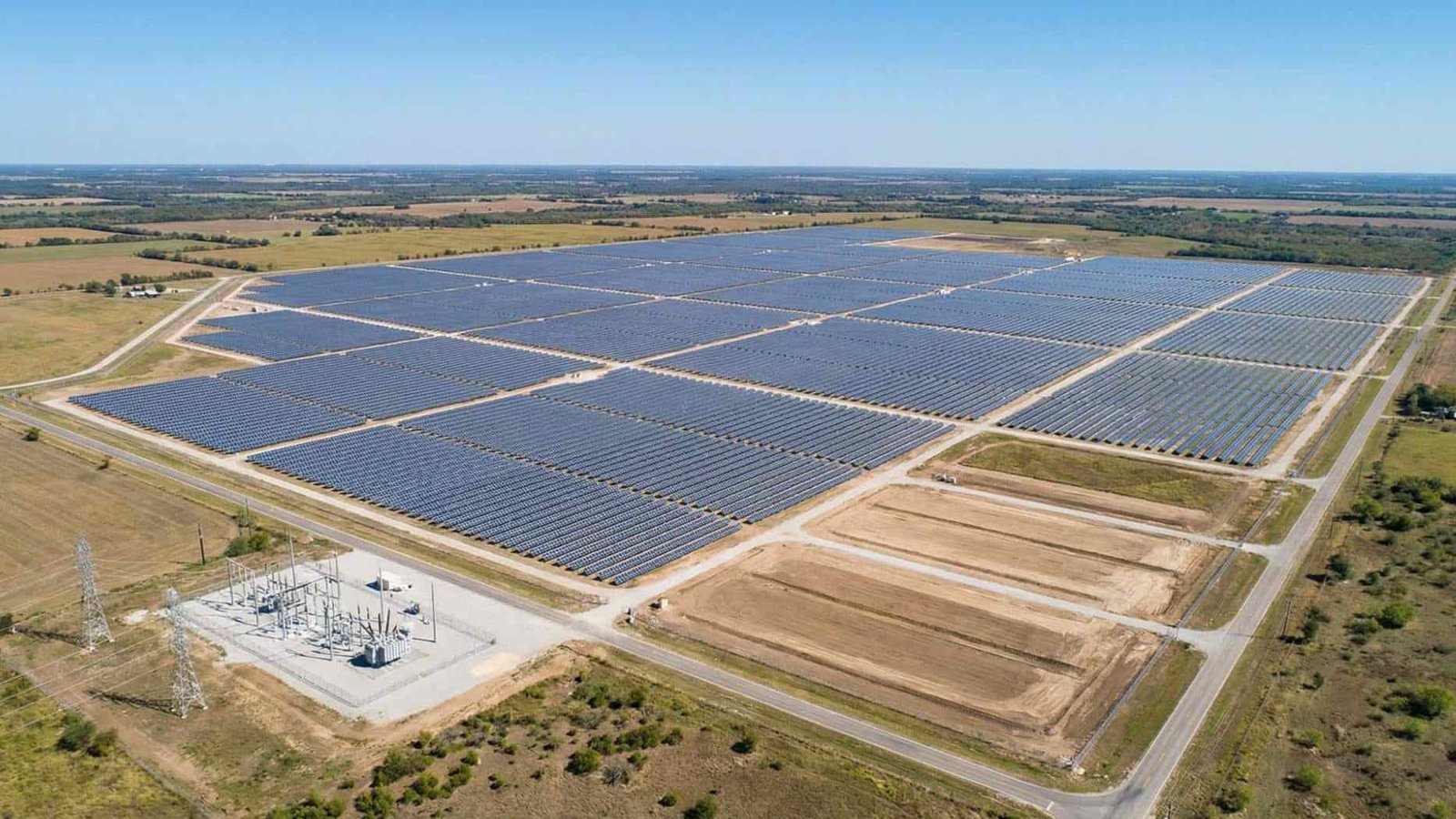
Elon Musk Finally Build World’s Biggest Solar Factory: Elon Musk’s industrial vision has always been built around one idea: go bigger, automate aggressively, and control as much of the supply chain as possible. From electric vehicles and batteries to artificial intelligence and humanoid robotics, the companies associated with Musk have repeatedly pursued massive industrial projects.
Now, a reported Tesla solar manufacturing initiative called Project Crystal Sun could take that strategy to an entirely new level. According to the information provided, the proposed facility in Fort Bend County, Texas, could target an extraordinary 100 gigawatts (GW) of annual solar manufacturing capacity.
If that target becomes reality, the project could have major implications for the U.S. solar industry, clean energy manufacturing, and the future power demands of artificial intelligence.
Project Crystal Sun: A $10.1 Billion Solar Manufacturing Ambition
The reported Project Crystal Sun would be located in Fort Bend County, Texas, near Houston. The proposed investment is approximately $10.1 billion, highlighting the enormous scale of Tesla’s reported solar ambitions.
The project is reportedly designed around a timeline that could see construction begin in late 2026, reach completion in 2028, and begin commercial operations during Q1 2029.
The employment impact could also be substantial. The proposal reportedly anticipates more than 10,000 construction jobs at peak employment and approximately 9,712 permanent full-time positions once operations are established.
The headline figure, however, is the planned 100 GW annual production capacity.
How Big Is 100 GW?
A 100 GW annual manufacturing target is difficult to visualize without comparison.
The information provided estimates existing U.S. solar manufacturing capacity at roughly 74 GW across manufacturers. First Solar, one of America’s largest domestic solar producers, has been targeting approximately 17.7 GW of capacity by 2027.
Meanwhile, the United States added around 32 GW of solar capacity during 2023.
That means a hypothetical 100 GW annual output from Project Crystal Sun would represent more than three times the amount of solar capacity installed across the entire United States in 2023.
Even if Tesla ultimately produced only a fraction of its reported target, such as 20 GW or 50 GW annually, it could still become one of the largest solar equipment manufacturers in the country.
Full Vertical Integration Could Be Tesla’s Biggest Advantage
One of the most important aspects of the reported project is not simply its size. It is the possibility of vertical integration.
Many solar factories primarily assemble finished modules using components manufactured elsewhere. Project Crystal Sun, by contrast, is reportedly intended to cover multiple stages of solar manufacturing within the same industrial ecosystem.
From Silicon to Solar Panels
The proposed manufacturing chain could include:
- Silicon ingot production – converting high-purity silicon into crystalline ingots.
- Wafer production – slicing those ingots into thin photovoltaic wafers.
- Solar cell manufacturing – processing wafers into functional photovoltaic cells.
- Module assembly – combining cells into finished solar panels ready for deployment.
This approach could give Tesla greater control over its solar supply chain.
China currently dominates many upstream stages of global solar manufacturing, including polysilicon processing, ingot production, and wafer manufacturing. Bringing more of these operations to the United States could reduce Tesla’s dependence on overseas suppliers and potentially improve supply-chain resilience.
For a company pursuing massive manufacturing volumes, controlling production from raw materials to finished products could also support automation, logistics efficiency, quality control, and cost reduction.
Tesla’s Solar Roof Experience Offers an Important Lesson
Tesla’s reported solar manufacturing ambitions also represent a major shift from the company’s earlier approach to residential solar.
The Solar Roof, introduced in 2016, attempted to integrate photovoltaic technology directly into roof tiles. The concept was visually appealing and ambitious, but it also introduced considerable complexity.
Why Solar Roof Was Difficult to Scale
Traditional solar panels benefit from standardization. Installers can use established mounting systems and place standardized panels across a wide variety of roofs.
Solar Roof required a much more customized process.
Reported challenges included:
- Higher customization requirements for individual roofs.
- Installation complexity involving specialized tiles and wiring.
- Pricing uncertainty, with some installation estimates increasing significantly.
- Lower-than-target installation volumes compared with Tesla’s original ambitions.
The broader lesson is important: complexity can make mass production difficult.
Instead of attempting to make every roof a custom solar product, a giant standardized manufacturing operation can focus on producing enormous quantities of panels at increasingly low costs.
Project Crystal Sun therefore appears, based on the supplied information, to represent a different philosophy: standardize the product, automate the factory, increase volume, and reduce cost per watt.
The Economics Behind Massive Solar Manufacturing
There is another reason a 100 GW factory could make strategic sense: the economics of solar power have changed dramatically over the past several decades.
Wright’s Law and the Solar Learning Curve
Solar technology has experienced extraordinary cost reductions as manufacturing volumes have increased.
The concept commonly associated with Wright’s Law suggests that production costs decline as cumulative production increases. In the solar industry, continued manufacturing expansion has helped drive major reductions in module prices.
The basic economic cycle is powerful:
More production → lower costs → higher demand → more production.
A factory designed for extraordinary scale could therefore be positioned to exploit the benefits of manufacturing learning curves, automation, purchasing power, and standardized production.
If Tesla can lower the cost of solar equipment significantly, it could potentially accelerate adoption across residential, commercial, industrial, and utility-scale markets.
AI Could Be the Real Reason for Tesla’s Energy Push
Perhaps the most important part of this story has little to do with traditional residential solar.
The future growth of artificial intelligence is creating enormous demand for electricity.
Large AI models require massive computing infrastructure. Data centers packed with advanced processors consume substantial amounts of electricity, while training and operating increasingly sophisticated AI systems could require even more power.
Musk has repeatedly argued that energy availability could become a major constraint for AI development.
That creates an interesting connection between Tesla’s different businesses.
Tesla’s Potential Vertical Energy Ecosystem
Imagine an integrated system involving:
Solar generation → Battery storage → Computing and industrial consumption
Tesla already operates in energy storage through products such as Megapack and Powerwall. A giant solar manufacturing operation could potentially complement that ecosystem by increasing access to low-cost solar generation.
The energy could ultimately support AI data centers, factories, electric vehicles, robotics, and other high-power applications.
This is where the reported Project Crystal Sun becomes more than a conventional solar factory.
It could represent part of a broader strategy to control the infrastructure required to generate, store, and consume electricity.
What a 100 GW Solar Factory Could Mean for the U.S.
If the reported project proceeds as described, its impact could extend beyond Tesla.
A facility of this scale could strengthen America’s domestic solar manufacturing ecosystem, create thousands of jobs, and increase domestic production of critical clean-energy components.
It could also intensify competition among U.S. solar manufacturers and potentially accelerate innovation in solar efficiency, automation, manufacturing technology, and energy storage.
However, a 100 GW target is extraordinarily ambitious. Building the physical facility is only one challenge. Tesla would also need to achieve high production yields, secure raw materials, develop competitive technology, attract a large workforce, and find enough customers for its output.
The Bigger Picture: Tesla’s Next Industrial Bet
Project Crystal Sun, if the reported plans materialize, could become one of the most ambitious solar manufacturing projects ever proposed.
The significance is not simply the reported 100 GW capacity. It is the combination of vertical integration, automation, energy storage, solar generation, and rapidly growing electricity demand from AI.
Tesla’s earlier Solar Roof strategy focused on integrating solar technology into buildings. This reported new strategy is fundamentally different: build solar at unprecedented scale and make the economics work through industrialization.
If successful, the project could help transform Tesla from an electric vehicle and battery company into an even larger energy infrastructure powerhouse.
For Elon Musk’s broader industrial vision, that may be the ultimate goal: not merely producing cars or computers, but building the energy ecosystem capable of powering the next generation of technology.
FAQs
1. What is Project Crystal Sun?
Project Crystal Sun is the reported name of a proposed Tesla solar manufacturing initiative in Fort Bend County, Texas. The project is reportedly designed around extremely large-scale solar production.
2. Where will Project Crystal Sun be located?
The reported mega-factory is planned for Fort Bend County, Texas, near Houston. The location would place the facility within a major U.S. industrial and energy market.
3. How much will Project Crystal Sun cost?
The reported investment for the project is approximately $10.1 billion, making it one of the most ambitious manufacturing investments associated with Tesla’s energy strategy.
4. How much solar capacity could Tesla produce?
The reported target is an extraordinary 100 gigawatts (GW) of solar manufacturing capacity per year. If achieved, that would make the facility one of the world’s largest solar manufacturing operations.
5. When could the Tesla solar factory begin operations?
According to the supplied project timeline, construction could begin in late 2026, with construction potentially completed in 2028 and commercial operations targeted for Q1 2029.
6. How many jobs could the project create?
The reported plans could generate more than 10,000 construction jobs at peak activity and approximately 9,712 permanent full-time jobs after the facility becomes operational.
7. Why is 100 GW such a significant number?
A 100 GW annual production target is enormous compared with current U.S. solar manufacturing and deployment figures. It would represent more than three times the approximately 32 GW of solar capacity installed across the United States in 2023.
8. Could Tesla become America’s largest solar manufacturer?
Yes, if the reported production target is achieved, Tesla could become one of the largest—and potentially the largest—solar equipment manufacturers in the United States. Even production significantly below 100 GW could still represent an enormous domestic manufacturing footprint.
9. What does vertical integration mean for Project Crystal Sun?
Vertical integration means controlling multiple stages of production rather than relying heavily on outside suppliers. The reported project could encompass silicon ingots, wafers, photovoltaic cells, and finished solar modules.
10. Why is vertical integration important for solar manufacturing?
Vertical integration could give Tesla greater control over its supply chain, production costs, quality, logistics, and manufacturing speed. It could also reduce dependence on imported upstream components.
11. Is Project Crystal Sun connected to Tesla’s Solar Roof?
The reported strategy appears to represent a significant shift from the Solar Roof approach. Instead of focusing primarily on customized solar roof tiles, Tesla could use standardized solar modules that are easier to manufacture and deploy at massive scale.
12. What went wrong with Tesla’s Solar Roof strategy?
The Solar Roof faced challenges involving customization, installation complexity, pricing, and production volume. Unlike standardized solar panels, roof tiles can require highly customized installation, making rapid scaling more difficult.
13. What is Wright’s Law in solar manufacturing?
Wright’s Law describes how production costs can decline as cumulative production increases. In the solar industry, increasing manufacturing scale and experience have contributed to substantial reductions in solar technology costs.
14. How could AI increase demand for solar power?
Artificial intelligence requires enormous computing infrastructure, and large data centers can consume significant amounts of electricity. As AI systems become more powerful, access to affordable and reliable electricity could become an increasingly important constraint.
15. How could Tesla’s solar products work with Megapack and Powerwall?
Tesla could potentially combine solar generation with battery storage through products such as Megapack and Powerwall. This creates a broader energy ecosystem capable of generating, storing, and delivering electricity when needed.
16. Could Project Crystal Sun change the global energy market?
If the reported 100 GW annual capacity becomes operational and reaches meaningful production levels, it could have a major impact on solar manufacturing and clean-energy supply chains. However, the project’s ultimate effect will depend on whether Tesla can successfully build, operate, and scale the facility as proposed.
Read More:
- New Tesla Semi Factory 50K Capacity SHOCKING Inside
- County vote hands Elon Musk’s Vegas tunnel network a huge new target
- Tesla Cybertruck AWD is a steal at $60k, is it still at $75k? Full Review
- SpaceX Completed Biggest Land Acquisition to Turn Starship Program Up A Notch
- Elon Musk JUST UPDATED Cybercab! New Specs SPOTTED Before NEXT WEEK’s Event!