
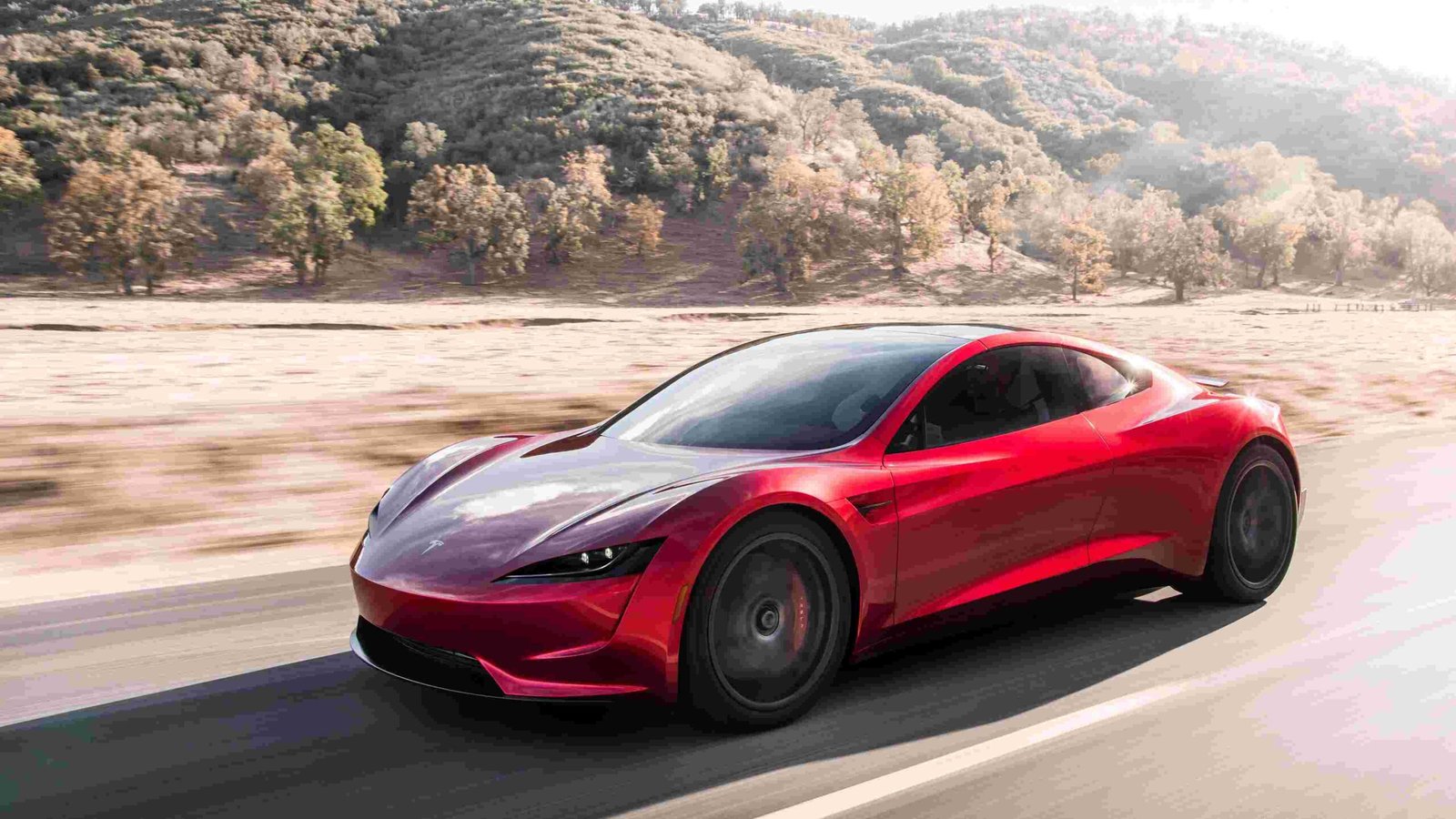
Elon Musk’s First Prototype of Flying Tesla Roadster is COMING in 2026: After years of delays, ambitious promises, and intense speculation, the next-generation Tesla Roadster is once again attracting global attention. Tesla has teased an upcoming unveiling scheduled for October 1st, 2026, with the rocket-inspired phrase “Go for launch.” The wording has naturally fueled speculation that the new Roadster could introduce technology far beyond conventional electric-car performance.
First revealed in 2017, the Next-Gen Roadster was presented as a revolutionary electric sports car. More recent comments attributed to Elon Musk, including remarks discussed on the All-In Podcast, have suggested that the vehicle could incorporate an unusual combination of automotive engineering and aerospace-inspired propulsion.
If the proposed technology reaches production or even a functional prototype stage, the Roadster could become one of the most technically unusual performance vehicles ever demonstrated.
The Next-Gen Tesla Roadster Goes Beyond Tire Traction
Traditional performance cars ultimately depend on their tires to transfer acceleration and braking forces to the road. Even an extremely powerful electric vehicle can only accelerate as quickly as its tires and suspension can maintain traction.
The proposed SpaceX Package changes that equation by introducing an additional source of thrust.
How Cold Gas Thrusters Could Work
Instead of relying on conventional chemical rocket combustion, the concept described involves high-pressure compressed gas stored inside specialized composite pressure vessels. Small directional nozzles could then release the gas to produce thrust.
A theoretical system could use approximately 10 strategically positioned thruster nozzles around the vehicle.
The basic concept would combine:
- Electric all-wheel drive for normal road propulsion
- High-pressure cold gas thrusters for additional thrust
- Directional nozzles for controlling vehicle movement
- Advanced software for coordinating acceleration and stability
The major attraction is that thruster-generated force does not depend entirely on the tire contact patch. Instead of asking the tires to transmit every unit of acceleration, the vehicle could theoretically supplement forward or lateral forces through direct thrust.
Could the Roadster Reach 0–60 MPH in About One Second?
The possibility of an approximately one-second 0–60 mph acceleration is one of the most eye-catching aspects of the concept.
However, such a figure should be treated as a theoretical target rather than a confirmed production specification unless Tesla officially verifies it. Achieving extreme acceleration would require careful management of vehicle stability, occupant forces, tire loading, structural strength, and propulsion-system control.
The technology is therefore about more than simply adding power. It is about changing how that power reaches the vehicle.
Could the Tesla Roadster Actually Fly?
The phrase “flying Tesla” has generated enormous attention, but there is an important distinction between a vehicle capable of a brief controlled liftoff and an aircraft capable of sustained flight.
A road-going Roadster equipped with thrust-producing nozzles would not automatically become an airplane.
Short Hover Versus Traditional Flight
A conventional aircraft generates sustained lift through wings, aerodynamic surfaces, or other dedicated flight systems. A hypothetical Roadster hover system would instead need to produce enough vertical thrust to overcome the vehicle’s weight.
That could theoretically allow:
- Brief liftoffs
- Controlled hovering
- Short jumps
- Pitch and roll adjustments
- Specialized maneuvering
But these capabilities would be fundamentally different from long-distance aerial transportation.
A multi-ton vehicle would also require extremely sophisticated control software. The onboard computer would need to continuously monitor roll, pitch, and yaw, adjusting individual thrusters to keep the vehicle stable.
This makes the concept as much a software and controls challenge as a propulsion challenge.
Active Aerodynamics Could Add Another Layer
The Roadster’s potential aerospace-inspired technology does not stop with thrusters. Another important area is active aerodynamics.
Tesla has pursued aerodynamic concepts involving the underbody and airflow management, and the broader idea of active ground-effect technology could provide significant benefits for a high-performance vehicle.
Ground-Effect Fans and Active Downforce
A theoretical active ground-effect system could use powerful fans to remove air from beneath the vehicle.
The process would work approximately like this:
- Fans evacuate air beneath the chassis.
- This creates a low-pressure region underneath the vehicle.
- The resulting pressure difference pushes the car toward the road.
- Moveable skirts could help maintain the low-pressure area.
- The system could potentially generate downforce without relying entirely on high vehicle speed.
This would be particularly interesting for cornering.
A conventional aerodynamic wing generally becomes more effective as speed increases. An active underbody system could potentially provide useful downforce at lower speeds as well.
Combining Suction and Thrusters
The most futuristic version of the concept combines two different forces.
Ground-effect technology could push the vehicle toward the pavement, increasing stability and tire loading. Meanwhile, directional thrusters could provide additional force to influence acceleration, braking, or vehicle attitude.
In theory, that creates a sophisticated interaction between aerodynamic grip, tire grip, electric propulsion, and thrust-vector control.
However, the practical implementation would be extraordinarily complex.
Engineering and Safety Challenges
Turning aerospace-inspired concepts into a road vehicle would introduce significant engineering and regulatory challenges.
High-Pressure Propulsion Safety
High-pressure gas systems require carefully engineered storage tanks, valves, pressure regulators, sensors, and emergency-release systems. Any failure would need to be managed without endangering passengers or nearby people.
Debris and Environmental Concerns
Thrust discharged close to the ground could potentially disturb dust, gravel, and other debris. That creates an obvious challenge for operating such a system around pedestrians, other vehicles, or public roads.
Software Lockouts
A production system would also require sophisticated failsafes and activation lockouts. Tesla would need to ensure that high-powered thrusters could not accidentally activate in inappropriate environments.
The software architecture would likely need multiple layers of authentication, monitoring, fault detection, and emergency shutdown capability.
Road-Legal Certification
Perhaps the biggest challenge would be certification.
A vehicle designed to intentionally leave the road introduces questions that ordinary automobiles do not encounter. A road car that briefly becomes airborne could require entirely different safety considerations from a conventional vehicle.
For this reason, extreme propulsion modes could potentially be limited to closed circuits, private facilities, or controlled demonstrations, depending on the final design and applicable regulations.
The Roadster as Tesla’s Halo Vehicle
The significance of the next-generation Roadster may extend beyond its sales numbers.
Tesla’s original 2008 Roadster helped demonstrate that an electric vehicle could deliver serious performance. The company subsequently expanded into luxury vehicles and eventually higher-volume models.
The next-generation Roadster could follow a similar halo vehicle strategy, serving as a technology showcase rather than simply a high-volume automobile.
From Electric Performance to Aerospace Technology
The progression can be viewed as:
2008 Roadster → Model S/X → Model 3/Y → Next-Generation Roadster
Each stage represents a different aspect of Tesla’s technological development.
The new Roadster concept could potentially combine:
- High-performance electric motors
- Advanced battery technology
- Aerospace-inspired propulsion
- Active aerodynamics
- Sophisticated vehicle-control software
- High-performance structural engineering
If these technologies prove viable, some elements could eventually influence other transportation platforms.
Tesla Roadster and the Future of Performance Cars
The most interesting aspect of the proposed 2026 Roadster is not simply its acceleration figure. It is the possibility of combining technologies that traditionally belong to separate engineering disciplines.
Electric motors provide instant torque. Advanced aerodynamics can improve stability. Computer-controlled systems can coordinate complex vehicle dynamics. Aerospace-inspired thrusters could theoretically introduce an entirely new method of generating force.
Together, these technologies could create a performance vehicle unlike a conventional supercar.
Still, it is important to separate confirmed information from conceptual claims and speculation. Until Tesla provides final specifications, demonstrations, and production details, capabilities such as sustained hovering, exact acceleration times, and the final SpaceX Package configuration remain unconfirmed.
What to Expect From the October 1, 2026 Unveiling
The reported October 1, 2026 unveiling could provide important answers about Tesla’s long-awaited Roadster program.
Key questions include whether Tesla will demonstrate a working SpaceX Package, how much thrust the system can generate, whether the vehicle can actually perform a controlled liftoff, and which technologies will be available on customer vehicles.
The event could also clarify whether the futuristic capabilities are intended for production vehicles, limited demonstrations, or specialized track applications.
Whatever Tesla ultimately reveals, the Roadster remains an ambitious symbol of the company’s approach to combining electric mobility, software, performance, and aerospace-inspired engineering.
Final Thoughts
The Next-Gen Tesla Roadster has spent nearly a decade moving between concept, promise, and speculation. With Tesla now teasing an October 2026 unveiling and using the phrase “Go for launch,” attention is once again focused on what the company may reveal.
A Roadster capable of using cold gas thrusters, active ground effects, and advanced computer-controlled dynamics would represent a dramatic departure from traditional sports-car engineering. Whether the final product actually delivers a flying or hovering capability remains to be demonstrated.
For now, the Roadster’s biggest story is the technology it represents: an attempt to push the boundaries of what an electric performance car can do by borrowing ideas from aerospace engineering.
FAQs
1. What is the Tesla Roadster 2026?
The Tesla Roadster 2026 is the upcoming second-generation Tesla sports car, originally unveiled as a concept in 2017. It is expected to combine extreme electric performance with advanced technologies.
2. When will the new Tesla Roadster be unveiled?
Tesla has teased an unveiling for October 1, 2026, accompanied by the phrase “Go for launch.” The final event details and specifications should be confirmed by Tesla.
3. Could the Tesla Roadster actually fly?
The proposed Roadster concept has been associated with SpaceX-inspired thrusters that could potentially provide enough vertical thrust for a brief liftoff. However, sustained flight like an aircraft is a different capability and has not been established as a production feature.
4. What is the SpaceX Package for the Tesla Roadster?
The SpaceX Package refers to a proposed performance system involving high-pressure cold gas thrusters. The concept is intended to supplement the Roadster’s electric propulsion with additional thrust.
5. How would Tesla Roadster cold gas thrusters work?
Cold gas thrusters would store compressed gas under high pressure and release it through directional nozzles. The expelled gas creates thrust that can potentially supplement acceleration or help control the vehicle’s movement.
6. How many thrusters could the Tesla Roadster have?
The concept described for the Roadster involves approximately 10 small thruster nozzles positioned around the vehicle. The exact number and configuration would depend on Tesla’s final engineering design.
7. Could the Tesla Roadster reach 0–60 mph in one second?
A near-one-second 0–60 mph time has been discussed as a theoretical possibility for a Roadster equipped with additional thrust. It should not be treated as a confirmed production specification until Tesla officially provides verified performance figures.
8. What limits acceleration in a conventional performance car?
One major limitation is tire traction. Even when an electric motor produces enormous torque, the tires must transfer that force to the road without excessive wheelspin.
9. What is active ground-effect technology?
Active ground-effect technology uses airflow beneath a vehicle to create additional downforce. A fan-based system could potentially reduce air pressure beneath the car and increase its contact with the road.
10. How could ground-effect fans improve the Roadster?
An active underbody system could potentially generate downforce at lower speeds, improving stability and cornering performance. It could work alongside the vehicle’s suspension, tires, aerodynamics, and electronic control systems.
11. Could the Roadster use thrusters for cornering?
A theoretical multi-nozzle system could provide directional thrust that assists with vehicle control. By independently controlling thrust vectors, software could potentially influence the car’s pitch, roll, or yaw.
12. Is the Tesla Roadster expected to be fully autonomous?
The Roadster’s proposed performance technology is separate from Tesla’s autonomous-driving systems. Whether the 2026 Roadster will include particular autonomous features depends on Tesla’s final specifications and software rollout.
13. Would a flying Tesla Roadster be legal on public roads?
A vehicle intentionally leaving the road would raise significant safety and regulatory questions. Extreme thruster or hover functions could potentially be restricted to controlled environments such as racetracks or private testing facilities.
14. What safety challenges could the SpaceX Package create?
High-pressure propulsion systems would require extensive safety controls, pressure monitoring, emergency shutdown mechanisms, and software lockouts. Thrust close to the ground could also disturb dust, gravel, and debris.
15. Why is the Tesla Roadster considered a halo vehicle?
The Roadster can serve as a halo vehicle, showcasing technologies and performance capabilities that may influence Tesla’s broader product development. The original 2008 Roadster similarly demonstrated the potential of high-performance electric propulsion.
16. What makes the 2026 Tesla Roadster different from other electric sports cars?
The proposed Roadster could combine electric all-wheel drive, advanced aerodynamics, active ground effects, computer-controlled vehicle dynamics, and SpaceX-inspired propulsion. If demonstrated as described, this combination would distinguish it from conventional electric performance cars.
Read More:
- SpaceX revealed Starship Flight 14 Orbital Plans & B20 Failure Cause Shocked the Entire Industry
- Elon Musk’s First Tesla Cyberbike Prototype Shocked the Industry
- SpaceX’s next Starship launch is about to attempt its biggest leap yet
- Starship Flight 14 Launch Date just Changed Again, No Launch This Week
- Elon Musk’s New Update On $119B Terafab, Biggest Building On Earth