
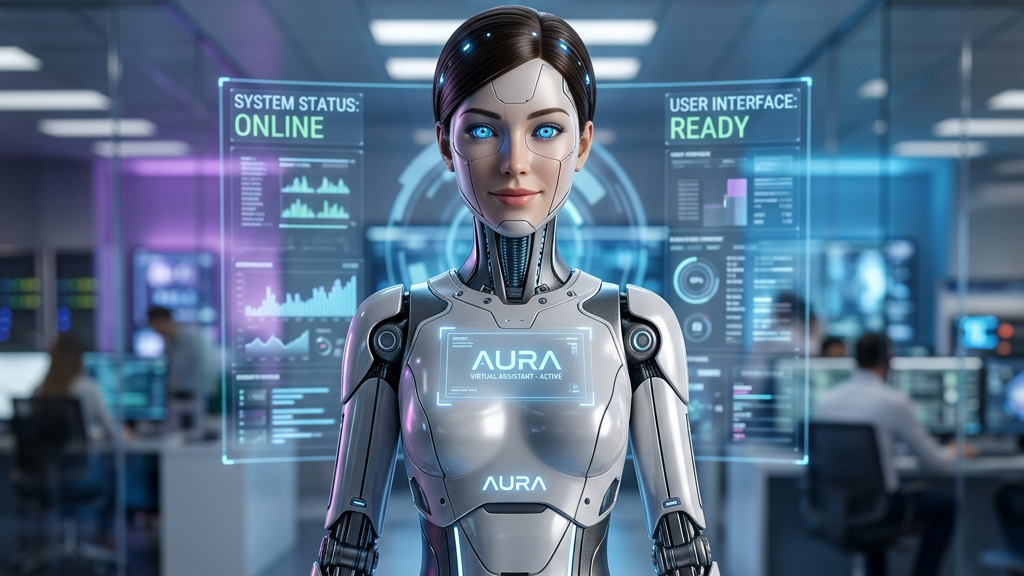
Elon Musk’s New Home Robot “CyberGirl” Finally Here: Cooking, Cleaning & Laundry: The convergence of robotics and artificial intelligence (AI) is opening a new chapter in household automation. For decades, robots were primarily associated with factories, warehouses, and carefully controlled environments. Today, advances in computer vision, neural networks, dexterous hands, and natural-language AI are bringing the possibility of general-purpose humanoid robots into everyday homes.
Building on Tesla’s humanoid robotics work through the Optimus program, concept discussions around specialized consumer versions have introduced names such as “CyberGirl” or domestic humanoid assistants. The idea is straightforward but technically ambitious: create a bipedal robot capable of helping people with routine tasks such as cooking, cleaning, laundry, organizing, and household assistance.
Rather than functioning as a single-purpose appliance, a future domestic humanoid could potentially learn different tasks and adapt to changing environments. However, turning this concept into a reliable household product requires major advances across AI perception, manipulation, safety, battery technology, and manufacturing.
The Vision Behind a Tesla Home Robot
A household is one of the most unpredictable environments for an autonomous machine. Factory robots typically operate around known objects, predefined routes, and repetitive workflows. Homes are different.
Furniture can move, objects can be left on the floor, lighting changes throughout the day, pets and children move unpredictably, and every home has a different layout.
A capable domestic humanoid robot therefore needs to understand its surroundings continuously rather than simply following predetermined instructions.
The concept can be summarized as:
Cameras → Spatial Understanding → AI Decision-Making → Motion Planning → Physical Action
This approach could allow a robot to identify an object, understand its location, determine how to interact with it, and perform the required movement.
End-to-End Vision Could Transform Home Robotics
Understanding an Unstructured Home
One of the most important technologies for general-purpose robotics is end-to-end vision intelligence. Instead of relying entirely on manually programmed rules, neural networks can process visual information and help determine appropriate actions.
A multi-camera system could continuously observe the robot’s surroundings and construct an internal representation of nearby objects.
This could include:
- Furniture
- People
- Pets
- Kitchen equipment
- Clothing
- Electrical cables
- Doors and cabinets
- Objects on floors and tables
A continuously updated 3D occupancy representation could help the robot determine where obstacles exist and how much physical space is available.
Vision-to-Action Learning
Traditional robots often depend on carefully programmed motion trajectories. A domestic humanoid, however, may encounter millions of variations of the same task.
For example, folding a shirt requires understanding the shirt’s shape, orientation, material, and position. An AI system trained using imitation learning could potentially learn relationships between human demonstrations and robot movements.
Instead of programming every possible shirt configuration, developers could train models to recognize the general objective and generate suitable movements.
This represents an important shift from pre-programmed automation toward adaptive robotics.
Dexterous Hands Are Critical for Cooking and Cleaning
Why Manipulation Is So Difficult
Walking around a house is only one part of the challenge. The much harder problem is manipulating everyday objects.
A human can effortlessly pick up an egg, open a cabinet, fold a towel, hold a glass, or use a spoon because our hands continuously adjust grip pressure.
For a robot, these seemingly simple actions require sophisticated sensing, actuator control, and artificial intelligence.
Advanced Robotic Hands
A future consumer humanoid could use multi-articulated fingers, high-degree-of-freedom wrists, force sensors, and tactile sensing to improve manipulation.
For example, while handling glassware, tactile sensors could help detect whether the object is slipping. The robot could then adjust its grip before the glass falls.
Similarly, cooking requires carefully controlled force. Cutting vegetables, stirring food, lifting cookware, or handling delicate ingredients all require different levels of pressure.
The combination of tactile feedback and AI control could therefore become one of the defining technologies of household robotics.
Cooking, Laundry and Cleaning Could Become Automated
Kitchen Assistance
A capable domestic robot could potentially assist with repetitive kitchen activities such as:
- Carrying ingredients
- Loading and unloading dishwashers
- Moving cookware
- Cleaning countertops
- Organizing kitchen objects
- Preparing simple ingredients
More advanced systems could eventually coordinate several steps of a meal-preparation workflow.
However, hot surfaces, sharp tools, liquids, and food safety make the kitchen one of the most demanding environments for autonomous robots.
Laundry Automation
Laundry presents another interesting challenge because clothing is soft, deformable, and unpredictable.
Unlike a rigid industrial component, a shirt can be crumpled into hundreds of different configurations.
A humanoid equipped with dexterous fingers could potentially identify garments, separate them, move them between locations, fold them, and place them into designated storage areas.
Household Cleaning
Cleaning could involve recognizing clutter, identifying surfaces, transporting objects, and navigating around furniture.
Instead of simply following a fixed path, a general-purpose robot would need to understand what needs to be cleaned and why.
Natural Language Could Become the Main Interface
A major advantage of AI-powered household robots could be simple conversational control.
Instead of programming a sequence of robotic movements, users could provide a high-level instruction such as:
“Clean the dining table and put the laundry away.”
From Voice Command to Physical Action
The AI system could potentially divide the request into multiple subtasks:
- Identify objects on the dining table.
- Separate dishes and other items.
- Transport appropriate objects to the kitchen.
- Locate laundry.
- Identify individual garments.
- Fold or organize clothing.
- Store items in appropriate locations.
This process combines large language models, computer vision, spatial reasoning, and robotic control.
The robot would still require continuous safety monitoring. If a person or pet suddenly enters its movement area, the system should be able to slow or stop its actions.
Battery and Thermal Engineering Matter Too
Efficient Humanoid Hardware
A household robot needs enough energy to operate for meaningful periods while remaining relatively lightweight.
Integrating the battery system into the robot’s torso could help manage weight distribution and lower the center of mass.
At the same time, electric motors and AI computing hardware generate heat.
Quiet Actuators for Residential Use
Industrial robots can tolerate considerable mechanical noise. A household assistant cannot necessarily operate under the same conditions.
Low-noise harmonic-drive actuators and efficient electric motors could help create smoother and quieter movement.
Thermal management is equally important. Heat generated by processors and motors could potentially be transferred through structural components and dissipated while maintaining safe external temperatures.
Safety Will Be a Core Requirement
A domestic humanoid would operate around people every day, making robot safety fundamentally different from industrial automation.
The system would need to recognize humans, pets, obstacles, fragile objects, and unexpected movements.
Multiple layers of protection could include:
- Real-time proximity detection
- Force and torque monitoring
- Collision avoidance
- Emergency stopping
- Controlled joint speeds
- Continuous environmental perception
The challenge is not merely making a robot capable of performing tasks. It is making that robot perform them predictably and safely around humans.
The Potential Economic Impact of Home Robots
If general-purpose humanoids become commercially viable, household automation could change how people think about domestic labor.
Routine chores consume time that could otherwise be used for work, education, family activities, or leisure.
A versatile robot could potentially automate portions of:
- Cleaning
- Laundry
- Dishwashing
- Household organization
- Basic meal preparation
- Material transportation
Another important application could be assistive living. Humanoid robots may eventually help older adults or people with mobility limitations perform everyday activities while supporting greater independence.
Could Manufacturing Bring Prices Down?
The economics of humanoid robotics will depend heavily on production scale.
If manufacturers can apply lessons from electric vehicles, batteries, motors, sensors, and automotive manufacturing, the cost of robotic systems could potentially decline as production increases.
However, achieving automobile-like manufacturing economics for sophisticated humanoid robots remains a major engineering and commercial challenge.
The eventual price will depend on hardware complexity, computing requirements, actuator costs, battery capacity, manufacturing volume, software capabilities, and reliability.
The Future of “CyberGirl” and Domestic Humanoid Robotics
The idea of a “CyberGirl” home robot represents a broader vision for consumer robotics rather than simply another household appliance. The ultimate goal is a machine capable of seeing, understanding, moving, manipulating objects, and responding naturally to human instructions.
Tesla’s Optimus efforts provide an important reference point for this broader direction, while the concept of specialized consumer variants highlights the potential expansion of humanoid robotics beyond factories.
The biggest breakthrough will not simply be teaching a robot to perform one impressive demonstration. It will be creating a system that can reliably handle thousands of unpredictable household situations.
If advances in AI, tactile sensing, robotic hands, batteries, actuators, and manufacturing continue to converge, the home could become one of the next major frontiers for robotics. The transition from robots that perform isolated tasks to general-purpose domestic assistants would represent a significant technological shift—and could fundamentally change how everyday chores are performed.
FAQs
1. What is Tesla’s “CyberGirl” home robot?
“CyberGirl” is a concept name used in discussions about a potential consumer-focused humanoid robot inspired by Tesla’s Optimus robotics program. The idea is a general-purpose domestic assistant capable of helping with household tasks.
2. Is CyberGirl an officially released Tesla robot?
The term “CyberGirl” is generally used as a concept or nickname for a potential domestic humanoid variant. It should not be confused with a confirmed commercial Tesla product unless Tesla officially announces such a model.
3. What could a CyberGirl home robot do?
A capable domestic humanoid could potentially perform tasks such as cleaning, laundry, organizing objects, carrying items, washing dishes, and assisting with basic food preparation.
4. How would a humanoid robot understand a home?
The robot could use multiple cameras, computer vision, spatial mapping, and neural networks to continuously analyze its surroundings. This could allow it to identify furniture, people, pets, objects, and potential obstacles.
5. Why is household robotics difficult?
Homes are highly unstructured and unpredictable environments. Unlike factories, household layouts, lighting, objects, furniture, pets, and human movements can change constantly.
6. Could CyberGirl cook food?
Future domestic humanoids could potentially assist with food preparation and kitchen tasks. Cooking is particularly challenging because it involves hot surfaces, sharp tools, fragile objects, liquids, and ingredients with different physical properties.
7. Could the robot fold laundry?
Yes, laundry handling is a potential application for advanced humanoid robots. However, folding clothes requires sophisticated vision and dexterous manipulation because fabrics are soft and can take many different shapes.
8. What makes robotic hands important?
Dexterous robotic hands allow a humanoid to manipulate objects with greater precision. Tactile and force sensors could help the robot adjust its grip when handling fragile items such as glasses, eggs, dishes, or other household objects.
9. Could users control the robot with their voice?
A future domestic robot could potentially use natural-language commands. An AI system could interpret a request, divide it into smaller tasks, and coordinate the robot’s movements to accomplish the overall objective.
10. How could AI help a domestic humanoid?
Artificial intelligence could help the robot recognize objects, understand instructions, plan actions, navigate rooms, and adapt to situations that were not explicitly programmed in advance.
11. Would a home robot need special safety systems?
Absolutely. A domestic humanoid would operate around people, children, pets, furniture, and fragile objects. Safety systems could include collision detection, force monitoring, proximity sensors, controlled movement speeds, and emergency stopping.
12. How would a humanoid robot manage its battery?
A domestic humanoid would require a compact battery and power-management system capable of supporting motors, sensors, onboard computing, and other electronics. Battery placement could also influence the robot’s balance and stability.
13. Would a home humanoid robot be noisy?
Developers would likely prioritize quiet motors and actuators for residential environments. Technologies such as efficient electric motors and harmonic-drive mechanisms could help produce smoother and quieter movements.
14. Could humanoid robots help elderly people?
General-purpose humanoids could potentially provide assistive living support, such as retrieving objects, carrying items, helping with household chores, and assisting with certain daily activities. Their practical usefulness would depend on reliability and safety.
15. When could domestic humanoid robots become common in homes?
The timeline remains uncertain. Making a humanoid robot capable of safely and reliably performing a wide variety of household tasks requires advances in AI, robotics, tactile sensing, battery technology, manufacturing, and safety. Commercial adoption will depend on how successfully these challenges are solved.
Read More:
- SpaceX revealed Starship Flight 14 Orbital Plans & B20 Failure Cause Shocked the Entire Industry
- Elon Musk’s First Tesla Cyberbike Prototype Shocked the Industry
- SpaceX’s next Starship launch is about to attempt its biggest leap yet
- Starship Flight 14 Launch Date just Changed Again, No Launch This Week
- Elon Musk’s New Update On $119B Terafab, Biggest Building On Earth