
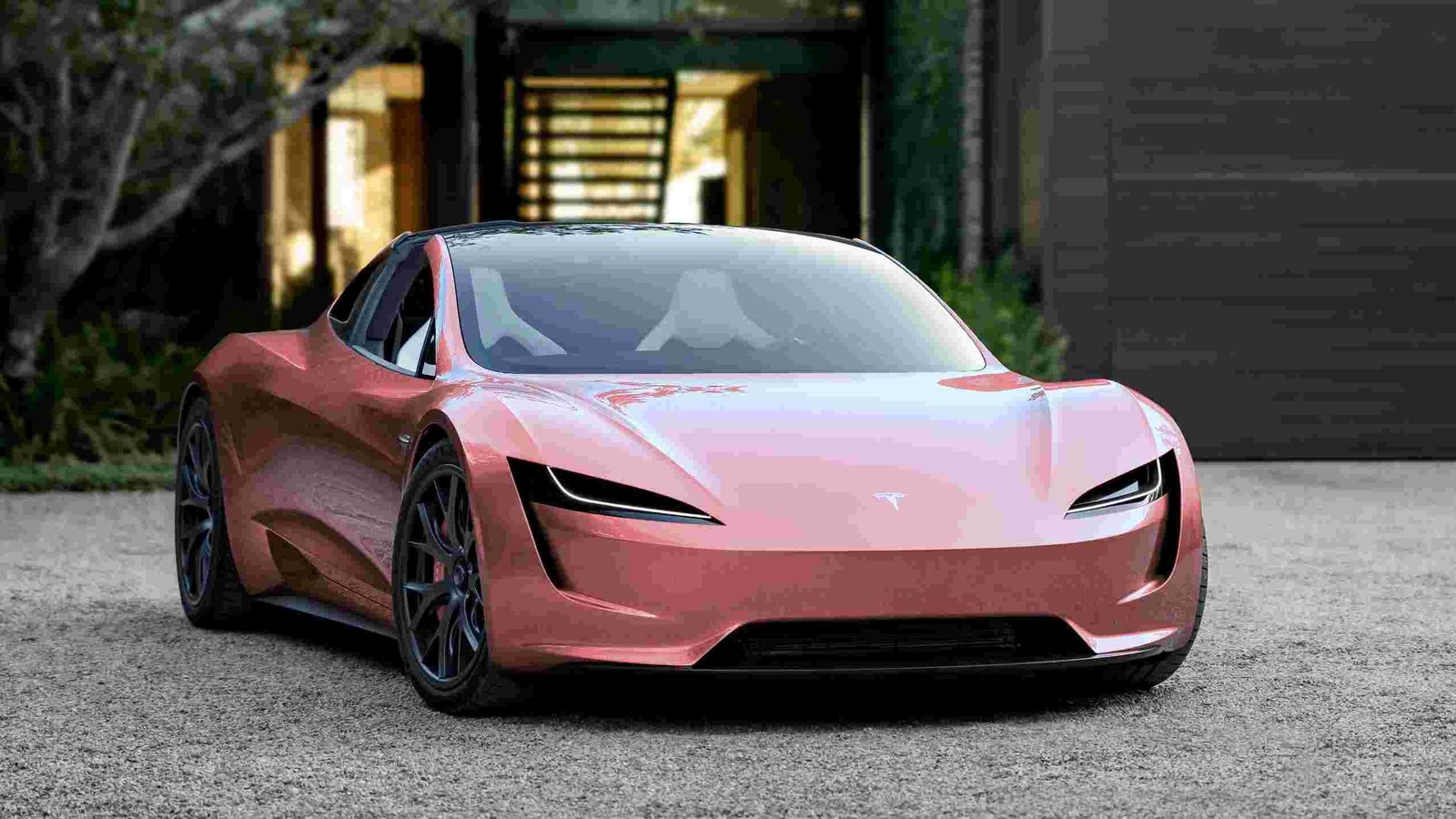
Tesla Roadster 2.0’s CRAZY Secret Just Leaked! FLYING Mode Revealed: The Tesla Roadster 2.0 has long been surrounded by extraordinary performance claims, but the technology described in patents and design discussions could make the next-generation electric hypercar even more radical than expected. From sub-one-second 0–60 mph acceleration to advanced active aerodynamics and a potential SpaceX Package, the Roadster is being designed around a fundamentally different approach to vehicle performance.
Traditional supercars depend heavily on engine power, tires, wings, and mechanical grip. Tesla’s concept goes further by attempting to actively manipulate the forces acting on the vehicle. Electric fans, ground-effect suction, high-pressure air systems, and sophisticated thermal management could potentially work together to push the Roadster beyond conventional traction limits.
Tesla Roadster 2.0 and the Fight Against Tire Friction
One of the biggest limitations facing any high-performance vehicle is tire friction. Even with enormous amounts of motor power, a car cannot accelerate indefinitely because the tires eventually lose their grip on the road.
Conventional aerodynamic wings also have an important limitation: they generally need airflow before they can generate significant downforce. That means they are least useful precisely when a vehicle launches from a standstill.
Tesla’s proposed solution is active downforce generated by underbody fans.
Active Vacuum Downforce Fans
The concept describes multiple powerful electric fan units positioned underneath the vehicle. Instead of simply relying on airflow over wings, the fans would pull air from beneath the chassis and create a low-pressure region.
The result would be an artificial ground-effect vacuum that pushes the vehicle toward the road.
This is important because increasing the force pressing the tires against the pavement can increase the amount of traction available for acceleration and cornering.
At launch, such a system could theoretically provide downforce before the vehicle has reached high aerodynamic speeds. Combined with all-wheel-drive electric motors, this could dramatically improve initial traction.
The source material proposes potential acceleration forces exceeding 2.0g to 2.5g, although such figures should be viewed as engineering targets or concepts rather than confirmed production specifications.
The SpaceX Package Could Change Everything
Perhaps the most dramatic element associated with the Roadster is the proposed SpaceX Package.
Elon Musk has previously discussed using rocket-inspired technology to enhance the Roadster’s performance. The concept replaces the rear seats with specialized hardware, including a high-pressure composite overwrapped pressure vessel (COPV) and associated propulsion equipment.
Cold-Gas Thruster Technology
The basic idea involves storing gas under extremely high pressure and releasing it through strategically positioned nozzles.
The concept could provide forces that don’t depend entirely on tire traction.
A simplified system could include:
- Rear-facing thrusters for additional forward thrust
- Side thrusters for vehicle-control assistance
- Front-facing systems for braking or directional control
- Computer-controlled valves for extremely rapid adjustments
- High-pressure storage tanks integrated into the vehicle
This represents a major departure from traditional hypercar engineering.
Instead of asking the tires to generate every acceleration and handling force, the vehicle could theoretically use compressed-gas propulsion to supplement the electric drivetrain.
Could the Tesla Roadster Actually Fly?
The phrase “Flying Mode” has generated enormous interest around the Roadster. However, there is an important distinction between a vehicle performing a brief hop and a genuine flying automobile.
A high-pressure propulsion system could theoretically generate additional vertical or directional force under carefully controlled conditions. When combined with active fans and sophisticated control software, this could produce unusual vehicle movements.
However, a production Roadster capable of sustained flight has not been established by the information provided.
The more realistic interpretation is that a future performance system could potentially create short-duration lift, launch assistance, or vehicle-control effects rather than turning the Roadster into a conventional aircraft.
That distinction is critical when separating engineering concepts from confirmed production features.
Advanced Aerodynamics for Extreme Cornering
Straight-line acceleration is only one part of hypercar performance. A vehicle capable of reaching enormous speeds also needs to remain stable while cornering.
Traditional hypercars use combinations of front splitters, rear wings, diffusers, active suspension, and aerodynamic surfaces.
The Roadster concept takes another approach by emphasizing active systems.
Active Ground Effect
The proposed fans could potentially generate additional downforce without requiring massive external wings.
That could offer two advantages.
First, the vehicle could potentially maintain a cleaner aerodynamic profile. Second, the system could theoretically adjust downforce according to driving conditions.
Instead of relying entirely on passive aerodynamic components, computer-controlled systems could respond dynamically to:
- Vehicle speed
- Steering angle
- Wheel slip
- Acceleration
- Braking
- Road conditions
- Vehicle attitude
This creates the possibility of a software-controlled aerodynamic platform rather than a vehicle whose aerodynamic behavior is largely fixed.
Wet Roads and Hydroplaning Challenges
Extreme performance becomes much more complicated when the road is wet.
At high speeds, water can accumulate between a tire and the pavement, causing hydroplaning. When this happens, the tire temporarily loses effective contact with the road.
The proposed Roadster approach combines directional tire tread design with additional aerodynamic downforce.
Wide channels in the tire tread could help evacuate water, while active downforce could increase the force keeping the vehicle planted.
However, no aerodynamic system can completely eliminate the laws of physics. Tire condition, water depth, speed, road surface, and tire design would continue to determine hydroplaning risk.
Thermal Management: The Hidden Challenge
Creating extreme performance isn’t only about producing power. An electric hypercar must also manage enormous amounts of heat.
A tri-motor drivetrain operating at very high power levels can generate substantial thermal loads. If fans, motors, inverters, and propulsion systems are operating simultaneously, the cooling requirements become even more demanding.
Advanced Liquid Cooling
The Roadster concept therefore requires sophisticated liquid-cooling systems capable of removing heat from the battery, motors, and power electronics.
Battery cooling is particularly important because repeated high-power acceleration can rapidly increase cell temperatures.
An advanced thermal architecture could allow the vehicle to maintain high performance for longer periods rather than delivering one spectacular launch followed by significant power reduction.
Silicon Carbide Power Electronics
Another important technology is silicon carbide (SiC) semiconductor technology.
SiC-based inverters can provide high efficiency while reducing certain power-conversion losses. In an extreme electric vehicle, even small improvements in efficiency can translate into meaningful reductions in heat generation.
Fast electronic control could also allow the vehicle’s motors to respond rapidly to changing traction conditions.
Roadster 2.0 vs. Traditional Hypercars
The fundamental difference is philosophy.
A traditional hypercar generally improves performance by adding more engine power, better tires, lighter materials, and more sophisticated aerodynamics.
The Roadster concept attempts to combine those principles with technologies derived from aerospace and electric propulsion.
| Performance Area | Traditional Hypercar | Tesla Roadster 2.0 Concept |
|---|---|---|
| Power Source | Internal combustion or hybrid | Tri-motor electric drivetrain |
| Downforce | Wings and diffusers | Active fans and ground effect |
| Launch Assistance | Tire traction | Electric torque + active downforce |
| Additional Propulsion | None | Potential cold-gas thrusters |
| Thermal Management | Conventional performance cooling | Advanced liquid cooling |
| Power Electronics | Standard/high-performance inverter | Potential SiC technology |
| Performance Philosophy | Mechanical optimization | Software + aerospace integration |
A New Era of Electric Hypercar Engineering
The Tesla Roadster 2.0 represents a fascinating engineering concept because it challenges the assumption that a road car must rely almost entirely on tires and conventional aerodynamic surfaces.
Its proposed combination of instant electric torque, active ground-effect fans, advanced cooling, sophisticated control software, and SpaceX-inspired propulsion technology could create an entirely different approach to vehicle dynamics.
The most important question is not whether every rumored feature will reach production. It is whether Tesla can successfully integrate these systems into a safe, reliable, road-legal vehicle.
If even a portion of the most ambitious concepts becomes reality, the Roadster could redefine expectations for electric hypercars. Rather than simply being another extremely fast EV, it could become a technological demonstration of how automotive engineering and aerospace technology can converge.
For now, claims surrounding sub-one-second acceleration and “Flying Mode” should be treated cautiously until Tesla provides definitive production specifications and demonstrations. But the engineering direction is undeniably fascinating—and it explains why the Tesla Roadster 2.0 continues to attract so much attention.
FAQs
1. What is the Tesla Roadster 2.0?
The Tesla Roadster 2.0 is Tesla’s next-generation electric sports car designed to deliver extreme acceleration, high top speed, and long driving range.
2. Can the Tesla Roadster 2.0 accelerate from 0–60 mph in under one second?
Tesla has discussed exceptionally quick acceleration for the Roadster. The sub-one-second 0–60 mph claim is associated with the most ambitious performance configurations, potentially using additional traction and propulsion technologies.
3. What is the Tesla Roadster SpaceX Package?
The SpaceX Package is a proposed high-performance configuration that could use high-pressure gas storage and cold-gas thrusters to supplement the vehicle’s electric powertrain.
4. Will the Tesla Roadster 2.0 actually fly?
The term “Flying Mode” refers to the possibility of using propulsion and aerodynamic systems to create brief lift or hopping effects. It should not currently be interpreted as confirmation that the Roadster will function as a conventional aircraft.
5. What are active vacuum downforce fans?
Active vacuum downforce fans are proposed underbody fans designed to remove air from beneath the vehicle and create a low-pressure region. This could increase the force pressing the car toward the road.
6. Why would Tesla use fans underneath the Roadster?
Traditional aerodynamic wings become more effective as speed increases. Underbody fans could theoretically create downforce at very low speeds, potentially improving traction during hard launches and slow-speed cornering.
7. How could the Roadster overcome tire traction limits?
The concept combines all-wheel-drive electric torque with additional downforce and potentially thruster assistance. Increasing the force acting on the tires could theoretically increase available mechanical grip.
8. What are cold-gas thrusters?
Cold-gas thrusters produce thrust by releasing compressed gas through specially designed nozzles. Unlike combustion rockets, they do not require burning fuel to create thrust.
9. Could Roadster thrusters help with cornering?
Potentially, strategically positioned thrusters could provide additional directional forces during extreme maneuvers. However, the exact production implementation and capabilities have not been fully established.
10. Could the SpaceX Package help the Roadster brake?
A thrust-based system could theoretically provide an additional braking force when directed appropriately. Conventional brakes, tires, and regenerative braking would still remain fundamental to vehicle deceleration.
11. How does the Roadster handle hydroplaning?
The concept combines directional tire tread channels with additional aerodynamic downforce to help maintain tire contact with wet pavement. However, no system can completely eliminate hydroplaning under unsafe road conditions.
12. What kind of drivetrain does the Tesla Roadster 2.0 use?
The Roadster has been associated with a tri-motor all-wheel-drive configuration, providing independent electric propulsion and extremely rapid torque delivery.
13. How does Tesla manage the Roadster’s heat?
Extreme electric performance requires advanced liquid cooling for the battery, motors, and power electronics. Effective thermal management is essential for maintaining repeated high-power performance.
14. What are silicon carbide (SiC) inverters?
Silicon carbide inverters are advanced power-electronics components that can improve electrical efficiency and reduce certain losses compared with conventional semiconductor technologies. They can be particularly valuable in high-performance EV applications.
15. What top speed is expected from the Tesla Roadster 2.0?
The Roadster has been associated with a top speed above 250 mph in its most ambitious specifications. The final production specification and independently verified performance remain important factors.
16. How much range could the Tesla Roadster 2.0 have?
The original performance targets have included more than 600 miles of range. Actual range would depend on the final battery, wheels, tires, driving conditions, and production configuration.
17. Could the Tesla Roadster 2.0 redefine the hypercar market?
Potentially, yes. If Tesla successfully combines extreme electric acceleration, active ground-effect technology, advanced thermal management, and SpaceX-inspired propulsion, the Roadster could introduce a very different approach to hypercar engineering.
Read More:
- Tesla wins over Netflix’s Selling Sunset star, who’s now ditching his Bentley
- Tesla snags Semi supply deal with major logistics firm
- Tesla Robotaxi expands hours, Musk explains why it’s been a challenge
- Tesla reveals early Robotaxi charging strategy, showing scrappy DNA
- Elon Musk Confirms Tesla Is Building A New Larger MINIVAN! This Is Best
1 thought on “Tesla Roadster 2.0’s CRAZY Secret Just Leaked! FLYING Mode Revealed”