
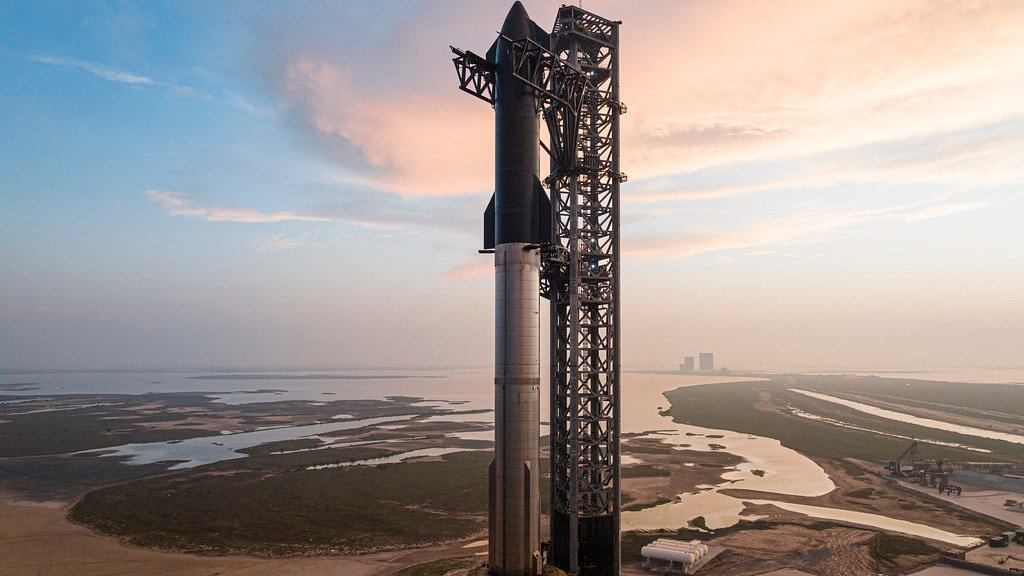
Starship Flight 15 May Not Launch This Month Due To… S40 Came to Gulf: The commercial spaceflight industry is entering another critical phase as SpaceX, Blue Origin, and NASA continue developing technologies for orbital missions, lunar exploration, and deep-space astronomy. At SpaceX’s Starbase in Boca Chica, Texas, preparations surrounding Starship Flight 15 are attracting attention as testing and vehicle movements indicate that the mission could face another schedule adjustment.
At the same time, Blue Origin is developing concepts for long-term lunar infrastructure, while NASA is advancing new observatories designed to investigate the far-infrared universe.
For SpaceX, however, the immediate focus remains on validating Starship hardware, engines, and ground systems before committing to another major flight.
Why Starship Flight 15 May Not Launch This Month
SpaceX has built its Starship development program around rapid testing and continuous iteration. Rather than prioritizing a fixed launch date, engineers frequently adjust schedules when new vehicle behavior or hardware issues require additional validation.
That philosophy could be particularly important for Starship Flight 15, especially if the mission is expected to demonstrate increasingly complex operations.
Ship 42 Testing Could Affect the Timeline
One of the important developments is activity surrounding Ship 42. The vehicle is undergoing extensive ground testing designed to verify its structural and propulsion systems before it can be cleared for a major flight.
Cryogenic testing is particularly important because Starship must store extremely cold liquid methane and liquid oxygen. These temperatures place significant stress on:
- Propellant tanks
- Fuel and oxidizer plumbing
- Thermal protection systems
- Structural connections
- Insulation systems
Testing under these conditions can reveal weaknesses that may not appear during ordinary inspections.
If engineers discover anything requiring modification, the resulting work could push a launch beyond the current schedule.
S40 Came to the Gulf—But What Does It Mean?
Another development attracting attention is the movement of Ship 40 toward the Gulf.
The arrival of S40 in the Gulf area does not necessarily mean that the vehicle is being prepared for another flight. SpaceX has historically used older or surplus hardware for testing, transportation evaluations, recovery experiments, engineering analysis, and eventual recycling.
Why Moving Older Hardware Matters
Retired prototypes can still provide valuable information. Engineers can use them to examine:
- Transport procedures
- Recovery operations
- Splashdown scenarios
- Ground-support equipment
- Vehicle handling
- Structural behavior
- Scrapping and recycling processes
Therefore, S40’s movement should be viewed within the broader Starship development program rather than automatically interpreted as a direct indication of the Flight 15 launch date.
The Biggest Challenge Could Be the First Ship Catch
One of the most ambitious objectives associated with future Starship development is the tower catch of the upper stage.
SpaceX’s Mechazilla tower uses enormous mechanical arms, commonly called chopsticks, to potentially catch returning Starship hardware. The concept could dramatically improve reusability by eliminating the need for conventional landing legs and reducing the amount of infrastructure required for vehicle recovery.
However, catching a returning spacecraft is substantially more complicated than simply landing it.
The vehicle must approach the tower with extremely accurate:
- Position control
- Velocity control
- Engine performance
- Guidance
- Attitude control
- Timing
A mistake during a tower catch could potentially damage expensive ground-support infrastructure.
Why SpaceX May Choose Safety Over Speed
The launch tower and associated equipment represent a massive investment. A failed maneuver could damage the launch mount, catch arms, or other critical systems and create a much longer delay than postponing the flight in the first place.
That is why engine reliability and precise vehicle control are becoming increasingly important as Starship progresses toward more demanding missions.
Raptor 3 and the Reliability Challenge
SpaceX’s development of the Raptor 3 engine architecture represents another major step in Starship’s evolution.
Future Starship missions require engines to operate reliably through several very different phases of flight.
Launch and ascent require enormous thrust. Once the spacecraft reaches orbit, however, the requirements change dramatically.
For an orbital maneuver or controlled descent, the vehicle may need an engine to restart in microgravity, where propellant naturally behaves differently than it does under Earth’s gravity.
The basic sequence can be summarized as:
Launch → Orbital Flight → Engine Restart → Controlled Descent → Precision Landing/Catch
Each stage introduces different engineering challenges.
Reliability Is Essential for Lunar Missions
The importance becomes even greater when Starship is used for lunar missions.
NASA’s Artemis Human Landing System (HLS) architecture requires extremely high levels of reliability because future astronauts will depend on the vehicle for transportation between lunar orbit and the Moon’s surface.
A successful Starship program therefore isn’t simply about achieving higher thrust or greater payload capacity. It must also demonstrate repeatable and predictable performance.
Blue Origin’s Lunar Power Tower
While SpaceX focuses on Starship, Blue Origin is looking beyond transportation toward the infrastructure needed for sustained lunar operations.
One of the biggest challenges facing future lunar settlements is the 14-day lunar night. Unlike Earth, the Moon has long periods without direct sunlight in many locations.
Blue Origin has explored the concept of a Lunar Power Tower designed to provide a more reliable energy source.
Vertical Solar Arrays
The proposed architecture uses tall structures carrying solar panels at locations where sunlight can be captured for extended periods.
This is particularly attractive around the lunar south pole, where certain elevated areas can receive sunlight for much longer periods than most of the lunar surface.
Using Lunar Resources
Another fascinating aspect is in-situ resource utilization, or ISRU.
Instead of transporting every structural component from Earth, future lunar infrastructure could potentially use materials extracted from lunar regolith.
Resources containing silicon, iron, and aluminum could eventually support manufacturing activities on the Moon.
Creating a Lunar Microgrid
A centralized power system could distribute electricity to:
- Lunar landers
- Rovers
- Scientific instruments
- Habitats
- Industrial equipment
Such infrastructure could become essential if humanity moves from short-duration lunar missions toward a permanent lunar presence.
NASA PRIMA Could Reveal the Hidden Universe
The future of space exploration isn’t limited to rockets and lunar bases. NASA is also working on concepts designed to answer fundamental questions about the universe.
The proposed PRIMA (PRobe Far-Infrared Mission for Astrophysics) would investigate the universe using far-infrared wavelengths.
Why Far-Infrared Astronomy Matters
Many astronomical objects are hidden behind enormous clouds of cosmic dust. Visible light can struggle to pass through these regions, but far-infrared radiation can provide valuable information.
PRIMA’s proposed wavelength range extends roughly from 24 to 235 micrometers, allowing scientists to investigate phenomena that conventional optical telescopes cannot observe as effectively.
| Mission Area | Traditional Telescopes | PRIMA Concept |
|---|---|---|
| Wavelength | Visible/Near-Infrared | Far-Infrared |
| Key Targets | Stars and galaxies | Dust-obscured star formation |
| Water Studies | Limited | Cosmic water vapor |
| Cooling | Passive/Mechanical | Ultra-cold cryogenic cooling |
| Scientific Goal | Broad astronomy | Origins of matter and star formation |
PRIMA could help scientists investigate star formation, interstellar water, heavy elements, and galaxy evolution.
The Bigger Picture for Space Exploration
The possible delay involving Starship Flight 15 demonstrates an important reality about modern aerospace development: progress is not always measured by how quickly a rocket launches.
Every cryogenic test, engine evaluation, vehicle movement, and ground-system inspection can provide information that improves future missions.
Meanwhile, Blue Origin’s lunar power concepts demonstrate that reaching the Moon is only the beginning. Long-term exploration will require electricity, manufacturing, transportation, communication, and reliable habitats.
NASA’s far-infrared ambitions add another dimension by expanding humanity’s ability to understand the universe itself.
A New Era Is Taking Shape
From Starbase in Texas to the lunar south pole and the far reaches of the cosmos, today’s space programs are increasingly interconnected.
If Starship Flight 15 slips beyond the expected schedule, the delay could ultimately represent another step in SpaceX’s strategy of testing, learning, and improving hardware before attempting more ambitious operations.
The movement of S40 to the Gulf, the testing of newer Starship vehicles, advances in Raptor technology, Blue Origin’s lunar infrastructure concepts, and NASA’s far-infrared astronomy plans all point toward the same conclusion: the next era of space exploration will depend not on one breakthrough, but on the successful integration of rockets, engines, infrastructure, energy systems, robotics, and advanced science.
As these programs continue to evolve, every test at Starbase and every new lunar or astronomical concept brings humanity closer to a future where reusable spacecraft, permanent lunar infrastructure, and deeper exploration of the universe become increasingly realistic.
FAQs
1. What is Starship Flight 15?
Starship Flight 15 is a planned test flight in SpaceX’s Starship development program. It is intended to evaluate the performance of the Starship vehicle, its engines, guidance systems, and other flight hardware.
2. Why might Starship Flight 15 be delayed?
Flight 15 could be delayed because of additional vehicle testing, cryogenic validation, engine reliability checks, and ground-system preparations. SpaceX often adjusts launch schedules when hardware requires further evaluation.
3. What is Ship 42?
Ship 42 is an upper-stage Starship vehicle undergoing extensive ground testing. Its preparation includes evaluating structural integrity, propulsion systems, cryogenic tanks, plumbing, and thermal protection components.
4. What is the significance of S40 coming to the Gulf?
The movement of Ship 40 (S40) toward the Gulf could be related to transportation, recovery, testing, inspection, or recycling activities. It does not necessarily mean that S40 is being prepared for another orbital flight.
5. Why does SpaceX perform cryogenic testing?
Cryogenic testing exposes Starship’s tanks and related systems to extremely low temperatures similar to those experienced when storing liquid methane and liquid oxygen. This helps engineers identify potential structural or plumbing problems before flight.
6. What is the Starship tower catch?
The Starship tower catch is SpaceX’s planned method of recovering the returning spacecraft using the large mechanical arms, known as Mechazilla chopsticks, on the launch tower. The goal is to increase vehicle reusability.
7. Why is the first Starship catch so challenging?
A successful catch requires extremely accurate guidance, engine control, timing, velocity, and positioning. A failure could potentially damage the launch tower and other expensive ground-support equipment.
8. What is Raptor 3?
Raptor 3 is an advanced generation of SpaceX’s methane-fueled rocket engine technology. It is designed to provide the thrust and reliability required for increasingly demanding Starship missions.
9. Why is engine restart important for Starship?
Engine restart is important because Starship may need to restart engines after reaching orbit. Reliable ignition in microgravity is essential for orbital maneuvers, controlled descent, and future lunar missions.
10. How could Starship support NASA’s Artemis program?
Starship is being developed as a potential Human Landing System (HLS) for NASA’s Artemis program. A lunar Starship could transport astronauts and cargo between lunar orbit and the Moon’s surface.
11. What is Blue Origin’s Lunar Power Tower?
The Lunar Power Tower is a proposed infrastructure concept intended to provide electricity for future lunar operations. It could use elevated solar arrays to capture sunlight for extended periods near the lunar south pole.
12. Why is electricity important for a permanent Moon base?
A permanent lunar settlement would require continuous power for habitats, life-support systems, communications, rovers, scientific equipment, and manufacturing. Reliable energy would be one of the most important foundations of long-term lunar exploration.
13. What is ISRU on the Moon?
In-Situ Resource Utilization (ISRU) means using resources found on the Moon rather than transporting everything from Earth. Lunar regolith could potentially provide materials such as silicon, iron, and aluminum for future construction and manufacturing.
14. What is NASA PRIMA?
PRIMA, or the PRobe Far-Infrared Mission for Astrophysics, is a proposed NASA space telescope concept designed to study the universe using far-infrared wavelengths that can reveal objects and processes hidden by cosmic dust.
15. What could PRIMA help scientists discover?
PRIMA could help researchers study dust-obscured star formation, cosmic water vapor, heavy-element production, and galaxy evolution. Its observations could provide new information about how matter developed throughout cosmic history.
16. What does the future of space exploration depend on?
The future of space exploration depends on the integration of reusable rockets, reliable engines, lunar power systems, advanced robotics, manufacturing technologies, and next-generation scientific observatories. Projects such as Starship, lunar infrastructure, and PRIMA represent different parts of this broader space exploration ecosystem.
Read More:
- Tesla Roadster 2.0’s CRAZY Secret Just Leaked! FLYING Mode Revealed
- Tesla wins over Netflix’s Selling Sunset star, who’s now ditching his Bentley
- Tesla snags Semi supply deal with major logistics firm
- Tesla Robotaxi expands hours, Musk explains why it’s been a challenge
- Tesla reveals early Robotaxi charging strategy, showing scrappy DNA