
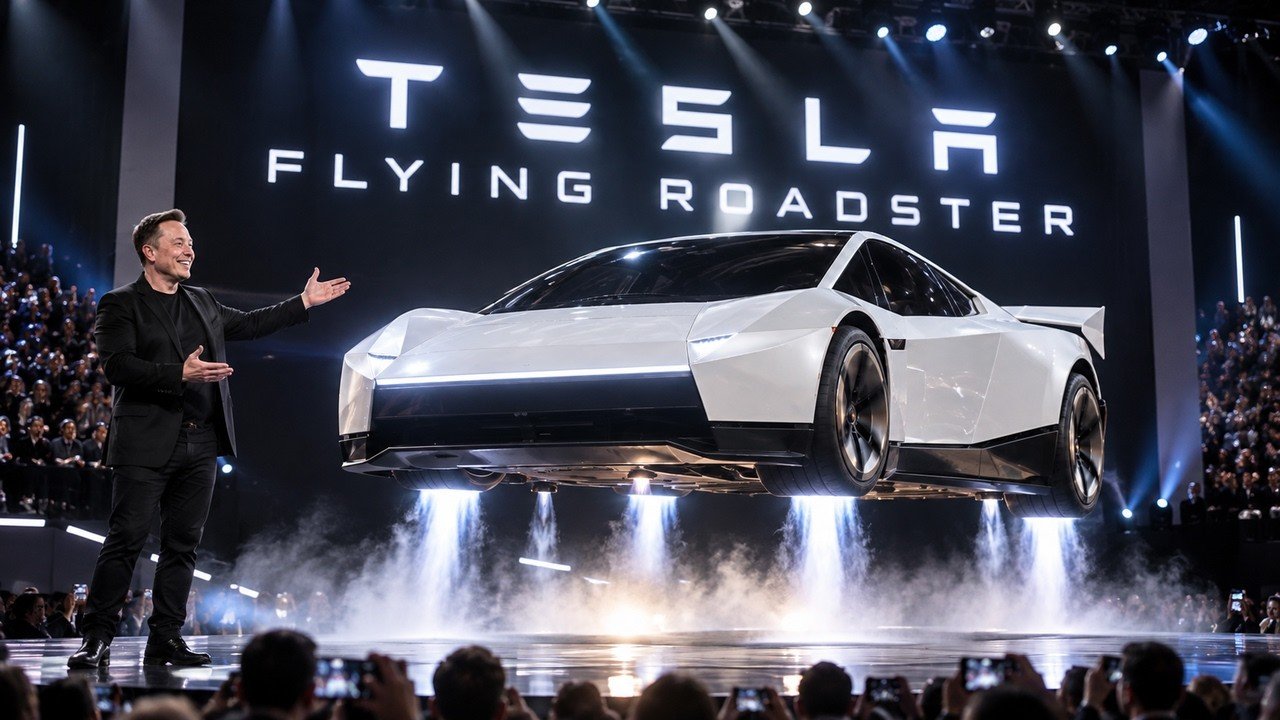
Elon Musk Has Finally Unveiled a Flying Tesla Roadster 2026: Imagine a car that accelerates from 0 to 60 mph in less than a second, sticks to vertical surfaces, and performs spectacular mid-air maneuvers. What once sounded like science fiction is now being discussed as a possible direction for the future of electric supercars.
The 2026 Tesla Roadster, associated with Elon Musk’s ambitious vision of combining automotive engineering with SpaceX technology, represents an extraordinary concept that could redefine high-performance transportation.
Unlike conventional supercars that depend primarily on tire grip, aerodynamic downforce, and electric motors, the next-generation Roadster concept explores technologies such as cold-gas thrusters, active suction fans, and aerospace-inspired engineering. However, the extreme specifications described in early reports should be treated as claims that require official confirmation and independent testing.
The New Tesla Roadster 2026: A Supercar Beyond Imagination
The Tesla Roadster project first attracted global attention in 2017, when Elon Musk introduced plans for an electric sports car designed to challenge traditional performance vehicles. The original vision included extraordinary acceleration, a high top speed, and a driving range that could make the vehicle practical beyond the racetrack.
Following years of delays and speculation, expectations surrounding the Tesla Roadster 2026 have continued to grow. The central ambition remains clear: create an electric supercar that combines breathtaking speed with advanced battery technology and innovative engineering.
A Design Inspired by Aerospace Technology
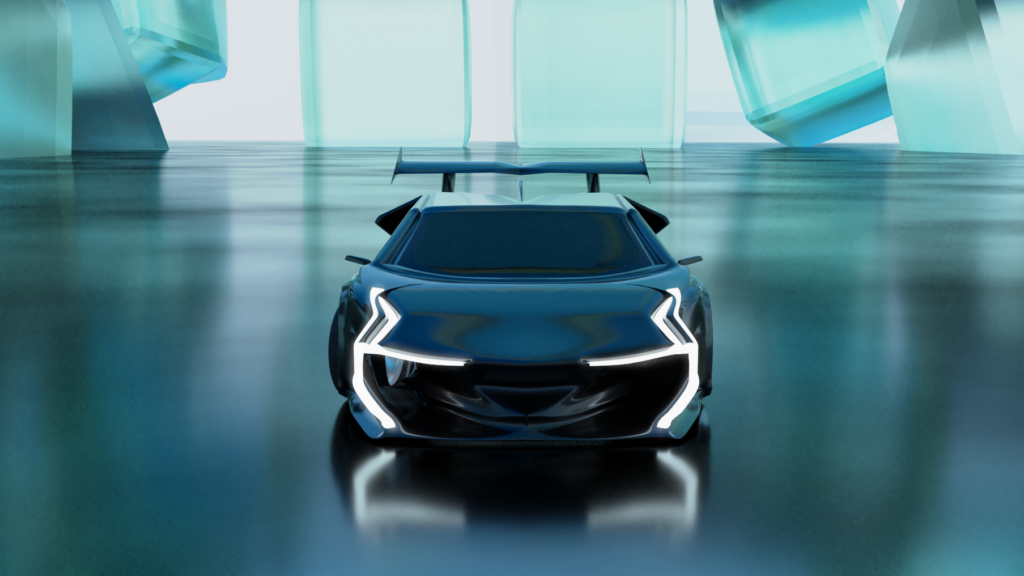
The redesigned Roadster concept features a low, wedge-shaped profile, sharp body lines, and an aggressive aerodynamic appearance. Its futuristic styling evokes high-performance aircraft, including the SR-71 Blackbird and modern fighter jets.
A lightweight structure, carefully shaped bodywork, and optimized airflow could help improve high-speed stability. The vehicle’s design would also need to accommodate powerful electric motors, a substantial battery pack, sophisticated cooling systems, and any additional equipment required for experimental propulsion technology.
The result is a vision of an electric hypercar that blends automotive design with aerospace inspiration.
SpaceX Technology Could Transform the Tesla Roadster
One of the most fascinating elements associated with the proposed Roadster is the possibility of integrating SpaceX-inspired technology into a production vehicle.
Traditional electric cars generate motion through electric motors that rotate the wheels. Their acceleration ultimately depends on how effectively the tires transfer force to the road. The proposed aerospace-inspired approach explores whether additional thrust and active aerodynamic systems could push performance beyond conventional limits.
Cold-Gas Thrusters: The Technology Behind the Flying Car Concept
Cold-gas thrusters operate by releasing pressurized gas through specially designed nozzles. The escaping gas generates a reaction force that can change an object’s movement or orientation.
In spacecraft, this technology helps control position and attitude without requiring conventional chemical rocket combustion. A similar principle applied to an experimental Roadster could potentially deliver short bursts of directional thrust.
The concept described in the supplied report includes approximately ten nozzles connected to high-pressure air tanks with a combined capacity of around 600 liters. These figures should not be considered confirmed production specifications without reliable technical documentation from Tesla.
If implemented and validated, such a system could potentially support rapid attitude adjustments or specialized acceleration demonstrations.
However, cold-gas thrusters do not automatically make a car capable of sustained flight. Their effectiveness depends on gas pressure, mass flow, thrust direction, vehicle weight, and the duration of available thrust. Any road-going implementation would also require extensive safety testing and regulatory approval.
Tesla Roadster 2026 – Claimed Features, Performance and Technology
| Feature | Details |
|---|---|
| Vehicle Name | Tesla Roadster 2026 |
| Vision | Next-generation electric supercar with aerospace-inspired technology |
| Design | Futuristic wedge-shaped body, sharp lines, and aerodynamic styling |
| Standard Performance Acceleration | Claimed 0–60 mph in under 1.6 seconds |
| Thrust Version Acceleration | Claimed 0–60 mph in under 0.9 seconds |
| Roadster Rocket Acceleration | Claimed 0–60 mph in under 0.59 seconds |
| Claimed Top Speed | More than 370 km/h (230 mph) |
| Claimed Driving Range | More than 480 km per charge |
| Proposed Propulsion Technology | Cold-gas thrusters inspired by aerospace systems |
| Proposed Thruster Arrangement | Approximately 10 nozzles |
| Reported Compressed-Air Capacity | Around 600 liters |
| Powertrain Ambition | Approximately 1 megawatt (1,000 kW) |
| Active Aerodynamic Technology | Proposed suction fans to increase downforce and tire grip |
| Potential Upside-Down Driving | Experimental concept requiring independent testing |
| SpaceX Connection | Potential integration of SpaceX-inspired thruster technology |
| Main Engineering Challenges | Passenger safety, battery cooling, stability, braking, and regulatory approval |
| Expected Competitors | High-performance electric supercars and traditional hypercars |
| Original Roadster Announcement | 2017 |
| Original Announced Base Price | $200,000, according to the 2017 announcement |
| Confirmed Production Specifications | Final performance, price, availability, and experimental features require official confirmation |
| Overall Outlook | An ambitious electric supercar concept combining extreme performance and aerospace-inspired engineering |
Could Suction Fans Let the Roadster Drive Upside Down?
Another extraordinary feature discussed in the concept is an active suction system.
High-performance fans can create a low-pressure region beneath a vehicle, increasing the force pressing it toward a surface. This principle is related to ground-effect and fan-assisted aerodynamic systems explored in specialized racing and experimental vehicles.
By increasing effective downforce, such technology could potentially improve tire grip and cornering performance.
The more dramatic suggestion is that the Roadster could adhere to vertical structures or travel upside down. Achieving this would require sufficient suction force, reliable surface contact, careful weight management, and precise control.
Driving upside down is not an established capability of the production Tesla Roadster. It remains an extraordinary engineering claim that would require a demonstrated prototype and independently verified testing.
Tesla Roadster 2026 Performance and Expected Specifications
The next-generation Roadster has long been associated with ambitious performance targets. The supplied report describes three possible configurations, ranging from a conventional high-performance model to experimental versions incorporating additional propulsion equipment.
The following figures represent claims from the source material rather than independently verified production specifications.
1. Tesla Roadster Performance Model
The standard performance configuration is described as a two-seat electric supercar capable of accelerating from 0 to 60 mph in under 1.6 seconds.
Such acceleration would place the vehicle among the most ambitious electric performance cars ever proposed. Achieving it would depend on motor output, battery discharge capability, vehicle weight, tire performance, and road conditions.
2. Tesla Roadster Thrust Version
The proposed Thrust version incorporates auxiliary thrusters intended to provide additional acceleration beyond conventional wheel-driven propulsion.
The supplied report suggests a 0–60 mph time below 0.9 seconds. That figure would be extraordinary, but it requires careful independent validation, including clarification of measurement methods and operating conditions.
3. Tesla Roadster Rocket
The most radical configuration described is the single-seat Roadster Rocket, featuring an experimental aerial maneuvering system.
The source claims acceleration to approximately 60 mph in less than 0.59 seconds. Such a result would represent an exceptional engineering challenge involving occupant safety, extreme acceleration forces, stability, and precise thrust control.
No such performance should be treated as a verified production capability without official specifications and independent testing.
Tesla Roadster 2026: Claimed Specifications at a Glance
| Specification | Figures Described in the Source |
|---|---|
| Standard performance acceleration | Under 1.6 seconds, 0–60 mph |
| Thrust version acceleration | Under 0.9 seconds, 0–60 mph |
| Roadster Rocket acceleration | Under 0.59 seconds, 0–60 mph |
| Claimed top speed | More than 370 km/h |
| Claimed driving range | More than 480 km |
| Proposed thruster arrangement | Approximately 10 nozzles |
| Reported compressed-air capacity | Around 600 liters |
| Powertrain ambition | Approximately 1 megawatt |
These numbers are reported targets and concept claims, not a confirmed final specification sheet. Actual production performance, range, pricing, and availability remain dependent on official announcements and testing.
Can the Tesla Roadster Defeat Traditional Hypercars?
The Roadster’s most important competition would come from established hypercars and other high-performance electric vehicles.
Conventional hypercars combine powerful engines or electric motors with advanced suspension systems, sophisticated braking technology, lightweight materials, and aerodynamic engineering. Their performance is measured across more than a short acceleration run.
The proposed Tesla Roadster could have a major advantage if it delivers exceptional acceleration while maintaining practical range and reliable everyday operation.
However, straight-line speed alone does not determine which car performs best.
Braking, Handling, and Thermal Management Matter
A vehicle that accelerates extremely quickly must also be capable of stopping safely. Repeated high-speed runs generate substantial heat in motors, batteries, tires, and braking components.
The vehicle must also remain predictable during cornering, emergency maneuvers, and operation on uneven surfaces.
Additional thrusters, pressure vessels, or fan systems could introduce extra weight and complexity. Engineers would need to balance these disadvantages against any measurable performance improvements.
Independent track testing will ultimately determine whether the Roadster can outperform established hypercars in real-world conditions.
The Challenges of Building a Flying Electric Supercar
Turning an extraordinary prototype into a production vehicle is a difficult task.
First, passenger safety would be essential. Extremely rapid acceleration and unusual aerial maneuvers could expose occupants to dangerous forces. Any experimental flight-related capability would require carefully defined operating limits.
Second, battery efficiency and thermal management would remain major engineering priorities. A high-output electric powertrain must deliver substantial power without compromising reliability or usable driving range.
Third, regulatory requirements would influence how the vehicle could be operated. Technologies that produce thrust or enable unconventional movement could face restrictions that ordinary road vehicles do not encounter.
Finally, manufacturing costs could be substantial. Aerospace-grade components, specialized pressure systems, and advanced active-aerodynamic equipment could make an experimental configuration significantly more expensive than a conventional electric sports car.
These challenges explain why spectacular demonstrations do not automatically translate into commercially available vehicles.
How the Tesla Roadster Could Influence the Future of Transportation
Regardless of whether the most ambitious claims become reality, the Roadster project highlights the growing relationship between the automotive and aerospace industries.
Electric motors, high-performance batteries, advanced software, lightweight materials, and aerodynamic optimization already influence both sectors. Further collaboration could produce improvements in vehicle control, energy efficiency, and high-performance engineering.
Tesla’s broader approach to innovation has encouraged the industry to reconsider what electric vehicles can achieve. A successful next-generation Roadster could strengthen that trend by demonstrating new ways to combine performance, software, and energy management.
The possibility of a car that briefly leaves the ground remains much more experimental than ordinary electric propulsion. Nevertheless, the concept encourages engineers to explore technologies beyond traditional automotive boundaries.
Conclusion: Is the Flying Tesla Roadster the Future?
The Elon Musk Tesla Roadster 2026 represents an exciting vision of an electric supercar that could combine extreme acceleration, futuristic styling, and aerospace-inspired engineering.
Its proposed cold-gas thrusters, suction systems, and extraordinary performance figures have captured the imagination of automotive enthusiasts. Yet the distinction between an ambitious concept and a verified production vehicle remains essential.
The Roadster’s ultimate success will depend on whether Tesla can deliver its promised performance alongside safety, reliability, efficiency, and practical usability.
If the company validates even a portion of its most ambitious targets, the next-generation Roadster could become an important milestone in electric performance engineering. For now, the flying-car concept remains a fascinating possibility rather than a proven everyday reality.
FAQs
1. What is the Tesla Roadster 2026?
The Tesla Roadster 2026 is the anticipated next-generation electric sports car associated with Elon Musk’s vision of combining extreme acceleration, advanced battery technology, and futuristic automotive engineering. Some reports also describe experimental aerospace-inspired features, although final production specifications require official confirmation.
2. Can the Tesla Roadster 2026 really fly?
The Roadster has been associated with the concept of using SpaceX-inspired thrusters for brief, controlled movements. However, sustained flight has not been established as a verified production capability. Any claims about flying or aerial maneuvers require a demonstrated prototype and independent testing.
3. How fast can the Tesla Roadster 2026 accelerate?
The original Roadster announcement included a target of 0–60 mph in 1.9 seconds. The supplied report describes more ambitious configurations claiming acceleration times below 1.6 seconds, 0.9 seconds, and even 0.59 seconds. These more extreme figures remain unverified claims, not confirmed production specifications.
4. What is the expected top speed of the Tesla Roadster 2026?
The supplied report describes a potential top speed exceeding 370 km/h (approximately 230 mph). The actual production top speed will depend on Tesla’s final engineering specifications and independent performance testing.
5. What driving range could the new Tesla Roadster offer?
The source describes a potential driving range exceeding 480 kilometers per charge. Tesla’s original 2017 Roadster announcement targeted approximately 620 miles of range under its stated test assumptions. The final range of any production version will depend on its battery capacity, efficiency, tires, and driving conditions.
6. What are cold-gas thrusters in the Tesla Roadster?
Cold-gas thrusters release pressurized gas through specialized nozzles to generate thrust. In spacecraft, they are used for position and orientation control. A similar system in an experimental Roadster could potentially provide short bursts of directional force, but its real-world performance and production availability would need to be demonstrated.
7. How could the Tesla Roadster drive upside down?
The concept described in the supplied report uses high-performance suction fans to create a low-pressure area beneath the vehicle. This could increase the force holding the car against a surface. However, upside-down driving remains an unverified capability and would require extensive engineering and safety validation.
8. What makes the Tesla Roadster different from other electric supercars?
The Roadster is designed around a combination of electric propulsion, high acceleration, aerodynamic efficiency, and advanced software. Its proposed aerospace-inspired technologies distinguish it from conventional electric sports cars, although the feasibility of the most radical features has not been independently established.
9. Will the Tesla Roadster 2026 use SpaceX technology?
Elon Musk has previously discussed the possibility of incorporating SpaceX-inspired technology into the Roadster, including a potential thruster package. The exact hardware, configuration, and availability of such technology in a production vehicle require confirmation from Tesla.
10. How many versions of the Tesla Roadster are described in the report?
The supplied report describes three configurations: the Performance Model, Thrust Version, and Roadster Rocket. Their claimed acceleration capabilities vary, but these names and specifications should not be interpreted as a confirmed Tesla production lineup.
11. What is the expected power output of the Tesla Roadster 2026?
The supplied report mentions a powertrain ambition of approximately 1 megawatt, equivalent to 1,000 kilowatts. This figure is not a confirmed production specification, and the final power output will depend on Tesla’s official technical details.
12. Can the Tesla Roadster outperform traditional hypercars?
The Roadster could compete with leading hypercars if it delivers exceptional acceleration, high top speed, and consistent performance. However, braking, cornering, cooling, tire grip, and reliability are equally important. Independent track testing will be needed to determine how it compares with established competitors.
13. Will the Tesla Roadster 2026 be suitable for everyday driving?
A conventional production version could potentially offer everyday usability alongside high performance. However, experimental thrusters and aerial maneuvering equipment could introduce additional safety, maintenance, and regulatory challenges. Its practicality will depend on the final production design.
14. What challenges could Tesla face when developing a flying Roadster?
Major challenges include passenger safety, pressure-system reliability, vehicle stability, battery cooling, additional component weight, and regulatory approval. Engineers would also need to ensure that any experimental propulsion system operates predictably without compromising conventional road performance.
15. How much will the Tesla Roadster 2026 cost?
A definitive production price for the next-generation Roadster should be confirmed through Tesla’s official announcements. The original 2017 unveiling listed a $200,000 base price and a $250,000 Founders Series price, but those historical figures should not be assumed to represent current pricing or final production terms.
16. When will the Tesla Roadster 2026 be available to buyers?
The exact availability and delivery schedule should be verified through Tesla’s latest official announcements. The project has experienced delays since its 2017 unveiling, so prospective buyers should rely on confirmed production and delivery information rather than speculative launch dates.
Read More:
- Full New Tesla Roadster Highlights INSANE Lauch Event
- SpaceX Just Vertical Ship 40 Back – And What It Revealed Is Kind of Mind-Blowing
- Amazing Inside 4.0 Elon Musk’s Assembly Production Line
- Tesla Pi Phone 2026: Release Date, Price, Features & Truth Behind the $199 No-Bill Rumor
- The Tesla Semi 2026 Update is HERE