
SpaceX Just Vertical Ship 40 Back – And What It Revealed Is Kind of Mind-Blowing: SpaceX continues to push the boundaries of rocket engineering, spacecraft recovery, and reusable spaceflight. From testing next-generation Starship hardware at Starbase to delivering essential supplies and scientific equipment to the International Space Station (ISS), the company is advancing multiple aerospace projects simultaneously.
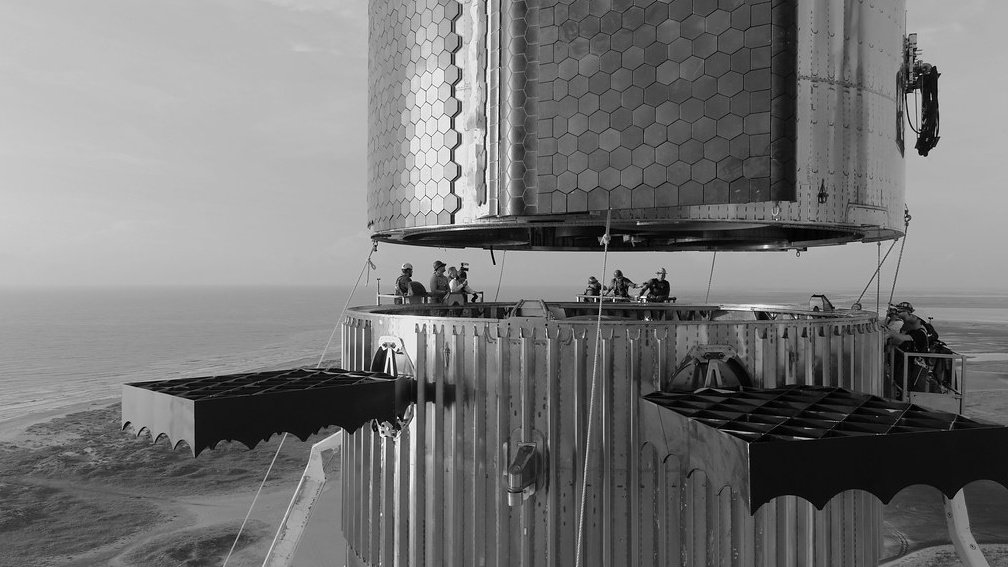
One of the most interesting recent developments is the return of Starship Ship 40 (S40) to an upright position inside Mega Bay 2. After spending more than two months lying horizontally following its ocean journey and transportation, the spacecraft was raised vertically, giving engineers a closer look at the condition of its exterior, thermal protection system, and underside.
Meanwhile, preparations for Starship Flight 16, along with SpaceX’s CRS-35 cargo resupply mission, demonstrate how reusable launch systems and commercial space transportation are becoming increasingly important to future space exploration.
Starship Ship 40 Returns Upright at Starbase
A Closer Look at Starship’s Post-Flight Condition
The return of Ship 40 to a vertical position represents an important opportunity to examine the physical condition of a Starship vehicle after flight and recovery operations.
After remaining horizontal for an extended period, S40 was moved into Mega Bay 2, where heavy-duty lifting equipment helped bring the spacecraft upright. This process allowed observers to examine sections that are difficult to inspect when the vehicle is lying on its side.
The most revealing details involved the spacecraft’s nose cone, thermal protection tiles, and underside. These areas experience different environmental conditions during launch, atmospheric re-entry, and recovery.
For SpaceX, understanding this wear is essential to developing a spacecraft that can eventually complete repeated missions with less refurbishment between flights.
Thermal Protection Tiles Show Visible Wear
One of the most important features of Starship is its thermal protection system (TPS). During atmospheric re-entry, the vehicle encounters extreme heating as it travels through the atmosphere at high speed.
The black heat-resistant tiles covering much of Starship’s exterior help protect the stainless-steel structure from these temperatures.
Visual observations of S40 indicated several areas requiring closer inspection:
- Surface abrasion: Parts of the black coating near the nose cone apex appeared worn, revealing lighter material underneath.
- Chipped thermal tiles: Some tiles appeared damaged around their edges, with portions seemingly chipped or broken.
- Underside damage: The protective material beneath the spacecraft showed more pronounced wear, including areas that appeared crumpled or torn.
- Remaining tile coverage: Many surrounding tiles appeared to remain attached, although visual inspection alone cannot establish their structural condition.
These observations raise important questions about how well the spacecraft’s protective systems performed during its flight.
However, visible damage does not automatically mean that the thermal protection system failed. Engineers must determine whether the wear occurred during atmospheric re-entry, ocean splashdown, transportation, or subsequent handling.
Why Starship’s Heat Shield Matters
The long-term objective of Starship development is to create a fully reusable transportation system capable of supporting frequent missions to Earth orbit, the Moon, and eventually Mars.
Achieving that goal requires more than successfully launching and landing a spacecraft. The vehicle must also withstand repeated thermal cycles without requiring extensive repairs after every mission.
Engineers therefore need to understand how individual tiles behave under extreme heat, aerodynamic pressure, vibration, and mechanical stress.
A detailed inspection of S40 inside Mega Bay 2 could help identify areas where tile attachment methods, protective materials, and refurbishment procedures may need improvement.
The key question is not simply whether Starship can survive re-entry, but how quickly it can be prepared for another flight.
How SpaceX Lifted Ship 40 Back Into a Vertical Position
The Engineering Behind the Recovery Process
Raising a massive spacecraft from a horizontal position requires specialized ground-support equipment and careful load management.
The lifting arrangement described in the available observations involved several major components.
1. Circular Base Frame
A support frame attaches to the lower section of the spacecraft. This structure helps distribute loads and provides a stable connection during the lifting operation.
2. Pivot Frame
A pivoting structure allows the spacecraft and its support equipment to rotate relative to one another. This helps control the vehicle’s movement as it transitions from horizontal to vertical.
3. Heavy-Duty Crane Rigging
Crane equipment and secured lifting points near the upper section help raise the nose of the spacecraft while the lower support structure rotates into position.
Together, these components allow the vehicle to be moved carefully without relying on a rocket-powered maneuver.
Why Recovery Is About More Than Catching a Rocket
SpaceX’s long-term Starship strategy includes recovering vehicles and returning them to service as efficiently as possible.
The company’s launch-tower catching system is intended to support recovery of Super Heavy boosters and, as the program develops, Starship vehicles. However, Ship 40’s return to a vertical position was a ground-handling operation, not a mechanical catch by the launch tower.
This distinction matters because catching a returning spacecraft and refurbishing it for another mission are separate engineering challenges.
A successful recovery must be followed by inspections, component checks, heat-shield evaluations, and any necessary repairs.
The experience gained from examining S40 could help SpaceX develop better procedures for rapid spacecraft turnaround and reusable rocket operations.
Starship Flight 16 Preparations: Booster 23 and Ship 43
Booster 23 Moves Toward Testing
While engineers examine Ship 40, SpaceX continues preparing additional hardware for future Starship flights.
According to the supplied project update, Booster 23 (B23) was moved out of its bay and placed on a test stand as part of preparations associated with Flight 16.
The booster must undergo relevant structural, pressure, and engine-system checks before it can be considered ready for launch operations.
One strategic question is where SpaceX will perform its final testing. If the booster is intended for operations from Florida, completing certain tests closer to its launch location could reduce the need to transport fully integrated hardware over long distances.
Such a decision would depend on the availability of suitable facilities, testing requirements, and the launch campaign schedule.
Ship 43 Advances Through Production
Starship Ship 43 (S43) is another vehicle identified in the supplied update. Its aft-section integration marked a step forward in its assembly process.
Unlike hardware that can be tested comprehensively at Starbase, vehicles destined for Florida may face additional logistical considerations because the launch infrastructure and test facilities differ between locations.
SpaceX must coordinate manufacturing, testing, transportation, and launch-site preparation to keep its development program moving.
The supplied timeline pointed toward a potential December Flight 16 target, with transportation of major hardware toward Florida expected during November. These dates should be treated as projected milestones rather than confirmed launch commitments.
The broader goal is to improve the pace at which Starship vehicles and Super Heavy boosters can move from production to testing and flight.
SpaceX CRS-35: Delivering Essential Supplies to the ISS
Falcon 9 and Dragon Support Orbital Research
SpaceX’s activities extend beyond Starship development. Its established Falcon 9 and Dragon systems also support routine cargo transportation to the International Space Station.
The supplied mission report describes CRS-35, a cargo resupply mission under NASA’s Commercial Resupply Services program. It identifies approximately 6,300 pounds (2,860 kilograms) of cargo intended for the orbiting laboratory.
The mission profile described in the source includes a Falcon 9 launch from Space Launch Complex 40 and a Dragon spacecraft identified as capsule C211.
Cargo missions like this provide astronauts with equipment, research materials, food, and other supplies needed to maintain the station and conduct experiments in microgravity.
Solar Arrays and Robotic Arm Hardware
One notable cargo item is the final pair of International Space Station Roll-Out Solar Arrays (iROSA) described in the supplied report.
Solar-array upgrades help support the station’s electrical power requirements as its research activities and onboard systems continue operating.
The mission also describes equipment intended to return a failed joint associated with the Canadarm2 robotic arm. Returning hardware for examination can help engineers investigate failures and improve future maintenance procedures.
These deliveries and returns demonstrate how cargo missions support both the immediate needs of astronauts and the long-term reliability of orbital infrastructure.
Microgravity Research Could Support Medical Advances
The CRS-35 cargo manifest described in the source also includes several research areas with potential benefits for medicine on Earth.
Artificial retina research involves investigating techniques for producing retinal materials and structures that could contribute to future vision-restoration technologies.
Three-dimensional heart tissue models may help researchers study cardiac biology and investigate how potential medicines affect human-like tissue structures.
Meanwhile, brain organoid research can provide models for investigating aspects of neurological conditions, including Alzheimer’s disease, Parkinson’s disease, and multiple sclerosis.
Microgravity offers researchers a distinctive environment for studying certain biological processes. Nevertheless, experimental results must undergo further analysis and validation before they can be translated into established medical treatments.
Why Dragon’s Return Capability Is So Important
Bringing Scientific Samples Back to Earth
A major advantage of SpaceX’s Dragon spacecraft is its ability to transport cargo to the ISS and return physical materials to Earth.
After completing its time at the station, Dragon can carry research samples, scientific equipment, and other payloads back through the atmosphere before making a parachute-assisted ocean splashdown.
This capability is especially valuable when experiments require laboratory analysis that cannot be performed fully aboard the station.
Other cargo vehicles also play important roles in supplying the ISS, but their disposal and return capabilities differ. Many resupply spacecraft are designed to burn up during atmospheric re-entry rather than return substantial cargo intact.
Dragon’s return function therefore provides an important link between orbital experimentation and Earth-based scientific research.
Conclusion: SpaceX Advances Reusability on Multiple Fronts
The return of Starship Ship 40 to a vertical position provides a valuable opportunity to examine spacecraft wear and evaluate the challenges of reusable spaceflight.
Visible damage to portions of its thermal protection system highlights why detailed inspections are necessary before engineers can determine how a vehicle performed during re-entry and recovery.
At the same time, preparations involving Booster 23, Ship 43, and the potential Flight 16 campaign demonstrate the coordination required to move Starship hardware through production, testing, and transportation.
Beyond Starbase, Dragon cargo missions continue supporting the ISS with supplies, station hardware, and scientific experiments.
Together, these activities illustrate SpaceX’s broader approach to space transportation: developing reusable launch systems while maintaining operational services that support research in orbit.
The ultimate measure of progress will not be a single launch or recovery. It will be the ability to operate spacecraft safely, inspect them efficiently, reuse them reliably, and deliver meaningful scientific and commercial value over repeated missions.
FAQs
1. What is SpaceX Starship Ship 40 (S40)?
SpaceX Starship Ship 40 is a spacecraft prototype developed as part of the Starship program. Its post-flight recovery and inspection provide engineers with useful information about spacecraft durability, thermal protection, and refurbishment requirements.
2. Why was Starship Ship 40 returned to a vertical position?
Ship 40 was raised upright inside Mega Bay 2 at Starbase to allow engineers and observers to inspect its exterior, nose cone, thermal protection tiles, and underside more closely after its recovery and transportation.
3. What damage was observed on Starship Ship 40?
Visual observations indicated surface abrasion near the nose cone, chipped or damaged thermal protection tiles, and wear on sections of the underside. A detailed engineering inspection would be needed to determine the extent and cause of the damage.
4. What is Starship’s thermal protection system (TPS)?
The thermal protection system (TPS) consists of heat-resistant materials, including tiles, designed to protect Starship’s structure during atmospheric re-entry. It helps the spacecraft withstand extreme temperatures as it returns from space.
5. Did Starship Ship 40’s heat shield fail during re-entry?
Visible tile damage alone does not establish that the heat shield failed. Engineers must determine whether the observed wear resulted from re-entry heating, splashdown, ocean transportation, or ground handling before drawing conclusions.
6. How was Starship Ship 40 lifted back into a vertical position?
The operation involved specialized ground-support equipment, including a lower support frame, a pivoting structure, and heavy-duty crane rigging. These components helped control the spacecraft as it moved from a horizontal to a vertical position.
7. Was Starship Ship 40 caught by SpaceX’s launch tower arms?
No. The described operation involved lifting Ship 40 upright using ground-support equipment and cranes. It was not a mechanical catch by the launch tower’s chopstick arms.
8. Why is Starship refurbishment important for SpaceX?
Refurbishment is essential because SpaceX aims to make Starship a reusable spacecraft. Efficient inspections, repairs, and component replacement could reduce turnaround time, lower operating costs, and support more frequent launches.
9. What is SpaceX Booster 23 (B23)?
Booster 23 is a Super Heavy booster identified in the supplied update as part of preparations associated with Starship Flight 16. Its readiness depends on completing the required structural, pressure, propulsion, and other qualification checks.
10. What is Starship Ship 43 (S43)?
Ship 43 is another Starship vehicle mentioned in the supplied update. Its assembly progress, including aft-section integration, forms part of SpaceX’s ongoing spacecraft production and testing activities.
11. When is Starship Flight 16 expected to launch?
The supplied report identifies December as a potential target window for Flight 16, with major hardware transportation toward Florida expected during November. These dates are projections from the source, not confirmation of an official launch date.
12. Why might SpaceX perform some booster testing in Florida?
Testing hardware closer to its intended launch site could reduce transportation challenges and simplify final integration. However, the decision depends on available facilities, engine-testing requirements, safety procedures, and the overall launch schedule.
13. What is SpaceX’s CRS-35 mission?
CRS-35 is identified in the supplied report as a Commercial Resupply Services mission intended to deliver cargo to the International Space Station. Such missions support astronauts, station maintenance, scientific investigations, and orbital research.
14. What scientific equipment and research could CRS-35 support?
The supplied mission description includes roll-out solar arrays, artificial-retina research, three-dimensional heart tissue models, and brain organoid studies. These experiments may contribute to advances in biological research and future medical technologies.
15. Why is Dragon’s cargo return capability important?
SpaceX’s Dragon spacecraft can return physical cargo and scientific samples to Earth after completing an ISS mission. Researchers can then examine materials in terrestrial laboratories, making the return capability valuable for microgravity experiments and hardware investigations.
16. What does Ship 40 reveal about the future of reusable Starship rockets?
Ship 40 highlights the importance of examining spacecraft after flight and recovery. Its condition can help engineers investigate thermal protection performance, handling damage, and refurbishment needs. Ultimately, reliable reuse depends on safe recovery, detailed inspections, effective repairs, and successful repeat flights.
Read More:
- Tesla opens the Q&A for its biggest earnings call yet
- Elon Musk breaks his silence on the Starlink impact to Ukraine drones
- Elon Musk says Tesla’s Roadster demo could be a bang, quite literally
- Starship’s NEW STMT looks Unreal and like Allien Technology
- 15,000 Tesla Bot Gen 3 Units Get INSANE Hand Upgrade For Cooking & Cleaning
1 thought on “SpaceX Just Vertical Ship 40 Back – And What It Revealed Is Kind of Mind-Blowing”