
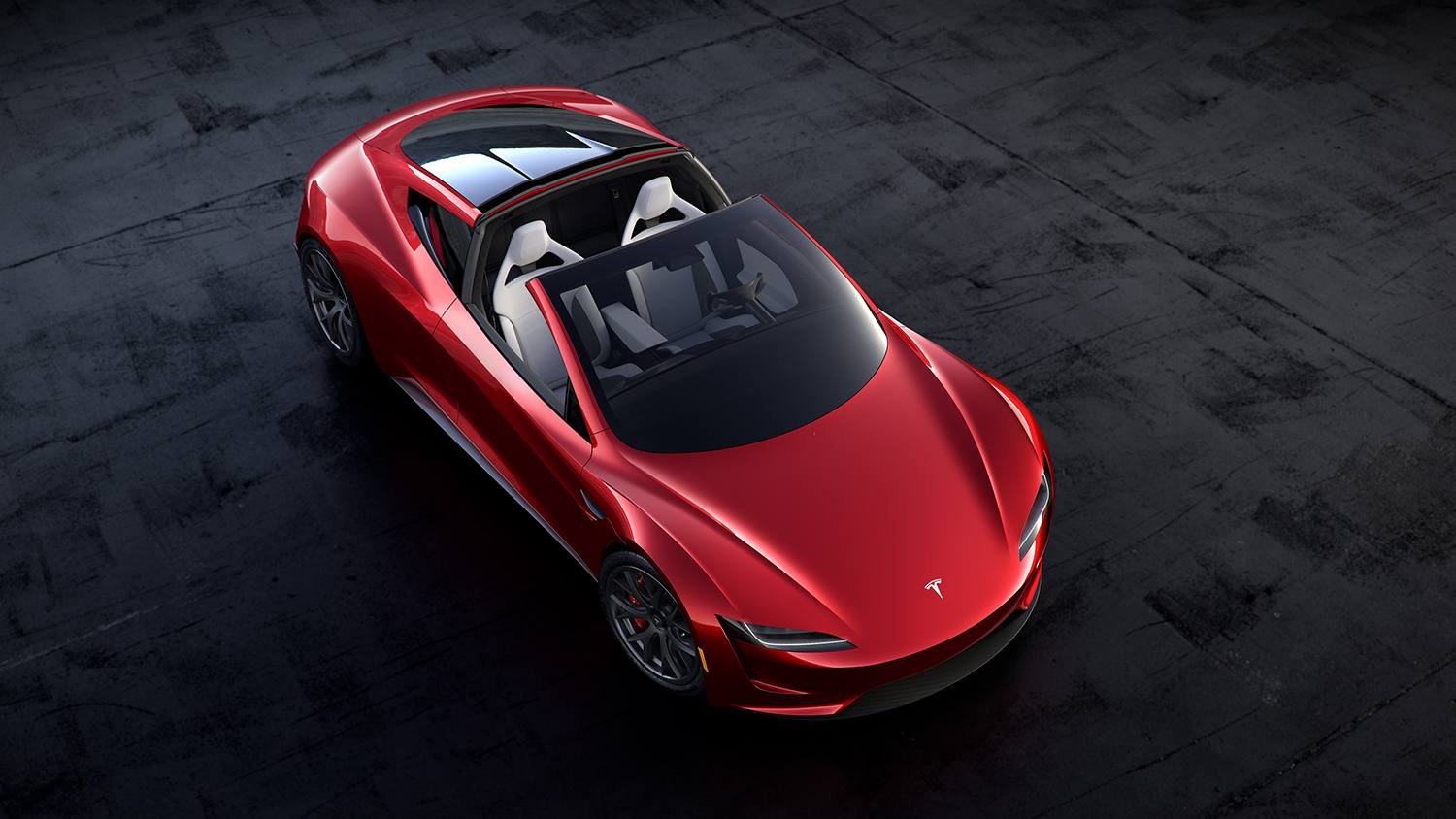
Elon Musk’s Next-Gen Battery Charging Tesla Roadster In 10 Minutes: The next-generation Tesla Roadster is attracting enormous attention for its extreme performance, futuristic engineering, and ambitious battery technology. While its incredible acceleration, rocket thrusters, and impressive aerial maneuvers have captured the public’s imagination, one of its most interesting developments is the advanced battery system designed specifically for this electric supercar.
According to the supplied report, Tesla is exploring a customized version of its 4680 battery technology, improved thermal management, and an 800-volt electrical architecture designed to support charging from 15% to 80% in approximately 10 minutes. If achieved under suitable charging conditions, this capability could significantly reduce charging downtime for a high-performance electric vehicle.
Beyond battery innovations, the latest Roadster discussion also highlights Tesla’s approach to Full Self-Driving (FSD) and the company’s expanding robotaxi operations. These developments demonstrate two different directions for Tesla: delivering a more engaging driving experience and developing autonomous transportation services.
1. Tesla Roadster’s Revolutionary 4680 Battery Technology
At the heart of the next-generation Tesla Roadster is a customized version of Tesla’s 4680 cylindrical battery cell. The name refers to the cell’s approximate dimensions: 46 millimeters in diameter and 80 millimeters in height.
Tesla has developed 4680 cells for applications that include electric vehicles and other energy-intensive platforms. However, a high-performance electric supercar requires a battery system capable of delivering substantial power while managing heat, weight, and charging speed.
The Roadster’s proposed battery improvements are intended to address these challenges.
Lightweight Aluminum Battery Casings
One of the reported engineering changes is the use of an aluminum outer casing instead of conventional steel for the Roadster’s customized battery cells.
Aluminum has a significantly lower density than steel, making it an attractive material for weight-sensitive automotive applications. Reducing battery-system weight can improve a vehicle’s acceleration, handling, and overall efficiency, although the final benefit depends on the complete battery design.
The potential advantages include:
- Reduced weight: Lightweight battery components can help improve the vehicle’s power-to-weight ratio.
- Improved heat transfer: Aluminum generally conducts heat more effectively than steel, potentially supporting more efficient thermal management.
- Performance optimization: Lower mass can help engineers balance acceleration, cornering stability, and energy consumption.
- Advanced packaging: Customized cell construction may allow engineers to optimize the battery pack for the Roadster’s performance requirements.
These potential improvements are particularly important in a vehicle designed around rapid acceleration and demanding driving conditions.
2. Dual-Sided Battery Cooling for Extreme Performance
High-performance electric vehicles face a significant engineering challenge: producing enormous amounts of power without allowing battery temperatures to rise beyond safe operating limits.
During repeated acceleration, battery cells generate heat. If temperatures become excessive, the battery management system may reduce power output to protect the cells and maintain reliability.
For the next-generation Roadster, the reported solution involves dual-sided battery cooling, which aims to remove heat from both sides of the cells rather than relying on cooling from only one side.
Maintaining Consistent Battery Temperatures
A carefully designed cooling system can help distribute temperatures more evenly throughout a battery pack. Reducing localized hot spots can improve thermal stability and help the battery deliver consistent performance during demanding driving sessions.
According to the supplied report, the proposed system is intended to support approximately 25 to 30 minutes of continuous high-performance track operation without severe thermal degradation.
This remains a target that would require independent testing and verified performance data.
The reported system is also designed to maintain strong power delivery as the battery’s charge level decreases from 100% toward 10%. Actual output, however, will depend on battery temperature, state of charge, software controls, and operating conditions.
For drivers, effective thermal management could be just as important as headline acceleration figures. A supercar that repeatedly delivers strong performance without excessive overheating would offer a more consistent driving experience.
3. Tesla Roadster’s 10-Minute Fast-Charging Technology
The most attention-grabbing claim surrounding the next-generation Tesla Roadster is its potential ability to charge from 15% to 80% in just 10 minutes.
The supplied report describes an 800-volt electrical architecture intended to support rapid charging. Higher-voltage systems can reduce current requirements for a given power level, potentially helping engineers manage electrical losses and charging-system design.
However, the vehicle’s final charging specifications and production capabilities would need to be confirmed by Tesla.
How the 800-Volt Architecture Could Help
An 800-volt architecture can offer several potential advantages when paired with compatible charging equipment and a battery engineered to accept high charging power.
These include:
- Faster charging potential: Higher-voltage operation can support high-power charging when the battery and charging station are designed for it.
- Improved electrical efficiency: Lower current for equivalent power can reduce resistive losses in suitable components.
- Better performance integration: Engineers can optimize the battery, inverter, wiring, and thermal-management systems together.
- Reduced charging downtime: A sufficiently fast charging curve could make longer journeys more convenient.
The report also discusses compatibility with Tesla’s V4 Supercharger technology. Actual charging speed would depend on the vehicle’s supported charging power, charger configuration, battery temperature, and charging conditions.
What Would a 10-Minute Charge Mean for Drivers?
The reported charging target is from 15% to 80%, representing a 65-percentage-point increase in battery charge.
For illustration, if the Roadster used a hypothetical 100-kWh battery pack, that increase would represent approximately 65 kWh of stored energy before accounting for charging losses. Delivering that amount in 10 minutes would require an average battery charging rate of roughly 390 kW.
This is a simplified calculation, not a confirmed Roadster specification. Real charging curves vary throughout a session, and the vehicle would need to sustain a sufficiently high average rate.
The report also discusses an estimated driving range exceeding 300 miles. That figure should be treated as a projection until Tesla publishes verified specifications and standardized range results.
If the charging and range targets are achieved, the Roadster could combine long-distance usability with the performance expected from an electric supercar.
4. Tesla Roadster and Full Self-Driving: A Different Strategy
Tesla’s autonomy ambitions are closely associated with its Full Self-Driving software. However, the next-generation Roadster may approach driver-assistance features differently from other Tesla vehicles.
According to the supplied report, designer Franz von Holzhausen indicated that the Roadster would not launch with the complete suite of FSD capabilities, instead offering a more limited set of features initially.
Why the Roadster May Prioritize Driver Engagement
The Roadster is designed as a low-slung performance car with an aggressive aerodynamic profile. Its packaging, visibility, and sensor-placement requirements may differ from those of larger vehicles designed primarily for daily transportation.
Its intended driving experience also emphasizes acceleration, steering feedback, and driver control.
This does not necessarily mean the Roadster will never receive additional autonomy features. Future capabilities would depend on hardware compatibility, software development, regulatory requirements, and Tesla’s product decisions.
Importantly, driver-assistance systems should not be confused with fully autonomous driving. Drivers must follow the vehicle’s instructions and remain responsible for safe operation unless a system is explicitly approved and designed to operate without their supervision.
5. Tesla Robotaxi Expansion and Safety Oversight
While the Roadster focuses on driver-oriented performance, Tesla’s robotaxi program represents a different vision: transportation services that increasingly rely on automated driving technology.
The supplied report describes an expansion of robotaxi operating hours in Austin, Texas, with service extending from 11 p.m. to midnight. It also cites a fleet exceeding 300 vehicles.
These figures should be independently verified because fleet sizes, operating areas, and service schedules can change.
Why Nighttime Testing Matters
Nighttime operation presents several challenges for automated driving systems, including reduced visibility, glare, pedestrians in poorly lit areas, wildlife, and vehicles without adequate lighting.
Testing in these conditions can help engineers evaluate perception systems, route planning, and responses to unexpected road situations.
However, extending service hours does not automatically establish that an autonomous system is safe under every condition.
Regulatory Scrutiny and Real-World Reliability
The report also references regulatory scrutiny involving allegations of speeding in active school zones.
Such allegations and any associated investigation should be assessed using official records and verified findings. An investigation does not, by itself, establish that a violation occurred.
For autonomous transportation, meaningful safety evaluation requires reliable evidence, including incident reporting, compliance with traffic laws, system performance across different environments, and transparent oversight.
Safety validation is essential as robotaxi services expand beyond limited operating conditions.
6. When Could the Next-Generation Tesla Roadster Arrive?
The supplied report points to a potential production timeline around 2028. However, this should be regarded as a reported target rather than a guaranteed delivery date.
Before production, the Roadster would need to demonstrate that its battery design, cooling system, charging performance, powertrain, and other components meet the required standards for safety, durability, and real-world use.
The challenge is not simply achieving impressive demonstrations. It is translating ambitious engineering goals into a reliable production vehicle that can operate consistently.
Tesla’s progress in battery manufacturing, power electronics, thermal management, and vehicle integration will be important in determining whether the proposed performance and charging targets become reality.
Conclusion: Can Tesla Redefine Electric Supercar Charging?
The next-generation Tesla Roadster promises an ambitious combination of high-performance battery technology, lightweight engineering, advanced thermal management, and rapid charging.
Its reported 4680 battery improvements, potential aluminum casings, dual-sided cooling, and 800-volt architecture illustrate how multiple engineering systems could work together to improve an electric supercar.
The most exciting claim is the possibility of charging from 15% to 80% in approximately 10 minutes. If Tesla can demonstrate that capability under real-world conditions, it could make electric supercar ownership more convenient without sacrificing performance.
At the same time, Tesla’s approach to FSD and its robotaxi expansion highlights the company’s broader transportation ambitions.
Ultimately, the Roadster’s success will depend on verified specifications, production readiness, charging infrastructure, and real-world testing. Until official figures are confirmed, its most ambitious claims remain promising engineering targets rather than established production capabilities.
FAQs
1. What is special about the next-generation Tesla Roadster battery?
The next-generation Tesla Roadster is reported to feature a customized version of Tesla’s 4680 cylindrical battery cells, designed to deliver high power output, improved thermal management, reduced weight, and faster charging.
2. Can the next-generation Tesla Roadster charge in 10 minutes?
According to the supplied report, the Roadster is designed to charge from 15% to 80% in approximately 10 minutes. This remains a reported target that requires confirmation through official specifications and real-world testing.
3. What are Tesla 4680 battery cells?
Tesla 4680 battery cells are cylindrical lithium-ion cells measuring approximately 46 millimeters in diameter and 80 millimeters in height. Their design supports efforts to improve battery manufacturing, vehicle integration, and energy performance.
4. Why might Tesla use aluminum battery casings in the Roadster?
Aluminum is lighter than steel by volume and offers good thermal conductivity. Using aluminum battery casings could help reduce battery-pack weight and improve heat transfer, potentially benefiting the Roadster’s efficiency and performance.
5. What is dual-sided battery cooling?
Dual-sided battery cooling is a thermal-management approach that removes heat from both sides of a battery cell. It is intended to improve temperature uniformity, reduce localized hot spots, and support consistent power delivery during demanding driving conditions.
6. How long could the Tesla Roadster maintain high-performance driving?
The supplied report describes a target of approximately 25 to 30 minutes of continuous track operation without severe thermal degradation. Actual performance would depend on battery temperature, driving conditions, cooling capacity, and the final production design.
7. Will the next-generation Tesla Roadster use an 800-volt architecture?
The report describes a proposed 800-volt electrical architecture. Such a system can support high-power charging and reduce current requirements for a given power level, provided the battery and charging equipment are compatible.
8. What driving range could the new Tesla Roadster offer?
The supplied report discusses a projected range exceeding 300 miles. The final range will depend on battery capacity, vehicle efficiency, driving conditions, and Tesla’s official specifications.
9. How much battery capacity could the Tesla Roadster have?
The report uses an estimated 100-kWh battery pack as an illustration. This figure is not a confirmed production specification, and Tesla would need to announce the actual battery capacity.
10. Will the Tesla Roadster support Tesla V4 Superchargers?
The report discusses potential compatibility with Tesla V4 Superchargers. Actual charging speeds will depend on the Roadster’s charging hardware, the station’s capabilities, battery temperature, and the charging curve.
11. Why is battery cooling important in an electric supercar?
Battery cooling helps prevent excessive temperatures during rapid acceleration and sustained high-power driving. Effective thermal management can protect battery components, support consistent performance, and help maintain long-term reliability.
12. Will the next-generation Tesla Roadster include Full Self-Driving?
According to the supplied report, the Roadster may launch with a limited selection of Full Self-Driving features rather than the complete suite. Its final driver-assistance capabilities will depend on Tesla’s confirmed hardware and software plans.
13. Why might the Tesla Roadster have fewer autonomous-driving features at launch?
The Roadster’s low-slung body, aerodynamic design, visibility requirements, and performance-focused character may influence its initial driver-assistance configuration. Any future expansion would depend on engineering development, regulatory approval, and software compatibility.
14. What is Tesla’s robotaxi program?
Tesla’s robotaxi program aims to provide transportation services using automated driving technology. The program requires ongoing software development, real-world testing, regulatory compliance, and safety evaluation before broader autonomous operation can be established.
15. When could the next-generation Tesla Roadster enter production?
The supplied report points to a potential production timeline around 2028. This should be treated as a reported target rather than a guaranteed launch date until Tesla confirms its production schedule.
16. Could the next-generation Tesla Roadster change the electric supercar market?
The Roadster could influence the electric supercar market if it delivers its reported combination of rapid charging, high performance, effective battery cooling, and competitive driving range. Its actual impact will depend on verified specifications, pricing, availability, and real-world performance.
Read More:
- SpaceX’s Gwynne Shotwell just made a quiet gesture toward Tesla
- SpaceX’s biggest earnings test yet lands Tuesday, and Tesla shareholders should be watching
- Tesla CEO Elon Musk reminds everyone about Roadster’s true meaning
- Elon Musk will give ‘every kid in America’ a SpaceX share in 2027
- New Elon Musk’s Tesla Bot Optimus Gen 3 Capabilities LEAKED
2 thoughts on “Elon Musk’s Next-Gen Battery Charging Tesla Roadster In 10 Minutes”