
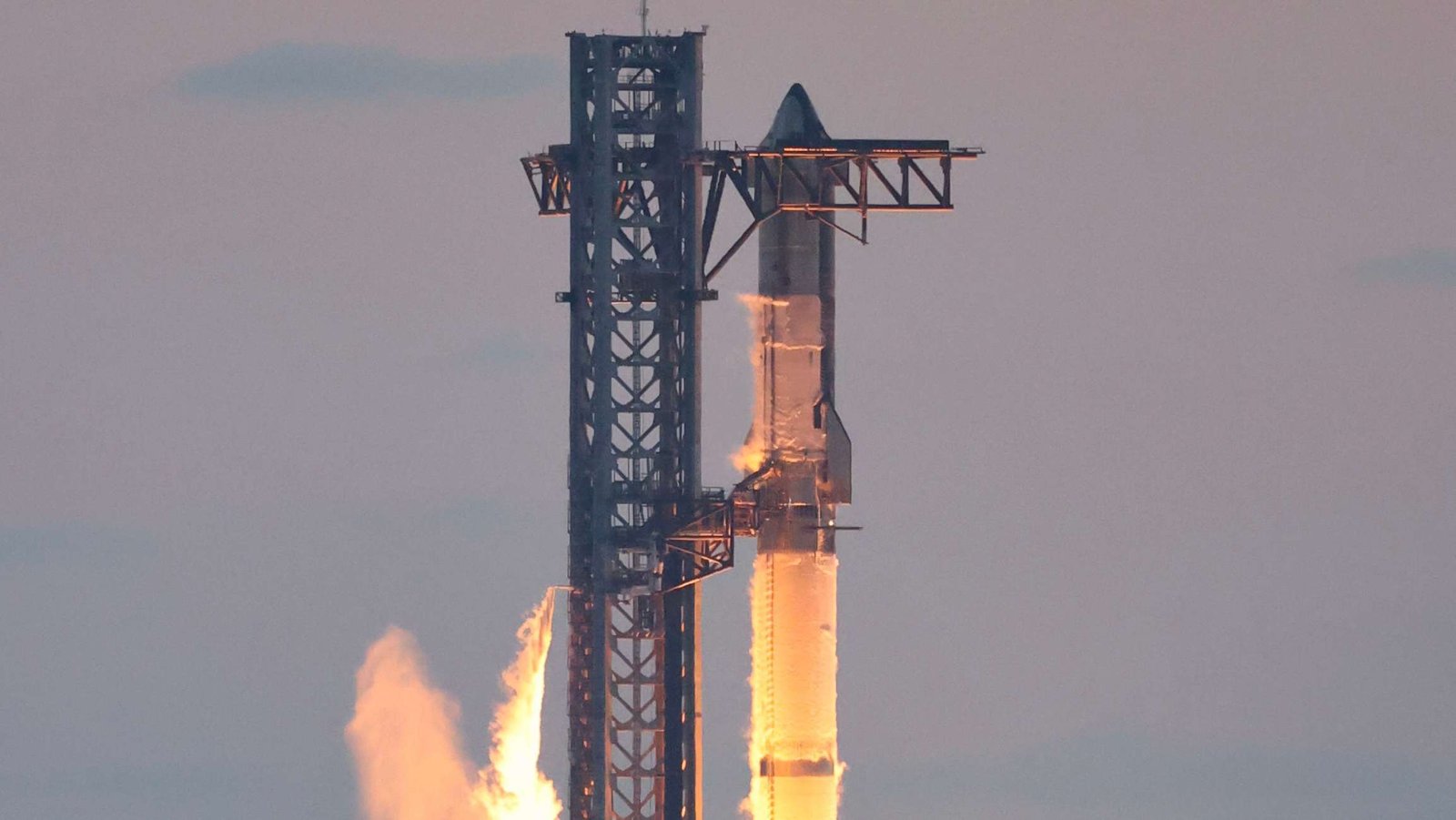
Elon Musk reveals Starship V4 with 9 Engines to Unlock a New Starship Era: SpaceX is preparing for one of the most ambitious upgrades in the history of its Starship program. While the company continues developing Starship Version 3 (V3), attention is already shifting toward the next-generation Starship V4, which could introduce a significantly larger spacecraft, additional Raptor engines, increased propellant capacity, and much greater payload performance.
One of the biggest changes is the planned expansion of the Starship upper stage from six engines to nine engines. This is not simply an engine upgrade. It represents a major architectural evolution that could transform how SpaceX approaches orbital transportation, lunar missions, and eventually human exploration of Mars.
According to the discussed development roadmap, Starship V4 could feature a longer fuselage, larger fuel tanks, and six vacuum-optimized Raptor engines. These improvements are designed to provide the additional performance needed for increasingly demanding deep-space missions.
Starship V4: A Major Leap Beyond Version 3
SpaceX has continuously redesigned Starship to improve its performance, reliability, and manufacturing efficiency. Version 3 represents another important step, but Version 4 could take the spacecraft into an entirely different performance category.
The most noticeable change is the proposed nine-engine configuration.
Earlier Starship upper-stage designs used three sea-level Raptor engines and three vacuum-optimized engines. The V4 configuration is expected to retain the three sea-level engines while increasing the vacuum engine count from three to six.
This would bring the total number of engines on the spacecraft to nine.
Why Nine Engines Matter
Adding three additional engines could provide several important advantages:
- Higher total thrust: More engines can help accelerate a larger and heavier spacecraft.
- Improved performance: Additional thrust can compensate for the increased mass of larger propellant tanks.
- Greater engine redundancy: Multiple engines could provide additional operational flexibility if an engine experiences problems.
- Better deep-space capabilities: The upgraded propulsion system could support more demanding orbital and interplanetary missions.
The complete Starship and Super Heavy stack could feature 42 engines, according to the discussed V4 configuration.
Assuming the use of Raptor 3 engines, the ship’s initial thrust could reach approximately 2,700 metric tons under the estimates presented in the development discussion.
A Longer Starship With Much Larger Fuel Tanks
The nine-engine configuration is closely connected to another major change: increasing the overall length of Starship.
A larger spacecraft needs more than additional propulsion. It also requires greater propellant capacity to support its increased mass and ambitious mission requirements.
Starship V4 is expected to feature a stretched fuselage with additional room for liquid methane and liquid oxygen tanks.
These propellants are essential to the Raptor engines, and increasing their storage capacity could allow the spacecraft to carry more fuel for orbital operations, payload delivery, and deep-space journeys.
More Propellant Means Greater Mission Flexibility
A larger fuel supply could improve Starship’s ability to perform high-energy missions while maintaining sufficient propellant reserves for critical operations.
However, increasing the spacecraft’s size also creates engineering challenges. SpaceX must balance tank capacity, structural mass, engine performance, thermal protection, and aerodynamic stability.
The additional engines are intended to help address the increased mass while preserving the performance needed for demanding missions.
Starship V4 Could Push Payload Capacity Toward 200 Tons
One of the most exciting possibilities surrounding Starship V4 is its potential payload capacity.
SpaceX has targeted more than 100 metric tons to low Earth orbit (LEO) for Starship V3 in a fully reusable configuration.
With a larger structure, additional propellant, and a more powerful propulsion system, V4 could potentially increase that figure substantially.
Some projections discussed for the upgraded vehicle suggest a payload capacity between 150 and 200 metric tons to low Earth orbit under optimized mission profiles.
These figures should be treated as engineering projections rather than demonstrated performance. Actual payload capacity will depend on the final vehicle design, flight conditions, recovery requirements, and reusability performance.
Why Higher Payload Capacity Is Important
Greater payload capacity could change the economics of space transportation.
Starship could potentially deliver:
- Larger satellite constellations.
- Massive space station modules.
- Lunar infrastructure and construction equipment.
- Scientific instruments and exploration vehicles.
- Supplies for future Mars missions.
The ability to transport more cargo in fewer launches could make ambitious space projects more practical.
Orbital Refueling Could Transform Moon and Mars Missions
Perhaps the most important capability connected to Starship V4 is orbital refueling.
Traveling beyond low Earth orbit requires enormous amounts of propellant. A spacecraft carrying everything needed for a lunar or Martian journey would face significant limitations.
SpaceX’s solution involves using tanker Starships to transfer propellant to another Starship while both vehicles are in orbit.
This approach could allow a spacecraft to launch into orbit, receive additional fuel, and then begin its journey toward the Moon or Mars.
Why Starship V4 Could Make Refueling More Efficient
A larger V4 tanker could potentially carry more propellant per mission.
That means SpaceX could reduce the number of tanker launches required to prepare a spacecraft for certain deep-space missions.
This is particularly important because every additional launch requires coordination, vehicle availability, successful orbital operations, and reliable propellant transfer.
Improving tanker efficiency could help SpaceX develop a more sustainable transportation system for future lunar exploration.
The technology could also support NASA’s long-term lunar ambitions, including crewed lunar missions targeted around 2028 in the roadmap discussed.
Raptor 3 and Raptor 4: The Engine Evolution
The development of Starship V4 is also connected to SpaceX’s ongoing Raptor engine improvements.
Raptor 3 is designed to be lighter, more powerful, and less complicated than earlier versions. Reducing engine complexity is important because Starship requires a large number of engines across its booster and spacecraft.
Every improvement in manufacturing efficiency, engine reliability, and maintenance could help SpaceX move closer to rapid vehicle reuse.
Future developments involving Raptor 4 could push engine performance even further.
Balancing Power and Reliability
Although nine engines could provide additional thrust and potential redundancy, they also introduce more mechanical components.
Every additional engine must operate reliably under extreme temperatures, vibration, pressure, and demanding flight conditions.
SpaceX therefore needs to improve not only engine performance but also manufacturing quality, maintenance procedures, and overall system reliability.
The ultimate objective is to create a spacecraft capable of flying repeatedly without expensive refurbishment after every mission.
How Starship V4 Compares With Other Heavy-Lift Rockets
Starship V4 could create a significant difference in the heavy-lift launch market.
Traditional launch systems have impressive capabilities, but SpaceX is pursuing a different strategy based on the full reusability of both the booster and spacecraft.
Falcon 9 delivers approximately 22 metric tons to low Earth orbit, while Falcon Heavy can deliver around 63.8 metric tons in a fully expendable configuration.
NASA’s Space Launch System (SLS) Block 1 is designed to deliver approximately 95 metric tons to low Earth orbit.
Blue Origin’s New Glenn is another important competitor, with a reported payload capability of approximately 45 metric tons to low Earth orbit.
Starship’s long-term objective is to go beyond these payload limitations while making both stages reusable.
The biggest difference is not simply how much cargo a rocket can carry. It is how frequently the system can fly and how economically it can transport cargo into space.
Why Starship V3 Must Prove Itself Before V4 Arrives
Despite the excitement surrounding Starship V4, SpaceX still needs to demonstrate that its current V3 architecture can perform reliably.
The V3 design introduces major improvements, including Raptor 3 engines, upgraded hot staging, redesigned grid fins, and increased propellant capacity.
These changes must be tested under real flight conditions before SpaceX moves toward a significantly larger spacecraft.
Upcoming V3 missions will be important for demonstrating several critical technologies:
- Reliable booster and ship recovery using the Mechazilla launch tower.
- Improved thermal protection during atmospheric reentry.
- Successful in-space engine relights.
- Reliable deployment of payloads, including Starlink satellites.
- Orbital propellant transfer between Starships.
- Faster inspection, refurbishment, and relaunch operations.
The Importance of Full Reusability
SpaceX’s long-term vision depends on making Starship reusable at a much higher frequency.
Recovering a vehicle is only one part of the process. The company must also inspect it, prepare it for another mission, and launch it again without excessive delays or costs.
These capabilities are essential before Starship can become a practical transportation system for regular lunar and Mars missions.
When Could Starship V4 Make Its Debut?
The development discussion points toward 2027 as a potential target for Starship V4, but a firm flight debut date has not been established.
SpaceX is still working through the technical challenges associated with V3, and moving directly to a larger nine-engine spacecraft would introduce additional development risks.
The company must validate the new propulsion configuration, structural changes, fuel systems, thermal protection, and recovery technologies.
Therefore, the V4 timeline will depend heavily on how successfully V3 performs during its upcoming flight campaigns.
Final Thoughts: Starship V4 Could Begin a New Era of Space Exploration
Starship V4 represents a potentially major evolution in SpaceX’s long-term space transportation strategy. Its proposed nine-engine upper stage, larger propellant tanks, extended fuselage, and increased payload capacity could make it significantly more capable than previous Starship versions.
The possibility of carrying 150 to 200 metric tons to low Earth orbit, combined with more efficient orbital refueling, could open new opportunities for lunar infrastructure, satellite deployment, and eventually human missions to Mars.
However, these capabilities remain development goals and projections that must be demonstrated through testing and actual flights.
Before reaching the V4 era, SpaceX must prove that V3 can deliver reliable launches, successful recoveries, orbital refueling, and rapid reusability.
If these milestones are achieved, Starship V4 could become one of the most important steps toward making large-scale space transportation a reality.
FAQs
1. What is Starship V4?
Starship V4 is a proposed next-generation version of SpaceX’s Starship spacecraft designed to improve payload capacity, propulsion performance, fuel storage, and deep-space transportation capabilities.
2. How many engines will Starship V4 have?
Starship V4 is expected to feature nine Raptor engines on its upper stage, consisting of three sea-level engines and six vacuum-optimized engines.
3. Why is SpaceX adding nine engines to Starship V4?
SpaceX plans to add more engines to generate additional thrust, support a larger spacecraft, improve propulsion performance, and provide greater flexibility during demanding space missions.
4. How many engines will the complete Starship V4 rocket have?
The complete Starship V4 and Super Heavy stack is expected to feature 42 engines, according to the configuration discussed in the development roadmap.
5. What is the expected thrust of Starship V4?
Assuming Raptor 3 engines, the Starship upper stage could produce approximately 2,700 metric tons of initial thrust under the estimates discussed.
6. Will Starship V4 be larger than Starship V3?
Yes, the proposed V4 design is expected to feature a longer fuselage and larger propellant tanks, providing additional room for methane and liquid oxygen.
7. How much payload can Starship V4 carry?
Starship V4 could potentially deliver between 150 and 200 metric tons to low Earth orbit under optimized mission profiles. However, these figures remain projections rather than proven flight capabilities.
8. What is the main difference between Starship V3 and V4?
The major differences include V4’s proposed nine-engine upper stage, increased propellant capacity, longer structure, higher thrust, and potentially greater payload capacity.
9. What engines will Starship V4 use?
The V4 development concept is associated with SpaceX’s evolving Raptor engine family, including Raptor 3 and potential future improvements involving Raptor 4.
10. How will Starship V4 improve orbital refueling?
Its larger propellant capacity could allow tanker Starships to transfer more fuel per flight, potentially reducing the number of refueling launches required for lunar and Mars missions.
11. Will Starship V4 help SpaceX reach Mars?
Yes. Its increased payload capacity, larger fuel tanks, and orbital refueling capabilities could support future crewed Mars missions and the transportation of equipment, supplies, and infrastructure.
12. Can Starship V4 support NASA’s lunar missions?
Starship’s development is closely connected to NASA’s lunar exploration ambitions. Its potential improvements could support lunar transportation, cargo delivery, and future lunar infrastructure.
13. When could SpaceX launch Starship V4?
The development roadmap discussed points toward 2027 as a potential target, but SpaceX has not established a firm V4 flight debut date.
14. Why does SpaceX need to test Starship V3 before V4?
Starship V3 must demonstrate important technologies, including reliable launches, booster and ship recovery, thermal protection, engine relights, and orbital refueling before SpaceX moves toward the more complex V4 architecture.
15. How does Starship V4 compare with NASA’s SLS rocket?
NASA’s SLS Block 1 is designed to deliver approximately 95 metric tons to low Earth orbit. Starship V4 could potentially exceed that capacity while pursuing full reusability of both its booster and spacecraft.
16. Will Starship V4 make space travel cheaper?
Starship V4 could help reduce space transportation costs through higher payload capacity, orbital refueling, and reusable rocket technology. However, actual cost reductions will depend on successful testing, reliable recovery, and rapid turnaround operations.
Read More:
- Tesla Bot Gen 3 REAL Demo In 1 Months! Elon Musk REVEALS ALL
- Tesla Full Self-Driving v15 rollout begins: full release notes and improvements
- The Ultimate Guide to Tesla Heater: Everything You Need to Know
- Why Tesla’s Energy Business Will Dominate in 2027
- Elon Musk Just Revealed Starship V4, it’s MUCH Bigger Than Anyone Expected
1 thought on “Elon Musk reveals Starship V4 with 9 Engines to Unlock a New Starship Era”