
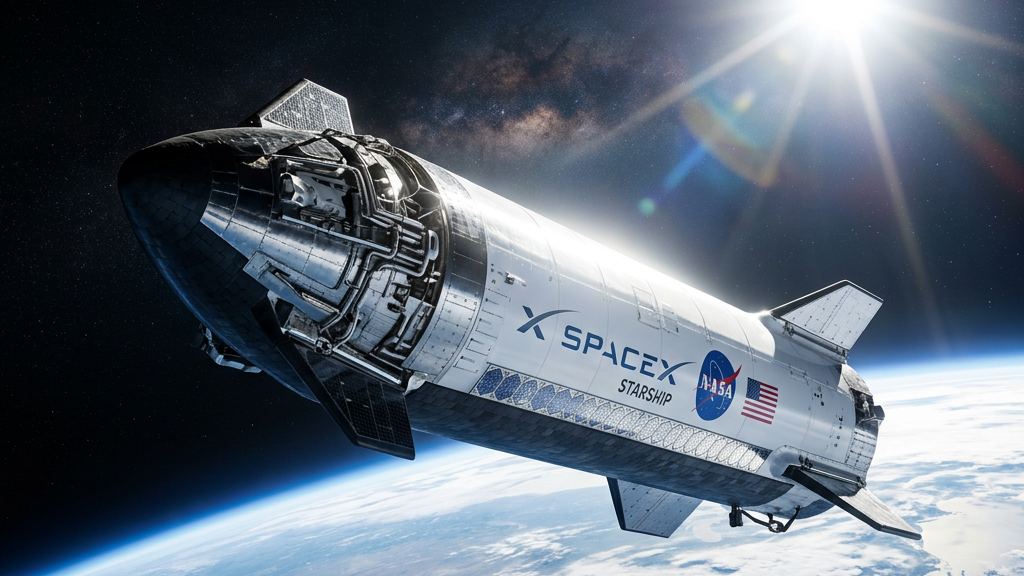
Elon Musk Just Revealed Starship V4, it’s MUCH Bigger Than Anyone Expected: SpaceX is preparing to take its ambitious Starship program to another level with the announcement of Starship V4, a significantly larger and more powerful version of its next-generation spacecraft. Following the historic achievements of Starship Flight 15, which demonstrated the successful return and launch tower catch of Ship 42, Elon Musk has revealed a new development that could reshape the future of space transportation.
Starship V4 is expected to introduce major improvements in vehicle height, propellant capacity, engine configuration, and deep-space performance. With a proposed length of approximately 70 meters and nine Raptor engines on its upper stage, the next-generation spacecraft is designed to support increasingly demanding missions to the Moon, Mars, and beyond.
The announcement highlights SpaceX’s long-term ambition to develop a fully reusable transportation system capable of making spaceflight more affordable and frequent.
Starship V4: A Much Bigger and More Powerful Spacecraft
One of the most significant changes coming with Starship V4 is its increased size. According to the video, the next-generation upper stage is expected to reach approximately 70 meters in length, compared with around 52 meters for Starship V3.
Interestingly, SpaceX is expected to maintain the vehicle’s existing 9-meter diameter rather than making the spacecraft wider. Instead, engineers are focusing on extending the tank section to create additional internal volume.
This approach could allow SpaceX to increase propellant capacity without completely redesigning the vehicle’s overall structural architecture.
More Than 60% Additional Propellant Capacity
The proposed increase in propellant capacity is particularly important. Starship V3 is described as carrying approximately 1,600 metric tons of propellant, while V4 could exceed 2,500 metric tons, depending on its final configuration.
That represents an increase of more than 60%.
More propellant could provide several important advantages:
- Greater orbital maneuvering capability for complex missions.
- Increased flexibility during long-duration space operations.
- Improved support for orbital refueling campaigns.
- More operational margin for lunar and Mars missions.
- Potentially greater payload flexibility.
For SpaceX, carrying more propellant per launch could improve mission planning and reduce the number of tanker flights required for certain objectives, although actual requirements will depend on mission profiles and orbital conditions.
Starship V4 Introduces a Nine-Engine Upper Stage
Another major upgrade involves the propulsion system. Starship V3 uses six Raptor engines on its upper stage, consisting of three sea-level engines and three vacuum-optimized engines.
Starship V4 is expected to increase that number to nine engines.
The proposed configuration includes:
- 3 sea-level Raptor engines
- 6 Raptor vacuum engines
Adding three additional vacuum engines could significantly improve the spacecraft’s propulsion capabilities during orbital operations and other spaceflight activities.
Why Vacuum Raptor Engines Matter
Vacuum-optimized Raptor engines are designed specifically for operation in the low-pressure environment of space. Their larger expansion nozzles allow exhaust gases to expand more efficiently, helping extract additional energy from the combustion process.
This makes vacuum engines particularly valuable when Starship is operating outside Earth’s atmosphere.
By doubling the number of vacuum engines from three to six, SpaceX could increase available thrust and improve propulsion flexibility during important mission phases.
The upgrade also reflects the continuing evolution of the Raptor engine family.
Raptor 4: Higher Thrust and Improved Performance
SpaceX is also working toward more powerful Raptor engines. Previous discussions have referenced a potential sea-level thrust target of approximately 300 metric tons for Raptor 4, while more recent comments have discussed even higher figures.
However, higher thrust is only one part of the engineering challenge.
SpaceX must balance engine performance with reliability, structural mass, propellant consumption, and manufacturing simplicity. A powerful engine is valuable only when it can operate consistently and support repeated flights.
Flight 15 also demonstrated why propulsion and propellant management remain important. Booster 22 aborted its attempted tower catch after an issue involving its boostback burn and a low-propellant-mass warning.
These experiences provide important engineering lessons as SpaceX develops more capable vehicles.
How Starship V4 Could Transform NASA’s Artemis Program
One of the biggest applications for Starship V4 could be supporting NASA’s Artemis lunar exploration program.
Starship has been selected as the Human Landing System for planned Artemis lunar missions. However, sending a large spacecraft toward the Moon requires substantial amounts of propellant.
SpaceX’s approach involves launching tanker versions of Starship to transfer propellant into a spacecraft waiting in Earth orbit.
This creates a complex logistical operation involving multiple launches, orbital rendezvous, and propellant transfers.
A larger Starship with greater internal propellant capacity could improve this process by increasing the amount of fuel available during each mission.
Potential benefits include:
- Greater flexibility during orbital refueling.
- Improved mission planning and propellant reserves.
- Support for larger lunar exploration objectives.
- More capable spacecraft for future deep-space missions.
However, the actual number of tanker launches will depend on vehicle performance, orbital conditions, and the final mission architecture.
Mars Missions Remain the Bigger Goal
Beyond the Moon, Starship’s ultimate objective is to support human exploration and settlement of Mars.
A Mars mission requires a spacecraft capable of carrying substantial cargo, supporting long-duration operations, and potentially returning to Earth.
The proposed V4 improvements could help SpaceX move closer to those requirements.
More propellant, additional vacuum engines, and a larger upper stage could provide the foundation for more ambitious interplanetary missions.
Lessons From NASA’s Space Shuttle Program
SpaceX’s focus on full reusability becomes easier to understand when comparing Starship with NASA’s Space Shuttle.
The Space Shuttle was one of the most recognizable spacecraft in history. It introduced a partially reusable launch system that combined a recoverable orbiter with reusable solid rocket boosters.
However, its external fuel tank was discarded during every mission.
The orbiter also required extensive maintenance after returning from space. Its thermal protection system contained thousands of heat-shield tiles that needed careful inspection and, in some cases, replacement.
Despite early expectations of dramatically reduced launch costs, the Shuttle program became an expensive transportation system.
The program completed 135 missions over more than three decades, using five operational orbiters.
Why Starship’s Reusability Strategy Is Different
SpaceX is pursuing a different approach.
Instead of recovering only selected components, the company wants to make both the Super Heavy booster and Starship upper stage fully reusable.
The ultimate objective is to launch, recover, inspect, refuel, and launch again with minimal turnaround time.
This is where the Mechazilla launch tower becomes especially important.
Its mechanical arms are designed to catch returning vehicles directly at the launch site, potentially eliminating the need for separate landing platforms or ocean recovery operations.
If SpaceX can achieve reliable and rapid recovery, it could fundamentally change the economics of orbital transportation.
Flight 15 Proved an Important Part of the Starship Vision
Starship Flight 15 represented an important milestone in SpaceX’s development program.
During the mission, Ship 42 returned from orbit and was successfully caught by the launch tower’s mechanical arms.
This demonstrated that Starship’s upper stage could complete a demanding return sequence and be recovered using the company’s innovative tower system.
The achievement was particularly important because recovering an orbital-class spacecraft is considerably more complicated than recovering a conventional aircraft or returning a capsule by parachute.
Starship must withstand extreme heating during atmospheric re-entry, maintain precise control, and perform a carefully coordinated landing maneuver.
What Still Needs to Improve?
Despite the progress, several engineering challenges remain:
- Heat-shield durability: Starship must demonstrate consistent protection during repeated atmospheric re-entries.
- Landing reliability: Both the booster and upper stage need dependable recovery procedures.
- Rapid turnaround: SpaceX must reduce inspection, maintenance, and refurbishment requirements.
- Engine reliability: Raptor engines must support increasingly frequent launches.
- Manufacturing capacity: Production facilities must build enough vehicles to support the intended launch schedule.
These improvements will determine whether Starship can eventually achieve airline-style operations.
Starbase and Star Factory: Building Ships at Industrial Scale
Developing a larger spacecraft is only one part of SpaceX’s strategy. The company also needs the manufacturing infrastructure to produce Starships at a much higher rate.
Its facilities at Starbase in Texas are central to this effort, with additional production infrastructure intended to support increasingly ambitious manufacturing targets.
The long-term vision involves moving away from the traditional aerospace production model, where individual spacecraft take years to manufacture.
Instead, SpaceX wants to produce rockets using repeatable industrial processes, advanced automation, and standardized components.
If successful, this approach could allow the company to manufacture and operate spacecraft at a frequency that would have been difficult to imagine during the early Space Shuttle era.
The Future of Starship V4: A New Era of Space Transportation
Starship V4 represents an ambitious next step in SpaceX’s long-term development strategy.
Its proposed 70-meter upper stage, more than 2,500 metric tons of propellant capacity, and nine-engine configuration could provide important improvements for lunar missions, orbital transportation, and future Mars exploration.
However, the real test will be whether these upgrades translate into dependable flight performance, successful recovery, and rapid reuse.
Flight 15 demonstrated what might be possible when an orbital spacecraft returns directly to its launch tower. Starship V4 aims to build on that progress with greater capacity and more powerful propulsion.
If SpaceX can successfully combine these improvements with high-volume manufacturing, reliable heat-shield technology, and frequent launches, Starship could become a major part of humanity’s future space infrastructure.
The journey toward fully reusable space transportation is far from complete, but Starship V4 could represent one of the most important steps toward making routine travel beyond Earth a reality.
FAQs
1. What is SpaceX Starship V4?
SpaceX Starship V4 is the proposed next-generation version of the Starship spacecraft, featuring a taller upper stage, increased propellant capacity, and an upgraded nine-engine configuration designed to improve deep-space capabilities.
2. How tall will Starship V4 be?
According to the information presented in the video, Starship V4 is expected to reach approximately 70 meters in length, compared with around 52 meters for Starship V3.
3. Will Starship V4 be wider than Starship V3?
No major increase in diameter is currently described. Starship V4 is expected to retain its 9-meter diameter, with additional internal volume coming primarily from an extended tank section.
4. How much propellant can Starship V4 carry?
Starship V4 could carry more than 2,500 metric tons of propellant, representing an increase of over 60% compared with the approximately 1,600 metric tons attributed to Starship V3.
5. How many engines will Starship V4 have?
Starship V4 is expected to feature nine Raptor engines on its upper stage, consisting of three sea-level engines and six vacuum-optimized engines.
6. Why is SpaceX adding more Raptor vacuum engines to Starship V4?
Additional vacuum engines could provide greater thrust and improve propulsion efficiency during orbital operations and other spaceflight activities where conventional atmospheric pressure is absent.
7. What is the difference between Raptor 3 and Raptor 4?
Raptor 4 is expected to introduce higher thrust and further performance improvements over earlier Raptor generations. SpaceX’s development goals include improving engine capability while maintaining reliability and manufacturing efficiency.
8. How will Starship V4 help NASA’s Artemis program?
Starship V4’s proposed larger propellant capacity could support NASA’s Artemis lunar missions by providing additional flexibility for orbital refueling, lunar transportation, and deep-space operations.
9. Why does Starship need orbital refueling?
Starship requires substantial amounts of propellant for certain lunar and deep-space missions. Orbital refueling allows multiple tanker spacecraft to transfer propellant to a Starship waiting in Earth orbit before it begins its journey.
10. Can Starship V4 help SpaceX reach Mars?
Yes. Its proposed improvements in propellant capacity, propulsion, and spacecraft volume could support SpaceX’s long-term goal of transporting cargo and eventually humans to Mars.
11. What happened during SpaceX Starship Flight 15?
During Flight 15, Ship 42 successfully returned from orbit and was caught by the Mechazilla launch tower’s mechanical arms, demonstrating an important milestone in SpaceX’s spacecraft recovery technology.
12. What is the Mechazilla tower catch system?
Mechazilla is SpaceX’s launch tower recovery system, which uses large mechanical arms to catch returning Starship vehicles and Super Heavy boosters, potentially reducing the need for separate landing and recovery operations.
13. How is Starship different from NASA’s Space Shuttle?
The Space Shuttle used a partially reusable architecture that discarded its external fuel tank after each flight and required extensive orbiter refurbishment. Starship is designed for full reusability, including recovery of both its booster and upper stage.
14. What are the biggest challenges facing Starship V4?
Major challenges include heat-shield durability, engine reliability, propellant management, successful landing operations, rapid refurbishment, and large-scale manufacturing. SpaceX must address these areas before achieving routine reusable flights.
15. Where is SpaceX manufacturing Starship vehicles?
SpaceX’s primary Starship development and manufacturing operations are based at Starbase in Texas. The company is working to expand production capabilities and improve manufacturing speed through industrial-scale processes.
16. When could Starship V4 begin flying?
The exact operational debut date for Starship V4 has not been firmly established in the information provided. Its introduction will depend on engineering development, manufacturing readiness, testing, and SpaceX’s overall flight schedule.
Read More:
- Elon Musk’s World’s First 1000GW Solar Factory SHOCKED Energy Industry
- Tesla Full Self-Driving v15 gets release date from Elon Musk
- 2027 Model 2 The Truth Behind Tesla’s $25,000 EV
- 2027 Tesla Pi Phone $799 Finally Hit The Market, Elon Musk SHOCKED Apple
- There’s a Crazy Plan in Starship Flight 16 – The Whole Industry Needs It
2 thoughts on “Elon Musk Just Revealed Starship V4, it’s MUCH Bigger Than Anyone Expected”