
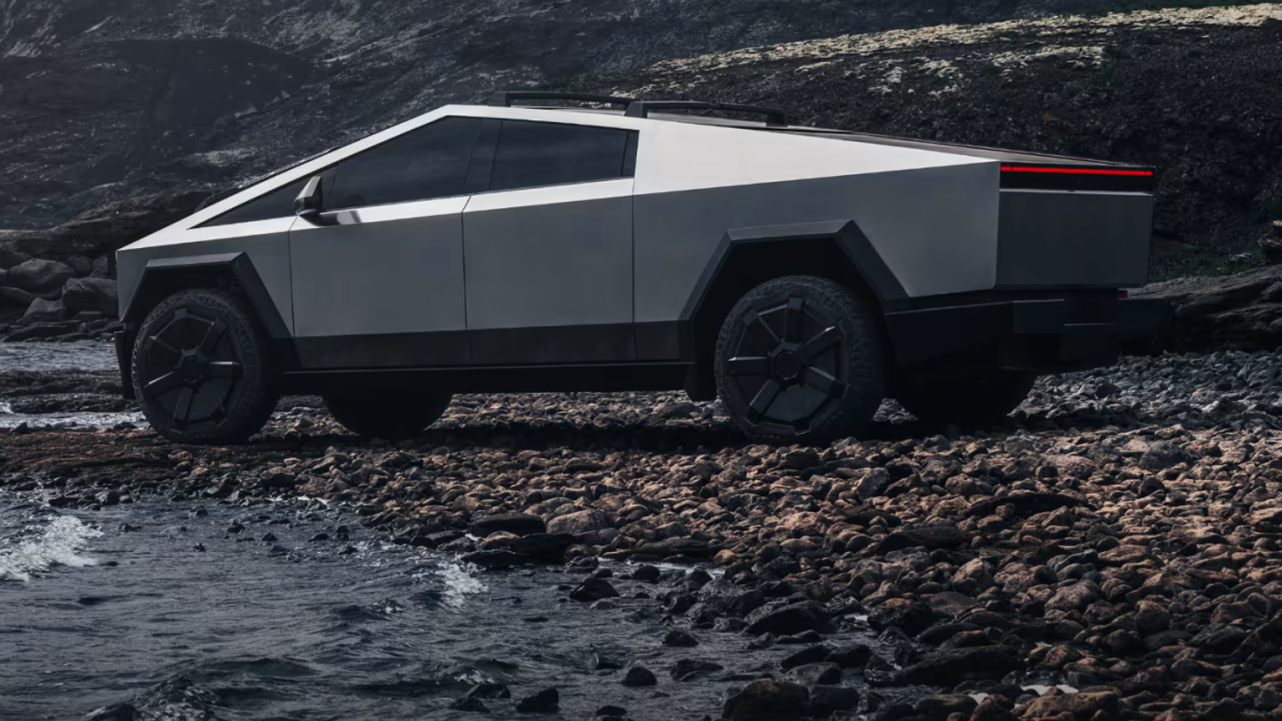
The Tesla Cybertruck has never been just another pickup truck. From the moment it was unveiled, it challenged everything the automotive world believed about design, engineering, and manufacturing. Now, more than two years after the first deliveries began in late 2023, Tesla has quietly entered the 2026 model year, and the industry is buzzing with leaks, rumors, and confirmed upgrades that could completely redefine the Cybertruck’s future.
Despite a challenging 2025 marked by declining sales, recalls, and consumer skepticism, Tesla appears confident that 2026 will mark a major turning point. With Full Self-Driving (FSD) version 14, dramatically improved charging times, next-generation 4680 battery variants, and even whispers of a compact Cybertruck, the company is preparing what many believe will be its most aggressive comeback yet.
In this deep-dive, we’ll explore what truly sets the 2026 Tesla Cybertruck apart, why Tesla believes it can ignite a new wave of demand, and how engineering beneath the surface may ultimately silence critics.
The Cybertruck’s Rocky Road: From Breakout Star to Market Slowdown
When Tesla began full-scale Cybertruck deliveries in 2024, the vehicle quickly became the best-selling electric pickup truck in the United States, with 38,965 units sold in its first full year. Expectations were sky-high. Elon Musk famously projected annual sales of up to 250,000 units.
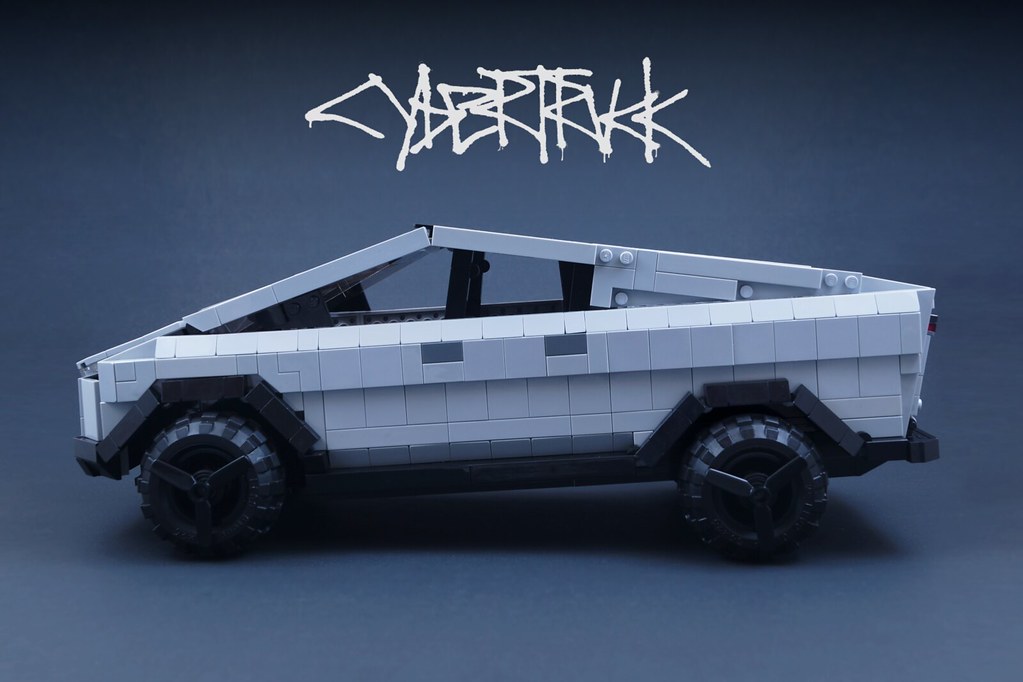
However, reality proved harsher.
2025 Sales Decline Explained
By the end of 2025, Tesla is estimated to have sold only 17,000–19,000 Cybertrucks, even after including fourth-quarter deliveries. In the first quarter of 2025, the Cybertruck lost its top EV pickup crown to the Ford F-150 Lightning, signaling a significant shift in consumer sentiment.
Several factors contributed to this slowdown:
- High pricing, starting near $80,000
- Polarizing exterior design
- Quality and safety concerns
- Multiple recall campaigns
The data suggests that the Cybertruck, once seen as a must-have product, temporarily drifted into niche territory within the electric pickup segment.
Quality Concerns and Recalls: A Blow to Consumer Confidence
As of October 2025, the Cybertruck had undergone more than 10 separate recall campaigns, ranging from moderate issues to serious safety concerns.
The Most Serious Recall: Cantrail Detachment
The most notable defect involved the cantrail, a decorative metal trim above the windshield that could lose adhesion and detach while driving. This issue affected approximately 46,960 vehicles and generated around 150 customer complaints.
While Tesla stated that no accidents had been reported, the recall fueled negative press and heightened consumer anxiety.
Other Reported Issues Included:
- Inverter failures causing sudden power loss
- Tire pressure monitoring system malfunctions
- Off-road lights detaching
- Underperforming windshield wipers
- Accelerator pedal sticking risks
Although not all were classified as high severity, the sheer frequency of recalls eroded trust and slowed adoption.
Why 2026 Could Be the Cybertruck’s Redemption Year
Despite its struggles, Tesla has not backed down. Instead, it has doubled down on innovation, manufacturing efficiency, and long-term strategy.
Full Self-Driving (FSD) Version 14: A Game Changer
In key markets like South Korea and China, the Cybertruck has already received FSD Version 14, a system considered comparable to Tesla’s RoboTaxi autonomy platform.
This upgrade positions the Cybertruck as:
- A future-ready autonomous vehicle
- A potential commercial fleet asset
- A long-term investment rather than a novelty
For many buyers, advanced autonomy could outweigh design controversies entirely.
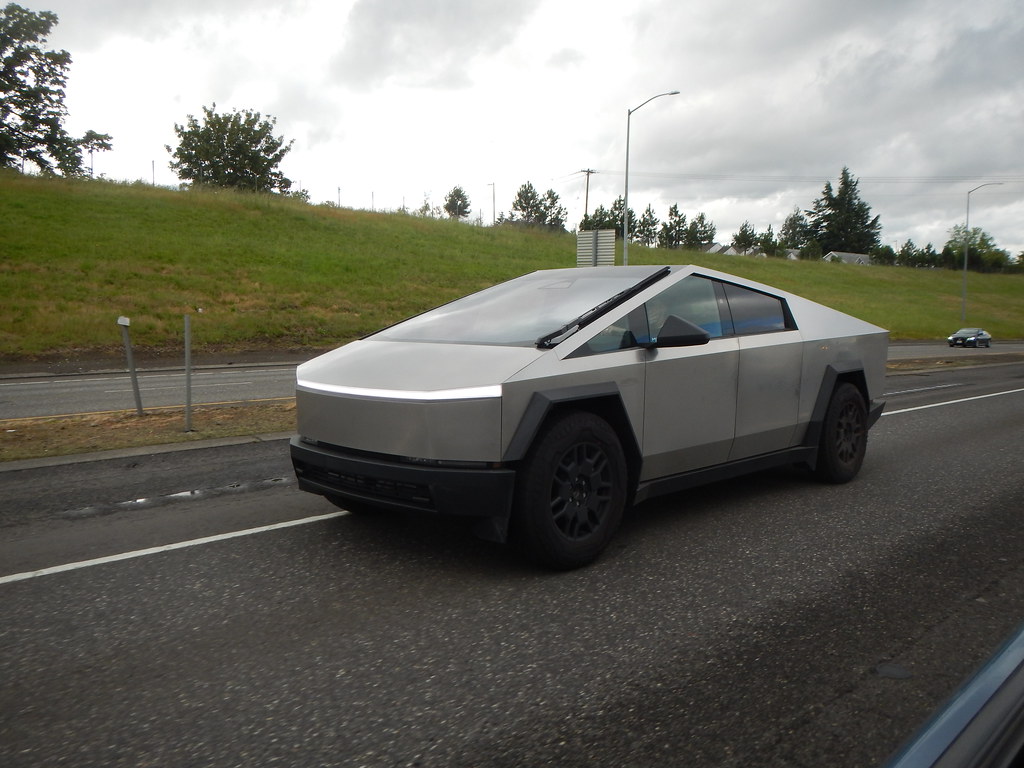
Cybertruck Pricing: From Luxury to Mass Market?
Pricing has always been one of the biggest barriers to Cybertruck adoption.
Current Pricing (2025):
- Rear-Wheel Drive: ~$79,999
- Extended Range: ~$88,000
- Cyberbeast (0–60 mph in 2.6s): ~$100,000
According to Doug DeMuro, founder of Cars & Bids, a major price correction is already underway.
“Cybertrucks are rapidly approaching the $50,000 mark and could hit $35,000 within the next 18 months.”
This depreciation trend mirrors vehicles like the Hummer EV and Rivian R1T, but appears even steeper for the Cybertruck—good news for consumers.
Manufacturing Breakthroughs at Gigafactory Texas
One of the most underappreciated Cybertruck stories is Tesla’s manufacturing revolution.
Next-Generation Giga Casting Technology
By late 2025, Tesla overhauled its entire Giga casting process, rather than making incremental tweaks.
Key Improvements:
- Rear structure reduced from ~80 parts to a single integrated casting
- Integrated suspension and wiring mounting points
- 15–20% faster Giga Press cycle times
- Dramatically fewer alignment and finishing defects
Drone footage from November 2025 showed record numbers of finished cast frames, confirming a major increase in throughput.
These improvements laid the foundation for stabilized deliveries in Q3 and Q4 2025.
Cybertruck Global Expansion: Europe and China in Sight
After clearing much of its U.S. backlog, Tesla expanded Cybertruck deliveries to Mexico and Canada by late 2024.
By early 2026, prototype Cybertrucks were spotted undergoing regulatory and safety testing in Europe and China, signaling serious international ambitions.
Global markets could be the next growth engine, especially as prices decline and autonomy improves.
The Exoskeleton: Engineering the World’s Toughest Pickup
While critics focus on appearance, the Cybertruck’s real magic lies beneath the surface.
World’s Largest One-Piece Door-Ring Structure
- Constructed from high-strength boron steel
- Inner and outer frames welded into a single rigid B-pillar
- Exceptional crash resistance and torsional rigidity
Massive Giga Castings
- Front casting: 6,500-ton press
- Rear casting: 9,000-ton press
- 5,000 castings per day across four machines
These castings are nickel-plated for enhanced corrosion resistance, oxidation resistance, and heat tolerance.
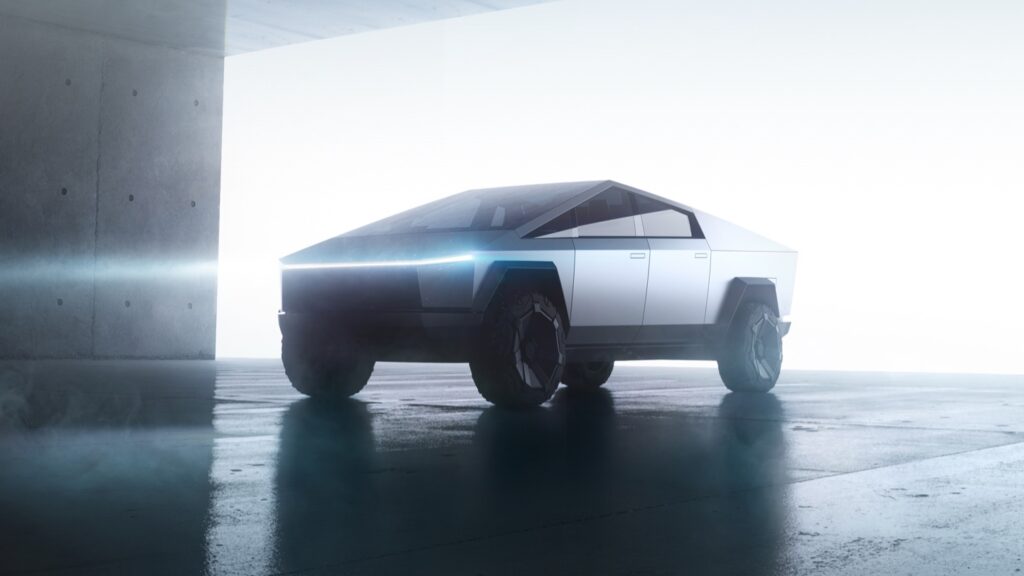
Performance, Capability, and Safety
The Cybertruck isn’t just futuristic—it’s brutally capable.
- Payload capacity: Up to 2,500 lb
- Towing capacity: Up to 11,000 lb
- Impact absorption: Designed to handle rear-end collisions at ~50 mph
In severe crashes, the front underbody casting fractures intentionally, dispersing energy to protect occupants—though this does raise repair costs.
800V Architecture, Bidirectional Charging, and Steer-by-Wire
Electrical Excellence
- 800V architecture with dual 400V pack splitting
- 43-minute Supercharger charging times
- Bidirectional power output up to 11.5 kW
- Can power an average home for three days
Steer-by-Wire + Rear-Wheel Steering
- Dual redundant 48V electric motors
- Vehicle remains controllable even if one system fails
- 10° rear-wheel steering angle
- Turning radius: just 17.5 ft, compared to ~23 ft for traditional pickups
48V Architecture: The Hidden Efficiency Revolution
Tesla’s shift from 12V to 48V systems delivers massive benefits:
- 75% reduction in electrical current
- 68% less wiring length
- 84% reduction in high-power cable mass
- Gigabit-speed Ethernet replacing traditional wiring
This architecture enables new accessories like winches, air compressors, and advanced lighting—creating new revenue streams for Tesla.
The 4680 Battery Strategy That Shocked the Industry
The 4680 battery is Tesla’s boldest bet yet—and 2026 may finally unlock its potential.
Why Four 4680 Battery Variants Matter
Tesla is expected to launch four distinct 4680 cells in early 2026:
NC05 – The Workhorse
- Designed for RoboTaxi fleets and Tesla Semi
- Prioritizes durability and lifecycle
- Target: 1 million miles
NC20 – The Cybertruck Upgrade
- Higher energy density
- Targets 400+ mile range
- Optimized for Cybertruck and future SUVs
NC30 & NC50 – The Cost Killers
- Silicon-carbon anodes
- Dramatically lower production costs
- Key to mass-market affordability
These variants address yield challenges, scrap losses, and scalability, positioning Tesla to produce millions of EVs annually by 2026.
So, Is the Cybertruck a Failure—or a Sleeping Giant?
The Cybertruck’s struggles in 2025 raise a fair question:
Did Tesla misread American truck buyers—or is this simply the calm before a comeback?
With:
- FSD-level autonomy
- Massive price corrections
- Breakthrough manufacturing
- Next-gen batteries
- Global expansion underway
All signs point to 2026 being a pivotal year.
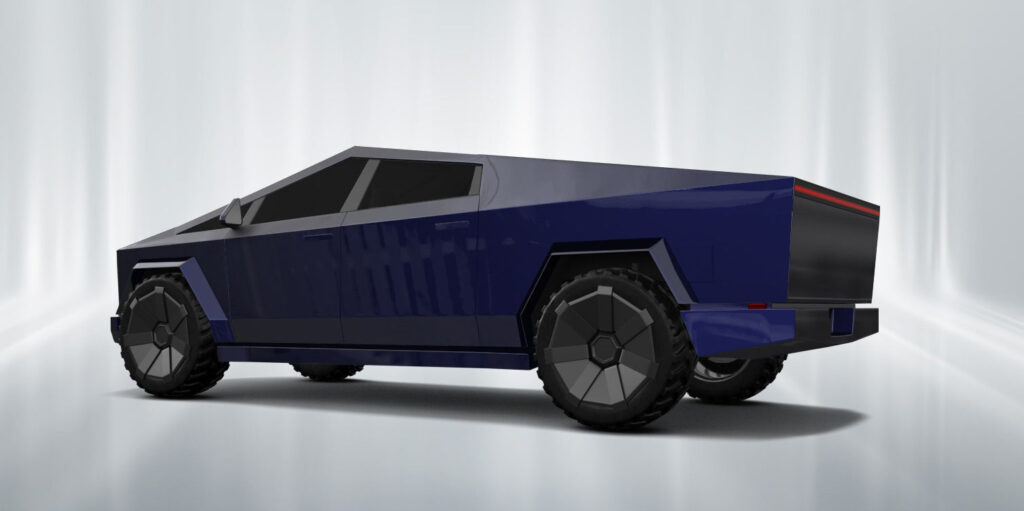
Final Thoughts: Why 2026 Could Redefine the Cybertruck Legacy
The 2026 Tesla Cybertruck is no longer just about bold design. It’s about engineering excellence, manufacturing mastery, and strategic patience. While early adopters faced challenges, the next wave of buyers may enjoy better quality, lower prices, longer range, and true autonomy.
If Tesla executes its plan, the Cybertruck could evolve from a controversial experiment into one of the most important electric vehicles of the decade.
FAQs
1. What is new in the 2026 Tesla Cybertruck?
The 2026 Tesla Cybertruck introduces major upgrades, including Full Self-Driving (FSD) Version 14, faster Supercharger charging (around 43 minutes), improved manufacturing quality, enhanced Giga casting structures, and the upcoming next-generation 4680 battery variants designed for better range, durability, and cost efficiency.
2. Will Tesla release a compact Cybertruck in 2026?
Industry rumors suggest Tesla may introduce a compact Cybertruck variant as early as 2026. While not officially confirmed, internal discussions and leaked imagery point toward a smaller, more affordable electric pickup targeting urban and international markets.
3. Why did Cybertruck sales decline in 2025?
Cybertruck sales declined due to high pricing, multiple recalls, quality concerns, and strong competition from rivals like the Ford F-150 Lightning. Consumer hesitation grew as the model shifted from a mass-market expectation to a more niche product in 2025.
4. What is Full Self-Driving (FSD) Version 14 on the Cybertruck?
FSD Version 14 is Tesla’s most advanced autonomous driving system, already deployed in markets like China and South Korea. It offers near-RoboTaxi-level autonomy and is expected to play a major role in boosting Cybertruck demand in 2026.
5. How fast does the Cybertruck charge at Tesla Superchargers?
The 2026 Cybertruck can charge from low battery to near full in approximately 43 minutes at Tesla Supercharger stations, thanks to its 800V electrical architecture.
6. What is the driving range of the 2026 Cybertruck?
Current Cybertruck variants offer around 320–340 miles of range, but upcoming NC20 4680 battery cells are expected to push future models beyond 400 miles on a single charge.
7. What are the different 4680 battery variants Tesla is developing?
Tesla plans to release four 4680 battery variants:
- NC05 – High durability for RoboTaxi fleets and Tesla Semi
- NC20 – Higher energy density for Cybertruck and SUVs
- NC30 & NC50 – Lower-cost cells using silicon-carbon anodes
8. Why is the 4680 battery so important to Tesla?
The 4680 battery enables lower production costs, longer range, and structural battery integration, making it central to Tesla’s long-term strategy for affordable, high-volume EV production in the U.S.
9. How much will the Cybertruck cost in 2026?
While current pricing ranges from $79,999 to $100,000, analysts like Doug DeMuro predict the Cybertruck could drop to around $35,000–$50,000 within the next 18 months due to market depreciation and cost reductions.
10. What recall issues has the Cybertruck faced?
The Cybertruck has experienced over 10 recalls, including issues with cantrail trim detachment, inverter failures, accelerator pedal concerns, TPMS malfunctions, and detaching off-road lights. Tesla has addressed these issues through software updates and hardware fixes.
11. Is the Cybertruck safe despite its recalls?
Yes. Despite recalls, the Cybertruck features an extremely rigid exoskeleton, energy-dissipating Giga castings, and advanced safety systems. Tesla reports no accidents linked to the most serious recall issues.
12. What makes the Cybertruck’s exoskeleton unique?
Unlike traditional body-on-frame trucks, the Cybertruck uses a stainless-steel exoskeleton that serves as the primary load-bearing structure, delivering exceptional durability and off-road strength.
13. How capable is the Cybertruck for towing and hauling?
The Cybertruck supports up to 11,000 lb of towing capacity and 2,500 lb of payload, making it competitive with full-size gas-powered pickup trucks.
14. What is steer-by-wire and rear-wheel steering on the Cybertruck?
The Cybertruck features steer-by-wire technology with redundant 48V motors and rear-wheel steering with up to 10° of angle, reducing the turning radius to just 17.5 feet.
15. Can the Cybertruck power a house?
Yes. With bidirectional charging up to 11.5 kW, the Cybertruck can power an average home for approximately three days during a power outage when paired with proper equipment.
16. Will the Cybertruck be sold internationally?
Yes. Tesla has begun testing Cybertruck prototypes for European and Chinese regulatory approval, with international deliveries expected to expand starting in 2026.
17. Is the Cybertruck expected to make a comeback in 2026?
Many analysts believe 2026 will be a comeback year for the Cybertruck, driven by lower prices, advanced autonomy, better batteries, and improved manufacturing quality, potentially transforming it from a niche vehicle into a mainstream electric pickup.
Read More:
- Starship Flight 12 launch Date So Close after Pad-2 almost Completed…Sooner Than We Thought
- Tesla AI Head says future FSD feature has already partially shipped
- Elon Musk’s xAI bets $20B on Mississippi with 2GW AI data center project
- Tesla Model Y Standard Long Range RWD launches in Europe
- Tesla Model 3 becomes Netherlands’ best-selling used EV in 2025
- Elon Musk’s Grokipedia surges to 5.6M articles, almost 79% of English Wikipedia
2 thoughts on “Elon Musk LEAKED 2026 Tesla Cybertruck FSD NEW Update! 4680 Battery Power SHOCKED Industry”