
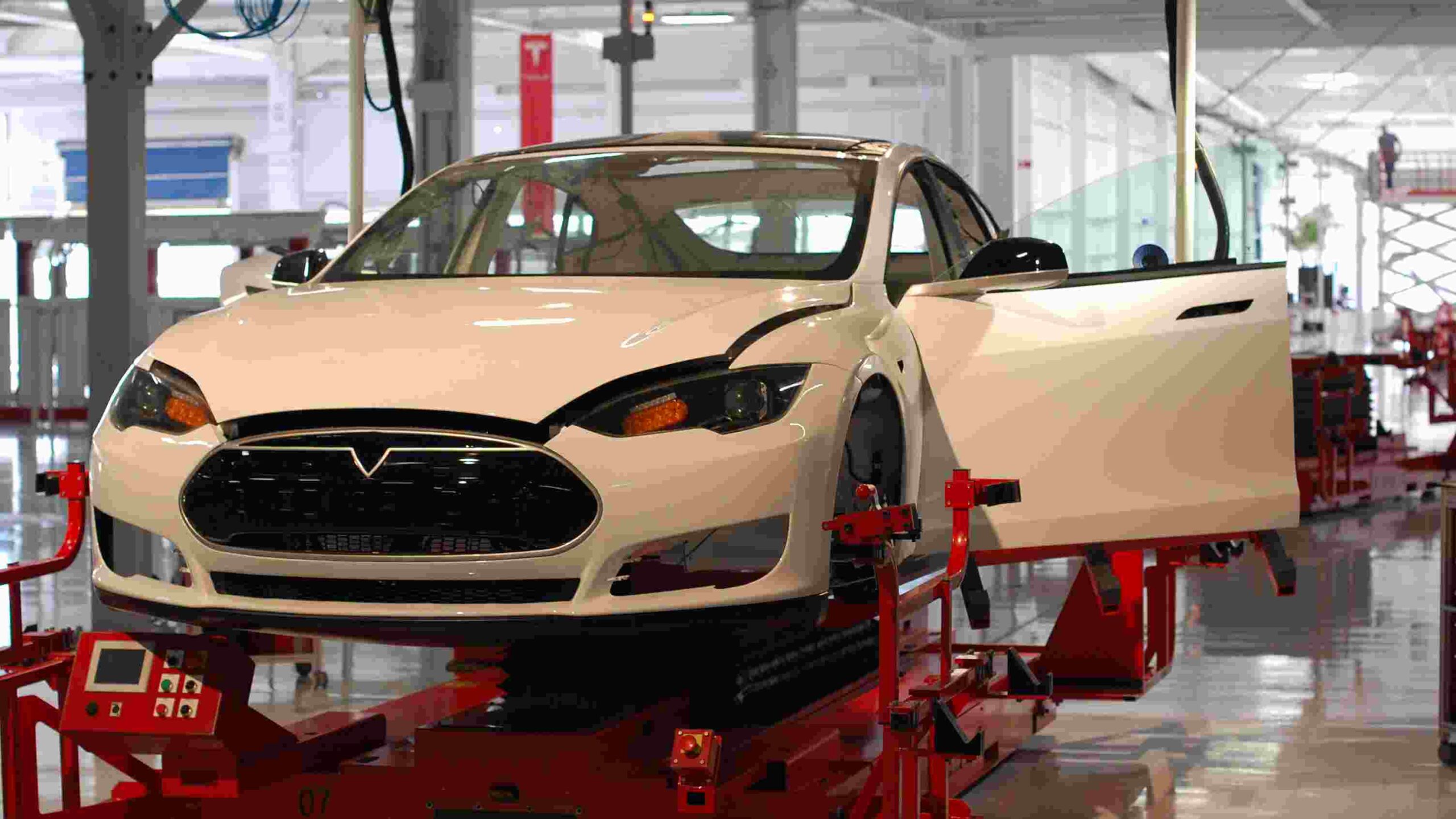
Tesla Giga Press 4.0 Upgrade! Cybercab Casting Progress BIG Changes: The global automotive industry is entering a revolutionary new era where manufacturing efficiency, factory architecture, and production speed are becoming more important than ever before. While most automakers are focused on improving battery technology or software systems, Tesla is aggressively transforming the way vehicles are physically built.
With the launch of the Tesla Gigapress 4.0, the company is introducing one of the biggest manufacturing innovations in modern automotive history. This new system goes far beyond simple die-casting upgrades. It fundamentally changes how electric vehicles are assembled, reducing production complexity, cutting factory size, and dramatically lowering manufacturing costs.
At the center of this transformation is Tesla’s ambitious goal to create the ultimate “unboxed” manufacturing process, which could reduce vehicle production costs by nearly 50% while enabling mass production of future vehicles like the Tesla Cybercab, affordable compact EVs, and autonomous transport platforms.
In this article, we’ll explore how the Gigapress 4.0 upgrade works, why it is so important, and how it could permanently reshape the future of the automotive industry.
The Evolution of Tesla Gigacasting Technology
Tesla first shocked the automotive world with the introduction of its original Gigapress 1.0 technology. This system allowed Tesla to replace dozens of individual metal parts with a single massive aluminum casting.
For example, the Tesla Model Y rear underbody eliminated nearly 70 separate components and replaced them with one giant cast structure. This dramatically simplified manufacturing and reduced assembly line complexity.
However, despite its groundbreaking success, the original Gigapress system faced major engineering limitations.
The Biggest Problem With Gigapress 1.0
Traditional die-casting systems operate using a linear injection and ejection process. Molten aluminum is injected into a steel mold under enormous hydraulic pressure. Once the metal cools and solidifies, the mold opens in a straight line, and the finished part is removed.
While effective, this process creates a huge limitation:
- It can only produce open-faced structures
- It cannot manufacture fully enclosed hollow sections
- Complex multi-directional geometries become impossible
This issue became known as the “trapped-core problem.”
Why Hollow Structures Matter in Vehicle Engineering
In structural engineering, hollow box sections provide one of the best combinations of:
- High strength
- Low weight
- Maximum torsional rigidity
This is why industries such as aerospace and Formula racing heavily rely on hollow tubular structures.
Aircraft fuselages, racing car chassis, and advanced engineering systems use hollow designs because they deliver superior stiffness without excessive material weight.
Unfortunately, traditional die-casting technology could not create these hollow chambers efficiently.
The Engineering Paradox
To create a hollow internal cavity, manufacturers would normally place a solid steel core inside the mold. However, after the aluminum hardens around the core, the steel becomes permanently trapped inside the casting.
This makes the entire component unusable.
Because of this limitation, many automakers believed that megacasting technology had already reached its physical limit.
Tesla disagreed.
Inside Tesla Gigapress 4.0 Technology
The Tesla Gigapress 4.0 upgrade introduces a revolutionary solution using 3D-printed sand cores combined with advanced die-casting technology.
This hybrid manufacturing method allows Tesla to create giant hollow aluminum structures that were previously impossible to manufacture.
How the New System Works
The process begins with highly specialized industrial 3D printers.
Using a method called binder jetting, Tesla creates temporary sand cores made from:
- Specialized foundry sand
- Liquid chemical binders
- Precision additive manufacturing
These sand structures are inserted directly into the casting die before molten aluminum is injected.
Step-by-Step Casting Process
Step 1: Sand Core Placement
The 3D-printed sand cores are carefully positioned inside the mold cavity.
These cores define the future hollow internal sections of the casting.
Step 2: Molten Aluminum Injection
Superheated aluminum floods the mold under extreme pressure.
The liquid metal flows completely around the sand cores and fills every section of the mold.
Step 3: Solidification
The aluminum rapidly cools and hardens, creating a strong outer shell around the temporary sand structures.
Step 4: Mechanical Vibration Removal
After casting, the component moves to a specialized post-processing station.
There, powerful high-frequency vibrations break apart the chemical binders holding the sand together.
The internal sand instantly collapses into loose particles and exits through engineered drainage holes.
The final result is a single-piece hollow structural casting with incredible strength and reduced weight.
Biomimicry: Tesla’s Bird Bone Engineering Inspiration
One fascinating aspect of Gigapress 4.0 is its use of biomimicry.
Tesla’s hollow casting architecture closely resembles the structure of avian bones.
Bird bones are:
- Extremely lightweight
- Highly rigid
- Internally hollow
- Optimized for strength-to-weight efficiency
Tesla is essentially applying the same biological principles to automotive engineering.
Massive Weight Reduction Benefits
Using this technology, Tesla can reduce component weight dramatically.
For example:
- Traditional cast structure: around 60 kilograms
- Hollow-box cast structure: below 40 kilograms
This weight reduction improves:
- Vehicle efficiency
- Battery range
- Performance
- Structural rigidity
- Crash safety
The combination of lower mass and higher stiffness is a major breakthrough for EV engineering.
Faster Vehicle Development Cycles
Another huge advantage of Gigapress 4.0 is its flexibility.
Traditional automotive tooling can take:
- 12 months or longer for validation and redesign
With 3D-printed sand cores, Tesla can rapidly produce new geometries and test different structures much faster.
This cuts development cycles down to:
- 2 to 3 months
That level of speed gives Tesla a massive competitive advantage over traditional automakers.
Tesla’s “Unboxed” Manufacturing Revolution
The real purpose of Gigapress 4.0 is not just lighter castings.
It is designed to enable Tesla’s radical new Unboxed Manufacturing Process.
This system completely reimagines how cars are assembled.
The Problem With Traditional Car Factories
For over 100 years, automakers have followed the same manufacturing philosophy.
First, manufacturers create a large hollow shell called the:
Body in White (BiW)
This metal skeleton then moves down a production line where workers and robots must:
- Install wiring
- Mount seats
- Attach dashboards
- Fit carpets
- Route cooling systems
The problem is that workers must operate inside a cramped enclosed cabin.
This creates:
- Slow assembly speeds
- Higher labor costs
- Increased manufacturing errors
- Larger factory footprints
Traditional production lines are highly inefficient.
How Tesla’s Unboxed Process Works
Tesla eliminates the traditional vehicle shell entirely.
Instead of building a car from the inside out, Tesla manufactures independent modules separately.
Modular Production Structure
The vehicle is split into multiple sub-assemblies:
Front Underbody Module
This section includes:
- Suspension systems
- Cooling components
- Front structural elements
Rear Hollow-Box Module
Produced using Gigapress 4.0, this giant casting contains:
- Rear drive systems
- Suspension mounting points
- Structural reinforcement
Structural Battery Platform
The center section remains completely open during assembly.
This allows robotic systems to install:
- Seats
- Carpets
- Interior modules
- Consoles
with unrestricted access.
The Benefits of Parallel Assembly
Because modules are built independently, Tesla can run multiple assembly operations simultaneously.
This creates several huge advantages:
Faster Production Speeds
Parallel manufacturing significantly improves factory throughput.
Smaller Factories
Tesla estimates the new process could reduce factory footprint size by:
- 40%
Lower Manufacturing Costs
Tesla expects overall production costs to drop by:
- 50%
Fewer Robots and Welds
Gigapress 4.0 eliminates:
- Hundreds of stamped parts
- Thousands of spot welds
- Numerous inspection stages
- Massive welding robot systems
The manufacturing line becomes dramatically simpler.
Cybercab: The First Major Test Platform
Although much attention is focused on the upcoming Tesla Cybercab, industry experts believe the vehicle is actually serving as a pilot program for Tesla’s future manufacturing architecture.
The Cybercab is expected to validate:
- Hollow-box casting systems
- Unboxed manufacturing
- High-speed modular assembly
- Low-cost autonomous production
Once proven successful, Tesla can scale the same methods across multiple future vehicle platforms.
Tesla Model 2 and Affordable EV Production
One of the biggest beneficiaries of Gigapress 4.0 could be Tesla’s rumored affordable compact EV, often referred to as the:
Tesla Model 2
The biggest challenge facing automakers today is profitability in low-cost EVs.
Why Cheap EVs Are Difficult to Build
Battery packs alone account for:
- 30% to 40% of total vehicle costs
At the same time, traditional manufacturing systems require:
- Large labor forces
- Complex supply chains
- Extensive welding operations
- Hundreds of structural parts
This destroys profit margins on affordable vehicles.
Tesla’s Strategy: Extreme Simplicity
Tesla’s manufacturing philosophy is simple:
Remove Complexity Everywhere
By simplifying the production process, Tesla aims to produce profitable EVs at prices competitors cannot match.
Gigapress 4.0 supports this strategy by eliminating:
- Secondary welding operations
- Large supplier networks
- Excessive part counts
- Redundant production stages
This could allow Tesla to profitably produce a vehicle priced near:
- $25,000
If successful, it would create enormous pressure on competitors like:
- Ford
- General Motors
- Volkswagen
- BYD
Future Applications Beyond Passenger Cars
The long-term impact of hollow-box casting goes far beyond compact sedans.
Tesla’s new manufacturing architecture could redefine larger vehicle categories as well.
Autonomous Shuttles and Minivans
Large autonomous vehicles typically suffer from severe chassis flex due to their long wheelbases.
Traditional solutions require:
- Heavy reinforcement beams
- Thick steel floor structures
- Additional weld points
These increase:
- Weight
- Cost
- Energy consumption
Hollow Structural Chambers Solve This Problem
Gigapress 4.0 enables giant enclosed structural chambers that behave similarly to aircraft fuselages.
Benefits include:
- Higher torsional rigidity
- Improved crash protection
- Reduced mass
- Increased cabin space
This could become critical for future autonomous transportation systems.
Rugged SUVs and Off-Road Vehicles
Off-road vehicles require strong suspension mounting points and reinforced structures.
Traditional body-on-frame designs are durable but extremely heavy.
Tesla’s hollow-box structures can provide:
- Localized reinforcement
- Superior rigidity
- Reduced overall mass
This is especially important for electric SUVs where excess weight directly impacts driving range.
The Real Competitive Battlefield Has Changed
Most legacy automakers are currently focused on:
- Battery chemistry
- Software systems
- Autonomous driving
- Range improvements
Tesla appears to be focusing on something entirely different:
Factory Architecture
According to Elon Musk, the true competitive advantage is:
“The machine that builds the machine.”
Gigapress 4.0 perfectly represents this philosophy.
Tesla is no longer simply optimizing vehicles.
It is optimizing the entire industrial production ecosystem.
Why Competitors May Struggle to Catch Up
Replicating a software feature is difficult.
Replicating an entirely new manufacturing architecture is vastly harder.
Tesla’s advantages include:
- Integrated factory design
- Custom casting technology
- Proprietary manufacturing methods
- Rapid design iteration
- Simplified supply chains
Legacy manufacturers remain deeply tied to traditional assembly line structures developed over decades.
Completely redesigning these systems would require:
- Massive capital investments
- Factory reconstruction
- Supply chain restructuring
- Workforce retraining
This makes Tesla’s lead potentially very difficult to close.
The Future of Automotive Manufacturing
The Tesla Gigapress 4.0 upgrade may ultimately become one of the most important industrial breakthroughs of the electric vehicle era.
By combining:
- 3D-printed sand cores
- Hollow-box casting
- Modular assembly
- Unboxed manufacturing
Tesla is attempting to fundamentally rewrite the rules of automotive production.
The company’s vision goes beyond making better cars.
It aims to build:
- Smaller factories
- Faster production lines
- Lower-cost EVs
- Highly scalable autonomous platforms
Most importantly, Tesla is trying to achieve all of this while reducing manufacturing complexity at an unprecedented scale.
Final Thoughts
Tesla’s Gigapress 4.0 system is not simply a casting machine upgrade.
It represents a complete transformation in how vehicles may be engineered and manufactured in the future.
The integration of 3D-printed sand-core technology, hollow structural architecture, and modular production systems could allow Tesla to dominate the next phase of automotive manufacturing.
If Tesla successfully scales this system across future products like the Cybercab, Model 2, autonomous shuttles, and next-generation SUVs, the competitive landscape of the global EV market could change permanently.
The biggest challenge for rivals may no longer be matching Tesla’s batteries or software.
Instead, the true battle could be against a manufacturing ecosystem optimized around speed, simplicity, and industrial efficiency unlike anything the automotive world has ever seen.
FAQs
1. What is Tesla Gigapress 4.0?
Tesla Gigapress 4.0 is an advanced mega casting manufacturing system designed to produce large hollow aluminum vehicle structures using 3D-printed sand cores and high-pressure die casting technology.
2. How is Gigapress 4.0 different from Gigapress 1.0?
Gigapress 1.0 could only create open-faced castings using traditional linear molds, while Gigapress 4.0 can manufacture complex hollow-box structures with improved rigidity and lower weight.
3. What is the purpose of Tesla’s hollow-box casting technology?
The purpose is to create stronger and lighter vehicle structures that improve:
- Vehicle rigidity
- Battery efficiency
- Crash safety
- Production speed
- Manufacturing cost reduction
4. What are 3D-printed sand cores?
3D-printed sand cores are temporary internal molds created using binder jetting technology. These sand structures help form hollow sections inside aluminum castings.
5. How does Tesla remove the sand from the casting?
Tesla uses high-frequency mechanical vibrations to break apart the sand binders. The loose sand then exits through specially engineered drainage holes.
6. What is Tesla’s “Unboxed” manufacturing process?
The Unboxed Process is Tesla’s new modular production system where vehicle sections are built separately and merged at the final assembly stage instead of using a traditional single body shell.
7. Why is the unboxed process important?
This process improves:
- Factory efficiency
- Production speed
- Robot accessibility
- Assembly accuracy
- Manufacturing scalability
It also significantly reduces factory size and production costs.
8. How much can Tesla reduce production costs with Gigapress 4.0?
Tesla aims to reduce overall vehicle manufacturing costs by nearly 50% using modular assembly and advanced hollow-box casting techniques.
9. Which Tesla vehicle will use Gigapress 4.0 first?
Industry experts believe the upcoming Tesla Cybercab will be the first major production platform using the new manufacturing architecture.
10. Will the Tesla Model 2 use Gigapress 4.0?
The rumored affordable Tesla Model 2 is expected to heavily rely on Gigapress 4.0 technology to achieve low-cost mass production.
11. Why are hollow structures better for EVs?
Hollow structures provide:
- Higher strength
- Lower weight
- Better energy efficiency
- Increased driving range
- Improved chassis rigidity
These advantages are especially important for electric vehicles.
12. How does Gigapress 4.0 improve factory efficiency?
The system reduces:
- Part counts
- Welding operations
- Supplier complexity
- Assembly stages
- Factory floor space requirements
This creates faster and more efficient production lines.
13. Can other automakers copy Tesla’s Gigapress technology?
While competitors may attempt to replicate it, Tesla’s manufacturing ecosystem involves:
- Proprietary factory design
- Specialized casting systems
- Advanced software integration
- Unique production workflows
This makes duplication extremely difficult.
14. How does Gigapress 4.0 help autonomous vehicle production?
The technology enables simplified, scalable manufacturing for future:
- Autonomous taxis
- Robo-vans
- Delivery vehicles
- Commercial EV fleets
This supports high-volume autonomous transportation production.
15. What industries inspired Tesla’s hollow-box casting design?
Tesla’s design was inspired by:
- Aircraft engineering
- Formula racing structures
- Avian bone architecture (bird bones)
These industries use lightweight hollow structures for maximum strength and efficiency.
16. Why is Tesla focusing so heavily on factory architecture?
Tesla believes the real long-term competitive advantage is not just the car itself, but “the machine that builds the machine.” By optimizing factory architecture, Tesla can manufacture vehicles faster, cheaper, and at larger scale than competitors.
Read More:
- Sodium-Ion Battery 2026 Tesla: Model 2 $25K, 10,000-cycle future vs LFP reality
- Tesla patent reveals strategy for solving major Full Self-Driving, Optimus issue
- NASA’s first human outpost on the Moon starts now – SpaceX on deck
- Tesla teases going Plaid Mode with the Model 3
- Tesla’s dedicated Optimus factory construction officially underway at Giga Texas
2 thoughts on “Tesla Giga Press 4.0 Upgrade! Cybercab Casting Progress BIG Changes”