
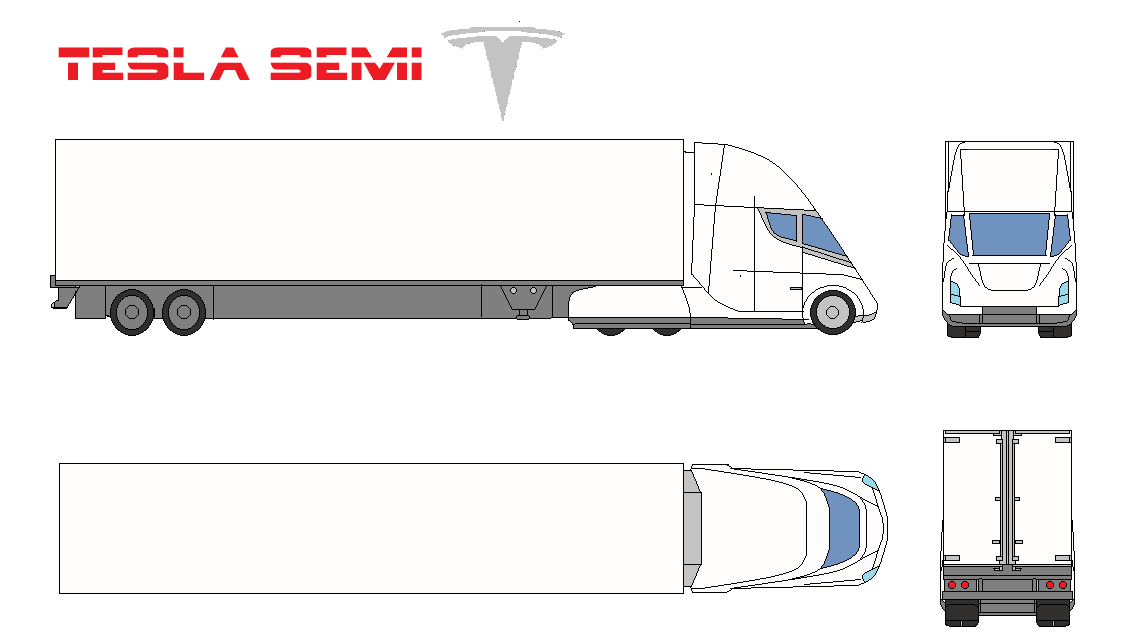
A New Upgraded Tesla Semi Truck Will Destroy Logistics: The transportation industry is entering a new era where artificial intelligence (AI), autonomous driving, electric vehicles (EVs), and advanced manufacturing are reshaping global logistics. Tesla is leading this transformation with two ambitious projects—the Tesla Semi Truck and the futuristic Cybercab. While the Tesla Semi is proving its value on real roads with impressive fleet performance and advanced Full Self-Driving (FSD) technology, the Cybercab remains stuck waiting for software approval.
In this article, we’ll explore how the new upgraded Tesla Semi could completely transform freight transportation, why its technology is years ahead of traditional diesel trucks, and what Tesla’s Cybercab reveals about the future of autonomous mobility.
Tesla Semi Is Revolutionizing Commercial Trucking
Heavy-duty trucking is one of the most demanding transportation sectors in the world. A fully loaded Class 8 truck can weigh up to 82,000 pounds, requiring exceptional braking, stability, and driver awareness.
Tesla has designed the Tesla Semi to solve these challenges while dramatically reducing operating costs.
Some of the biggest advantages include:
- Operating cost of just 15 cents per mile
- 95% fleet uptime
- More than 13.5 million miles driven in real-world operations
- Individual trucks exceeding 440,000 miles
These numbers demonstrate that the Tesla Semi is no longer a prototype—it has become a practical commercial vehicle capable of handling demanding logistics operations.
Advanced Full Self-Driving (FSD) Integration
One of the biggest upgrades arriving on the Tesla Semi is its enhanced Full Self-Driving (FSD) capability.
Tesla has been testing Semi trucks equipped with special ground truth validation systems mounted on the roof. These advanced sensor rigs collect extremely accurate environmental data that allows engineers to compare what the AI “sees” with what actually exists on the road.
This process helps improve:
More Accurate Lane Detection
The AI learns to recognize lane markings under different weather and lighting conditions.
Better Traffic Recognition
Vehicles, road barriers, pedestrians, and merging traffic become easier for the neural network to identify.
Improved Safety
Any mistakes made by the AI are corrected using the validation data, continuously improving Tesla’s autonomous driving software.
This constant learning process allows Tesla’s vision-based AI system to become more reliable over time.
Why Autonomous Trucking Is Much Harder Than Passenger Cars
Driving a passenger car autonomously is already difficult.
Driving an 82,000-pound electric truck is significantly more challenging.
Longer Braking Distance
A heavy truck carries enormous momentum. Even a small delay in braking can become dangerous.
Jackknife Prevention
Sudden steering corrections can cause trailers to swing uncontrollably, creating a dangerous jackknife situation.
Greater Visibility Requirements
The AI must detect hazards much farther ahead compared to ordinary passenger vehicles.
Because of these challenges, Tesla has developed specialized software exclusively for the Semi rather than simply copying the passenger-car FSD system.
Vehicle Dynamics Control Makes Tesla Semi Safer
One of Tesla’s biggest engineering breakthroughs is its Vehicle Dynamics Control (VDC) system.
Unlike diesel trucks that rely on mechanical traction control, the Tesla Semi uses instant electric torque vectoring.
When driving on slippery roads, such as Tesla’s Alaska winter testing facility, the system can:
- Detect wheel slip instantly
- Adjust motor torque within milliseconds
- Stabilize the truck before the driver even notices traction loss
Traditional diesel trucks require:
- Engine power reduction
- Hydraulic brake activation
- Mechanical response delays
Tesla’s fully electric drivetrain reacts almost instantly, providing significantly better stability.
The New Tesla Semi Interior Is Built for Professional Drivers
Tesla has redesigned the Semi’s cabin based on real-world driver feedback.
Major Interior Improvements
Dual 16-inch QHD Displays
The previous 15-inch screens have been upgraded to larger 16-inch QHD displays, giving drivers easier access to navigation, vehicle diagnostics, and camera feeds.
Improved Driver Ergonomics
Tesla raised the cup holders, expanded storage compartments, and redesigned steering-wheel controls for easier one-handed operation.
Better Visibility
The centrally positioned driver’s seat provides outstanding visibility while the side windows now lower much farther into the doors, making communication at shipping terminals easier.
The truck now uses 10 strategically positioned exterior cameras instead of the earlier 26-camera prototype configuration, simplifying the hardware while maintaining excellent visibility.
Tesla Cybercab Shows the Future of Autonomous Transportation
While the Tesla Semi continues making progress, Tesla’s Cybercab tells a different story.
The Cybercab is a fully autonomous robotaxi with:
- No steering wheel
- No pedals
- No manual controls
Tesla has already manufactured over 100 Cybercabs at Gigafactory Texas.
However, none have entered commercial service.
The reason is simple:
The software isn’t ready yet.
Without a fully validated FSD Version 15, regulators cannot approve widespread deployment.
This highlights an important lesson in autonomous transportation:
Building vehicles is easier than building safe autonomous intelligence.
Reaction Injection Molding Changes Car Manufacturing
Tesla is also transforming vehicle production using Reaction Injection Molding (RIM).
Instead of traditional stamped steel body panels, Tesla creates lightweight composite panels through a chemical molding process.
Benefits of RIM Technology
- Lower manufacturing costs
- Faster production
- Reduced factory size
- Elimination of large paint shops
- Lower greenhouse gas emissions
- Approximately 35% lower manufacturing CO₂
Tesla also uses in-mold pigmentation, meaning color is mixed directly into the composite material rather than applied later through multiple paint layers.
This saves:
- Water
- Energy
- Production time
- Environmental impact
Tesla’s Bigger AI Computer Solves the Memory Problem
Autonomous driving requires enormous computing power.
Tesla’s standard AI4 computer contains approximately 32 GB of RAM across two processors.
The Cybercab reportedly doubles this capacity to around 64 GB, allowing much larger neural network models to run directly inside the vehicle.
More memory enables:
Faster Image Processing
The AI can analyze multiple camera feeds simultaneously.
Lower Latency
Decisions happen more quickly, which is essential for city driving.
Future AI Expansion
The larger computer prepares Tesla for increasingly advanced autonomous software.
This hardware upgrade could become one of the biggest enablers of next-generation self-driving technology.
Cybercab Targets Industry-Leading Energy Efficiency
Tesla isn’t only focusing on autonomy.
The Cybercab is also designed to become one of the world’s most efficient electric vehicles.
Efficiency Targets
- 6.1 miles per kWh
- Approximately 165 Wh per mile
Compared with the Tesla Model 3, this represents an improvement of roughly 35–50% in energy efficiency.
Tesla achieved this by:
- Removing steering components
- Eliminating pedals
- Simplifying the interior
- Reducing overall vehicle weight
At only 3,113 pounds, the Cybercab is roughly 750 pounds lighter than a Model 3 despite carrying advanced AI computing hardware.
Lower weight means:
- Lower electricity costs
- Greater driving range
- Reduced operating expenses
- Higher fleet profitability
Conclusion
The new upgraded Tesla Semi Truck is rapidly becoming one of the most advanced commercial vehicles ever built. With Full Self-Driving integration, Vehicle Dynamics Control, real-world fleet validation, and an ergonomically redesigned cabin, Tesla is positioning the Semi to redefine global freight transportation.
At the same time, the Cybercab demonstrates that software remains the greatest challenge in autonomous mobility. Tesla has already solved many manufacturing problems through innovations like Reaction Injection Molding, lightweight composite construction, and powerful onboard AI computers. However, until FSD Version 15 achieves full regulatory approval and proves it can safely operate without human intervention, the Cybercab will remain a glimpse of the future rather than a fully deployed reality.
As AI hardware continues to improve and Tesla refines its autonomous driving software, the transportation industry is moving toward a future where electric trucks, autonomous logistics, and intelligent robotaxis become the new standard. If Tesla succeeds, the upgraded Tesla Semi could dramatically lower freight costs, improve safety, reduce emissions, and permanently transform the global logistics industry.
FAQs
1. What is the Tesla Semi Truck?
The Tesla Semi is Tesla’s all-electric Class 8 commercial truck designed for long-haul freight transportation. It offers lower operating costs, high efficiency, and advanced driver-assistance features.
2. How much does the Tesla Semi cost to operate?
According to Tesla’s reported fleet data, the Tesla Semi can operate at an estimated cost of around 15 cents per mile, making it significantly cheaper than many diesel-powered trucks.
3. Does the Tesla Semi support Full Self-Driving (FSD)?
Tesla is actively developing an advanced version of Full Self-Driving (FSD) for the Semi. The company is collecting real-world driving data to improve autonomous trucking capabilities.
4. How many miles has the Tesla Semi driven in real-world testing?
Tesla’s Semi fleet has accumulated approximately 13.5 million miles of real-world driving, with some individual trucks surpassing 440,000 miles.
5. What makes the Tesla Semi safer than traditional diesel trucks?
The Tesla Semi features Vehicle Dynamics Control (VDC), instant electric torque vectoring, advanced traction control, and multiple cameras that improve stability and reduce the risk of jackknife accidents.
6. What is Vehicle Dynamics Control (VDC)?
Vehicle Dynamics Control is Tesla’s intelligent stability system that continuously adjusts motor torque to maintain traction and vehicle stability, especially on slippery roads.
7. Why is autonomous trucking more difficult than self-driving cars?
Heavy-duty trucks have much greater weight, longer braking distances, larger blind spots, and higher momentum, making autonomous driving significantly more complex than passenger vehicles.
8. What upgrades does the new Tesla Semi interior include?
The updated Tesla Semi features dual 16-inch QHD displays, improved storage, redesigned steering controls, larger side windows, higher cup holders, and an optimized central driving position.
9. What is the Tesla Cybercab?
The Tesla Cybercab is a fully autonomous robotaxi designed without a steering wheel or pedals. It is built specifically for self-driving transportation services.
10. Why hasn’t Tesla launched the Cybercab yet?
Although Tesla has produced more than 100 Cybercabs, large-scale deployment is waiting for the completion and regulatory approval of Full Self-Driving Version 15.
11. What is Reaction Injection Molding (RIM)?
Reaction Injection Molding is a manufacturing process that creates lightweight composite body panels using liquid materials instead of traditional stamped steel, reducing production costs and emissions.
12. How does in-mold pigmentation benefit Tesla manufacturing?
In-mold pigmentation mixes color directly into composite materials, eliminating the need for traditional paint shops while reducing water usage, VOC emissions, and manufacturing time.
13. Why does the Cybercab have a more powerful onboard computer?
The Cybercab is expected to feature significantly more memory than Tesla’s standard AI4 computer, allowing larger AI models to process real-time driving decisions more efficiently.
14. How energy efficient is the Tesla Cybercab?
Tesla targets an impressive efficiency of approximately 6.1 miles per kilowatt-hour (kWh), making the Cybercab one of the most energy-efficient electric vehicles ever developed.
15. Will the Tesla Semi replace diesel trucks?
While diesel trucks will remain in service for years, the Tesla Semi’s lower operating costs, reduced maintenance, and zero tailpipe emissions could accelerate the transition toward electric freight transportation.
16. Why is the Tesla Semi considered the future of logistics?
The Tesla Semi combines electric power, AI-driven technology, advanced safety systems, lower operating costs, and continuous software improvements, making it one of the most promising innovations in modern commercial transportation.
Read More:
- SpaceX Starship Flight 13’s Launch Schedule is Beyond What You Expected! China is even Crazier
- Tesla shows rapid teardown of Model S and X lines, paving the way for Optimus at Fremont
- Elon Musk’s Giant $122B Tesla Terafab Outchip The Entire World
- China Did Something Never Done before Surprised Us All! SpaceX Takes Changes on B20 before Test
- Tesla confirms crucial detail of Miami Robotaxi launch
1 thought on “A New Upgraded Tesla Semi Truck Will Destroy Logistics”