
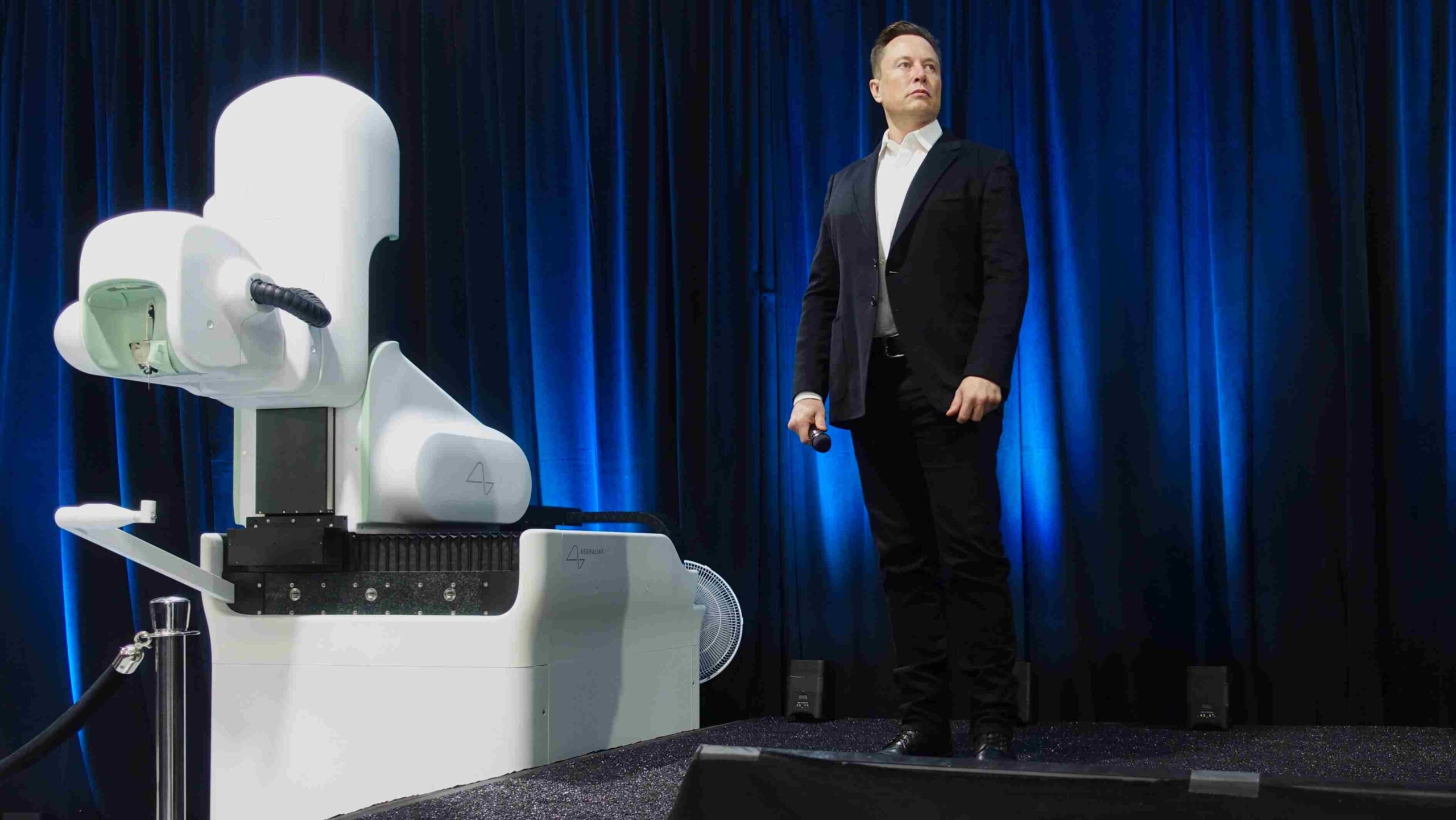
Elon Musk UPDATE Neuralink 4.0 Chip Destroy Entire BCI Industry: The world is entering a revolutionary era where the boundaries between human biology and digital technology are rapidly disappearing. At the center of this transformation stands Neuralink, the neurotechnology company co-founded by Elon Musk. With the announcement of its fourth-generation brain implant, known as the 01 Chip, Neuralink is pushing the limits of what was once considered science fiction.
Developed in partnership with Samsung’s advanced 4-nanometer semiconductor technology, Neuralink 4.0 promises unprecedented advancements in the Brain-Computer Interface (BCI) industry. From restoring movement to paralyzed patients and enabling communication for ALS sufferers to potentially giving sight to the blind, Neuralink’s latest innovations could redefine modern medicine.
However, Neuralink is not alone. Companies and research institutions worldwide are racing to develop competing BCI technologies, creating a global battle for dominance in the future of human-machine integration.
In this article, we explore the groundbreaking Neuralink 4.0 chip, patient success stories, the revolutionary Blindsight project, global competitors, and Elon Musk’s ultimate vision for humanity’s future.
What Is Neuralink 4.0?
Neuralink 4.0, also called the 01 Chip, is the company’s most advanced brain implant to date. It represents a significant leap beyond previous generations by offering enhanced performance, improved safety, and more efficient communication between the human brain and digital devices.
The chip is specifically designed to overcome the major challenges associated with long-term implantation inside the human brain, including heat management, durability, and signal transmission.
Samsung Partnership Marks a Major Shift
For its first three generations, Neuralink relied on TSMC (Taiwan Semiconductor Manufacturing Company) for chip production. The move to Samsung Foundry marks a major strategic change.
Samsung’s advanced 4nm manufacturing process enables Neuralink to pack billions of transistors into an incredibly small implant while significantly reducing power consumption.
This allows the chip to operate more efficiently while generating less heat—a critical requirement for any device implanted directly inside the brain.
Key Features of the Neuralink 01 Chip
The fourth-generation Neuralink implant introduces several technological breakthroughs that could transform the BCI industry.
True Bidirectional Brain Communication
Earlier brain-computer interfaces primarily focused on reading brain activity. Neuralink 4.0 takes things much further.
The 01 Chip can:
- Read signals from neurons
- Interpret user intentions
- Send signals back into the brain
- Stimulate targeted neural pathways
This creates a two-way communication system between the human brain and computers.
Such functionality opens the door to restoring lost neurological functions and potentially enhancing human capabilities in the future.
Improved Thermal Management
One of the greatest engineering challenges in brain implants is heat.
The human brain is extremely sensitive to temperature changes. Even a small increase can damage tissue and trigger immune responses.
By utilizing Samsung’s 4nm process, Neuralink dramatically lowers power consumption, reducing heat generation and improving long-term safety.
Long-Term Biological Durability
The brain is an extremely harsh environment for electronics.
Cerebrospinal fluid contains salts and chemicals that naturally corrode foreign materials over time.
To address this problem, Neuralink has developed advanced protective materials and encapsulation technologies designed to keep the implant functioning reliably for decades.
Neuralink Human Trials Continue to Expand
While hardware specifications are impressive, real-world patient outcomes are what truly matter.
Neuralink’s clinical trials have accelerated significantly over the past year.
Growing Number of Human Participants
What began as a highly scrutinized experiment involving a single patient has expanded rapidly.
Reports indicate that more than 25 patients have now received Neuralink implants.
Most participants suffer from:
- Quadriplegia
- Spinal cord injuries
- Amyotrophic Lateral Sclerosis (ALS)
These conditions leave patients unable to move or communicate effectively.
Neuralink aims to restore independence through direct brain-computer communication.
Patients Are Controlling Computers Using Thought Alone
One of the most remarkable outcomes of Neuralink’s trials is the ability of patients to operate digital devices using only their thoughts.
Users can move cursors, select icons, type messages, and interact with software without touching a keyboard or mouse.
Brain-to-Computer Speeds Surpass Traditional Input Devices
According to Neuralink data, some advanced users are achieving communication speeds that rival or even exceed those of healthy individuals using conventional computer hardware.
This demonstrates the enormous potential of high-bandwidth BCIs.
Instead of relying on physical movement, users simply think about an action, and the system translates those intentions into digital commands.
Audrey Cruz: A Life-Changing Success Story
One of Neuralink’s most inspiring success stories involves Audrey Cruz.
After becoming quadriplegic following a devastating car accident at age 16, Cruz spent decades unable to perform many everyday tasks independently.
Using Neuralink technology, she successfully controlled a computer cursor and signed her name using digital ink.
Observers noted that her handwriting closely resembled her natural handwriting from before the accident.
Even more impressive, Cruz has begun designing and programming custom video games using only her brain signals.
Her achievements highlight the life-changing potential of advanced brain-computer interfaces.
Neuralink’s Next Goal: Reconnecting the Brain and Body
Computer control is only the beginning.
Neuralink’s broader objective is to restore physical movement in people suffering from paralysis.
Bypassing Damaged Spinal Cords
In many spinal cord injuries, the brain still generates movement commands.
The problem is that damaged neural pathways prevent those signals from reaching muscles.
Neuralink is developing a system that can:
- Detect movement intentions in the brain
- Capture those signals
- Bypass damaged spinal tissue
- Deliver commands directly to muscles
If successful, this technology could allow paralyzed individuals to regain movement in their arms and legs.
Such a breakthrough would represent one of the greatest medical advancements of the century.
Restoring Speech for ALS Patients
Another major focus is helping patients who have lost the ability to speak.
AI-Powered Speech Decoding
ALS gradually destroys motor neurons responsible for muscle movement, including those required for speech.
Neuralink is developing machine-learning systems capable of decoding a person’s intended words directly from brain activity.
The process works by:
- Monitoring language centers of the brain
- Identifying speech intentions
- Converting neural patterns into digital language
- Generating natural-sounding voice output
Current systems can already produce basic phrases and short sentences.
Future versions aim to deliver fluid, real-time conversations at normal human speaking speeds.
Blindsight: Neuralink’s Revolutionary Vision Project
Perhaps the most ambitious Neuralink project is Blindsight, a technology designed to restore sight to blind individuals.
How Blindsight Works
Traditional treatments focus on repairing damaged eyes or optic nerves.
Blindsight takes a completely different approach.
Instead of relying on the eye, the system directly stimulates the brain’s visual cortex.
The system includes:
- External camera-equipped glasses
- Visual processing software
- Brain implant connected to the visual cortex
Video data is converted into electrical patterns and transmitted directly into the brain.
Essentially, the system writes visual information directly into the brain’s image-processing center.
From Low-Resolution Vision to Superhuman Sight
Neuralink acknowledges that early versions of Blindsight will provide only basic visual experiences.
Initial users may see imagery similar to:
- Early Atari games
- Pixelated graphics
- Low-resolution black-and-white visuals
However, future upgrades could dramatically increase resolution.
Potential Superhuman Abilities
Elon Musk has suggested that future versions could provide capabilities beyond natural human vision.
Possible enhancements include:
Infrared Vision
Users could see heat signatures in complete darkness.
Ultraviolet Perception
Individuals could detect wavelengths normally invisible to humans.
Advanced Distance Mapping
The system may eventually provide radar-like spatial awareness.
If achieved, these capabilities would represent a major step toward human augmentation.
The R1 Surgical Robot
One of Neuralink’s most important innovations is not the chip itself but the robot that implants it.
Why Human Surgeons Alone Are Not Enough
Neuralink implants use ultra-thin threads containing up to 1,024 electrodes.
These threads are thinner than a human hair and too delicate for manual insertion.
The human brain contains countless blood vessels, making precision essential.
Even minor mistakes can lead to:
- Brain hemorrhage
- Stroke
- Tissue damage
Robotic Precision at the Micron Level
The R1 Surgical Robot uses:
- Computer vision
- Artificial intelligence
- High-speed robotics
It identifies blood vessels, maps safe insertion paths, and implants electrodes with microscopic accuracy.
This technology is crucial for scaling Neuralink from dozens of patients to potentially millions worldwide.
Global Competition in the BCI Industry
Although Neuralink receives the most media attention, several competitors are making significant progress.
Paradromics
Paradromics is developing a high-bandwidth brain-computer interface focused primarily on speech restoration.
Its system offers extremely high channel counts and robust medical architecture.
Synchron
Synchron has taken a less invasive approach.
Its device, known as the Stentrode, is inserted through blood vessels rather than directly into brain tissue.
Advantages include:
- No open-brain surgery
- Lower surgical risks
- Faster patient recovery
The tradeoff is reduced data bandwidth compared to Neuralink.
China’s NEO System
China has rapidly become a major player in neurotechnology.
The NEO System places sensors above the brain’s protective membrane rather than penetrating brain tissue.
Benefits include:
- Lower infection risk
- Reduced inflammation
- Easier regulatory approval
Importantly, the NEO device is already integrated into China’s healthcare reimbursement system, making it accessible to a much larger patient population.
Elon Musk’s Ultimate Vision for Humanity
While Neuralink’s immediate focus is medical treatment, Elon Musk has repeatedly stated that his long-term goals extend much further.
The AI Challenge
Musk believes humanity faces a growing challenge.
Humans communicate with technology at relatively slow speeds through keyboards, touchscreens, and speech.
Artificial intelligence systems communicate and process information at dramatically faster rates.
This creates what Musk views as a widening gap between human cognition and machine intelligence.
Merging Humans with AI
Neuralink’s long-term vision is to create a high-bandwidth interface connecting the human brain directly to digital systems.
The objective is not simply treating disease but enabling humans to:
- Access information instantly
- Communicate at unprecedented speeds
- Expand cognitive abilities
- Remain competitive alongside advanced AI systems
According to Musk, this could help prevent human obsolescence in an increasingly AI-driven future.
Challenges Facing Neuralink
Despite remarkable progress, significant obstacles remain.
Scientific Challenges
Researchers still need to solve complex problems involving:
- Long-term brain compatibility
- Neural signal interpretation
- Vision restoration
- Speech decoding accuracy
Regulatory Challenges
Obtaining approvals across multiple countries requires extensive testing and validation.
Ethical Concerns
Questions remain regarding:
- Privacy
- Security
- Data ownership
- Human enhancement
As BCIs become more powerful, society will need to establish clear ethical frameworks.
Conclusion
The Neuralink 4.0 “01” Chip represents one of the most significant breakthroughs in modern neurotechnology. Powered by Samsung’s advanced 4nm manufacturing process, supported by the highly precise R1 Surgical Robot, and validated through increasingly successful human trials, Neuralink is rapidly moving from experimental science to practical medical reality.
From helping paralyzed individuals control computers with their thoughts to restoring speech and potentially giving sight back to the blind through Blindsight, the possibilities are extraordinary.
Yet the future of the Brain-Computer Interface industry remains highly competitive. Rivals such as Synchron, Paradromics, and China’s NEO System are pursuing alternative approaches that may prove safer, cheaper, or easier to scale.
Ultimately, the winner of the BCI revolution will not simply be the company with the most powerful chip. Success will belong to the organization that can combine high-performance neural communication, long-term safety, affordability, and global accessibility.
As Neuralink accelerates toward its ambitious goals, one thing is becoming increasingly clear: the age of direct brain-computer communication is no longer science fiction—it is rapidly becoming reality.
FAQs
1. What is Neuralink 4.0?
Neuralink 4.0 is the latest generation of Elon Musk’s brain-computer interface (BCI) technology. It features the new 01 brain chip, designed to improve communication between the human brain and digital devices through faster, more efficient neural signal processing.
2. What is the Neuralink 01 Chip?
The 01 Chip is Neuralink’s fourth-generation brain implant built using Samsung’s advanced 4-nanometer semiconductor process. It offers improved performance, lower power consumption, better heat management, and enhanced long-term durability.
3. How does Neuralink work?
Neuralink works by implanting tiny electrodes into the brain that can detect and transmit neural signals. These signals are interpreted by software, allowing users to control computers, smartphones, and other devices using their thoughts.
4. Has Neuralink been tested on humans?
Yes. Neuralink has already implanted its brain-computer interface in multiple human participants, primarily individuals with paralysis, spinal cord injuries, and ALS. Clinical trials continue to expand as the company gathers more real-world data.
5. Can Neuralink help paralyzed people walk again?
Neuralink is developing technologies that could potentially bypass damaged spinal cord pathways and reconnect brain signals directly to muscles or external stimulators. While still under development, the goal is to help restore movement in paralyzed individuals.
6. What is Blindsight by Neuralink?
Blindsight is Neuralink’s experimental visual prosthesis designed to restore vision by sending visual information directly to the brain’s visual cortex, bypassing damaged eyes and optic nerves.
7. Will Blindsight restore normal vision immediately?
No. Early versions of Blindsight are expected to provide low-resolution visual experiences. Neuralink plans to improve image quality over time as electrode density and processing capabilities advance.
8. Can Neuralink give people superhuman vision?
According to Elon Musk, future versions of Blindsight could potentially support advanced capabilities such as infrared vision, ultraviolet perception, and enhanced spatial awareness. However, these features remain long-term goals.
9. What role does Samsung play in Neuralink 4.0?
Samsung is responsible for manufacturing the new 01 Chip using its advanced 4nm semiconductor technology. This partnership helps Neuralink improve chip performance, efficiency, and scalability.
10. What is the R1 Surgical Robot?
The R1 Surgical Robot is Neuralink’s automated implantation system. It uses computer vision and robotic precision to insert ultra-thin electrode threads into the brain while avoiding blood vessels and minimizing surgical risks.
11. How is Neuralink different from Synchron?
Neuralink uses electrodes implanted directly into brain tissue for higher data bandwidth. Synchron uses an endovascular approach, placing its device through blood vessels near the brain, reducing the need for open-brain surgery but offering lower signal resolution.
12. Is Neuralink approved by the FDA?
Neuralink has received FDA approval to conduct certain human clinical trials in the United States. However, broader commercial approval for widespread use will require additional testing and regulatory review.
13. Can Neuralink restore speech for ALS patients?
Neuralink is developing systems that decode speech intentions directly from brain activity. The technology aims to help ALS patients communicate through AI-generated speech even after losing the ability to speak naturally.
14. When will Neuralink 4.0 be available to the public?
Neuralink’s 01 Chip is expected to enter advanced human testing before eventual large-scale production. Public availability will depend on clinical trial results, regulatory approvals, and manufacturing readiness.
15. What is Elon Musk’s long-term vision for Neuralink?
Elon Musk envisions Neuralink as a way to create a high-bandwidth connection between humans and artificial intelligence. His goal is to help humanity keep pace with rapidly advancing AI by enhancing communication and cognitive capabilities through direct brain-computer interfaces.
Read More:
- Elon Musk challenges Tesla credit rating from Moody’s after SpaceX gets a higher one
- Tesla gives its biggest signal yet that Cybercab launch is imminent
- Tesla Bot Gen 3 Is Ready For Work! Next-Gen AI6 Chip And Only $25K!
- NEW TESLA MODEL 2 Aluminum Battery SHOCK: 300 Miles & 1-Min Charge?
- Tesla Full Self-Driving is getting a major parking upgrade, Elon Musk says
1 thought on “Elon Musk UPDATE Neuralink 4.0 Chip Destroy Entire BCI Industry”