
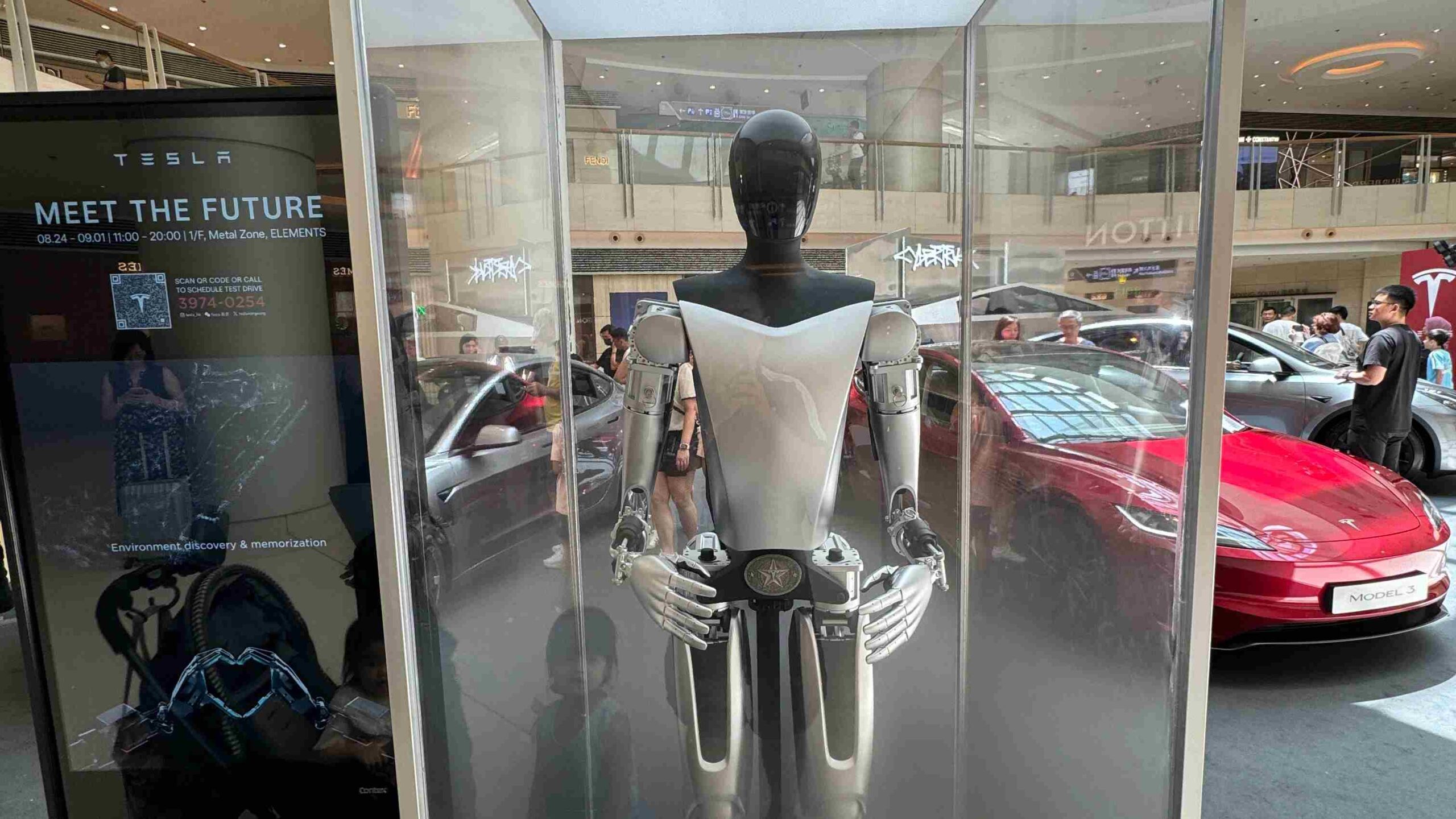
Tesla Bot Gen 3 Is Ready For Work! Next-Gen AI6 Chip And Only $25K!: For years, the idea of a humanoid robot capable of performing meaningful work seemed like something reserved for science fiction movies. While robotics companies showcased machines that could run, jump, and perform acrobatic stunts, very few robots were capable of delivering real economic value in everyday environments.
That reality may be changing rapidly.
Tesla is now positioning its Optimus humanoid robot, powered by the revolutionary AI6 chip, as one of the most important technological products of the next decade. According to Elon Musk, Tesla’s next-generation AI hardware could achieve unprecedented levels of intelligence and efficiency, helping transform Optimus from a prototype into a productive worker.
With a targeted price of just $25,000, Tesla Bot Gen 3 could become the first truly affordable humanoid robot capable of working in factories, warehouses, businesses, and even homes.
The combination of advanced artificial intelligence, custom silicon, and Tesla’s manufacturing expertise has the potential to reshape labor markets, automation, and the global economy.
Why Humanoid Robots Have Struggled Until Now
Mobility Was Never the Real Problem
For years, robotics development focused heavily on physical movement.
Companies spent billions creating robots capable of:
- Running at high speeds
- Jumping over obstacles
- Climbing stairs
- Performing backflips
- Navigating rough terrain
These demonstrations generated excitement, but they failed to solve the biggest challenge in robotics.
The true bottleneck was always intelligence.
A robot that can walk across a room is impressive. A robot that can understand instructions, make decisions, adapt to changing conditions, and complete tasks independently is valuable.
This distinction is what separates a laboratory demonstration from a commercially viable worker.
What Makes a Robot Truly Useful?
To provide real-world value, a humanoid robot must be able to:
- Understand complex human instructions
- Recognize thousands of different objects
- Navigate unpredictable environments
- Coordinate dozens of movements simultaneously
- Handle fragile items safely
- Complete multi-step tasks without supervision
Tesla’s Optimus project focuses primarily on solving these intelligence challenges rather than simply improving movement.
The company treats robotics as a software-first problem, using advanced AI systems to create a robot capable of genuine productivity.
The AI6 Chip: The Brain Behind Tesla Bot Gen 3
Tesla’s Unified AI Strategy
One of Tesla’s biggest advantages is that it does not develop separate AI platforms for different products.
Instead, Tesla’s custom silicon is designed to power multiple technologies simultaneously:
- Full Self-Driving (FSD)
- RoboTaxi Networks
- Optimus Humanoid Robots
- AI Training Data Centers
- Large Neural Network Infrastructure
This approach allows Tesla to spread development costs across several high-growth industries while accelerating innovation.
More importantly, it demonstrates that Optimus is not a side project.
It is a central pillar of Tesla’s long-term vision.
The Massive Performance Leap From AI4 to AI6
Tesla’s AI roadmap reveals a dramatic increase in computing power.
AI Hardware Evolution
| Chip Generation | Relative Performance |
|---|---|
| AI4 | 1x |
| AI5 | 5x |
| AI6 | 10x |
Tesla’s upcoming AI5 platform is expected to deliver approximately five times the performance of AI4.
The next-generation AI6 chip is projected to double AI5’s capabilities.
Combined, this creates a staggering 10x increase in computing power compared to the hardware currently operating in Tesla vehicles.
That raises an important question:
Why does Tesla need ten times more AI power?
The answer lies in the difference between self-driving cars and humanoid robots.
Why Humanoid Robots Need More Computing Power Than Cars
Self-Driving Cars Operate in Structured Environments
A self-driving vehicle must:
- Detect road lanes
- Identify traffic signs
- Monitor surrounding vehicles
- Adjust steering and speed
- Follow traffic rules
While complex, roads remain relatively structured environments.
Humanoid Robots Face Infinite Variables
Humanoid robots must operate in environments designed by and for humans.
Every home, factory, office, and warehouse is different.
For example, when unloading groceries, Optimus must:
- Listen to spoken instructions
- Understand intent
- Identify objects
- Estimate distances
- Maintain balance
- Control hand pressure
- Plan actions
- Complete tasks sequentially
All these operations occur simultaneously.
This requires multiple neural networks running in parallel with extremely low latency.
The AI6 chip is specifically designed to handle this enormous computational burden.
Revolutionary AI6 Architecture
Advanced SRAM Integration
Tesla’s engineering teams have reportedly redesigned the AI6 architecture to dedicate up to 50% of accelerator die space to SRAM (Static Random-Access Memory).
SRAM provides:
- Ultra-fast data access
- Reduced latency
- Improved neural network performance
- Faster decision-making
Instead of constantly retrieving data from slower memory systems, Optimus can access critical information instantly.
This allows the robot to respond more naturally and efficiently.
LPDDR6 Memory Bandwidth
Tesla is also transitioning toward LPDDR6 memory technology.
Benefits include:
- Higher bandwidth
- Faster data transfer
- Greater multitasking capability
- Improved AI responsiveness
Rather than simply processing information faster, Optimus will be able to understand more aspects of its environment simultaneously.
This is a crucial step toward achieving human-like reaction speeds.
Tesla Bot Gen 3 in Manufacturing
Transforming Tesla Gigafactories
Tesla plans to deploy Optimus robots extensively inside its own manufacturing facilities.
Modern factories still rely heavily on human workers for tasks that traditional automation struggles to perform.
Examples include:
- Moving components
- Sorting inventory
- Packaging products
- Organizing tools
- Preparing workstations
These activities consume thousands of labor hours every day.
Optimus is designed to absorb much of this workload.
Real-Time Quality Control
Unlike conventional factory robots, Optimus can perform advanced inspections.
The robot may be capable of:
- Detecting manufacturing defects
- Identifying missing parts
- Monitoring equipment health
- Checking alignment accuracy
- Flagging quality issues
This transforms Optimus from a simple labor replacement into an intelligent quality assurance system.
A New Era of Collaborative Robotics
Traditional industrial robots often require:
- Safety cages
- Fixed workstations
- Specialized programming
- Expensive reconfiguration
Optimus takes a completely different approach.
Thanks to advanced vision systems and AI-powered awareness, it can safely work alongside humans.
A single robot could:
- Move battery packs in the morning
- Conduct inspections in the afternoon
- Help clean production lines at night
This flexibility dramatically reduces operational costs.
The Huge Logistics and Warehousing Opportunity
Solving Labor Shortages
Warehouses face ongoing challenges including:
- Worker shortages
- High turnover rates
- Workplace injuries
- Rising labor costs
Current automation systems often require expensive infrastructure changes.
Conveyor systems, automated storage systems, and robotic sorting networks can cost millions of dollars.
Why Optimus Changes Everything
A humanoid robot fits into existing workflows.
Optimus can:
- Enter truck trailers
- Unload shipments
- Scan packages
- Organize inventory
- Stack pallets
- Assist workers
Because warehouses are already designed for humans, a humanoid robot can operate without requiring major infrastructure modifications.
This makes deployment significantly easier and more cost-effective.
Tesla’s Vision for Household Robotics
Beyond Robotic Vacuum Cleaners
The consumer market represents Tesla’s ultimate goal.
Today’s household robots are limited to simple cleaning functions.
Optimus aims to become a comprehensive home assistant capable of handling a wide range of daily chores.
Potential tasks include:
- Folding laundry
- Loading dishwashers
- Cleaning surfaces
- Organizing rooms
- Taking out trash
- Watering plants
- Preparing simple meals
This would represent a major leap forward in consumer robotics.
Why Household Tasks Are So Difficult
Every Home Is Different
Unlike factories, homes are highly unpredictable.
Furniture gets moved.
Children leave toys everywhere.
Pets create obstacles.
Lighting conditions constantly change.
A successful household robot must reason and adapt continuously.
This level of intelligence requires tremendous computational power, making the AI6 chip a critical component of Tesla’s strategy.
How Tesla Bot Could Help Solve the Elder Care Crisis
A Growing Global Challenge
According to global demographic projections, the number of people aged 65 and older will increase dramatically over the coming decades.
Many countries already face shortages of:
- Caregivers
- Nurses
- Home health aides
- Support workers
The situation is expected to become more severe as populations age.
Optimus as an Elder Care Assistant
Tesla Bot could provide valuable assistance by:
- Carrying groceries
- Retrieving objects
- Providing medication reminders
- Monitoring falls
- Assisting with household chores
- Supporting independent living
While not replacing medical professionals, Optimus could significantly reduce the burden on families and caregivers.
This market alone could create enormous demand for humanoid robots.
The Economics of a $25,000 Robot
A Game-Changing Price Point
Perhaps the most disruptive aspect of Optimus is its projected cost.
Tesla aims for a retail price of approximately $25,000.
Considering the robot’s potential capabilities, this price could fundamentally alter labor economics.
Comparing Human and Robot Productivity
A typical employee works approximately:
2,000 hours per year
An Optimus robot could potentially operate:
7,000+ hours annually
Assuming operation for roughly 20 hours per day with charging breaks.
This creates a dramatic difference in productivity.
Even after accounting for:
- Electricity
- Maintenance
- Insurance
- Software updates
The cost per hour could be substantially lower than traditional labor costs.
For businesses operating on thin margins, the incentive to adopt robotic workers may become overwhelming.
Tesla’s Competitive Advantage
Custom AI Silicon
Tesla designs its own chips specifically for AI workloads.
This creates:
- Better optimization
- Higher efficiency
- Improved performance
- Greater control over development
Massive Training Data
Tesla benefits from data collected by millions of vehicles worldwide.
This provides a unique advantage in:
- Computer vision
- Object recognition
- Spatial understanding
- Autonomous navigation
Manufacturing Expertise
Most robotics companies build small numbers of prototypes.
Tesla already operates some of the world’s most advanced manufacturing facilities.
Its experience producing vehicles at scale can be directly applied to mass-producing humanoid robots.
This combination of AI, data, and manufacturing forms a powerful competitive moat.
Conclusion: The Beginning of the Humanoid Robot Economy
The AI6 chip is far more than a semiconductor upgrade.
It represents the foundation for a new generation of intelligent machines capable of performing meaningful work in real-world environments.
Tesla Bot Gen 3 has the potential to transform:
- Manufacturing
- Warehousing
- Logistics
- Retail
- Household services
- Elder care
By combining advanced artificial intelligence, custom silicon, and scalable manufacturing, Tesla is positioning Optimus as one of the most disruptive products of the modern era.
The central question is no longer whether humanoid robots can exist.
The real question is whether Tesla can successfully deliver a $25,000 intelligent worker capable of generating real economic value.
If the AI6 platform performs as expected, Tesla Bot Gen 3 may become the catalyst for the next industrial revolution—one where intelligent humanoid robots work alongside humans across virtually every sector of the global economy.
FAQs
1. What is Tesla Bot Gen 3?
Tesla Bot Gen 3, also known as Optimus Gen 3, is Tesla’s next-generation humanoid robot designed to perform a wide range of tasks in factories, warehouses, businesses, and homes. It combines advanced robotics with Tesla’s latest artificial intelligence technology.
2. What is the AI6 chip in Tesla Bot Gen 3?
The AI6 chip is Tesla’s upcoming custom AI processor designed to provide significantly more computing power than previous generations. It serves as the robot’s brain, enabling advanced reasoning, object recognition, decision-making, and task execution.
3. How powerful is Tesla’s AI6 chip compared to AI4?
Tesla’s AI6 chip is expected to deliver approximately 10 times more computing performance than the current AI4 hardware used in Tesla vehicles, making it capable of handling much more complex AI workloads.
4. Why does a humanoid robot need so much computing power?
Humanoid robots operate in unpredictable environments and must process speech, vision, movement, balance, object handling, and task planning simultaneously. This requires substantially more computing power than many traditional automation systems.
5. What tasks can Tesla Optimus perform in factories?
Tesla Optimus can assist with:
- Transporting materials
- Sorting inventory
- Quality inspections
- Packaging products
- Organizing workstations
- Monitoring equipment performance
6. Can Tesla Bot work in warehouses and logistics centers?
Yes. Tesla Optimus is designed to handle warehouse operations such as unloading trucks, moving inventory, scanning packages, stacking pallets, and assisting with fulfillment processes.
7. How much will Tesla Bot Gen 3 cost?
Elon Musk has suggested a long-term target price of around $25,000, making it one of the most affordable advanced humanoid robots if Tesla achieves mass production.
8. Will Tesla Bot replace human workers?
Tesla positions Optimus as a tool that can perform repetitive, dangerous, or physically demanding tasks. While it may automate certain jobs, it is also expected to work alongside humans in many industries.
9. Can Tesla Optimus be used at home?
Yes. Tesla’s long-term vision includes household applications where Optimus could help with chores such as folding laundry, washing dishes, organizing rooms, taking out trash, and basic meal preparation.
10. How could Tesla Bot help elderly individuals?
Optimus could support seniors by carrying groceries, retrieving items, providing medication reminders, assisting with household tasks, and monitoring for falls or emergencies.
11. What makes Tesla different from other humanoid robot companies?
Tesla benefits from:
- Custom AI chip development
- Massive real-world data collection
- Advanced AI training infrastructure
- Large-scale manufacturing expertise
- Integration with Tesla’s broader AI ecosystem
12. When will Tesla Bot Gen 3 be available?
Tesla has not announced an official public release date for Optimus Gen 3. Early deployments are expected to begin within Tesla’s own factories before wider commercial and consumer availability.
13. How does Tesla train Optimus robots?
Tesla uses advanced neural networks trained on vast amounts of real-world data. The company also leverages its AI supercomputing infrastructure to continuously improve robot performance and decision-making capabilities.
14. Can Tesla Bot perform multiple jobs during a single workday?
Yes. Unlike traditional industrial robots that are designed for one specific task, Optimus is intended to switch between different activities, such as material handling, inspection, cleaning, and logistics support.
15. Why is Tesla Bot considered a potential industrial revolution?
Many experts believe Optimus could transform labor-intensive industries by providing affordable, intelligent robotic workers. If successful, Tesla Bot could significantly impact manufacturing, logistics, retail, healthcare support, and household automation worldwide.
Read More:
- NEW TESLA MODEL 2 Aluminum Battery SHOCK: 300 Miles & 1-Min Charge?
- Tesla Full Self-Driving is getting a major parking upgrade, Elon Musk says
- Elon Musk just upped his Tesla stake further fueling SpaceX merger conversation
- Tesla Cybercab has one important piece that AI4 cars might need for FSD
- Tesla teases greater Grok FSD integration and ‘Banish’ feature ‘in about 3 months’
1 thought on “Tesla Bot Gen 3 Is Ready For Work! Next-Gen AI6 Chip And Only $25K!”