
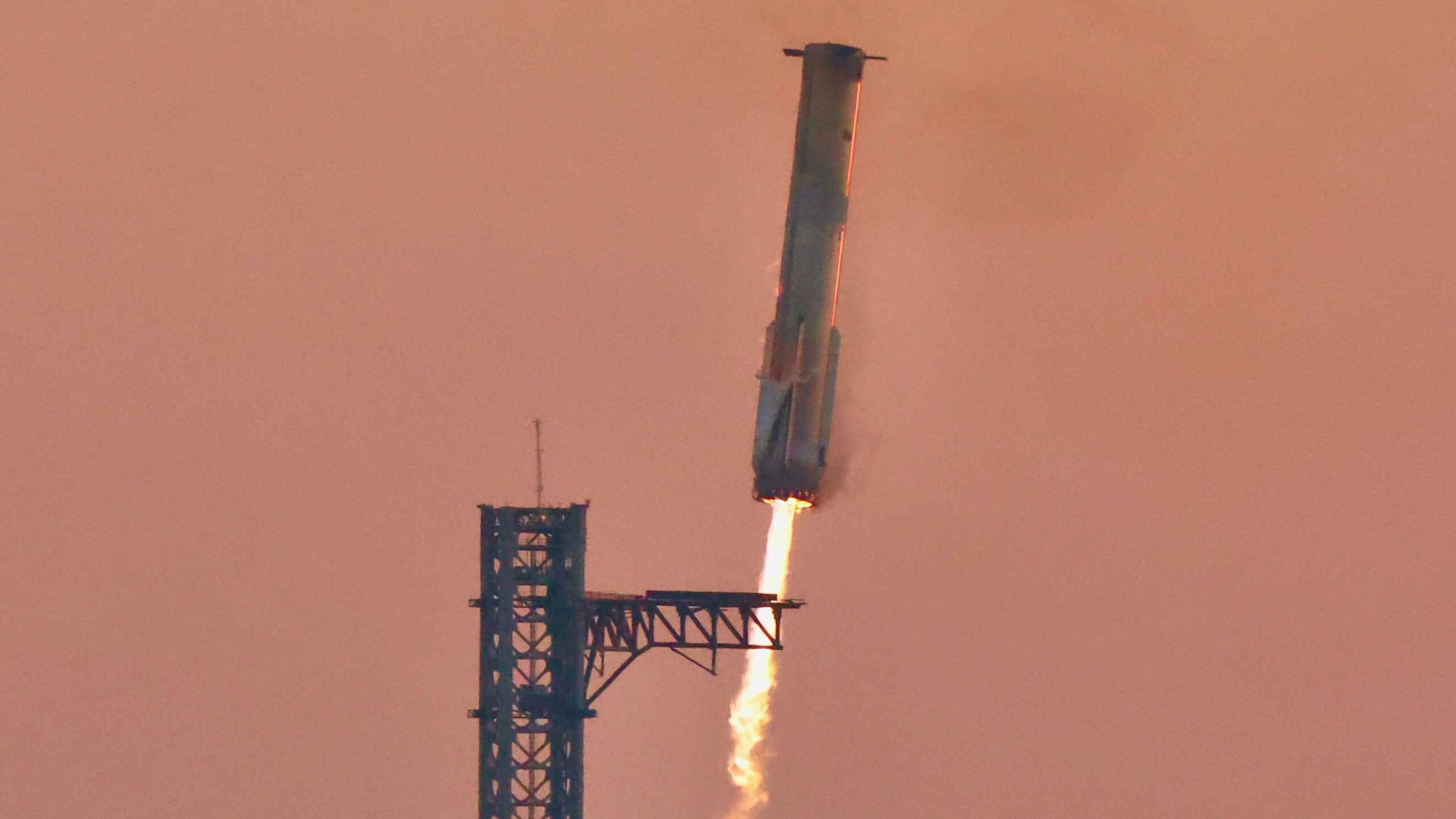
SpaceX’s Much Safer Way to Land Starship on the Moon Shocked NASA: The dream of returning humans to the Moon is closer than ever, but one of the biggest challenges facing modern space exploration isn’t reaching the lunar surface—it’s landing safely once you get there. As NASA and SpaceX prepare for future Artemis missions, engineers are confronting a problem that has become increasingly difficult as spacecraft grow larger and more capable.
A recent lunar landing mishap highlighted just how fragile lunar landings can be. In February 2024, the robotic lander Odysseus successfully reached the Moon but tipped over moments after touchdown because one of its landing legs caught uneven terrain. While Odysseus stood only 4.3 meters tall, the SpaceX Starship Human Landing System (HLS) towers an incredible 52 meters high.
That makes Starship approximately 12 times taller than Odysseus, creating unprecedented engineering challenges. To solve these risks, SpaceX is introducing innovative solutions that are changing how NASA thinks about lunar exploration. Some of these concepts—including a radical horizontal landing approach—have surprised even veteran aerospace engineers.
In this article, we’ll explore why landing Starship on the Moon is so difficult, how SpaceX plans to reduce the danger, and why these new strategies could transform the future of lunar exploration.
The Massive Challenge of Landing Starship on the Moon
Landing a spacecraft on the Moon is fundamentally different from landing on Earth.
The Moon has:
- No atmosphere
- No aerodynamic braking
- Extremely uneven terrain
- Variable regolith depth
- Limited flat landing zones
For a small robotic probe, these factors are challenging enough. For a giant spacecraft weighing hundreds of tons, they become potentially mission-ending.
Starship HLS is designed to transport astronauts, cargo, equipment, and supplies between lunar orbit and the Moon’s surface. However, its enormous height creates a significant center-of-mass problem.
The taller a spacecraft becomes, the more vulnerable it is to tipping during touchdown. Even a small tilt can rapidly escalate into a catastrophic failure.
SpaceX’s New Artemis Logistics Strategy
Eliminating the Dangerous 100-Day Wait
One of the most important changes SpaceX has introduced isn’t happening on the Moon at all—it’s happening in space.
For years, NASA’s Artemis architecture required Starship HLS to:
- Launch from Earth.
- Refuel using multiple tanker missions.
- Travel alone to lunar orbit.
- Wait up to 100 days for astronauts aboard Orion.
This approach created major risks.
The Cryogenic Fuel Problem
Starship relies on:
These cryogenic propellants must remain extremely cold to stay usable.
Keeping them stable for months in deep space requires:
- Advanced insulation
- Active cooling systems
- Continuous thermal management
Any failure could result in propellant boil-off, reducing fuel reserves needed for lunar operations.
The June 2026 Mission Architecture Shift
In June 2026, SpaceX revealed a dramatically simplified approach.
Instead of sending a specialized Starship HLS ahead of time, SpaceX plans to use a modified Version 3 Starship directly from its production line.
The spacecraft will:
- Launch into Low Earth Orbit (LEO)
- Dock with NASA’s Orion spacecraft
- Conduct integration testing
- Perform a coordinated journey toward the Moon
This significantly reduces mission complexity and increases safety.
Why Docking in Low Earth Orbit Changes Everything
Shorter Mission Timelines
Under the new architecture, Starship and Orion travel together much earlier in the mission.
Instead of spending months waiting in lunar orbit, the spacecraft spend only a few days in transit.
This offers several major benefits.
Zero Cryogenic Boil-Off Risk
By shortening mission duration, SpaceX virtually eliminates the danger of long-term cryogenic fuel loss.
Benefits include:
- Improved fuel efficiency
- Reduced thermal management requirements
- Greater mission reliability
Fewer Tanker Launches
Because less fuel is wasted during prolonged waiting periods, fewer orbital refueling missions are required.
This means:
- Lower operational costs
- Fewer docking procedures
- Reduced mission risk
Immediate Emergency Options
Having Orion nearby provides astronauts with a ready-made escape vehicle.
If problems occur, crews no longer need to wait days for rescue options.
This dramatically improves mission safety.
Understanding the Physics Behind Lunar Tip-Overs
What Is Moment of Inertia?
The greatest threat facing Starship during lunar landing is a concept called moment of inertia.
Moment of inertia measures how resistant an object is to rotational movement.
For tall spacecraft, this creates a serious challenge.
When a lean begins, the force required to stop that lean grows rapidly.
Height Makes the Problem Worse
A simple engineering rule applies:
The taller the spacecraft, the greater the tipping force.
If a lander’s height doubles:
- Rotational leverage increases dramatically.
- Stabilization becomes much harder.
- Recovery systems require far greater authority.
At 52 meters tall, Starship possesses enormous rotational leverage.
If the spacecraft begins tipping, its attitude-control thrusters may not react quickly enough to stop the motion.
The Lunar South Pole Creates Additional Risks
NASA’s Tight Landing Requirements
NASA generally limits safe landing slopes to approximately 8 degrees.
However, the Moon’s south pole contains terrain far more challenging than that.
Many regions feature:
- 15-degree slopes
- 20-degree slopes
- Crater edges
- Rocky ridges
- Permanently shadowed areas
This creates a difficult environment for any large lander.
The Hidden Threat of Lunar Regolith
Lunar soil, known as regolith, adds another layer of uncertainty.
Regolith depth varies significantly across the lunar surface.
Some areas contain:
- Compact soil
- Loose dust pockets
- Hidden depressions
If one landing leg sinks deeper than the others, Starship could instantly develop a dangerous tilt angle.
Even a sinkage of 1 to 1.5 meters may push the spacecraft beyond safe limits within seconds.
At that point, recovery may become impossible.
The Revolutionary Horizontal Landing Concept
A Radical Alternative to Vertical Landings
To address these risks, engineers have explored a surprising idea:
Landing Starship horizontally.
Instead of touching down upright, Starship would rotate shortly before landing and settle on its side.
This concept sounds unusual, but it offers remarkable mechanical advantages.
How the Horizontal Landing Would Work
The proposed sequence is highly sophisticated.
Step 1: Controlled Vertical Descent
Starship would descend toward the lunar surface using its powerful engines.
Its velocity would decrease from orbital speeds to just a few meters per second.
Step 2: Mid-Air Rotation
At roughly 50 meters altitude, Starship would activate all 48 Reaction Control System (RCS) thrusters.
Over approximately 10 seconds, the spacecraft would rotate around 60 degrees.
Step 3: Belly Landing
A reinforced landing surface would deploy along Starship’s underside.
The spacecraft would then settle gently onto the lunar terrain.
Step 4: Anchoring Systems
Specialized harpoons could penetrate the regolith and secure the vehicle to prevent movement.
Why a Horizontal Landing Is Safer
Massive Reduction in Ground Pressure
One of the biggest advantages is load distribution.
A vertical Starship concentrates enormous weight onto relatively small landing feet.
This generates high ground pressure.
A horizontal Starship spreads that same weight across a huge contact area.
The result:
- Less sinking
- Better stability
- Reduced tipping risk
The comparison is simple:
High heels versus snowshoes.
Snowshoes spread weight over a larger area, preventing sinking into snow.
The same principle applies on the Moon.
Eliminating the Giant Lunar Elevator
The current Starship design requires astronauts to descend approximately 30 meters from the crew cabin to the lunar surface.
This requires a complex external elevator.
Potential problems include:
- Mechanical failures
- Dust contamination
- Electrical issues
With a horizontal Starship, astronauts simply walk down a short ramp.
This dramatically improves reliability.
Instant Lunar Habitat
A horizontal Starship becomes an immediate lunar base.
Benefits include:
- Over 1,100 cubic meters of pressurized space
- Direct rover deployment
- Easier cargo unloading
- Improved living conditions
Instead of building habitat structures immediately, astronauts could occupy the landed Starship itself.
Enhanced Radiation Protection
Cosmic radiation remains one of the biggest dangers on the Moon.
A horizontally landed Starship allows lunar bulldozers to pile regolith directly over the vehicle.
This natural shielding can block significant amounts of harmful radiation.
Such protection would be critical for long-duration missions.
The Structural Problems with Horizontal Landing
Despite its advantages, horizontal landing introduces serious engineering difficulties.
The Soda Can Effect
Rockets are optimized for vertical loads.
Consider an aluminum soda can.
Standing upright, it can support substantial weight.
Placed on its side, it crushes easily.
The same principle applies to Starship.
Its tanks are designed to handle forces traveling vertically through the structure.
Horizontal loads create entirely different stresses.
Additional Structural Reinforcement
To survive horizontal operations, Starship would require:
- Internal support ribs
- Reinforced tank structures
- Additional load-bearing systems
Engineers estimate this could add 8 to 12 tons of extra mass.
In aerospace engineering, every ton matters.
Additional structure reduces:
- Payload capacity
- Scientific equipment
- Crew supplies
- Fuel reserves
The Liftoff Problem Nobody Has Solved
Landing Is Easy Compared to Launching
A horizontal landing may solve the tipping problem, but it creates another challenge.
A spacecraft lying on its side cannot simply launch into space.
Before takeoff, it must somehow return to a vertical position.
The 300-Ton Rotation Challenge
No practical lunar system currently exists that can reliably:
- Lift Starship
- Rotate it upright
- Prepare it for launch
Building such infrastructure would be extremely difficult and expensive.
For this reason, horizontal Starships are poorly suited for crew-return missions.
Why Vertical Landings Still Matter
For missions such as:
- Artemis III
- Artemis IV
- Future crewed lunar expeditions
Astronauts must return safely to orbit.
This requires a spacecraft capable of launching directly from the Moon.
As a result, vertical Starship landings remain the most practical solution for human return missions.
However, SpaceX’s improved orbital logistics significantly reduce overall mission risks.
The Future of Moon Bases May Be Horizontal
Permanent Infrastructure Deployment
While crewed missions need vertical launch capability, cargo missions do not.
This is where horizontal Starships become incredibly attractive.
Potential uses include:
- Warehouses
- Fuel depots
- Power stations
- Research laboratories
- Habitat modules
Once delivered, these structures never need to launch again.
Their primary goal is safe deployment and long-term operation.
The Distributed Ascent Vehicle Strategy
Many space planners now support a different philosophy.
Instead of combining every function into one giant spacecraft, future missions may separate responsibilities.
Heavy Cargo Lander
A dedicated cargo vehicle would focus solely on transporting infrastructure.
Its design could prioritize:
- Stability
- Payload volume
- Surface operations
Pre-Staged Ascent Lifeboat
A separate ascent vehicle would already be waiting on the Moon before astronauts arrive.
Advantages include:
- Independent return capability
- Reduced mission risk
- Greater redundancy
- Enhanced crew safety
This approach mirrors successful survival strategies used during early Antarctic expeditions, where transportation and emergency evacuation systems were kept separate.
Conclusion
The challenge of landing SpaceX Starship safely on the Moon is far more complex than simply reaching lunar orbit. A towering 52-meter spacecraft faces unique dangers from uneven terrain, hidden regolith pockets, and the unforgiving physics of rotational instability.
To overcome these challenges, SpaceX is implementing a multi-layered strategy. The company has already transformed Artemis mission logistics by moving critical docking operations into Low Earth Orbit, eliminating lengthy lunar-orbit waiting periods and reducing cryogenic fuel risks.
Meanwhile, engineers continue exploring revolutionary concepts such as horizontal lunar landings, which could dramatically reduce tipping risks while creating instant habitats and infrastructure platforms for future lunar settlements.
Although horizontal landings may not be practical for crew-return missions, they could become the preferred solution for delivering permanent bases, power systems, and industrial facilities to the Moon.
As NASA and SpaceX push humanity toward a sustained lunar presence, these innovative solutions may ultimately determine how safely—and how quickly—we establish our first permanent foothold beyond Earth.
FAQs
1. Why is landing Starship on the Moon more difficult than landing smaller spacecraft?
Landing Starship is significantly more challenging because it stands approximately 52 meters tall, creating a much higher center of gravity than smaller lunar landers. This makes the spacecraft more vulnerable to tipping if it lands on uneven terrain or encounters soft lunar soil.
2. What happened to the Odysseus lunar lander in 2024?
The Odysseus lander successfully reached the Moon but tipped onto its side shortly after touchdown. The incident was caused by one landing leg interacting with uneven lunar terrain, highlighting the risks of lunar landings even for relatively small spacecraft.
3. What is SpaceX Starship Human Landing System (HLS)?
The Starship Human Landing System (HLS) is a lunar version of SpaceX’s Starship developed to transport astronauts between lunar orbit and the Moon’s surface as part of NASA’s Artemis program.
4. Why did SpaceX change its Artemis mission architecture?
SpaceX revised its mission architecture to reduce risks associated with long-duration deep-space operations. The new approach allows Starship and Orion to dock in Low Earth Orbit (LEO) before traveling together toward the Moon, eliminating extended waiting periods in lunar orbit.
5. What is cryogenic boil-off and why is it important?
Cryogenic boil-off occurs when extremely cold propellants such as liquid methane and liquid oxygen gradually evaporate. Reducing mission duration helps preserve fuel and improves mission reliability.
6. How does the new Low Earth Orbit docking strategy improve safety?
Docking in Low Earth Orbit shortens mission timelines, reduces fuel loss, lowers the number of required tanker launches, and provides astronauts with quicker emergency return options.
7. What is moment of inertia and why does it matter for Starship?
Moment of inertia measures an object’s resistance to rotational movement. Because Starship is extremely tall, any tilt during landing generates powerful rotational forces that are harder to stop, increasing the risk of a tip-over.
8. Why is the lunar south pole considered a challenging landing site?
The lunar south pole contains rugged terrain, steep slopes, craters, and permanently shadowed regions. These conditions make it difficult to find safe, flat landing zones for large spacecraft.
9. What role does lunar regolith play in landing risks?
Lunar regolith varies in depth and density across the Moon’s surface. If one landing leg sinks deeper into soft regolith than the others, it can cause dangerous tilting and potentially lead to a spacecraft tipping over.
10. What is the horizontal Starship landing concept?
The horizontal landing concept involves rotating Starship shortly before touchdown and allowing it to land on its side instead of remaining upright. This approach aims to improve stability and reduce tipping risks.
11. How would Starship rotate during a horizontal landing?
Engineers have proposed using Starship’s Reaction Control System (RCS) thrusters to perform a controlled rotation approximately 50 meters above the lunar surface before touchdown.
12. What are the advantages of a horizontal lunar landing?
A horizontal landing could provide better stability, lower ground pressure, easier astronaut access, simplified cargo unloading, and immediate conversion into a lunar habitat.
13. Why is lower ground pressure beneficial on the Moon?
Lower ground pressure spreads the spacecraft’s weight over a larger area, reducing the chance of sinking into soft regolith and improving overall landing stability.
14. What are the disadvantages of a horizontal Starship?
A horizontal Starship would require significant structural reinforcement, increasing vehicle weight and reducing payload capacity. It would also face major challenges during liftoff.
15. Why can’t a horizontally landed Starship easily return to space?
A spacecraft lying on its side cannot launch directly. It would first need to be lifted back into a vertical position, and no practical lunar system currently exists to perform this task for a vehicle as large as Starship.
16. Could horizontal Starships be useful for future Moon bases?
Yes. Horizontal Starships could serve as permanent lunar infrastructure, including habitats, warehouses, fuel depots, research stations, and power facilities that are not intended to launch again.
17. What is the future of lunar exploration according to this concept?
Many experts believe future lunar missions will use separate vehicles for cargo delivery and crew return. This approach increases safety by ensuring astronauts always have an independent and reliable way to return home.
Read More:
- Elon Musk UPDATE Neuralink 4.0 Chip Destroy Entire BCI Industry
- Elon Musk challenges Tesla credit rating from Moody’s after SpaceX gets a higher one
- Tesla gives its biggest signal yet that Cybercab launch is imminent
- Tesla Bot Gen 3 Is Ready For Work! Next-Gen AI6 Chip And Only $25K!
- NEW TESLA MODEL 2 Aluminum Battery SHOCK: 300 Miles & 1-Min Charge?
1 thought on “SpaceX’s Much Safer Way to Land Starship on the Moon Shocked NASA”