
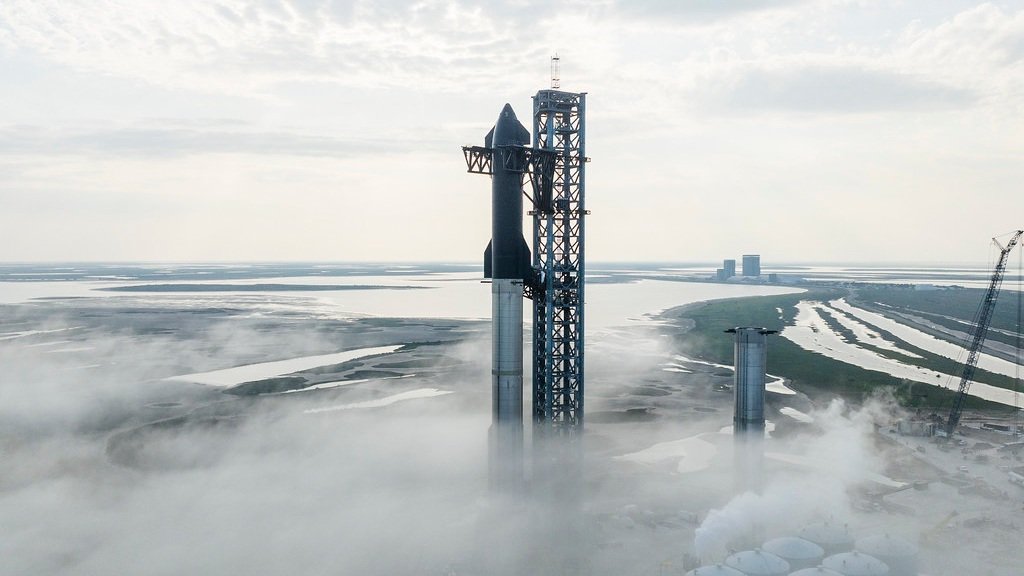
Elon Musk declared Starship Booster 22 Problem is Worse than We Thought: SpaceX’s ambitious Starship development program has encountered another major challenge after Super Heavy Booster 22 failed to complete its planned tower catch attempt. Instead of returning safely to the launch tower, the massive booster diverted toward an offshore splashdown, where it ultimately exploded following the activation of its Flight Termination System (FTS). The incident has raised important questions about the reliability of Starship’s recovery systems and the technical challenges SpaceX must overcome before achieving routine booster catches.
Although the launch and several major flight milestones went according to plan, a problem involving the booster’s Guidance, Navigation, and Control (GNC) system prevented the planned recovery. The incident also attracted attention because of unusual green coloring in parts of the exhaust plume.
However, Booster 22’s flight was not entirely unsuccessful. Several important V3 performance milestones demonstrated meaningful progress toward SpaceX’s long-term goal of making Starship fully reusable.
What Happened to Starship Booster 22?
The biggest disappointment of Booster 22’s flight was the cancellation of its planned return to the launch tower. SpaceX had hoped to demonstrate another successful Super Heavy booster catch, but the vehicle was forced to follow a contingency recovery path.
According to the flight analysis discussed in the episode, SpaceX had not successfully caught a Super Heavy booster since Flight 8 on March 6, 2025. With six subsequent flights passing without another successful booster catch, Booster 22 extended the unsuccessful streak to seven consecutive flights.
Several possible explanations initially attracted attention, including engine problems, communication failures, insufficient tank pressurization, and tower readiness. However, live commentary during the flight pointed toward a GNC system issue as the likely reason for the aborted recovery.
Why Did SpaceX Abort the Tower Catch?
The flight initially appeared successful. Starship lifted off, completed its ascent, and performed hot staging and stage separation without major problems.
During the boost-back maneuver, 32 of the booster’s 33 Raptor engines fired to redirect the vehicle toward its launch site. The go-for-catch command also remained active during the earlier phases.
However, a problem detected later during the coast phase forced SpaceX to abandon the tower recovery.
Instead of attempting a potentially dangerous landing, Booster 22 diverted toward the ocean for a contingency descent. After splashing down, its Flight Termination System was activated, followed by the explosion.
This decision highlights an important principle behind SpaceX’s recovery operations: safety comes before a successful tower catch.
Understanding the GNC System Failure
The most important technical question surrounding Booster 22 is why its Guidance, Navigation, and Control system encountered problems.
The GNC system is essential for controlling a rocket during flight. It combines multiple technologies to determine where the vehicle is, where it needs to go, and how its engines and control systems should respond.
Guidance, Navigation, and Control Explained
Each part of the GNC system performs a different responsibility:
- Guidance: Determines the vehicle’s intended flight path and trajectory.
- Navigation: Estimates the rocket’s position, velocity, and orientation.
- Control: Sends commands to engines and other systems to maintain the required trajectory.
A tower catch requires extremely precise positioning. The booster must approach the launch tower at the correct speed, angle, and location.
Even a relatively small uncertainty in its position or orientation can create significant risks during the final descent.
If the GNC system cannot confidently confirm that the booster is following a safe trajectory, attempting a tower catch could endanger the launch infrastructure and surrounding areas.
Could the Same Problem Affect Ship 42?
Another important concern involves Starship Ship 42, which also needs reliable navigation and control systems during its return.
If Booster 22 experienced a software, sensor calibration, or hardware integration problem, SpaceX will need to understand the root cause before future flights.
The company must ensure that similar issues do not affect other vehicles, particularly during critical landing and recovery operations.
Why Did Booster 22’s Exhaust Turn Green?
Another unusual detail from the flight was the green-colored exhaust plume that appeared during the later stages of the booster’s descent.
The unusual appearance quickly attracted attention across social media, with Starship observers discussing possible explanations.
One scientific explanation involves atomic emission spectroscopy.
When atoms or ions become highly energized, their electrons can move into higher energy states. As those electrons return to lower energy levels, they release photons at specific wavelengths. Depending on the elements involved, those wavelengths can produce different visible colors.
Could Copper Have Caused the Green Exhaust?
Copper-containing compounds are known to produce green or blue-green light under suitable conditions.
Raptor engines operate using liquid methane and liquid oxygen, while copper alloys are used in certain engine components because of their excellent thermal conductivity.
This has led to speculation that copper-related materials could have contributed to the unusual exhaust color.
However, the green plume does not automatically prove that Booster 22 experienced combustion chamber damage or a specific engine failure.
Other explanations, including changes in the combustion environment or propellant mixture, have also attracted attention.
Without detailed telemetry, material analysis, and hardware inspections, the exact cause remains uncertain.
V3 Super Heavy Booster Performance Shows Major Progress
Despite the aborted tower catch, Booster 22 achieved several important milestones that demonstrate how far SpaceX has progressed with its next-generation Super Heavy hardware.
The booster successfully completed liftoff, ascent, hot staging, and controlled descent before the recovery was diverted.
One particularly important achievement involved the performance of its 33 Raptor engines during launch.
Important V3 Booster Milestones
The flight demonstrated several encouraging developments:
- All 33 engines successfully ignited at liftoff.
- Hot staging and stage separation were completed cleanly.
- The landing burn progressed through the 13-to-5-to-3 engine sequence.
- The booster demonstrated controlled descent toward the ocean.
- It achieved approximately three seconds of hovering above the water.
One outer-ring engine reportedly failed to relight during the boost-back phase, but the booster continued through several important flight milestones.
The landing burn sequence was particularly significant because it demonstrated the vehicle’s ability to transition between different engine configurations during its return.
Why the Three-Second Hover Matters
The approximately three-second hover was an encouraging demonstration of controlled descent performance.
A Super Heavy booster must manage enormous mass, engine thrust, and aerodynamic forces while approaching its recovery point.
Demonstrating a controlled hover above the ocean provides valuable information about engine performance, flight control, and landing procedures.
Although the booster did not complete the planned tower catch, these achievements can help SpaceX improve future V3 vehicles.
Can SpaceX Fix the Problem Before Starship Flight 16?
The next major question is whether SpaceX can resolve the GNC issue before Starship Flight 16.
The answer depends heavily on identifying the underlying cause.
If the problem originated from software, sensor calibration, or system integration, engineers may be able to implement corrections without requiring extensive hardware redesign.
However, if the investigation reveals a deeper hardware problem, additional testing and modifications could be necessary.
What to Expect From Flight 16
Flight 16 will be another important opportunity to demonstrate improvements in Starship’s launch and recovery systems.
SpaceX will need to validate several critical capabilities, including:
- Reliable Raptor engine ignition and performance.
- Accurate boost-back guidance.
- Stable navigation throughout the return flight.
- Reliable landing burn transitions.
- Precise positioning for the tower catch.
A successful recovery would represent a major milestone for the Starship program.
However, another attempt should depend on the results of the Booster 22 investigation rather than simply maintaining an aggressive flight schedule.
SpaceX’s Florida-to-Starbase Recovery Strategy
Beyond Flight 16, SpaceX is also preparing for a broader expansion of its Starship launch and recovery infrastructure.
The company has been developing its Florida launch operations, creating opportunities for future missions from different launch sites.
SpaceX vice president of launch Kiko Dontchev has discussed a potential Florida-to-Starbase cross-site recovery concept.
Under this approach, a Super Heavy booster could launch and return to a recovery tower in Florida, while the Starship upper stage could travel back toward Starbase in Texas.
This concept would demonstrate the flexibility of SpaceX’s future launch infrastructure.
However, the timing and exact flight assignment remain uncertain. SpaceX must first establish reliable launch, landing, and recovery operations before routinely coordinating recoveries across different locations.
Final Thoughts: Booster 22’s Failure Could Make Starship Stronger
The Booster 22 incident is another reminder that developing a fully reusable super-heavy launch system involves enormous technical challenges.
The aborted tower catch and subsequent offshore explosion were disappointing, especially after a long wait for another successful Super Heavy recovery.
Nevertheless, the flight delivered valuable information about GNC reliability, Raptor engine performance, landing burn transitions, and controlled descent.
The unusual green exhaust plume also created important questions that will require detailed engineering analysis.
For SpaceX, the priority now is identifying exactly what went wrong, improving the relevant systems, and applying those lessons to future V3 boosters.
Starship Flight 16 could become another important milestone if the necessary corrections are completed.
Ultimately, Booster 22 did not deliver the double-catch achievement many Starship fans were hoping to see. But its flight provided valuable engineering data that could bring SpaceX closer to its ultimate objective: making Starship a fully reusable launch system capable of supporting frequent, reliable, and affordable spaceflight.
FAQs
1. What happened to SpaceX Starship Booster 22?
SpaceX’s Super Heavy Booster 22 failed to complete its planned tower catch and diverted toward an offshore splashdown after experiencing a suspected Guidance, Navigation, and Control (GNC) system issue. Its Flight Termination System was activated after splashdown, followed by an explosion.
2. Why did Booster 22 abort its tower catch?
Booster 22 aborted its tower catch because of a reported GNC system problem detected during the coast phase. The issue prevented SpaceX from confidently proceeding with the planned recovery.
3. What does GNC mean in SpaceX Starship?
GNC stands for Guidance, Navigation, and Control. It is the system responsible for determining the rocket’s trajectory, tracking its position and orientation, and controlling its engines and other flight systems.
4. Did Booster 22 successfully launch?
Yes. Booster 22 successfully lifted off and completed several important flight milestones, including ascent, hot staging, and stage separation before its recovery attempt was aborted.
5. How many Raptor engines fired during Booster 22’s boost-back burn?
According to the flight analysis, 32 of Booster 22’s 33 Raptor engines fired during the boost-back maneuver toward the launch site.
6. Why did Booster 22’s exhaust plume turn green?
The unusual green exhaust plume may be related to copper-containing compounds or changes in the combustion environment. However, the exact explanation has not been confirmed through publicly available telemetry and hardware analysis.
7. Does green exhaust mean Booster 22 suffered engine damage?
No. Green exhaust does not automatically indicate combustion chamber damage or engine failure. Additional telemetry, inspection, and engineering analysis are necessary to determine its actual cause.
8. What is the Flight Termination System (FTS) on Starship?
The Flight Termination System (FTS) is a safety mechanism designed to terminate a vehicle’s flight when required. It helps prevent an uncontrolled rocket from creating greater risks during an abnormal flight situation.
9. When was SpaceX’s previous successful Super Heavy booster catch?
The previous successful Super Heavy booster catch discussed in the episode occurred during Starship Flight 8 on March 6, 2025.
10. How many consecutive flights have passed without a successful booster catch?
Following the previous successful catch on Flight 8, Booster 22 extended the streak to seven consecutive flights without a successful Super Heavy booster catch.
11. What were the major achievements of Booster 22’s flight?
Booster 22 demonstrated successful liftoff, clean hot staging, stage separation, boost-back operations, landing burn transitions, and approximately three seconds of controlled hovering above the ocean.
12. What does the 13-to-5-to-3 landing burn sequence mean?
The 13-to-5-to-3 engine sequence describes how the booster transitions between different numbers of operating Raptor engines during its landing burn. This allows it to manage thrust and control during its descent.
13. Could the Booster 22 GNC problem affect Starship Ship 42?
Potentially. SpaceX will need to investigate whether the problem involved shared software, sensor calibration, or hardware integration. Understanding the root cause is important to ensure that similar issues do not affect Ship 42 or future Starship vehicles.
14. Can SpaceX fix the Booster 22 problem before Starship Flight 16?
It is possible. If the problem involves software, sensor calibration, or system integration, engineers may be able to implement corrections relatively quickly. However, a more serious hardware issue could require additional testing and modifications.
15. What is SpaceX’s Florida-to-Starbase cross-site recovery plan?
The proposed cross-site recovery concept involves launching Starship from Florida, catching the Super Heavy booster in Florida, and returning the Starship upper stage to Starbase in Texas. The concept would demonstrate greater flexibility across SpaceX’s launch and recovery infrastructure.
16. Will Starship Flight 16 achieve another successful booster tower catch?
A successful tower catch during Starship Flight 16 remains possible, depending on the investigation into Booster 22’s GNC problem and the corrections SpaceX implements. The next flight could provide another important opportunity to advance Starship’s full reusability goals.
Read More:
- New Tesla’s Giga Press 50.000 Tons Destroy The Entire EV Industry
- Tesla Full Self-Driving v15: Reality View review, new features explained
- Tesla’s Unsupervised FSD future likely to bring Starlink to every model
- Tesla and SpaceXAI CEO Elon Musk reacts to Jensen Huang’s NVIDIA return
- Tesla FSD v15’s ‘Reality View’ has one complaint and Musk has the solution
1 thought on “Elon Musk declared Starship Booster 22 Problem is Worse than We Thought”