
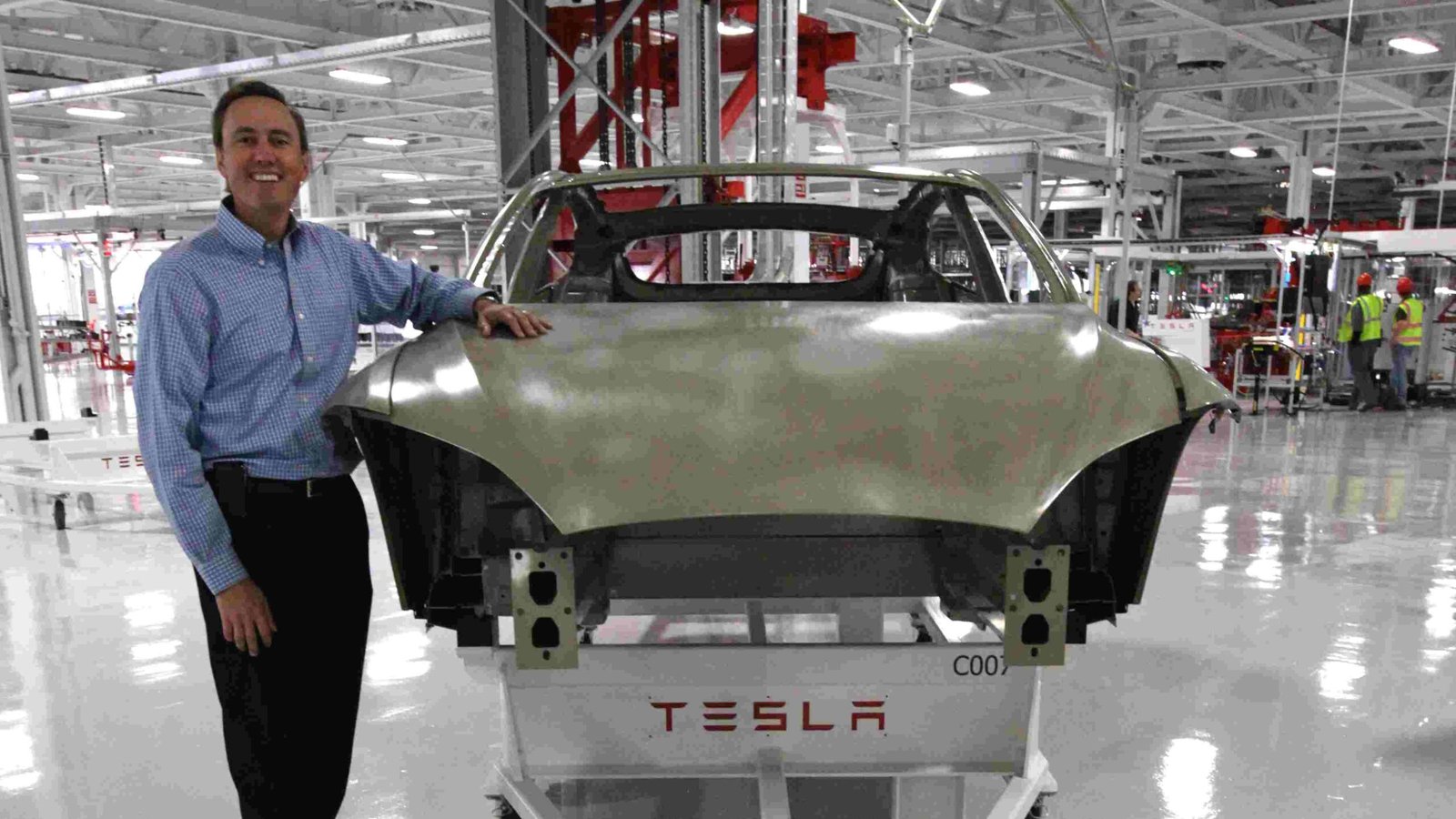
New Tesla’s Giga Press 50.000 Tons Destroy The Entire EV Industry: The automotive industry could be approaching one of its biggest manufacturing revolutions, and Tesla’s next-generation Giga Press may be at the center of it. Imagine a factory producing a new vehicle in less than 10 seconds, powered by a gigantic casting machine capable of applying up to 50,000 tons of clamping force. This ambitious vision could completely transform how electric vehicles are designed, manufactured, and delivered.
For decades, traditional automobile manufacturing has depended on hundreds of individual metal components, welding operations, stamping machines, and complicated assembly processes. Tesla wants to challenge this approach by introducing ultra-large aluminum castings, advanced automation, and faster production systems.
The proposed 50,000-ton Tesla Giga Press represents a significant step toward making automobile production faster, more efficient, and increasingly similar to consumer electronics manufacturing. If successfully developed and implemented, this technology could give Tesla a major manufacturing advantage over competing EV companies.
Tesla’s 50,000-Ton Giga Press: A New Era of Manufacturing
Tesla originally introduced its large-scale casting strategy during the development of the Model Y. Instead of manufacturing a vehicle structure using numerous smaller stamped metal components, Tesla began replacing complicated assemblies with massive single-piece aluminum castings.
This approach significantly reduced the number of individual parts required to manufacture a vehicle.
From Model Y Giga Press to Next-Generation Casting Machines
Developing these machines was not easy. Traditional equipment manufacturers struggled to build casting presses large enough to meet Tesla’s requirements.
Tesla eventually partnered with Italian manufacturer IDRA, which helped develop enormous high-pressure die-casting machines operating in the 6,000-ton to 9,000-ton range.
These machines became important parts of Tesla’s manufacturing strategy, supporting vehicles such as the Model Y and Cybertruck.
However, Tesla’s ambitions are moving toward an even larger scale.
According to the manufacturing concept discussed in the video, Tesla’s proposed fourth-generation 50,000-ton Giga Press could introduce significantly greater casting capacity, faster production cycles, and the ability to manufacture structural components for multiple vehicles simultaneously.
Producing a Vehicle in Less Than 10 Seconds
One of the most ambitious claims surrounding Tesla’s next-generation manufacturing strategy is its goal of producing a new vehicle every 10 seconds or less.
Earlier casting systems already helped Tesla simplify production, but the proposed next-generation equipment aims to push manufacturing speed much further.
A faster casting process could help Tesla:
- Reduce vehicle production time.
- Increase factory manufacturing capacity.
- Lower labor requirements.
- Reduce unnecessary assembly operations.
- Improve manufacturing efficiency.
- Support large-scale autonomous vehicle production.
However, a 10-second vehicle production target should be understood as an ambitious manufacturing objective, not a confirmed complete-vehicle assembly cycle.
How Tesla’s Giant Giga Press Works
Behind the enormous size of the Giga Press is a carefully controlled manufacturing process. Despite its massive dimensions, the machine uses the same fundamental principles as conventional high-pressure aluminum die casting.
The difference comes from the scale, pressure, automation, and precision involved.
1. Melting and Preparing Aluminum
The process begins with aluminum ingots and recycled casting materials entering specialized melting and holding systems.
According to the video, Tesla’s described setup includes two furnace systems:
- A natural gas melting furnace operating at approximately 850°C.
- An electric holding furnace maintaining temperatures between 750°C and 850°C.
Maintaining the correct temperature is essential because aluminum must remain sufficiently fluid before injection.
Recycled aluminum trim can also be returned to the production process, helping reduce material waste and improve resource efficiency.
2. Removing Impurities and Trapped Gas
Before molten aluminum enters the casting machine, it must undergo purification.
Unwanted gases, particles, and impurities can create weaknesses inside the finished component.
The process described in the video includes:
- A nitrogen atmosphere inside the holding furnace.
- Argon rotary degassing to remove trapped gases.
- Silicon carbide filtration to capture particles larger than approximately 25 microns.
This preparation helps improve the quality and structural reliability of the final aluminum casting.
3. Injecting Molten Aluminum Into the Mold
Once the aluminum is ready, the casting machine prepares its steel mold.
The mold surfaces receive lubrication, and a vacuum system removes air before molten aluminum enters the cavity.
The video describes approximately 35 milliliters of soybean oil being sprayed onto the mold and around 8 milliliters of lubricant being applied to the high-speed piston per cycle.
The molten aluminum is then injected into the mold under extremely high pressure.
This stage requires exceptional precision. Injecting aluminum too quickly can trap air bubbles, while injecting it too slowly can cause premature cooling before the metal completely fills the mold.
4. Cooling, Ejection, and Inspection
After the aluminum fills the mold, the component begins solidifying.
The video describes several important temperature and production controls:
- Cast components are ejected at approximately 400°C.
- Quenching reduces their temperature to around 50°C.
- Mold temperatures are maintained near 185°C.
- A typical casting cycle takes approximately one to two minutes.
After cooling, the component undergoes inspection, including X-ray testing, to identify potential internal defects.
Excess aluminum trim is collected and recycled, supporting a more efficient manufacturing system.
Why 50,000 Tons of Clamping Force Matters
A Giga Press needs enormous clamping force because molten aluminum enters its mold under extreme injection pressure.
Without sufficient locking force, the pressure could push the two halves of the steel mold apart.
This could cause aluminum leakage, manufacturing defects, and potentially damage the equipment.
A proposed 50,000-ton clamping system would represent an extraordinary engineering challenge, requiring highly specialized structural components, hydraulic systems, precision controls, and advanced cooling technology.
The goal is not simply to build the biggest machine. Tesla needs a complete manufacturing ecosystem capable of operating reliably at extremely high production volumes.
Tesla’s Giga Press Could Transform Vehicle Design
One of the biggest advantages of giga casting is its ability to replace numerous individual components with larger structural sections.
Traditional vehicle manufacturing often requires hundreds of separate parts connected through welding, fastening, and assembly operations.
Large aluminum castings can simplify this architecture.
Fewer Components, Less Weight, and Faster Assembly
The video highlights a reported reduction in major structural components from approximately 200 in the Model Y to just 80 in the Cybercab.
This illustrates how Tesla is exploring simpler vehicle architectures.
Fewer structural components could provide several advantages:
- Lower manufacturing complexity: Fewer individual parts need to be produced and assembled.
- Reduced vehicle weight: Optimized aluminum structures can eliminate unnecessary material.
- Improved structural rigidity: Large integrated components can reduce the number of joints.
- Lower labor requirements: Fewer welding and assembly operations are necessary.
- Reduced production costs: Simplified manufacturing can improve factory efficiency.
These benefits could become especially important for Tesla’s future autonomous vehicles.
Supporting the Cybercab and Future Tesla Models
The Tesla Cybercab represents a major opportunity for simplified manufacturing.
Unlike conventional vehicles designed around traditional steering and driving controls, autonomous vehicles could use different interior layouts and structural architectures.
A highly integrated casting system could help Tesla manufacture these vehicles with fewer components and less assembly complexity.
The proposed next-generation Giga Press is therefore closely connected to Tesla’s broader ambitions in robotaxis, autonomous transportation, and mass-market electric mobility.
Tesla’s Manufacturing Strategy and the Global EV Competition
Tesla is not the only automaker investing in large-scale casting technology.
Companies such as General Motors, Hyundai, Volvo, Zeekr, and XPeng are also exploring manufacturing approaches that reduce the number of individual vehicle components.
XPeng, for example, has invested in a large casting machine reportedly operating in the 16,000-ton class.
This demonstrates that giga casting is becoming an increasingly important part of the global automotive manufacturing race.
Tesla’s proposed 50,000-ton machine could provide a significant technological advantage if its performance and production economics meet expectations.
At the same time, competitors are developing their own solutions, meaning Tesla will need more than an impressive machine to maintain its position.
Its success will depend on manufacturing reliability, vehicle demand, production costs, quality control, and the ability to scale factories efficiently.
The Future of Tesla’s Giga Press Technology
A 50,000-ton casting machine cannot transform a factory by itself.
Tesla would need advanced mold-release systems, rapid cooling infrastructure, automated part handling, robotic trimming, and AI-powered real-time inspection to achieve its ambitious production targets.
The company must also balance manufacturing speed with structural quality and long-term vehicle durability.
The video additionally discusses changes to Tesla’s factory automation strategy, including a reduction in robotic arms compared with earlier production arrangements.
This suggests that the future of manufacturing may not necessarily require more robots. Instead, it could depend on smarter machines, simplified production processes, and better factory integration.
Tesla’s reported plans to discontinue Cybertruck production due to weaker demand are also mentioned in the video, although such a major strategic change should not be treated as confirmed without an official company announcement.
Conclusion: Could Tesla’s 50,000-Ton Giga Press Change the EV Industry?
Tesla’s proposed 50,000-ton Giga Press represents an ambitious vision for the future of automobile manufacturing.
By combining enormous casting machines, simplified vehicle structures, advanced automation, and faster production systems, Tesla aims to reduce manufacturing complexity while increasing production capacity.
The possibility of producing vehicles at dramatically faster rates could reshape the economics of electric vehicle manufacturing.
However, the real challenge will be turning these ambitious targets into reliable, high-volume production.
If Tesla successfully develops this next-generation manufacturing ecosystem, its impact could extend far beyond the company itself. Competitors may need to rethink their factory designs, production strategies, and vehicle architectures.
The future of the automotive industry may not be decided only by battery range, charging speed, or software. It could also be decided by which company can manufacture the best vehicles faster, cheaper, and more efficiently.
FAQs
1. What is Tesla’s 50,000-ton Giga Press?
Tesla’s proposed 50,000-ton Giga Press is a next-generation aluminum die-casting machine designed to manufacture large vehicle structural components using extreme clamping force. It aims to simplify vehicle production and increase manufacturing efficiency.
2. How powerful is Tesla’s new Giga Press?
The proposed machine is designed around an extraordinary 50,000 tons of clamping force, significantly exceeding the 6,000- to 9,000-ton machines used in earlier Tesla manufacturing applications.
3. Can Tesla produce a vehicle in less than 10 seconds?
Tesla’s manufacturing vision includes a target of producing a vehicle in less than 10 seconds. However, this is an ambitious production objective rather than a confirmed complete-vehicle assembly cycle.
4. Who manufactures Tesla’s Giga Press machines?
Tesla partnered with IDRA, an Italian manufacturer specializing in large high-pressure die-casting equipment, to develop its earlier Giga Press machines.
5. Why is Tesla developing a 50,000-ton Giga Press?
Tesla aims to reduce manufacturing complexity, eliminate unnecessary components, lower production costs, and increase vehicle production speed through large-scale aluminum casting.
6. How does the Tesla Giga Press work?
The Giga Press melts aluminum, prepares and purifies the molten metal, injects it into a specialized steel mold under high pressure, and then cools and ejects the finished structural component for inspection.
7. What temperature does Tesla use to melt aluminum?
According to the video, the natural gas melting furnace operates at approximately 850°C, while the electric holding furnace maintains temperatures between 750°C and 850°C.
8. What vehicles benefit from Tesla’s Giga Press technology?
Tesla has used large-scale casting technology in vehicles such as the Model Y and Cybertruck. Future applications could include the Cybercab and other next-generation electric vehicles.
9. How does giga casting reduce vehicle manufacturing costs?
Giga casting replaces numerous smaller metal components and welding operations with larger integrated structures. This can reduce assembly time, labor requirements, manufacturing complexity, and material waste.
10. How many structural components can giga casting eliminate?
The video highlights a reported reduction in major structural components from approximately 200 in the Model Y to around 80 in the Cybercab, demonstrating the potential of simplified vehicle architecture.
11. Why is clamping force important in a Giga Press?
Clamping force keeps the steel mold securely closed during high-pressure aluminum injection. Without sufficient force, molten aluminum could escape between the mold halves, creating defects and damaging production equipment.
12. How does Tesla ensure the quality of aluminum castings?
Tesla’s described casting process includes argon degassing, nitrogen protection, filtration, controlled cooling, and X-ray inspection to identify potential internal defects and improve component quality.
13. Are other automakers developing giga casting technology?
Yes. Companies including General Motors, Hyundai, Volvo, Zeekr, and XPeng are investing in large-scale casting technology to simplify vehicle production and compete in the electric vehicle market.
14. Will Tesla’s 50,000-ton Giga Press support Cybercab production?
The proposed technology could support future Cybercab manufacturing by producing large structural components with fewer individual parts, potentially improving production speed and factory efficiency. Its specific production role remains subject to confirmation.
15. Could Tesla’s 50,000-ton Giga Press change the entire EV industry?
Potentially, yes. If Tesla successfully implements the technology at scale, it could establish new manufacturing standards through faster production, fewer components, lower assembly costs, and highly automated factories. Competitors may need to adopt similar innovations to remain competitive.
Read More:
- Tesla Full Self-Driving v15: Reality View review, new features explained
- Tesla’s Unsupervised FSD future likely to bring Starlink to every model
- Tesla and SpaceXAI CEO Elon Musk reacts to Jensen Huang’s NVIDIA return
- Tesla FSD v15’s ‘Reality View’ has one complaint and Musk has the solution
- IT’HERE! Tesla Cell Phone Release Date: Pi Phone 2027 $199, Starlink, titanium, microLED
1 thought on “New Tesla’s Giga Press 50.000 Tons Destroy The Entire EV Industry”