
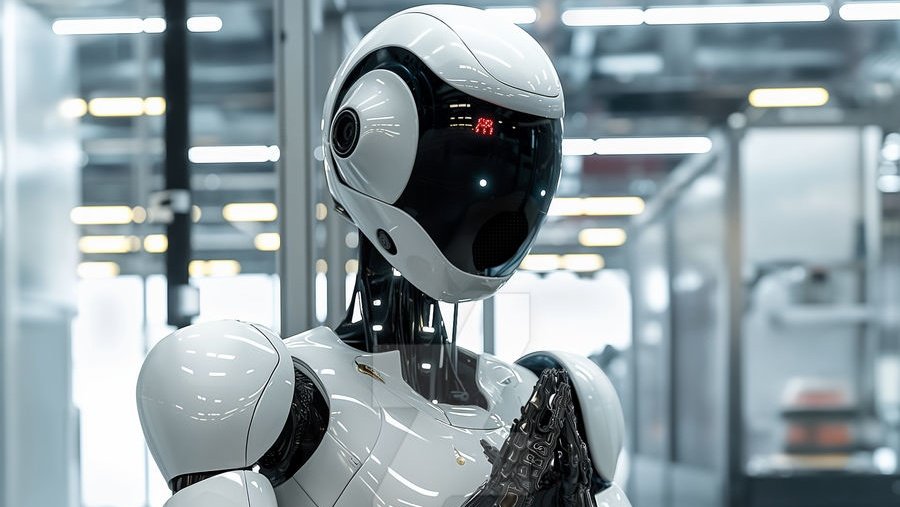
Elon Musk Drops Massive UPDATE On Tesla Bot Optimus: Tesla has officially signaled one of the biggest strategic shifts in its history. During the Tesla Q2 2026 earnings call, Elon Musk and Tesla’s VP of AI Software, Ashok Elluswamy, revealed that Optimus, Tesla’s humanoid robot, is no longer an experimental side project. Instead, it is becoming one of the company’s most important long-term growth initiatives.
For years, investors associated Tesla primarily with electric vehicles (EVs), battery technology, and Full Self-Driving (FSD) software. Now, Tesla is applying the same artificial intelligence that powers its autonomous vehicles to humanoid robotics.
From dismantling vehicle production lines at the Fremont Factory to building dedicated robot assembly infrastructure and designing custom AI chips, Tesla is laying the groundwork for mass-producing intelligent humanoid robots.
In this article, we’ll explore everything announced by Tesla and what it means for the future of robotics.
Tesla Makes a Historic Shift Toward Robotics
The clearest sign of Tesla’s changing priorities is its decision to remove the Model S and Model X production line at its Fremont Factory.
Instead of manufacturing luxury electric vehicles in that space, Tesla is converting the facility into the company’s first dedicated Optimus production line.
This move demonstrates that Tesla views Optimus as far more than a research project. The company is investing real manufacturing resources into scaling humanoid robots for future commercial deployment.
Unlike previous robot demonstrations, Tesla is now transitioning from prototypes to an actual manufacturing process.
Optimus Gen 3 Production Begins in Q3 2026
Tesla confirmed that Optimus Gen 3 production will officially begin during Q3 2026.
However, Elon Musk emphasized that production will intentionally remain slow during the initial rollout.
Rather than chasing production volume immediately, Tesla wants to refine every aspect of the manufacturing process.
The early production phase focuses on:
- Validating assembly line efficiency
- Testing robot durability
- Collecting real-world operational data
- Identifying manufacturing bottlenecks
- Improving actuator reliability
This measured approach mirrors Tesla’s strategy during the early days of Model 3 production, where continuous improvements ultimately enabled mass manufacturing.
The Optimus Academy: Tesla’s Secret Training Program
Instead of selling early Optimus robots to customers, Tesla will deploy them internally through a new initiative called the Optimus Academy.
This internal program allows robots to perform real factory tasks while continuously learning from their experiences.
Each Optimus robot gathers enormous amounts of visual and operational data using onboard cameras and sensors.
That information is processed through Tesla’s AI systems before software updates are distributed across the entire robot fleet.
This creates a continuous feedback loop where every robot benefits from the experience of every other robot.
The result is fleet-wide learning, similar to how Tesla vehicles improve through over-the-air software updates.
How Tesla Uses Full Self-Driving AI for Optimus
Perhaps the most exciting announcement came from Ashok Elluswamy, who explained that Tesla is adapting its Full Self-Driving neural network architecture for humanoid robotics.
The underlying concept remains remarkably similar.
Full Self-Driving Pipeline
- Cameras capture real-world images.
- AI analyzes the environment.
- The system outputs steering, acceleration, and braking commands.
Optimus Pipeline
- Cameras capture surrounding objects.
- AI understands spatial relationships.
- The robot generates joint movement, wrist rotation, finger control, and force adjustments.
Instead of controlling wheels, the AI now controls arms, hands, shoulders, knees, and fingers.
Tesla describes this as a “Pixels-to-Torque” neural network, converting visual information directly into physical movement.
Teaching Optimus Like a Human
Traditional industrial robots require extensive programming before completing even simple tasks.
Tesla wants Optimus to learn naturally.
Rather than relying solely on hard-coded instructions, the robot will learn from multiple data sources.
Human Demonstrations
Tesla employees wear motion-capture equipment while performing factory tasks.
These demonstrations teach Optimus how humans manipulate tools, carry objects, and complete assembly work.
Internet Video Learning
Tesla is also training Optimus using millions of publicly available instructional videos.
By observing human behavior across countless scenarios, the robot can develop broader reasoning abilities beyond factory environments.
This dramatically expands the robot’s potential capabilities.
Digital Optimus Accelerates AI Training
Physical robots are expensive and time-consuming to manufacture.
To overcome this limitation, Tesla created a virtual version known as Digital Optimus.
Inside highly realistic physics simulations, virtual robots practice thousands of tasks at incredible speed.
Once these AI models master new behaviors, Tesla transfers the learned neural network weights into real-world Optimus robots.
This approach significantly reduces development time while accelerating robot intelligence.
Engineering Challenges Tesla Must Solve
While AI software advances rapidly, building humanoid hardware presents major engineering challenges.
Human-Level Hand Dexterity
The human hand is incredibly complex.
Tesla must fit multiple:
- Micro-actuators
- Force sensors
- Cable-driven tendons
- Precision motors
into a compact robotic hand.
The robot must lift heavy industrial parts while maintaining enough precision to handle delicate objects without crushing them.
Its AI also needs to detect slipping objects and instantly adjust grip strength in real time.
Robot Safety Systems
An Optimus robot weighs approximately 70 kilograms (154 pounds).
A malfunction could create serious workplace hazards.
Tesla is developing multiple safety layers, including:
- Fault detection systems
- Passive joint locking
- Controlled shutdown modes
- Graceful collapse mechanisms
These systems help prevent injuries if power loss or hardware failures occur.
Tesla’s Biggest Supply Chain Challenge
Unlike automobiles, there is currently no mature global supply chain for humanoid robots.
Many industrial robotic components are simply too large, too heavy, or too power-hungry for Optimus.
As a result, Tesla is designing many parts internally.
These include:
- Custom actuators
- Planar gearboxes
- Lightweight circuit boards
- Compact battery systems
- Purpose-built control electronics
This vertical integration mirrors Tesla’s strategy in electric vehicle manufacturing.
Custom AI Chips Power Optimus
Real-time robotics requires enormous computing power.
Every watt consumed by onboard processors reduces battery life.
To maximize efficiency, Tesla is developing custom semiconductor solutions while working with manufacturing partners like TSMC, Samsung, and Micron.
These companies help supply advanced AI chips and high-bandwidth memory required for onboard neural network inference.
However, Tesla must compete with cloud providers, smartphone manufacturers, and AI data centers for access to cutting-edge semiconductor technology.
This makes silicon availability one of the biggest risks to large-scale robot production.
From Fremont to Giga Texas
Tesla’s roadmap follows a clear two-stage strategy.
Optimus Gen 3
- Initial production at Fremont
- Internal deployment
- Manufacturing optimization
- AI data collection
Optimus Gen 4
The next generation will move to Gigafactory Texas, where Tesla plans to scale production dramatically.
Gen 4 is expected to feature:
- Higher in-house component usage
- Simplified wiring
- Improved joint design
- Greater manufacturing automation
- Lower production costs
The lessons learned from Fremont will directly shape Tesla’s high-volume robot factory in Texas.
Why This Could Be Tesla’s Biggest Business Yet
Tesla’s decision to sacrifice established vehicle production capacity in favor of humanoid robot manufacturing marks one of the company’s boldest strategic moves.
Instead of relying solely on electric vehicle sales, Tesla is positioning itself at the center of the rapidly growing AI robotics industry.
By combining artificial intelligence, custom semiconductor design, advanced manufacturing, and autonomous learning, Tesla hopes to become the first company capable of mass-producing intelligent humanoid robots.
If Optimus succeeds, it could transform industries ranging from manufacturing and logistics to healthcare and household assistance.
For Tesla, this isn’t simply about building another product—it represents the next evolution of the company’s mission to automate physical labor using artificial intelligence.
Conclusion
The latest Tesla update confirms that Optimus has evolved from an ambitious concept into a core pillar of the company’s future. With Optimus Gen 3 entering production, the launch of the Optimus Academy, AI models powered by Tesla’s Full Self-Driving technology, and plans for large-scale manufacturing at Gigafactory Texas, Tesla is making one of the most significant bets in the history of robotics.
While major challenges remain—including hardware engineering, safety, custom components, and semiconductor supply—the company is leveraging its expertise in AI, software, and manufacturing to solve them. If Tesla executes successfully, Optimus could redefine how businesses and households use intelligent machines, opening a new era where humanoid robots become as transformative as electric vehicles.
FAQs
1. What is Tesla Optimus?
Tesla Optimus is a humanoid robot developed by Tesla to perform repetitive, dangerous, and labor-intensive tasks. It uses advanced artificial intelligence and computer vision technology derived from Tesla’s Full Self-Driving (FSD) system.
2. Why is Tesla focusing on Optimus instead of just electric cars?
Tesla believes humanoid robots could become a major future business. By expanding beyond electric vehicles, the company aims to automate physical work across factories, warehouses, businesses, and eventually homes.
3. When will Tesla Optimus Gen 3 enter production?
Tesla confirmed that Optimus Gen 3 is scheduled to begin production in Q3 2026 at its Fremont Factory, although the initial production ramp will be intentionally slow.
4. What is the Optimus Academy?
The Optimus Academy is Tesla’s internal training program where early Optimus robots perform real factory tasks. The robots continuously collect data that helps improve AI performance before wider commercial deployment.
5. How does Tesla Optimus use Full Self-Driving technology?
Optimus uses a similar end-to-end neural network architecture as Tesla’s Full Self-Driving system. Instead of controlling a vehicle, the AI converts camera inputs into movements for the robot’s joints, hands, arms, and fingers.
6. Can Tesla Optimus learn new tasks on its own?
Yes. Tesla is designing Optimus to understand natural language instructions, observe its surroundings, and learn new tasks using AI, human demonstrations, simulation, and real-world experience instead of relying only on pre-programmed commands.
7. What is Digital Optimus?
Digital Optimus is Tesla’s virtual simulation platform where AI models train inside realistic physics environments. After mastering tasks in simulation, the learned behaviors are transferred to physical robots.
8. Why did Tesla remove the Model S and Model X production line?
Tesla dismantled part of the Model S and Model X assembly line at the Fremont Factory to create space for its first dedicated Optimus manufacturing line, signaling a major shift toward humanoid robot production.
9. What challenges does Tesla face in building Optimus?
Tesla must overcome several challenges, including designing human-like robotic hands, improving battery efficiency, reducing heat generation, ensuring workplace safety, and creating a reliable supply chain for specialized robot components.
10. How heavy is the Tesla Optimus robot?
According to Tesla, Optimus weighs approximately 70 kilograms (154 pounds). Because of its size and weight, Tesla is developing advanced safety systems to prevent accidents during operation.
11. Does Tesla design its own hardware for Optimus?
Yes. Tesla is developing many custom components, including actuators, gearboxes, batteries, circuit boards, and control electronics to improve performance and reduce manufacturing costs.
12. Which companies supply chips for Tesla Optimus?
Tesla works with semiconductor manufacturers such as TSMC and Samsung for AI chip fabrication, while Micron supplies high-density memory needed for onboard AI processing.
13. Where will Tesla build future Optimus robots?
Early Optimus Gen 3 robots will be assembled at the Fremont Factory, while future high-volume production of Optimus Gen 4 is planned for Gigafactory Texas.
14. What industries could Tesla Optimus transform?
Optimus has the potential to assist in manufacturing, logistics, warehouse operations, retail, healthcare, construction, hospitality, and household tasks, helping automate repetitive or physically demanding work.
15. Will Tesla Optimus be available for consumers?
Tesla has not announced a consumer launch date. The company’s current focus is on internal deployment, AI training, manufacturing optimization, and improving robot performance before broader commercial availability.
16. Why is Tesla Optimus considered a major breakthrough in robotics?
Optimus combines advanced AI, computer vision, neural networks, custom hardware, and scalable manufacturing. If Tesla succeeds in mass-producing intelligent humanoid robots, Optimus could reshape industries much like electric vehicles transformed transportation.
Read More:
- Tesla stock tumbles after earnings, one of its sharpest single-day declines
- SpaceX Starship Flight 13 faces wrath of the Texas skies
- Tesla door handle saga gets its latest chapter and a big change is coming
- Tesla short sellers win big after shares fall after earnings
- Tesla’s Supercharger Diner probably just secured more locations