
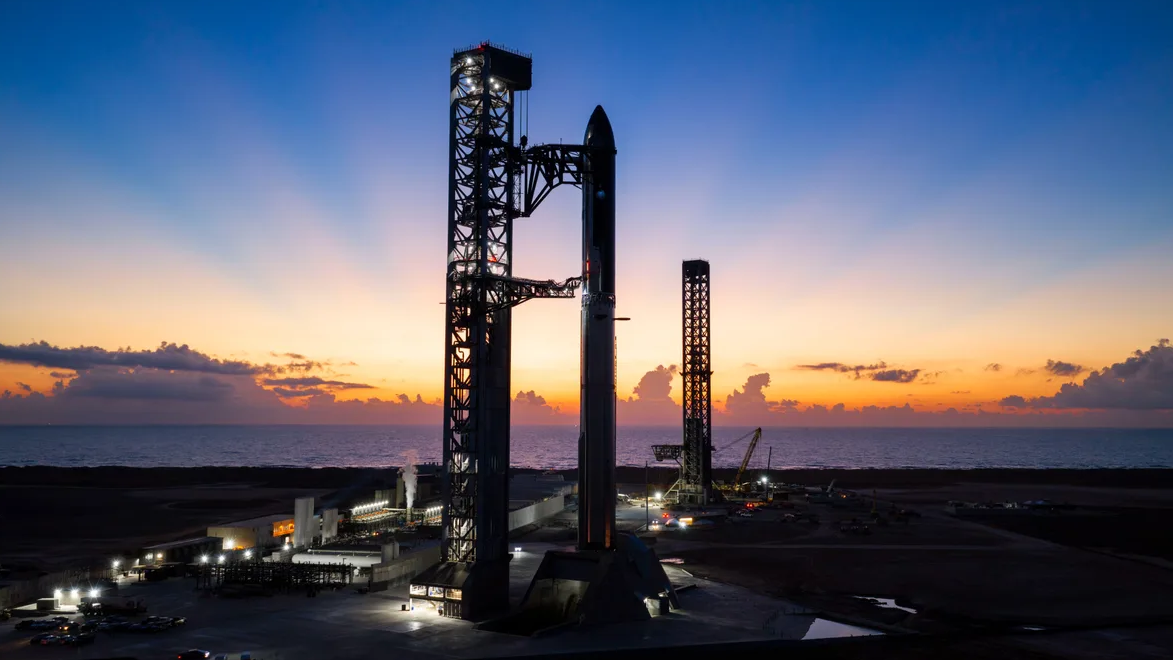
Elon Musk revealed Starship’s Full REUSE Plan in Months…But the First Ship Catching?: SpaceX’s Starship program is approaching one of its most important milestones yet: making the entire launch system reusable. While the Super Heavy booster has already demonstrated controlled recoveries at the launch site, the much more difficult challenge is now coming into focus—the recovery and reuse of the Starship upper stage.
According to the provided source, SpaceX is targeting a potential full-system reflight in late 2026 or early 2027, involving a previously flown Ship and Super Heavy booster. The biggest obstacle standing between the company and that milestone is the Ship catch, where the enormous upper stage would be captured directly by the launch tower’s Mechazilla chopstick arms.
Starship’s Full Reusability Plan
Traditional rockets generally sacrifice their upper stages after delivering payloads. Even Falcon 9, despite transforming orbital launch economics through first-stage recovery, still expends its upper stage.
Starship was designed around a different philosophy.
The goal is to recover and reuse both major stages of the vehicle. That means Super Heavy must return to the launch site, while Starship must survive orbital flight, atmospheric re-entry, and a controlled landing sequence before being captured.
The source describes the target window for a complete reflight as late 2026 to early 2027. If achieved, the milestone would represent a major step toward a transportation system where the same orbital-class hardware can be launched repeatedly rather than manufactured for individual missions.
From Reusable Booster to Reusable Ship
The evolution can be viewed in three stages:
- Legacy launchers: First and second stages are generally expended.
- Falcon 9: The first stage is recovered and reused, while the upper stage remains expendable.
- Starship: Both the Super Heavy booster and Ship are intended to be recovered and reused.
That distinction is crucial because recovering only the booster still leaves a major portion of the launch vehicle to be rebuilt for every mission.
Why the First Ship Catch Is So Difficult
The first attempted Ship catch is expected to be one of the most demanding recovery maneuvers in the Starship program.
The source states that Elon Musk assigned a 50% to 60% probability of success to the first upper-stage catch attempt. That figure reflects the much greater difficulty of recovering a vehicle that returns from orbital velocity compared with Super Heavy, which follows a lower-energy suborbital return profile.
The Ship faces extreme atmospheric heating, orbital re-entry speeds, precise aerodynamic control requirements, and a complicated final maneuver.
By comparison, Super Heavy performs a comparatively straightforward vertical descent toward the launch tower.
The Ship’s Belly-Flop Maneuver
One of Starship’s most recognizable features is its belly-flop re-entry.
Rather than descending vertically throughout the atmosphere, the Ship returns in a horizontal orientation. Its large aerodynamic flaps help control its trajectory and dissipate energy as it travels through the atmosphere.
Then, close to the launch site, the vehicle must perform an extremely precise sequence.
First, the Raptor engines ignite. The Ship then rotates from its horizontal belly-flop attitude toward a vertical landing orientation. Finally, it must eliminate lateral velocity and position itself accurately between the Mechazilla chopstick arms.
This entire sequence happens within a very narrow window.
Why SpaceX Wants Mechazilla to Catch Starship
A natural question is why SpaceX does not simply equip Starship with conventional landing legs.
The source identifies several reasons.
Reducing Mass
Landing legs would add significant structural mass to the vehicle. Removing them can preserve mass for payload and propellant, supporting the larger goal of maximizing Starship’s transportation capability.
Faster Turnaround
A tower catch also places the recovered vehicle directly beside the infrastructure needed for inspection, integration, fueling, and another launch.
Instead of recovering a vehicle remotely and transporting it back to a launch facility, SpaceX aims to combine recovery and launch-site integration into one location.
Avoiding Ocean Recovery
Ocean recovery introduces additional logistical challenges. Saltwater exposure can also create corrosion concerns for vehicle materials.
For a vehicle intended to fly repeatedly, SpaceX’s tower-catching architecture is therefore designed around rapid recovery and turnaround rather than simply surviving one landing.
Why Ship Recovery Is Harder Than Super Heavy
The difference between the two vehicles becomes especially obvious during re-entry.
Super Heavy returns from a suborbital trajectory, while the Ship must return from orbital velocity. The source describes the Ship’s return velocity as approximately Mach 25, accompanied by extreme atmospheric heating approaching roughly 1,500°C.
The Ship also relies on thousands of thermal protection tiles and active aerodynamic flaps.
Super Heavy, meanwhile, uses a more conventional vertical descent profile supported by grid fins and control systems.
The Ship therefore has to solve multiple problems simultaneously: thermal protection, aerodynamic control, engine relight, vehicle rotation, velocity cancellation, and final positioning.
Flight 15 Could Become a Major Catch Test
SpaceX has reportedly been preparing for the first live Ship catch through ground rehearsals and launch-site testing.
The source identifies Flight 15 as a potential target for the first live catch attempt, subject to operational data from earlier missions.
Testing includes simulations involving prototype structures, alignment sensors, hydraulic systems, and structural tolerances. At the same time, Starship flights continue to test and improve thermal protection systems and heat-shield attachment points.
The basic recovery profile would look like this:
Orbital re-entry → Belly-flop glide → Flip-and-burn → Vertical descent → Mechazilla catch
If every stage works correctly, the Ship could return directly to the launch tower without landing legs.
The Bigger Goal: Rapid Starship Reuse
The Ship catch matters for more than simply recovering an expensive vehicle.
Full reusability could become an important part of SpaceX’s plans for high-frequency orbital logistics.
One major example is in-space refueling. Missions involving the Moon or Mars require large quantities of propellant, and Starship’s architecture depends on repeated tanker launches to transfer fuel into an orbital depot.
A reusable fleet could perform multiple tanker missions without requiring a brand-new vehicle for every launch.
More Payloads, More Flights
Rapidly reusable Starships could also support high-density payload deployment, including future Starlink constellations and large scientific spacecraft.
Instead of launch cadence being limited primarily by manufacturing new vehicles, the operational focus could shift toward propellant, inspections, maintenance, and launch infrastructure.
Changing the Economics of Spaceflight
The long-term economic argument is equally important.
A fully reusable system can potentially spread the cost of manufacturing a vehicle across many missions. Instead of treating each rocket as largely disposable hardware, the system moves toward an operating model where the major recurring expenses become propellant, maintenance, inspections, and operations.
The First Ship Catch Could Change Starship Forever
The first successful Ship catch would not immediately mean Starship has reached routine airline-style operations. Many additional tests, reflights, inspections, and reliability demonstrations would still be required.
However, it would establish a critical piece of the architecture.
The Super Heavy booster is already the more mature part of the recovery system. The next major challenge is proving that the Ship can survive orbital re-entry and return accurately enough to be captured by Mechazilla.
If SpaceX can master that sequence and eventually demonstrate repeated reflights, Starship could move significantly closer to its intended role as a reusable transportation system.
The ultimate objective is not simply to catch a rocket.
It is to create a vehicle that can launch, fly, return, get caught, be prepared again, and fly another mission with dramatically less hardware discarded each time. The source describes mastering the Ship catch as a potential transition point from an experimental Starship program toward a reusable transportation fleet.
FAQs
1. What is SpaceX’s full Starship reuse plan?
SpaceX’s goal is to make both the Super Heavy booster and Starship upper stage reusable. The long-term concept is to recover, inspect, prepare, and relaunch the same hardware rather than expend the vehicle after each mission.
2. When could SpaceX attempt a full Starship reflight?
According to the provided source, SpaceX is targeting late 2026 or early 2027 for an attempt to reflight a previously flown Starship and Super Heavy.
3. What is the Starship Ship catch?
The Ship catch is the planned recovery technique in which Starship returns to the launch site and is captured by the Mechazilla chopstick arms attached to the launch tower.
4. How difficult will the first Starship catch be?
The source states that Elon Musk estimated a 50% to 60% probability of success for the first upper-stage catch attempt. The difficulty comes from Starship’s orbital-speed re-entry, thermal loads, aerodynamic maneuvering, and precise final positioning.
5. Why is catching Starship harder than catching Super Heavy?
Super Heavy returns from a suborbital trajectory, while the Ship must survive orbital re-entry. The Ship faces much higher re-entry speeds, extreme heating, and a more complicated transition from horizontal belly-flop flight to vertical landing.
6. What is the Starship belly-flop maneuver?
The belly-flop maneuver is Starship’s horizontal atmospheric re-entry technique. The vehicle uses its aerodynamic flaps to control its trajectory before performing a powerful flip-and-burn maneuver to transition into a vertical landing position.
7. What happens during the Starship flip-and-burn?
Near the end of descent, Starship must ignite its Raptor engines, rotate from its horizontal orientation to vertical, cancel lateral velocity, and position itself accurately between the Mechazilla arms.
8. Why doesn’t Starship use traditional landing legs?
The source explains that landing legs would add additional structural mass. SpaceX instead plans to use tower catching to reduce mass and potentially improve turnaround efficiency by recovering the vehicle directly at the launch site.
9. What is Mechazilla?
Mechazilla is the launch-tower recovery and handling system equipped with large chopstick arms. For Starship recovery, those arms are intended to capture the returning vehicle and position it for subsequent processing.
10. Could Flight 15 be the first Starship Ship catch attempt?
The provided source identifies Flight 15 as a potential target for the first live Ship catch, depending on operational information gathered during earlier flights.
11. How is SpaceX preparing for the first Ship catch?
SpaceX has been conducting ground rehearsals and catch simulations, including testing alignment sensors, hydraulic actuation, and structural tolerances. Starship flights also continue to provide data on heat-shield tiles and attachment systems.
12. How hot does Starship get during re-entry?
The source describes Starship’s orbital re-entry as involving extreme heating, with a peak temperature of approximately 1,500°C in the comparison provided. Its thermal protection system uses thousands of ceramic heat-shield tiles.
13. How could full Starship reuse affect launch costs?
Full reuse could allow the manufacturing cost of a vehicle to be spread across multiple flights. Instead of building a largely new vehicle for every mission, recurring expenses could increasingly center on propellant, inspections, maintenance, and operations.
14. Why is Starship reusability important for in-space refueling?
The Starship architecture described in the source relies on multiple tanker missions to place propellant into orbit. Reusable vehicles could perform repeated tanker flights without requiring a newly manufactured rocket for every launch.
15. Could reusable Starships support future Starlink launches?
Yes. The source identifies high-density payload deployment, including next-generation Starlink constellations, as one potential benefit of rapid Starship reuse. Higher vehicle availability could support more frequent heavy-payload missions.
16. What would a successful Ship catch mean for Starship?
A successful catch would demonstrate a critical part of SpaceX’s planned fully reusable architecture. It would show that an orbital-class Ship can return to the launch site and be recovered without conventional landing legs, moving the program closer to repeated vehicle reuse and a reusable transportation fleet.
Read More: